Tuesday, December 27, 2005

Hanukkah

Since the semester ended (but not, alas, the grading, which still isn't done!) I've been doing some traveling. I went to Washington, D.C., for the Association for Jewish Studies conference. I chaired a session on "Passages to Glory - Textual Ways of Transforming Experience Among Sectarians, Sages, and Early Jewish Mystics."
Do the verbal structures and literary devices of sectarian, rabbinic, and early Jewish mystical sources correspond to transformations of experience? Where such texts speak of heavenly journeys and glorifications, are they intended also to induce them? Were the wondrous perspectives produced by these texts experienced as actual, and how so? Our panel carries forward a conversation about Sectarians, Sages, and Early Jewish Mystics, once more comparing notes across the ages and sources - this time, on the relationship between text and experience.
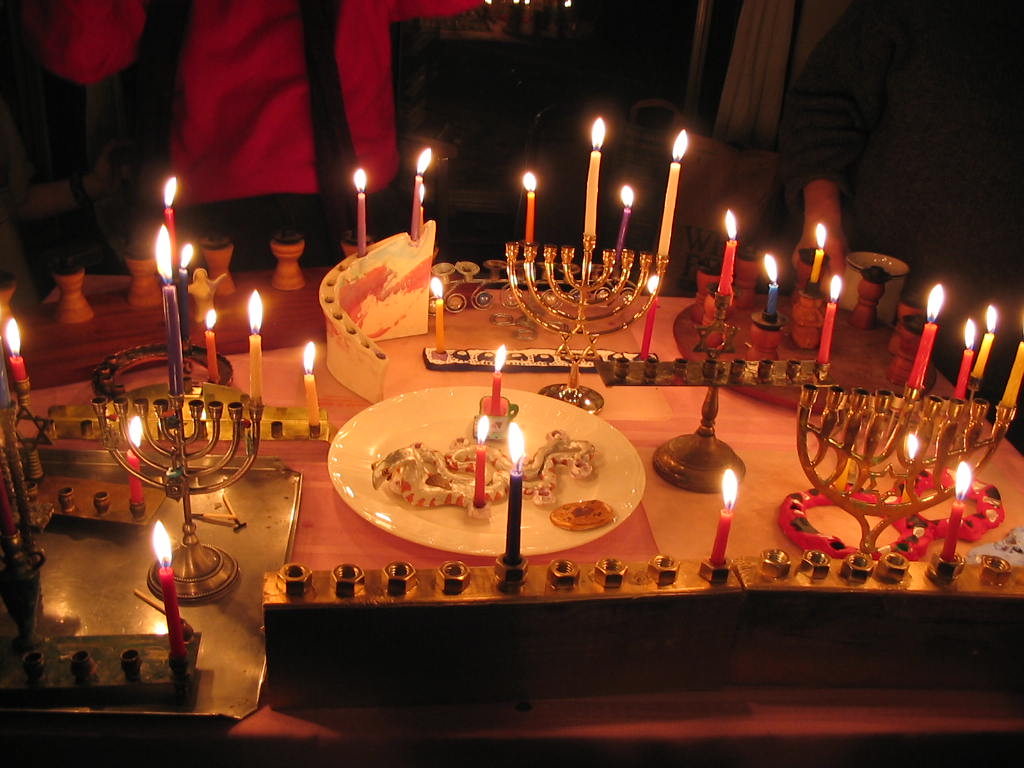
There were four speakers: Jonah Steinberg, Alan Segal, Nehemia Polen, and Daphna Arbel. I also went to a number of other good sessions on quite a variety of topics - it's always fun to go to sessions not in my field. I stayed an extra day in Washington to go to an Ithaca College Jewish Studies event (meeting with alumni) and then drove up to Boston to see family and friends, which has been a lot of fun. I've gone several Hanukkah celebrations, including visiting my cousins in New Hampshire. And some Hanukkiah photos follow!

Havurat Shalom candle-lighting.


At my cousins'.


A little bit later in the evening....

Monday, December 12, 2005

Bloggers on Paul Mirecki

More bloggers on Paul Mirecki:

WITCH HUNT IN KANSAS. The author comments: "[Kansas Rep.] Landwehr is right about one thing. This all is religious bigotry. But the bigotry comes from her side. Right wing 'Christians' have been trying to force their fundamentalist religious beliefs on the people of Kansas for too long now. When someone stands up to them, they cry foul and hide behind some bizarre banner of religious persecution. It’s a joke, though not a very funny one. "

Mark Goodacre on Paul Mirecki: assault, the media, and protection. He says, "Perhaps because I am now in American higher education myself, I find this report pretty depressing. The thought that a professor has now had to absent himself from class because of media harrassment, and that his colleagues and students are being interviewed on his character and integrity, is a very unhappy situation. I have long since ceased from releasing any personal information (address, phone number etc.) on phone-books, the web and so on (and I am surprised that Mirecki has been less careful) and this story hardly discourages me from that kind of course of action."

John Wilkins of Evolving Thoughts, a postdoctoral research fellow in the philosophy and history of biology, writes:
1. ID [intelligent design] is mythology. It is not only not science, but it fulfils one of the major functions of a mythos - to organise and unify a community against outsiders. Mirecki was right to teach it that way, and right to put it in religious studies, for there is no other motivation or feature of ID than the religious.

2. Mirecki's email was obnoxious, but in no way unjustified or immoral or contrary to decent ethical standards. Religious people make much worse comments about "godless atheists" every day, and in America, they (and he) have that right constitutionally. The apology ought to have been enough to settle this, in a civilised nation. And it was in a private forum. He didn't broadcast it to the nation, Altevogt did. Is it a surprise that Mirecki thinks fundamentalists are often stupid bastards? I do, and many others, a lot of whom are Christians of a more reasonable kind, also do. So what is at issue? That he said to those he had a reasonable expectation shared those values what he thought? Bad man! Bad bad man!

3. Mirecki has academic freedom, or ought to, to teach what he wants without interference from lobby groups or the majority. His peers - those who are professionals in his discipline - are the ones who are fit to judge his actions; not some politician or religious opponent. Threatening the freedom of academics by withholding funding is the reason why universities got out from under church control in the first place.

Mark Maynard suggests, "Perhaps, it occurs to me, we’re entering an era in which the right not only demands more of a presence in academia (as we’re seeing more and more), but in which liberal faculty are 'held accountable' for their unpopular beliefs. This event in Kansas might not, in other words, be an isolated event - the work of 'a few bad apples.' It could be a harbinger of things to come." I certainly hope not, but it is also one of my fears.

And on Daily Kos, several postings about Paul Mirecki.

Sunday, December 11, 2005

More on Mirecki

Latest developments in the story about Paul Mirecki: Anti-creationism professor: Resignation was forced.

An interesting blog comment: Academic Freedom.

A professor at Johnson County Community College, in Overland Park, Kansas, Professor of Biology Paul Decelles has an interesting blog that addresses issues of intelligent design and academic freedom, and he has a number of posts about Mirecki. He seems like a sensible person and writes that "Now granted e-mails are not private but I doubt Mirecki is alone in having written inappropriate emails." Whatever else this case may be, it's also a renewed warning that one should not write in an e-mail anything you would not want printed on the front page of your local newspaper.

On the question of whether it's legitimate to mock other people's religious beliefs and practices. An interesting example is presented by J-Walk Blog, who makes fun of Orthodox Jews who don't use electricity on Sabbath and avoid doing so through various technical strategems, such as the Shabbat alarm clock. He refers to this and other devices that allow people to use electrical appliances on the Sabbath as "probably one of the most absurd religious practices of all time." A few weeks ago Christopher Hitchens wrote an article in Slate attacking the practice of metzitzah be-peh (defined as "after removing the foreskin of the penis, the practitioner, or mohel, sucks the blood from the wound to clean it"). Hitchens, in his inimitable fashion, lambasted those who engage in this practice as well as politicians who hesitate to condemn it (in this case, Mayor Michael Bloomberg of NYC).

Are either of these writers wrong to mock or criticize Jewish practices? Not in my opinion. As far as I'm concerned they're free to make fun of Judaism or any other religion. I'm also free to disagree with them and argue against them.

People who teach religion on the college level do not lose their right to free speech by virtue of their jobs - including mocking speech about others. I don't think there's a place for that in the classroom, but if a professor wishes to make fun of others outside of the classroom, why is that wrong? There are a lot of things that people say that I don't like, but that doesn't give me the right to stop them from saying them or to dismiss them from their jobs for saying them. My only concern is basically a pedagogical one - in the classroom, or in other professional capacities, professors should behave in a respectful fashion towards students, regardless of whether they agree with what those students are saying on intelligent design or anything else. I also think that professors should do their best to refrain from one-sided advocacy in the classroom. This doesn't mean that they should avoid controversial topics or keep silent about their own opinions, but that they should educate students that there is more than one side to most arguments, and that it is worth listening to several points of view and analyzing them.

Academic Freedom and Creationism

Jim Davila at PaleoJudaica just brought to my attention a disturbing series of events involving Professor Paul Mirecki of the University of Kansas. For a summary of what has happened to Mirecki, see this recent article from the Lawrence, Kansas, local newspaper - Embattled KU Professor. In short, he got into a lot of trouble for making intemperate remarks about creationists in on e-mail and on a discussion board, was forced to resign his position as chair of the religion department, and in addition, was beaten up by a couple of thugs who mentioned the controversy when attacking him (see Professor blasts KU, sheriff's investigation).

The remarks were made in connection with a course that he planned to offer (but eventually had to cancel) on creationism and intelligent design, entitled: "Special Topics in Religion: Intelligent Design, Creationism and other Religious Mythologies." One of his e-mail messages read: "The fundies (fundamentalists) want it all taught in a science class. But this will be a nice slap in their big, fat face by teaching it as a religious studies class under the category 'mythology.''' Even before the e-mail was published, his announcement that he was teaching the class seems to have angered many people who were offended that he was calling creationism and intelligent design mythologies. (See this WorldNetDaily article for an account by someone offended by Mirecki's remarks).

I find this whole story very disturbing. While Mirecki should certainly have been more careful in what he wrote on e-mail, he's certainly free to do so (given both the First Amendment and principles of academic freedom). The only genuine concern I could see is in how he would have taught the class - he should be respectful of all students and permit students who disagree with him to speak.

Some members of the Kansas State Legislature, however, seem to have a weak grasp of what academic freedom is, and what it means to teach religion at a university (as opposed to a seminary).
The university’s action [cancelling Mirecki's course] wasn’t enough for conservative lawmakers, who said they want to know whether professors teaching other courses are letting their biases get in the way. “This may show a bigger problem than just Professor Mirecki,” said Rep. Brenda Landwehr, a Wichita Republican. “It may show we’re not providing fair and balanced opportunities to our students.”

Landwehr has called for hearings when the Legislature resumes next month. She said she wants to know whether professors are exhibiting any intolerance, whether it’s religious, political or any other kind.

Landwehr also questioned whether Mirecki should be allowed to teach religious studies courses. “It’s hard to teach religion if you don’t believe in it,” she said.

Sen. Kay O’Connor, an Olathe Republican, said public universities should not condone anti-Christian talk by professors. “We’re not in the taxpayer-funded hatred business,” she said. “Why should taxpayers give him an opportunity to profess his hatred for Christians?”
Landwehr doesn't seem to understand that it's possible to teach all sorts of things one doesn't believe in. One doesn't have to be religious to teach about religion. Nor is it wrong to criticize (or even make fun of) people who belong to other religions and their religious practices. (I don't think mockery belongs in the classroom, however - that's advocacy, not education).

Aside from the issue of the intemperance of Mirecki's language, the most disturbing feature is the idea that a religion course is not the proper place to discuss creationism and intelligent design. This is exactly the place to discuss these two ideologies/theologies. In fact, on Wednesday, in my Hebrew Scripture class, I asked my students to bring in news stories that mentioned the Bible in reference to contemporary issues. In one section we spent a lot of time discussing creationism/intelligent design, both in connection to the case of the Dover School Board, in Dover, Pennsylvania, and in Kansas. We discussed (briefly) what creationism/intelligent design are, how creationism derives from the biblical account of creation, and how intelligent design is also a theological way of understanding how life has come to be. At some point I would like to teach a class on the Bible in American life and culture, and the creationism vs. evolution debate is an obvious place to start. Other professors at my college also discuss this issue, from other points of view (for example, it's addressed in the biological anthropology classes).

There are other courses at the University of Kansas that do address these issues without being attacked by religious conservatives.
Walter Dimmick, associate professor in the department of ecology and evolutionary biology, said he taught students in his introduction to evolutionary biology course about natural theology and beliefs at the time of Charles Darwin. These topics are a starting point to his course on evolution. “Young people need to have an understanding of what science is and what science is not,” Dimmick said. Dimmick, who has taught this introductory class for three years, has never stirred controversy in or out of the classroom. Part of this may be due to his approach. “It’s not my job to try and change their religious beliefs,” he said.
I agree with Dimmick on that last point. In my Hebrew Scripture class I certainly introduce students to theories about the Bible that they will not have encountered before - the most prominent example being the documentary hypothesis - but I certainly don't require them to swear allegiance to them. I want them to understand the theories, not have faith in them. I'm not in the business of telling students what their religious beliefs should be. But just presenting these theories, whose intellectual basis is that human beings wrote the biblical texts and that it's possible to investigate their origins through literary and historical analysis, can be upsetting to some students, and not only to students who are self-identified as fundamentalist Christians. I don't like upsetting the students, but I do believe that in order to teach the Bible in an intellectually honest way, it's necessary to teach critical theories about the composition of the Bible.

Friday, December 09, 2005

Our friend Ramsay Clark

Another good Hitchens column on Ramsey Clark, Saddam's chief apologist.

Our Friends, the Iranians, Take Two

At the Organization of the Islamic Conference meeting in Mecca, Saudi Arabia yesterday (Dec. 8, 2005), President Mahmoud Ahmadinejad of Iran denied that the Holocaust occurred and suggested that the state of Israel be moved to Europe.
"Some European countries insist on saying that during World War II, Hitler burned millions of Jews and put them in concentration camps. Any historian, commentator or scientist who doubts that is taken to prison or gets condemned. Let's assume what the Europeans say is true…. Let's give some land to the Zionists in Europe or in Germany or Austria. They faced injustice in Europe, so why do the repercussions fall on the Palestinians?"
It is comforting to see so many countries condemning Ahmadinejad's comments, but on the other hand, the Holocaust denial that he expresses appears on Iranian state television and in the popular media in many Muslim countries.

Tuesday, December 06, 2005

Mel Gibson Developing Holocaust Mini-Series

Is this bizarre, or what?.
Mr. Gibson's television production company will base the four-hour miniseries for ABC on the self-published memoir of Flory A. Van Beek, a Dutch Jew whose gentile neighbors hid her from the Nazis but who lost several relatives in concentration camps.

The project is in its early stages, so there is no guarantee that it will be completed. Mr. Gibson is not expected to act in the mini-series, nor is it certain that his name, rather than his company's, will be publicly attached to the final product, according to several people involved in developing it.

But Quinn Taylor, ABC's senior vice president for movies for television, acknowledged that the attention-getting value of having Mr. Gibson attached to a Holocaust project was a factor. "Controversy's publicity, and vice versa," Mr. Taylor said.
And I guess all we want is publicity, right? Well, it gets more twisted:
ABC brought in Con Artists [Gibson's production company] after an independent producer, Daniel Sladek, proposed a project to the network based on Ms. Van Beek's story. With her husband, Felix, she survived the sinking of a passenger ship by a German mine, followed by three years in hiding during the German occupation of the Netherlands, before going to the United States in 1948.

The network chose Mr. Gibson's company shortly after having rejected a pitch by Ms. Cotton of Con Artists for another Holocaust-related subject, Mr. Taylor said. "This has the middle, the love story, that the other one didn't have," he explained.

Mr. Sladek said ABC's motive in engaging Mr. Gibson - an Academy Award-winning producer and director whose "Passion" sold $370 million in tickets in the United States alone - was to win the largest possible audience. "I think that what ABC wants out of this is to build the biggest billboard imaginable in order to get everyone logically interested to tune in and watch this," Mr. Sladek said.
Well, it's good to get that out in the open - if we're going to have a movie on the Holocaust, it's got to have a love story, I guess so that the great American public doesn't have to focus on the fact that the Holocaust is not, really, you know, a love story! And we need that big billboard, so Gibson's the way to get it. This is about as crass as it gets!

Sunday, December 04, 2005

Saddam and Ramsey Clark

A couple of interesting new articles on Iraq. The first one, The Big Black Book of Horrors, is on a recently published book about the atrocities of Saddam Hussein's regime. Le Livre Noir de Saddam Hussein presents comprehensive evidence about the crimes against humanity presented by Saddam and his dictatorship.
"The first weapon of mass destruction was Saddam Hussein," writes Bernard Kouchner, who has been observing atrocities in Iraq since he led the first Medecins Sans Frontieres mission there in 1974. "Preserving the memory of the arbitrary arrests that Saddam's police conducted every morning, the horrible and humiliating torture, the organised rapes, the arbitrary executions and the prisons full of innocent people is not just a duty. Without that one cannot understand either what Saddam's dictatorship was or the urgent necessity to remove him."
While I do not think that reading this book would be very pleasant, I hope that it is soon translated into English, for the benefit of all the American anti-war activists who think that President Bush (for all his flaws) is worse than Saddam.

The second one is an opinion piece by Christopher Hitchens - Sticking Up for Saddam - Ramsey Clark admits that his client is guilty. Hitchens demonstrates just how deep into the slime Clark has sunk since his days as Attorney General for President Lyndon Johnson in the 1960s - representing the likes of Slobodan Milosevic and Saddam Hussein. Of course, even murderous dictators need competent counsel - but I would prefer that that counsel not justify their clients' crimes.

NPR this morning had a piece on Ramsay Clark in which they were trying their best to be absolutely even-handed, and unfortunately in doing so left out some of the damning evidence against him, including his association with the Workers World Party (the real force behind International ANSWER).

Escaping from the SBL

My way home from the SBL was much more eventful than I hoped it would be. When I finished loading up my car with luggage, I went to start it – and lo and behold! It did not start. Through pure coincidence, a car with someone from AAA was driving through the parking garage at just that moment, so I flagged him down and asked him if he could start my car. He did my best, but concluded that the car needed a new starter motor. I called AAA to get a tow-truck to take my car to the Honda dealership.

When the tow-truck arrived, it transpired that it was much too big to go down to the lower level of the parking garage. The tow-truck guy called a buddy of his from his shop. The buddy arrived in a two-tone car (the door was red, the rest of the car was blue). He towed my car out of the garage, and it was then put onto the enormous tow-truck. We drove to the shop (any hope of going to the Honda dealership was scotched by the two-truck driver). As we drove deeper into a run-down section of Philadelphia I wondered what was going to happen to my car. We drove into the lot (surrounded by a fence with razor wire on the top!), and he eased my car off the truck. I went into the office to talk to the manager. He promised to start working on it first thing the next morning. Then my eye wandered around the walls of the office – and fixed on two photographs of the Lubavitcher rebbe, and a prayer for a successful business, in Hebrew. Needless to say, this is not what I expected to find in a repair shop in urban Philadelphia. I asked the manager if the shop was owned by an Israeli. He said to me, “Is that a problem?” I said no, I had spent time in Israel. Then the guy sitting next to him spoke up – in Hebrew. I replied. His father owned the shop. After that I felt a bit more confident that my car would get fixed and that the repairs would cost a reasonable amount of money.

The next morning, the buddy from the shop drove my fixed car to the hotel where I was staying, and I went back to the shop to pay for the repairs – which were indeed at a very reasonable price. I got to meet the boss, who indeed spoke with an Israeli accent. It was an unexpectedly pleasant experience, despite the fact that I had to stay an extra night in Philadelphia and then had the truly tedious drive from Philly to Boston via the N.J. Turnpike, the GW Bridge, and I-95…. I hope never to do that again on the day before Thanksgiving!

Enoch/Metatron at the SBL

I attended the AAR/SBL meeting in Philadelphia the week before Thanksgiving, and was part of the book review session organized by the Early Jewish and Christian Mysticism section. I reviewed the new book by Andrei Orlov, The Enoch/Metatron Tradition, which traces the development of traditions about Enoch from the Bible through to the Zohar, concentrating mostly on Enoch traditions in Second Temple literature and 2 and 3 Enoch. What I found particularly helpful about the book was its treatment of 2 Enoch, which is extant only in Slavonic. My review began this way:
This is a fine book on the development of the figure of Enoch from early Mesopotamian traditions about the seventh antediluvian king, Enmeduranki, to the transformed Enoch-Metatron of the Hekhalot literature, especially in Sefer Hekhalot, (3 Enoch). Andrei Orlov comprehensively demonstrates how the roles and titles of Enoch developed from his first appearance in Genesis, when “God took him” (Gen. 5:24), through the five subsections of 1 Enoch (in many cases influenced by Mesopotamian traditions about the seventh antediluvian king, Enmeduranki), to the Slavonic apocalypse of Enoch (2 Enoch), which he dates to first century Alexandria, and finally to Sefer Hekhalot. The book examines the early Enochic booklets and then Sefer Hekhalot, only then turning back to the Slavonic apocalypse in order to show how the roles and titles there are an earlier version of what is found in 3 Enoch. The second part of the book addresses the question of how Enoch’s roles and titles developed in 2 Enoch as a result of polemics with several other important mediatorial figures: Adam, Moses, and Noah. This book is the first complete effort to show how the Slavonic apocalypse adumbrates several important roles and titles of Enoch that reach their full development in the Hekhalot literature. As such, it is particularly important for scholars like myself who do not have control of the Slavonic original of 2 Enoch and must rely upon translations. On important aspect of the book is that Orlov demonstrates that the Shi’ur Qomah tradition, the tradition that states that it is possible to measure the anthropomorphic body of God, found in the Hekhalot literature, is present in an early form in 2 Enoch.

The two sessions of the Early Jewish and Christian Mysticism section were very interesting, as was the opportunity to go out to dinner with members of the section on Saturday night (although the food did take forever to come!)

The conference was fun – I got to see friends I hadn’t seen in quite a while, some of whom I will see again at the Association for Jewish Studies meeting, which is happening during the third weekend in December in Washington, D.C. I spent a fair amount of the conference in the Book Exhibit, as I usually do, and brought home a haul of books that I hope will be useful for my research.

Sunday, November 27, 2005

MEMRI: Latest News

According to this November 23, 2005 report by MEMRI: Latest News, a delegation from the Presbyterian Church USA met with Hezbullah's commander in southern Lebanon.
On October 20, 2005, the Lebanese press reported that a delegation from the Presbyterian Church USA, headed by Father Nihad Tu'meh and with Robert Worley as its spokesman, visited southern Lebanon at the invitation of Hizbullah, and met there with the terrorist organization's commander in southern Lebanon, Nabil Qawuq.

During the meeting, Qawuq expressed his doubts about U.S. actions in the region and the intentions of the Bush administration. Worley, on his part, assured Qawuq that he was not defending the U.S. administration, that all delegation members had voted Democratic, and that the Presbyterian Church had been pressured by U.S. Jewish organizations because of its campaign to divest from corporations working with Israel.
A separate delegation of families of 9/11 victims met with the Deputy Head of Hizbullah, Sheik Naim Qassem. A report was aired on this meeting on November 11, 2005.
Anchor: Sheik Naim Qassem met with an American delegation which included family members of victims of the 9/11 bombings in New York City. The delegation members said that the purpose of the visit was to spread peace and to establish ties with various forces in different regions of the world, in order to stress the united stand against terrorism and aggression.

Sheik Qassem recalled Hizbullah’s communiqués condemning the New York attacks and the recent bombings in Jordan. He emphasized that state-sponsored terrorism and the terrorism of some groups throughout the world should be condemned because it goes against humanity, regardless of religion, language or geography.

I find it utterly amazing that anyone from a family that had lost a loved one on 9/11 would want to meet with the leader of an Islamist terrorist group. It is a shame that this report has not been more widely disseminated, and the names of those who met with the Hizbullah leader revealed.


In the beginning was Al-Aqsa

An interesting new book on the contemporary Muslim denial of the history of the Temple in Jerusalem, reviewed in Haaretz.
The historian Dr. Yitzhak Reiter, who is now publishing a book entitled "From Jerusalem to Mecca and Back - the Muslim Rallying Around Jerusalem," has been collating for years thousands of publications, religious legal rulings, statements and pronouncements of Muslim clergymen, historians, public figures and statesmen on the subject of Jerusalem. His book draws in great detail a portrait of the great Muslim denial, a denial of the Jewish connection to Jerusalem, the Temple Mount and to the Temple. This argument has strengthened in intensity since the Six-Day War.

Saturday, November 26, 2005

How much genocide is too much?

Nicholas Kristoff has another column (from today's New York Times) on how the genocide is getting worse in Darfur. He points out that the Congress has cut out all funding for the 7,000 African Union peacekeepers (who are already too few really to do much to stop the genocide). Even though we decry this genocide, and call it what it is, we are not stopping it.

Since this column is behind the Times' subscriber firewall, I'm including the whole text.

NYALA, Sudan

Who would have thought that a genocide could become worse? But after two years of heartbreaking slaughter, rape and mayhem, the situation in Darfur is now spiraling downward. More villages are again being attacked and burned - over the last week thatch-roof huts have been burning near the town of Gereida and far to the northwest near Jebel Mun.

Aid workers have been stripped, beaten and robbed. A few more attacks on aid workers, and agencies may pull out - leaving the hapless people of Darfur with no buffer between themselves and the butchers. The international community has delegated security to the African Union, but its 7,000 troops can't even defend themselves, let alone protect civilians. One group of 18 peacekeepers was kidnapped last month, and then 20 soldiers sent to rescue them were kidnapped as well; four other soldiers and two contractors were killed in a separate incident.

What will happen if the situation continues to deteriorate sharply and aid groups pull out? The U.N. has estimated that the death toll could then rise to 100,000 a month. The turmoil has also infected neighboring Chad, which is inhabited by some of the same tribes as Sudan. Diplomats and U.N. officials are increasingly worried that Chad could tumble back into its own horrific civil war as well.

This downward spiral has happened because for more than two years, the international community has treated this as a tolerable genocide. In my next column, my last from Darfur, I'll outline the steps we need to take. But the essential starting point is outrage: a recognition that countering genocide must be a global priority.

It's true that a few hundred thousand deaths in Darfur - a good guess of the toll so far - might not amount to much in a world where two million a year die of malaria. But there is something special about genocide. When humans deliberately wipe out others because of their tribe or skin color, when babies succumb not to diarrhea but to bayonets and bonfires, that is not just one more tragedy. It is a monstrosity that demands a response from other humans. We demean our own humanity, and that of the victims, when we avert our eyes.

Already, large swaths of Darfur are so unsafe that they are "no go" areas for humanitarian organizations - meaning that we don't know what horrors are occurring in those areas. But we have some clues. There are widespread reports that the janjaweed, the government-backed Arab marauders who have been slaughtering members of several African tribes, sometimes find it convenient not to kill or expel every last African but to leave a few alive to grow vegetables and run markets. So they let some live in exchange for protection money or slave labor.

One Western aid worker in Darfur told me that she had visited an area controlled by janjaweed. In public, everyone insisted - meekly and fearfully - that everything was fine. Then she spoke privately to two sisters, both of the Fur tribe. They said that the local Fur were being enslaved by the janjaweed, forced to work in the fields and even to pay protection money every month just to be allowed to live. The two sisters said that they were forced to cook for the janjaweed troops and to accept being raped by them.

Finally, they said, their terrified father had summoned the courage to beg the janjaweed commander to let his daughters go. That's when the commander beheaded the father in front of his daughters. "They told me they just wanted to die," the aid worker remembered in frustration. "They're living like slaves, in complete and utter fear. And we can't do anything about it." That aid worker has found her own voice, by starting a blog called "Sleepless in Sudan" in which she describes what she sees around her. It sears at Sleepless in Sudan, without the self-censorship that aid groups routinely accept as the price for being permitted to save lives in Darfur.

Our leaders still haven't found their voices, though. Congress has even facilitated the genocide by lately cutting all funds for the African Union peacekeepers in Darfur; we urgently need to persuade Congress to restore that money. So what will it take? Will President Bush and other leaders discover some backbone if the killing spreads to Chad and the death toll reaches 500,000? One million? God forbid, two million? How much genocide is too much?
Sunday, November 13, 2005

The World Without Zionism

If you've ever wondered what happened to good old Stalinist rhetoric, take a look at the Iranian website, The World Without Zionism. This particular page denounces the "Zionist octopus."

And lest you think that anti-Zionist does not equal anti-Semitism, see this page on the site: Jewish Conspiracy. The source for this particular screed? "Jewish Conspiracy: The Protocols of the Learned Elders of Zion”

My guess is that this is intended to be an official website to accompany the recent Iranian "conference."

Saudi Arabia ends boycott of Israel

The Washington Times is running an article that says that Saudi Arabia has agreed to end all economic boycotts of Israel as a condition of entering the World Trade Organization. It will be entering the WTO next month.

Business Week also confirms that Saudi Arabia will be abandoning the Arab boycott of Israel:
The World Trade Organization on Friday approved Saudi Arabia's bid to become the 149th member of the global body, winding up a 12-year negotiating process slowed by the country's participation in the Arab League boycott of Israel.

The acceptance by all WTO members is necessary before a new member can be admitted, and Saudi Arabia made a number of agreements with different countries on opening up its markets.

Itzhak Levanon, Israel's ambassador to the WTO, said Saudi Arabia had provided sufficient guarantees in its accession process that it would follow the WTO's rules, which include "not having a boycott against anyone else inside the organization."

"Such types of boycotts within the WTO are totally unacceptable," Levanon told The Associated Press. "As soon as Saudi Arabia accepted all these rules, the door has been open for future relations when the moment is ready for that."

But Prince Abdulaziz, Saudi Arabia's assistant minister for petroleum affairs, was less clear: "They are a member and we are a member. We are just there as members of the WTO. Nothing more."
So which is it? Are Abdulaziz's comments just for internal consumption?

Eye of the Storm

A scary article on Iran by Amir Taheri in the Jerusalem Post of November 10, 2005. Some important points:
When Iran's President Mahmoud Ahmadinejad made his "wipe Israel off the map" remarks last month, many diplomats on both sides of the Atlantic rushed to explain, read between the lines and relativize what was an unambiguous statement of Teheran's long-established policy. They expressed the hope that Iran would "clarify" - meaning soften - its position....

Last week, however, Iran's "Supreme Guide" Ali Khamenehi, the nation's ultimate decision-maker under the Khomeinist Constitution, not only gave his ringing endorsement to Ahmadinejad's remarks, but went further by offering his "vision for Palestine." Addressing a congregation at the end of Ramadan, Khamenehi said Iran rejected the two-states formula proposed by the US, and would fight for the creation of a single state encompassing Israel and the Palestinian territories. In such a state, power would be in the hands of Muslims, although some Jews would be allowed to remain, under unspecified conditions. Khamenehi went further by suggesting that Israel's political and military leaders, especially Prime Minister Ariel Sharon, be tried on charges of crimes against humanity.

....Iran, on the other hand, has become more powerful. Internally, the soft-liners have been kicked out, allowing a new generation of radical revolutionaries to seize control of all levers of state power. Iran's oil income is at an all-time high, allowing the new president to buy popular support.

....Iran has also emerged as the main supporter of Palestinian radical movements, some of which had been without a patron since the fall of Saddam Hussein. Next February, Teheran is scheduled to host the largest gathering of radical leaders from across the Muslim world to endorse its one-state formula for ending the Israel-Palestine conflict.

....The state-owned media in Teheran are in combative gear. Echoing Ahmadinejad's analysis, the Iranian media present the West, led by the US, as a "sunset" (ofuli) power that must be taken on and defeated by a tolue'e (sunrise) Islamic power led by Iran. In that context the destruction of Israel becomes a key element in Teheran's strategy in the Middle East because Ahmadinejad knows that radical Sunni Arabs will not accept the leadership of Shi'ite Iran unless it is perceived as the only power capable of realizing their dream of wiping Israel off the map.
But it's clear that the Iranian regime is not only anti-Israel, but also antisemitic. In other words, its animus is directed not only at the state of Israel, but at the Jewish people in general. Memri reported in January about antisemitism and Holocaust denial in the Iranian media.

Some excerpts:
In an op-ed titled 'Lies of the Holocaust Industry,' published by the Iranian Foreign Ministry-affiliated Tehran Times, columnist Hossein Amiri claims that the Holocaust never took place, basing his beliefs on "revisionist historians" who have "proven" that the eradication of the Jews would have taken more than the six years of the war and that "ethnic cleansing through the use of the poison gas Zyklon-B, as the Zionists claim, was not possible at the time." ...

In an interview with MEHR [the official Iranian news agency], Dr. Fredrick Toben of the Adelaide Institute in Australia discussed U.S. policy towards Iran and the nuclear issue, and said that " the state of Israel is founded on the 'Holocaust' lie" and that "exposing this lie" will help "dismantle the Zionist entity."...

French Holocaust denier Professor Robert Faurisson, a former lecturer at Lyon University, was interviewed by MEHR. The following are excerpts:
Faurisson: "In France, Jewish power is even stronger than in the USA. In France it is our lobby number 1. Nobody dares to speak out against those people because of their alleged 'Holocaust'…"

MEHR: "… Actually, France doesn't respect the rights of its citizens, as it has banned the hijab (Islamic headscarf) in public schools. How do you assess that?"

Faurisson: "Because Jews, in a certain way, are used to treating the French as they treat Palestinians. The difference is that Palestinians refuse to obey the Jews, whereas the French obey the Jews, once more because of the Big Lie of the alleged 'Holocaust,' in which unfortunately they seem to believe.

"The alleged 'Holocaust' of the Jews is the sword and the shield of the Jewish tyranny all over the world. Destroy it."
Antisemitic statements were made by Iranian university professor Heshmatollah Qanbari in an interview on Iran's Channel 1 TV, in which he surveyed the "evil nature" of the Jews throughout history, basing his beliefs on "historical truth" according to the Koran, under the guise of a scientific analysis. Qanbari claimed that Jews throughout history were a "subversive element" in human society and an "anti-human movement," which is "dangerous to both Christians and Muslims," and monotheism in general. The Jews, according to Qanbari, are the source of "all corrupt traits in humanity," and throughout history they have exhibited expansionist tendencies, coveting and usurping other nations. Global domination is also one of their aims, according to Qanbari, who says that most of Europe is under Jewish control today. Qanbari also warned that the Zionists' "racist" and "satanic ideology may take over the world." ....

Currently being broadcast on the Iranian Sahar TV channel is the antisemitic drama series 'Al-Shatat,' which was originally aired on Hizbullah's Al-Manar TV station. 'Al-Shatat's' blatantly antisemitic features were the main cause for the banning of Al-Manar TV in France. The current rerun is a slightly modified version, in which some of the more gruesome features in the original were cut. The series still propagates the view that the Jews have sought to control the world for many centuries via a secret global Jewish government. According to the series plotline, this secret government has been led, since the 19th century, by the Rothschild family....
It's no surprise that the Iranian President and Supreme Ayatollah came out with their statements calling for the destruction of Israel - it is completely compatible with these official expressions of antisemitism in the Iranian media.

Wednesday, November 09, 2005

'We'll definitely win,' French teen says

A reporter from Ha'aretz went to speak to some of the rioting French youths. He says, first of all, "There is something odd about the events that have been occuring in France since October 27, especially if your only source of information is media reports: The French government is dispatching helicopters and elite units, thousands of police officers, imposing curfews and even contemplating deploying the army - against wild kids aged 13 or 14 who, because they have nothing to do at night, are torching cars."

The two boys he spoke to (apparently in their late teens) have completely failed to find work (even with much trying) after leaving school.
Both have been unemployed since leaving school, not for lack of trying. They send off their resume, go to interviews, are perennially rejected. The main reason they can't find work, they believe, is their address - nobody wants to hire youths from 93 (the administrative code for their province) - but also their ethnic origin. Mohammed has a white friend from the projects who also dropped out of school and came with him to a job interview: The friend was hired.

Their complaint is not abstract: The nearest employment center is far away, and they want a local one in Villepeinte.

What does Mohammed mean when he says they will win in the end? "To win is work and respect," he says.

It certainly sounds from stories like these that people who interpret the riots as being plotted by Islamists are wrong. These are young men who don't want to be separate from French society - they want work and respect.

Tuesday, November 08, 2005

Darfur - Consider the horrors of peace

Another good column by Christopher Hitchens on Realism in Darfur - Consider the horrors of peace.

As he says: "What was all that garbage about 'never again'? What was the meaning of Clinton's apology to the Rwandans? What did Colin Powell mean when he finally used the word 'genocide' to describe the events in Darfur, just before resigning as secretary of state and becoming an advocate for more realism all round?"

He conducts a thought experiment on Rwanda:
Any critique of realism has to begin with a sober assessment of the horrors of peace. Everybody now wishes, or at least says they wish, that we had not made ourselves complicit spectators in Rwanda. But what if it had been decided to take action? Only one member state of the U.N. Security Council would have had the capacity to act with speed to deploy pre-emptive force (and that would have been very necessary, given the weight of the French state, and the French veto, on the side of the genocidaires). It is a certainty that at some stage, American troops would have had to open fire on the "Hutu Power" mobs and militias, actually killing people and very probably getting killed in return. Body bags would have been involved. It is not an absolute certainty that all detained members of those militias would have been treated with unfailing tenderness. It is probable that some of the military contractors would have overcharged, and that some locals would have engaged in profiteering and even in tribal politics. It is impossible that any child of any member of the Clinton administration would have been an enlisted soldier. But we never had to suffer any of these wrenching experiences, so that we can continue to wish, in some parallel Utopian universe, that we had done something instead of nothing.

Or not exactly nothing. The United States ended up supporting the French military intervention in Rwanda, which was mounted in an attempt not to remove the genocidaires but to save them. Nonintervention does not mean that nothing happens. It means that something else happens. Our policy in Darfur has not just failed to rescue a stricken black African population: It has actually assisted the Sudanese Islamists in completing their policy of racist murder. Thank heaven that we are tough enough to bear the shame of this, and strong enough to forgive ourselves.

Does anyone think that this would not have been the reality in Rwanda? We might have saved hundreds of thousands of lives, but still had people complaining because we didn't go through the UN or listen to the French (who have their own problems now).

Adloyada: Paris is burning

An interesting perspective on the riots in France - Adloyada: Paris is burning. The author suggests that the riots are "the ultimate outcome of years of a statist system which has preserved a higher level of social protection and security for its own, whilst permanently marginalizing the children and grandchildren of the immigrants who were imported to do the work nobody wanted." She also tells a very interesting story about living in France as a teenager in 1960 and encountering young Algerian men:
I found I constantly got picked up by young Algerian men. It eventually penetrated my consciousness that the reason they made such a beeline for me was that no French girl would so much as look at them, and they were desperate for some sort of social and preferably sexual outlet.

I did begin spontaneously to think about what led to this state of affairs. Previously I would have thought of it as the product of something we in those days called prejudice. But I worked out for myself that it was more than that. There was clearly a system of importing the poor and desperate of actual or former colonies as cheap labour, and that the system would discard this labour as soon as it had served its purpose. It was my first serious independent accomplishment in political and sociological analysis, though it would be another twenty eight years before I got round to acquiring any formal qualifications in either subject.

The impact was powerful enough to have influenced my thinking till this day. The current riots,although they involve Muslims, seem to me to have much more in common with the riots and slogans of the black consciousness movement of the seventies. That manifested itself in Britain over incidents to do with alleged police brutality, or the failure of the police to solve murders or other serious crimes against black people.

I must say that whatever the ultimate reason for the riots, I have been quite astonished at the ineffectiveness of the police and government response in France. Only now are the police being given the power to impose curfews.

And one of Adloyada's commenters makes a point that I have also wondered about:
The Paris riots have this in common with the UK riots. I've not seen one interview with a decent ordinary person who has had his car torched, or with someone running a marginal, probably uninsurable business, now wrecked.

The media report either the clash of civilisations or the romantic rebel harbingers of revolution.

Sunday, November 06, 2005

Rage of French Youth Is a Fight for Recognition

This article argues that Rage of French Youth Is a Fight for Recognition - it's a protest against having no future, rather than being a religious statement.
Abdel, echoing the anger of many of the youths, said he resented the French government's efforts to thrust Muslim leaders into the role of mediators between the police and the violent demonstrators.

"This has nothing to do with religion," he said. "But non-Muslims are afraid of people like me with a beard. I look suspicious to them. Discrimination is all around us. We live it every day. It's become a habit. It's in the air."

He continued: "I grew up in France, yet I speak of God and religion. I have a double culture. I belong to both. We should stop the labeling."

Rezzoug, the caretaker, said he has seen local youths struggle with deep personal conflicts caused by their dual cultures. "They go to the mosque and pray," he said. "But this is France, so they also drink and party."


Some French opinions: (as reported by the Washington Post's blog:

"A country which prides itself as the fatherland of the humans right and the sanctuary of a generous social model shows, in the eyes of all, that it is incapable of ensuring dignified living conditions for young French people," said the editors of Le Monde (in French).

"Nothing has deterred the gangs from running rampage. Not calls for calm, not marches for peace. Not even thousands of extra police," says the English-language Euronews

The explosion of violence has split both the public and the political classes.

The comment of hardline Interior Minister Nicholas Sarkozy that the rioters were "scum" prompted to Socialist Party leader Francois Hollande to tell Liberation, a left-wing daily, that [he] had "zero tolerance" for Sarkozy and his "simplistic polemics."


Looking at the photographs available on the Washington Post website, it is amazing to me that no one has yet been killed in the rioting.