Sunday, July 09, 2006

In Israel

I've been in Israel since June 8, but obviously have not been posting to the blog, undecided whether in fact I wanted to continue writing a blog. But since I'm about to leave Israel to return to the U.S., and I don't really feel like leaving Israel, I thought I'd at least post some thoughts about my trip.

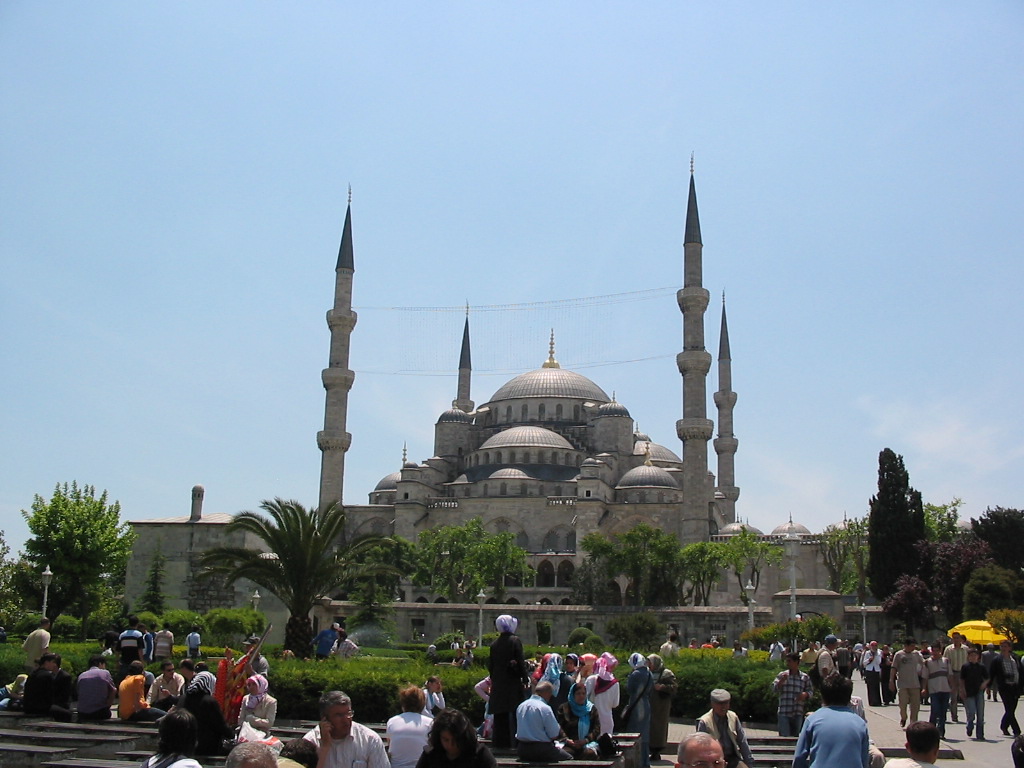
Going to Istanbul was being on vacation - a learning vacation, but a vacation nonetheless. I got to see some fabulous places I had never been to before (including the Blue Mosque, pictured here inside and out), I learned quite a bit about Ottoman history, I was fortunate to be able to get a glimpse of some of the dilemmas of modern Turkey - but this was a vacation in a foreign country.

Coming to Israel, however, felt like I was coming home, in a sense, even though I am an American citizen, not an Israeli. I've lived a total of four years in Israel, and have visited many times in addition to that. My first trip to Israel was in 1983, on a trip organized by New Jewish Agenda. I returned in 1987 for two years to study at the Hebrew University as part of my graduate studies in religion. I came back again in the 1992-93 academic year to do dissertation research. And then in 1998-99 I received another grant to do research at the Hebrew University. But that sounds like my only attachment to Israel is intellectual or academic.

It's much stronger than that, however. In 1990, I had been planning to visit Israel for part of the spring semester of 1991. But then, of course, Iraq invaded Kuwait on August 2, 1990, and it slowly became clear through the autumn that the U.S., in coalition with many other nations, would attack the Iraqis in Kuwait and force them back. Thus, I did not visit Israel in January of 1991, even though I wanted to. Throughout the Gulf War, I was constantly watching CNN, calling friends in Israel to make sure they were all right (racking up quite a phone bill in those days before real competition for international calling!), and wondering if I should go visit, nonetheless. I finally decided to go - to stay for six weeks, from Purim to Pesach. I flew to Israel on Purim, 1991 - which, as it happens, was the day the ceasefire was declared. When I landed at the airport, they were still giving people gas masks, but fortunately there was no need for them. I took the shared taxi to Jerusalem, and went to the reading of the book of Esther. People were wearing costumes that related to the Gulf War - one person had torn down the plastic sheeting from his windows and wrapped it all around himself, and stuck photos of Yasser Arafat (remember him? He supported Saddam Hussein) and Saddam Hussein on himself. What was he coming as? As the Gulf War!

Since then I've visited many more times, inbetween my year-long stays. I was here for a visit in the summer of 2001 - after the second intifada had broken out. It was unnerving to hear the gunfire on Gilo and the Israeli tank fire in reply. Since then, I visited several times in the winter, during the break between semesters, but this is the first time since then that I've come in the summer, and it's been quite lovely. I've been going to the National Library at the Givat Ram campus of the Hebrew University and doing research, which has gone very well - I've sent off one article and another one is close to being finished. I've seen lots of friends and even had dinner with some third cousins - of whose existence I didn't even know until my brother, the family genealogist, found them in his researches.

Some people might find that surprising, given the current political/military events - the attack on the Israeli military post near Gaza, in which two soldiers were killed and a third - Gilad Shalit - was abducted by the Hamas military wing; the murder of Eliyahu Asheri, a resident of Ithamar on the West Bank, killed right after his kidnapping; of the continuing rocket fire on Sederot and now on Ashkelon, from Gaza; and the Israeli military response, entering Gaza for the first time since the disengagement last summer. It's all certainly on my mind, but it's not the only part of my experience. I feel ambivalent about what Israel is doing. On the one hand, how can any government refuse to act when its cities are being attacked by random rocket fire that is aimed at civilians? On the other hand, why punish all the residents of Gaza by destroying the electrical station (insured by an American company), and depriving hundreds of thousands of people of electricity in the middle of the punishing heat of summer? Why warn the civilian residents of Beit Hanun (the region in Gaza from which Hamas and the other terror groups have been launching rockets at Sederot and Ashkelon) that they should leave when Israeli tanks and troops enter to chase those launching the rockets? Are they to blame? No.

But I think the Israeli government is really in a hard place - I can't say what I think they should do. How can they really negotiate with the Hamas government, as some are demanding, when even they don't seem to have any control over the Hamas military wing? And should they negotiate with kidnappers at all - won't it just encourage more kidnappings? But then, when I hear the remarks of Noam Shalit, the father of Gilad, pleading with the government to negotiate for the safe return of his son - how can Israel close off the avenue of negotiation completely?

I find myself really torn here - I listen to left-wing friends, and I agree with them that the Israeli government is being entirely unjust with the Palestinians, and that the separation fence/wall is an injustice and a disaster to innocent Palestinian civilians. But then, I listen to other friends, more centrist in their politics, who say that the wall is protecting innocent Israeli civilians from suicide bombings. Back in the U.S., I have other friends who are so certain that whatever Israeli does is absolutely wrong, and others who think that whatever Israel does is absolutely correct. From here, things seem so complicated - my own moral sense pulls me back and forth, I'm not sure how to judge.

But as I just wrote above, most of the time I've simply enjoyed myself here. In Jerusalem, it's generally pretty hot during the day, but then it cools off at night. Cool breezes start to blow in the late afternoon, and then as the sun sets it becomes comfortable. Tonight it's a lovely temperative, and I'm listening to the automatic sprinklers watering the garden of the apartment complex where I'm staying. When I go out on the mirpeset (porch) there is the scent of sweet flowers wafting upward. The photo on the left is a view from my garden.

Tuesday, May 30, 2006

Visiting Turkey

I'm off on another trip, this time to Istanbul, Turkey. I'm with a group studying Ottoman history, but we're really looking at sites from all periods of history in Istanbul. Our first day we went to the Haghia Sophia - the former great church of Byzantine times, which was transformed into a mosque with the Ottoman conquest in 1453. Across a beautiful garden with flowers and fountains is the Blue Mosque, built in the time of Sultan Ahmet I - an amazing, beautiful, serene building inside and out. We entered after the early afternoon prayer time was over and saw the soaring domes inside, with blue tiles (hence the name of the mosque) - many tourists but also people praying. I felt that I had entered a different atmosphere from that of contemporary tourist Istanbul, full of people from all over the world gawking at the sites. There is something about Islamic architecture that is truly impressive.

Yesterday we went to the Topkapi Palace, which was the palace of the Ottoman sultans for hundreds of years. Calling it opulent hardly does justice to the place - many buildings, spectacular blue and white tiles in the harem, treasures of the world amassed by the Ottomans and displayed in the Treasury. There are also holy Muslim relics, including the cloak of the Prophet and his sword, an impression of his footprint, hairs from his beard in reliquary boxes. In the room with the relics a man sat reciting from the Qur'an, since it is a Muslim pilgrimage site. It felt strange to be entering such a place as a tourist - but this is a feature of many holy places, which serve both as places of pilgrimage for the faithful and as sites for tourists to visit and touch the strange and exotic. (In Jerusalem, the Church of the Holy Sepulchre, the Western Wall, and the Temple Mount serve both functions).

Wednesday, May 24, 2006

New (to me) blogs to read

While wandering around the blogosphere, I've found some interesting blogs recently, including Emes Ve-Emunah, written by Harry Maryles and discussing many important and interesting Jewish issues from an Orthodox perspective. One I found particularly interesting was on "Gedolim and the Holocaust."

Another is Orthonomics by SephardiLady, who has some wise things to say about the necessary guidelines for Jewish schools to fight against sexual abuse of children.

Another, that I've read before, is Da'as Hedyot, who also has a very thoughtful posting on the recent sexual abuse scandal in the Orthodox world.

What is most interesting to me about all these blogs is the light they shine on a world that I am not part of - Orthodoxy and especially Ultra-Orthodox Judaism. Da'as Hedyot is fascinating in writing about the process by which he left the Orthodox world. There are other blogs (like Hasidic Rebel that describe the lives of people who still live an outwardly Orthodox or Hasidic life but who inwardly have traveled far away from it. I would not even know that people like him existed without the world of blogs. Sometimes it seems almost voyeuristic to read people's blogs - they are so revealing of themselves and their world, and I wonder if they imagine that people like myself are reading them (actually, I know that they do, because people like me post comments on their blogs).

Tuesday, May 23, 2006

Taheri-ng It Up

But is there actually a figure in Iran's government named Mostafa Pourhardani, as Jim Henley of Unqualified Offerings asks?

A quick dash around the blogosphere via Technorati presents several versions of sharp skepticism about Taheri's reaffirmation of his story, from the right to the left.

Amir Taheri responds to his critics

An interesting response from Taheri, but without enough details to satisfy me.
Regarding the dress code story it seems that my column was used as the basis for a number of reports that somehow jumped the gun.

As far as my article is concerned I stand by it.

The law has been passed by the Islamic Majlis and will now be submitted to the Council of Guardians. A committee has been appointed to work out the modalities of implementation.

Many ideas are being discussed with regard to implementation, including special markers, known as zonnars, for followers of Judaism, Christianity and Zoroastrianism, the only faiths other than Islam that are recognized as such. The zonnar was in use throughout the Muslim world until the early 20th century and marked out the dhimmis, or protected religious minorities. (In Iran it was formally abolished in 1908).

I have been informed of the ideas under discussion thanks to my sources in Tehran, including three members of the Majlis who had tried to block the bill since it was first drafted in 2004.
I do not know which of these ideas or any will be eventually adopted. We will know once the committee appointed to discuss them presents its report, perhaps in September.

Interestingly, the Islamic Republic authorities refuse to issue an official statement categorically rejecting the concept of dhimmitude and the need for marking out religious minorities.

I raised the issue not as a news story, because news of the new law was already several days old, but as an opinion column to alert the outside world to this most disturbing development.
From reading this press release, it does not sound that he knew what other articles were going to be published by the National Post on the dress code (unless he's being disingenuous). I don't know how it is that the NP acquired his article and what his relationship is with the editors of the paper. Perhaps, as some suggest, there is a sinister relationship between them - if so, perhaps commenters to this post can enlighten us further.

The sources he mentions are NOT other Iranian emigres, but (unnamed) sources in Teheran - which was also true in the original article, where he named one, Mostafa Pourhardani, Minister of Islamic Orientation. Who are the three unnamed members of the Majlis who are his sources? Why doesn't he name them?

But in this press release he is much less categorical than in his editorial piece, where he says that the law "also envisages separate dress codes for religious minorities, Christians, Jews and Zoroastrians, who will have to adopt distinct colour schemes to make them identifiable in public." He says further, "Religious minorities would have their own colour schemes. They will also have to wear special insignia, known as zonnar, to indicate their non-Islamic faiths. Jews would be marked out with a yellow strip of cloth sewn in front of their clothes while Christians will be assigned the colour red. Zoroastrians end up with Persian blue as the colour of their zonnar. It is not clear what will happen to followers of other religions, including Hindus, Bahais and Buddhists, not to mention plain agnostics and atheists, whose very existence is denied by the Islamic Republic." In the press release, in contrast, these are ideas under discussion - but by whom? And how likely is it that these ideas will come to fruition? Are these ideas put forth by a minority or a majority?

This is an unsatisfying statement, which raises more questions than it answers. I think it is necessary for Taheri to publish an additional article that supplies the sources for his statements and gives convincing details that counter the remarks by the Jewish representative to the Majlis and the Iranian government that categorically deny that one of the purposes of the law is to mark out religious minorities.

On the other hand, the article by Chris Wattie in the National Post (cited above) that contains the denials about the religious minorities part of the law, contains information that indicates that these provisions were under discussion at a certain point, if not now.
Sam Kermanian, of the U.S.-based Iranian-American Jewish Federation, said in an interview from Los Angeles that he had contacted members of the Jewish community in Iran - including the lone Jewish member of the Iranian parliament.

They denied any such measure was in place.

Mr. Kermanian said the subject of "what to do with religious minorities" came up during debates leading up to the passing of the dress code law. "It is possible that some ideas might have been thrown around," he said. "But to the best of my knowledge the final version of the law does not demand any identifying marks by the religious minority groups."

Ali Reza Nourizadeh, an Iranian commentator on political affairs in London, suggested that the requirements for badges or insignia for religious minorities was part of a "secondary motion" introduced in parliament, addressing the changes specific to the attire of people of various religious backgrounds. Mr. Nourizadeh said that motion was very minor and was far from being passed into law. That account could not be confirmed.

Meir Javdanfar, an Israeli expert on Iran and the Middle East who was born and raised in Tehran, said yesterday that he was unable to find any evidence that such a law had been passed. "None of my sources in Iran have heard of this," he said. "I don't know where this comes from." Mr. Javdanfar said that not all clauses of the law had been passed through the parliament and said the requirement that Jews, Christians and Zoroastrians wear special insignia might be part of an older version of the Islamic dress law, which was first written two years ago. "In any case, there is no way that they could have forced Iranian Jews to wear this," he added. "The Iranian people would never stand for it."

However, Mr. Kermanian added that Jews in Iran still face widespread, systematic discrimination. "For example, if they sell food they have to identify themselves and their shops as non-Muslim," he said.
Perhaps Taheri's Iranian informants are themselves not up to date on what the debates are and the meaning of the law; perhaps they spun it to him in this direction; perhaps Taheri himself is the author of the spin. I think the only way we'll know is with further detailed reporting.

Monday, May 22, 2006

Holocaust Museum blog

The U.S. Holocaust Memorial Museum has started a blog about Darfur and other crimes against humanity. Their Committee on Conscience also has a weekly podcast that one can subscribe to from this website.

Saudi textbooks - preaching hatred

Nina Shea reports on Saudi textbooks that the Saudi government describes as having been cleansed of intolerance towards Christians and Jews.

An eighth grade lesson: "As cited in Ibn Abbas: The apes are Jews, the people of the Sabbath; while the swine are the Christians, the infidels of the communion of Jesus."

A tenth-grade textbook perpetuates the lies of the "Protocols of the Elders of Zion":
A 10th-grade Saudi textbook on the hadith and Islamic culture for boys contains a lesson on the "Zionist movement." A key part of the lesson teaches students about the Protocols of the Elders of Zion, an anti-Semitic forgery that purported to expose a scheme for Jewish global domination and has been widely circulated since the early 20th century. Despite repeated debunking and a notorious role in inciting Nazi violence, the protocols are still taught to the 10th graders as an authentic document revealing what Jews genuinely believe. The lesson goes on to blame many of the world's wars and discord on the Jews.

Sunday, May 21, 2006

Iranian badge story false

Jewschool quotes a number of newspaper articles from the Canadian press which demonstrate that the story about Iranian badges is based on false information. Mobius says, "What seems apparent from this, at least to me, is that powerful forces are attempting to build international support for an invasion of Iran by equating its actions with that of Nazi Germany’s loudly in the press." He may be right about the National Post in Canada - their front page certainly made that point, with the headline of "Iran Eyes Badges for Jews" and under it a photograph of two Jews in Germany wearing the yellow star. But again, as I've stated in my comments to my previous post, this was not the only point that Taheri was making in his article - he wrote about how this law might affect Jews, Christians, and Zoroastrians in Iran, rather than singling out Jews.

In any case, regardless of what Iran may or may not be doing, I certainly do not support a U.S. war against Iran, which I think would be disastrous for the U.S., Iran, and Israel.

Update: The Jerusalem Post has also published an article denying the truth of the story, and describing what impact this new law, which deals with recommended "Islamic dress", might have on Iranian women.

See also this posting by Andrew Sullivan: "I've now read enough to feel confident in saying that the Canada National Post story about Jews in Iran being forced to wear yellow badges is almost certainly bunk. The Jewish delegate in Iran's pseudo-parliament denies it....Was this active disinformation? If so, who was behind it? And for what purpose? That seems to me to be the next salient question."

Further Update: Haaretz has an interesting article on the retraction of the story about the Iranian badges: "Yesterday, after it emerged that the report had been false, the affair of 'the yellow patch that wasn't' left us with one lesson: The world is ready to believe anything when it comes to a country ruled by Mahmoud Ahmadinejad.... '[The Iranian president] has aroused a tense mood of hostility toward himself and toward Iran," Iran expert Javedanfar said. "The Western world's readiness to accept without question this false accusation is an attempt to settle accounts with Ahmadinejad. It is as if the Western world was saying to him: Just as you are willing to be inaccurate when it comes to historical facts about the Holocaust, so we can pay you back in kind,' Javedanfar continued."

Soferet

Soferet has some wise words on the dangers of charismatic leadership:
Rabbis, gurus, priests, politicians, you name it. Charisma is a heady tool that should be used with caution. Remember with humility that we are all vessels of Torah, & it is the Torah we share that is so attractive. It speaks to people's souls. So it is shocking & sad that any liberties would be taken with another's soul.

"Rebbe-izing" people so that they give their power away is harmful. Rabbinic privilege does not extend to people's bodies. Assaulting your students, your employees, or anyone vulnerable to you is unethical.

Sacred physical intimacy can be achieved, IY"H, by equally empowered, lovingly covenanted partners.

Rabbinic abuse

This horrifying story about Mordechai Gafni, recently fired spiritual leader of "Bayit Chadash" in Israel, gives more details about his abuse of teenage girls in the United States, quite a while before he went to Israel and changed his name from Marc Winiarz. A series of postings on Jewschool, starting with Gafni Strikes Again on May 12 outlines the charges against him. The case has also been covered in the Forward and in Haaretz.

More information from a Ynet article:
Since the 1980s' Gafni – also known as Marc (Mordechai) Winyarz – has been accused of molesting teenage students as a young rabbi with the now-defunct Jewish Public School Youth organization, and of plagiarizing influential rabbis such as late Yeshiva University rector Rabbi Joseph Dov Soleveitchik and Shlomo Carlebach. One former colleague who experienced Winyarz's sexual advances first-hand says he had a magnetic charm, but was entirely unpredictable and manipulative. "He simply couldn't control himself," she says.

As a rabbi in Boca Raton, Florida in the late 1980s, Gafni was censured by the South County Rabbinical Association for ''denigrating'' other congregations, for "undermining" the work of the local kosher food authority and for raiding other synagogues for members. The censure was eventually revoked. And Rabbi Shlomo Riskin says Gafni's was the only ordination he has ever revoked. Riskin is the chief rabbi of Efrat and one of Modern Orthodoxy's leading spokesmen....

In a 2004 interview with New York Jewish Week editor Gary Rosenblatt, Gafni admitted committing statutory rape as a young rabbi, but dismissed the allegations because he was a "stupid kid and we were in love.... She was 14 going on 35, and I never forced her," said the rabbi. But unconfirmed reports attributed to that victim paint a rather less flattering picture of their "affair":

"(There he was) in my room, standing over me at my bedside in only his underwear. I had not even heard him come in the door. He lay down next to me and began touching me again, like he had previously. I said, 'Mordechai, no, this is wrong.' It was as if he didn't even hear me. I just shut down and let him do what he was going to do. He continued fondling me, took off all of my clothes and his. He positioned himself on top of me ready for intercourse.

"'When did you get your last period?' he asked. What a weird question. I wasn't sure of the answer. I just made something up. 'That's no good.' He replied. 'You know I could get you pregnant.' He seemed disappointed as he lay beside me. Mordechai took my hand and forced me to help him climax. I had never done anything like that before. I had never even seen a man naked. He ejaculated all over me. I felt horrible. When he was finished he stood abruptly.

"Get cleaned up and come upstairs," he ordered and left the room. But by the time this interview was published, the New York State statute of limitations had expired, and Gafni was never prosecuted.
I haven't commented on this case before because I've never met Gafni, attended Bayit Chadash, and have only a slight connection to Jewish Renewal. But this is a truly disturbing story, one unfortunately with many echoes in other parts of the Jewish and Christian worlds.

Saturday, May 20, 2006

A colour code for Iran's 'infidels'

I've finally had a look at Amir Taheri's article in the National Post - A colour code for Iran's 'infidels' - and it doesn't mention Iranian exiles as his source for the article. He also quotes from various Iranian officials, and seems to have very detailed information. I am wondering what the truth is - is the Iranian government denying this story because it casts such a negative light on the country, or is it doing so simply because the story isn't true? An Israeli expert on Iran also denies the truth of this report. I hope we'll learn in the next few days what the truth is.

Experts say report of badges for Jews in Iran is untrue

An updated report from the National Post (Canada) - Experts say report of badges for Jews in Iran is untrue.

Arash Abadpour, of the Kamangir blog, provides a translation of the main points of the law, which do not mention anything about non-Muslims.

On the possible Iranian law

Doubts are being cast on the story from Iran about requiring distinguishing clothing for Jews, Christians, and Zoroastrians.

It is interesting to me that those who comment on this possible law always draw the comparison to the Nazis, who required Jews to wear the yellow star. The supposed Iranian law, at least as stated in the articles I have read, requires it rather for adherents of the three religions that have "protected" (dhimmi) status under Muslim religious law, who live according to the so-called Pact of Umar, which dates to the 9th century C.E. The Pact requires members of the dhimmi peoples to acknowledge the superiority of Islam and act in a humble manner towards Muslims. For example, according to the version I've just linked to, Christians were not supposed to build new churches. Christians were not to "imitate them [Muslims] in [their] dress, either in the cap, turban, sandals, or parting of the hair." In exchange for agreeing to these terms, Jews, Christians, and Zoroastrians were permitted to practice their religions and within certain specified conditions, to live freely under Muslim rule. They also had to pay the jizya, a special poll-tax that guaranteed them safety under Muslim rule. Other limitations were that dhimmis were not supposed to hold government office with control over Muslims, but in the Middle Ages this provision (as well as others) were often ignored.

Other Iranian laws that are in force seem to be inspired by the rules of the dhimma. The last paragraph in the New York Sun article says:
Iran's constitution already carves out special status for non-Muslims. For example, it prohibits non-Muslims from obtaining senior posts in either the army or government. A national ordinance made into law in 2000 and 2001 requires all non-Muslim butchers, grocers, and purveyors of food to post a form in the window of their place of business warning Muslims they do not share their faith. At the time the code was defended in order to enforce Islamic dietary law. Muslims in Iran officially enjoy preference over non-Muslims in terms of admission to universities and colleges.
Professor Laurence Loeb's book, Outcaste: Jewish Life in Southern Iran (New York: Gordon and Breach, 1977), describes the strict dhimmi rules that Jews in Iran, based on notions of the impurity of non-Muslims, lived under until the 1920s:
Professor Laurence Loeb’s seminal analysis of dhimmi Jews under Muslim suzerainty in Iran documents the social impact of Shi’ite najas [impurity] regulations, beginning with the implementation of a “badge of shame [as] an identifying symbol which marked someone as a najas Jew and thus to be avoided. From the reign of Abbas I [1587-1629] until the 1920s, all Jews were required to display the badge.”
See also this article on the history of the impurity regulations in Iran as applied to Jews and Christians. (I am hesitant to link to these two articles, which were published in Front Page Mag, but I have read Loeb's book and his conclusions are as described in these articles).

While the supposed law is vile, it may be a real historical mistake to point to Nazi influence - there is plenty of historical precedent in Iran prior to the rise of Nazism for this kind of invidious singling out of non-Muslims for prejudice and discrimination.

Another denial that the proposed law would refer to Jews, Christians, or Zoroastrians comes from the AP:
Iran's conservative-dominated parliament is debating a draft law that would discourage women from wearing Western clothing, increase taxes on imported clothes and fund an advertising campaign to encourage citizens to wear Islamic-style garments....

In Tehran, legislator Emad Afroogh, who sponsored the bill and chairs the parliament's cultural committee, told The Associated Press on Friday there was no truth to the Canadian newspaper report. ''It's a sheer lie. The rumors about this are worthless,'' he said.

Afroogh said the bill seeks only to make women dress more conservatively and avoid Western fashions. ''The bill is not related to minorities. It is only about clothing,'' he said. ''Please tell them (in the West) to check the details of the bill. There is no mention of religious minorities and their clothing in the bill,'' he said.

Iranian Jewish lawmaker Morris Motamed told the AP: ''Such a plan has never been proposed or discussed in parliament. Such news, which appeared abroad, is an insult to religious minorities here.''

At Iran's mission to the United Nations, a diplomat, speaking anonymously because he was not allowed to make official statements, called the report ''completely false... We reject that. It is not true. The minorities in Iran are completely free and are represented in the Iranian parliament,'' the diplomat said.

According to the bill, a joint committee of the parliament and Cabinet ministers will decide on the tax increase on imported clothes and other details. ''Promotion of Western and spontaneous styles has become a cultural problem in major cities. It needs national attention,'' Mahmoud Hosseini, spokesman of the cultural committee in the Majlis, or parliament, has said in comments broadcast live on state radio.

Friday, May 19, 2006

Revival of the "Badge of Shame"?

The Iranian parliament has recently passed a bill requiring non-Muslims in Iran - Jews, Christians, and Zoroastrians - to wear distinguishing marks on their clothing to single them out from Muslims.

Haaretz picked up the story but with some skepticism - "According to Meir Jawadnafar, an Israeli expert on the Iranian government, Tehran has not yet determined the nature of Muslim dress that will be required in the country. Therefore, he says, the claim that it was decided that Iran's Jews would be forced to wear yellow badges on their clothing is baseless. He said the Iranian government has no intention of forcing ethnic groups to wear specific colors." Also, "Some Israeli commentators suggested the story still needed to be fully verified, pointing to the fact that the source of the story was Iranian exiles strongly opposed to the regime ruling their country."

Bad News from Darfur

The peace accord between Sudan and one of the rebel groups seems to have had little effect - Darfur Effort Said to Face Collapse
Jan Egeland, the chief United Nations aid coordinator, told the Security Council today that conditions in Darfur had deteriorated so drastically that the international assistance effort there faced collapse in weeks.
Lydia Polgreen of the NY Times also reports that Violent Rebel Rift Adds Layer to Darfur's Misery
Two of the main rebel factions fighting the Sudanese government and its allied militias have turned on each other, spurred by ethnic tensions and what appears to be a relentless grab for more territory. Now the rebels have unleashed a tide of violence against the very civilians they once joined forces to protect.

"Right now, we don't have any security problem with the government forces or with the janjaweed," said Lt. Col. Wisdom Bleboo, the commander of 140 African Union troops based in nearby Tawila, referring to the Arab militias that have terrorized the people of Darfur in recent years. "It is only the fighting between the rebel factions that is causing us trouble."

The tactics of the rebels have grown so similar to those of their enemies that an attack on this dusty village on April 19 bore all the marks of the brutal assault that first forced its people to flee their homes three years ago. Soldiers in uniform, backed by men toting machine guns on camels, flooded the village, burning huts, shooting, looting and raping.

Only this time, the soldiers were not government troops, as they had been before. Nor were the men on camels and horseback the fearsome janjaweed, who often destroy villages alongside government forces in a campaign of state-supported murder and rape that the Bush administration has called genocide.

Instead, last month's attack came from a faction of the Sudan Liberation Army, the same rebel movement that says it wants to liberate the non-Arab people of Darfur from the yoke of Arab domination. Alongside the rebels were armed nomadic herdsmen from the Zaghawa, a non-Arab tribe that is supposedly fighting for the people of Darfur against the government.

Monday, May 15, 2006

A Cruel Joke is Played on Darfur

In this article published by Eric Reeves, he writes that A Cruel Joke is Played on Darfur. This is what a NATO force on the ground could do to stop the genocide:
A robust brigade of NATO-quality troops, ideally (if improbably) operating with a UN mandate, serving as the core of a larger force of approximately 20,000 troops, could immediately change the security dynamic on the ground in ways critical for the almost 4 million human beings now defined by the UN as "conflict-affected" and in need of humanitarian assistance.

Such a force could produce an immediate and complete stand-down of Khartoum’s regular forces, including helicopter gunships. The Janjaweed could be put on notice that they would be destroyed if they assembled in groups larger than a couple of dozen (this would have the effect of "disarming" these brutal militias, since they function as a quasi-military force only when the aggregate in the hundreds or thousands). Camps for displaced persons could be protected from marauding remnants of the Janjaweed and other violent elements. Vital humanitarian corridors and operations could be protected. And there would be sufficient manpower available to start the process of providing security for people as they return to their lands. Crucially, staunching the flow of genocidal violence into an increasingly unstable eastern Chad could also begin.

Yes, there are risks and significant costs to such an operation; it will be neither short nor easy. But the alternative is to survey the current death toll, in excess of 450,000 from all causes, and declare that we are prepared to accept hundreds of thousands of additional deaths in the coming months as we enter the most deadly hunger gap to date (the period between spring planting and fall harvest). Food stocks are critically low, humanitarians continue to evacuate, more than 700,000 people are beyond the reach of all aid efforts in the greater humanitarian theater of Darfur and eastern Chad. This is Rwanda in slow-motion, and the Abuja accord between one faction of the Sudan Liberation Army and Khartoum’s genocidaires provides no guarantees or guarantors that might halt Darfur’s ghastly spectacle.
However, as this article from Sudan Tribune reports, the U.S. bid even to form a U.N. force in Darfur has run into objections from China, Russia, and several African nations:
The U.S. has run into strong resistance in its bid for a Security Council resolution that would give the U.N. immediate control over peacekeepers in Darfur, diplomats said Friday. Objections from China, Russia and several African nations have forced the U.S. to strip out much of the most powerful language of the draft, possibly delaying the deployment of U.N. peacekeepers in the troubled Sudanese region. The retreat is a blow to U.S. President George W. Bush, who had announced Monday that he would seek the new resolution and asked Secretary of State Condoleezza Rice to press for it during a U.N. visit Tuesday.

It was part of several new initiatives from Bush to bring an end to the suffering in Darfur, where violence has killed nearly 200,000 people since 2003. Late last week, Darfur’s government and rebels signed a peace deal at last.

A new draft of the U.S. resolution circulated late Thursday makes several key concessions. For example, it asks only that a U.N. assessment team inspect the A.U. force "with a view to a follow-on United Nations operation in Darfur."

The draft also asks all parties to the Darfur deal, the U.N. and other organizations "to accelerate transition to a United Nations operation."

Sudan’s government has previously refused to allow the assessment team into the country, though officials have suggested the peace deal could ease its concerns.

"The expectation continues that we will have a joint planning team on the ground in Darfur as soon as possible," U.N. spokesman Stephane Dujarric said. "We would expect the government of Sudan to cooperate fully and let this team do its work."

The African Union forces, which number about 7,200, are now low on funds and have largely been ineffective in stopping atrocities and re-establishing security.

According to the U.N. plan, the force would be bolstered and folded into the command of a U.N. peacekeeping force monitoring a separate peace deal between Sudan’s largely Muslim north and the Christian and animist south.

U.S. Ambassador John Bolton said Friday he did not think the new draft was "substantially weaker," though he acknowledged several changes had been required.

"I think some things were removed in an effort to reach a broader consensus within the council about what the text would be," Bolton said. "I think we’re very close to bringing it before the council. I hope it will be unanimous but again, we’re prepared to go whether it’s unanimous or not."

But several diplomats said objections remained. They portrayed the latest draft more as a U.S. effort to show progress on Darfur than as a text that will move any closer to a U.N.-led mission there. The diplomats spoke on condition of anonymity because they were not authorized to discuss the draft publicly.

China and Russia, two veto-wielding members of the council, oppose that even the new draft is written under Chapter VII of the U.N. Charter, which could make it legally binding and enforceable by sanctions.

The African Union has asked that the council delay voting on the draft until after Monday, when its Peace and Security Council meets to endorse the Darfur peace deal and discuss the possibility of giving the U.N. authority over the A.U. force.

Truce Is Talk, Agony Is Real in Darfur War

Lydia Polgreen of the New York Times has published a series of articles since the peace agreement signed between the largest of the Darfur rebel groups and the Sudanese government - all unfortunately pointing to the same thing, that the Truce Is Talk, Agony Is Real in Darfur War.
It took three months for Fatouma Moussa to collect enough firewood to justify a trip to sell it in the market town of Shangil Tobayi, half a day's drive by truck from here. It took just a few moments on Thursday for janjaweed militiamen, making a mockery of the new cease-fire, to steal the $40 she had earned on the trip and rape her.

Speaking barely in a whisper, Ms. Moussa, who is 18, gave a spare account of her ordeal.

"We found janjaweed at Amer Jadid," she said, naming a village just a few miles north of her own. "One woman was killed. I was raped."

Officially, the cease-fire in the Darfur region went into effect last Monday.

That was three days after the government and the largest rebel group signed a broad peace agreement, creating hope for an end to the brutal assaults that have left more than 200,000 dead and have driven two million from their homes, a campaign of government-sponsored terror against non-Arab tribes in Darfur that the Bush administration has called genocide.
There seemed to be a glimmer of hope with the agreement, but now it seems as if it is going in the same direction as the truce signed in 2004 - nowhere. And the genocide continues. I believe that the only thing that will really change what is happening there is persistent, strong U.S. pressure on the Sudanese government - not just to get the various parties to sign an agreement, but to send a strong U.N. force to Darfur with the power and authority to disarm the Janjaweed and the rebel militias. But that would require the 5 permanent members of the U.N. security council all agreeing - and I don't see much hope of that with China on the security council, with its interest in Sudanese oil.

Sunday, May 14, 2006

Welcome to Avaslan

While looking at some of the referrers to my blog, I came across the Welcome to Avaslan site. It was set up by Brian Friedman, who also has family origins in Liepaja/Libau, Latvia. He writes:
Thank you for visiting Avaslan. This website is named after the ancestral farm of my Zlotover ancestors, which was situated on the banks of the Venta river in Northern Lithuania.

The four grandparental branches of my family tree all originated from the same corner of the Pale of Settlement. The family all left Heim in the late 1880s with most emigrating to England or Ireland. These days family members are spread throughout the world - from China to Australia, US, Israel and everywhere inbetween.

My genealogy research has been predominately focused in the triangle bordered by Vilnius in Lithuania and Riga and Liepaja in Latvia. In earlier times, this was largely known as the Duchy of Courland.

During my researches, I have traipsed through tumbled down cemeteries, waded in remote streams in search of ruined watermills and attended emotional memorial services in the killing fields of Skede. I have also met local dignitaries and on one occasion even had drinks with the British ambassador to Latvia on board a Royal Navy warship in Liepaja.
Brian writes about his attending the dedication of the memorial to the Jews murdered on the beaches of Skede, and provides photos of Libau as it used to be and of present-day Liepaja. I wish I could e-mail him to thank him for the website, but there's no link provided, so this posting will have to express my thanks.

Seeing his site made me wonder about other websites put up by descendants of Libau Jews (other than Jews in Liepaja/Latvia 1941-45, put up by Edward Anders and Juris Dubrovskis, which is a database of victims and survivors of WWII. If I come across any more I will note them here.

Thursday, May 04, 2006

Darfur Proposal Meets Demands

There is a glimmer of hope that a compromise has been reached between the Darfur rebels and the Sudanese government: Darfur Proposal Meets Demands.
Jaffer Monro, spokesman for the largest rebel group, the Sudan Liberatian Movement, told The Associated Press that the U.S.-drafted revisions to an earlier draft made an agreement possible.

''We are going to study them, but the improvements give us the sign that we can agree, that we do not need to renegotiate and that there will be no further delay for the final agreement,'' he said.
If this is true, perhaps this is a real start to a beginning of peace - but we will have to see.

Darfur rally

I went to the rally for Darfur on Sunday, April 30, in Washington, D.C. I arrived in D.C. on Friday afternoon, and went with a friend to a Darfur-oriented Friday night service at the Religious Action Center of Reform Judaism, organized by a couple of local DC havurot (prayer groups). A couple of people spoke after services about Darfur, one of them a woman who had just come back from six months of working in Darfur against gender-based violence. It was wonderful to see a room full of people concerned about Darfur. I've spent a lot of time in the last couple of years feeling that I was one of only a few who really cared about Darfur - there has been very little organizing on this issue in Ithaca - so it was great to see that there actually is a movement of people who believe that it is important to stop a genocide going on right in front of our eyes, rather than mourning it later on, as we did with Rwanda.

On Sunday we joined a larger group of people from DC havurah circles going to the rally, meeting first at Ebenezer's, a cafe close to Union Station, from which we walked to the rally. On our way, we passed a large Unitarian pre-rally get-together. Some of the people with us were from a recently-organized group, Jewish Seminarians for Justice - consisting of people going to rabbinical schools ranging from Hebrew Union College (Reform) to Yeshiva University (Orthodox). We arrived at the rally shortly before it "officially" began. It was really a thrill to see such a large crowd - it eventually grew to between 50,000 and 75,000 people.

At least in the corner of the rally where I was, there were many different Jewish groups represented - various synagogues, the Reform movement, youth groups including Young Judea, students from Yeshiva University, etc. From what I've read, the rally was actually more diverse than that, as the Washington Post article reported: "They wore skullcaps, turbans, headscarves, yarmulkes, baseball hats and bandanas. There were pastors, rabbis, imams, youths from churches and youths from synagogues. They cried out phrases in Arabic and held signs in Hebrew. But on this day, they said, they didn't come out as Jews or Muslims, Christians or Sikhs, Republicans or Democrats." Although the Post reporter seemed to think that Jews were among the largest contingent of demonstrators: "But yesterday's rally brought together people from dozens of backgrounds and affiliations, many of whom strongly disagree politically and ideologically on many issues. Judging from T-shirts and banners identifying the various groups, Jews appeared to be among the largest contingent of demonstrators."

There were many many speakers. Some of the highlights: Elie Wiesel, who spoke first; Paul Rusesabagina, whose story was told in "Hotel Rwanda," Richard Land, of the National Association of Evangelicals; also a woman from Darfur who now lives in the U.S. Most speakers did not propose specific policies, but asked for awareness and for pressure on the U.S. government to do what it could. (There has been some criticism of this in the blogosphere, but I think that in a rally with such a broad coalition it would have been impossible for the speakers all to call for one particular policy). Some speakers asked for a NATO force in Darfur, I think even a couple called for a U.S. force.

We stayed at the rally until about 5:00 (it was supposed to end at 4:30... but still seemed to be going strong as we walked away).

I am very glad that I went - I now have the feeling that there is an actual, grassroots movement to try to save the people of Darfur, and perhaps we will have an effect on their fate. On Monday morning I went on a lobbying day organized by the Religious Action Center, something I've never done before. We were going in state delegations to lobby our senators on such issues as including more money in the emergency supplemental bill now before Congress for peacekeepers and to support the AU force. I went with the New York group and we spoke with legislative aides to Senators Clinton and Schumer. Clinton seemed to be much more active on this issue than Schumer. I think it's a good thing we went, it's always good to let our senators and congressmen know we care about issues like this, not just about how the price of gas is too high.

One of the things I took away from the rally and the lobbying was an appreciation of how involved the U.S. government really has been in trying to deal with Darfur. The U.S. is the single largest donor to the UN World Food Program's food relief in Darfur. The U.S. has been very involved in the negotiations going on in Abuja between the Sudanese government and the rebels. David Saperstein of the RAC said something very interesting about the rebels, by the way - that we should not regard them as inherently better than the Sudanese government, it's not like they are the "good guys" either. We were not rallying to support either side, but to support the people of Darfur who are being murdered, raped, and driven from their homes - principally, of course, by the government of Sudan, its military, and the Janjaweed. On Monday the assistant secretary of state Zoellick flew out to Abuja to try to rescue the talks - I hope that he and others will succeed in bringing the warring parties to some kind of agreement. President Bush also called the President of Sudan yesterday to urge him to compromise. This diplomatic effort is much more important than I had previously realised. I hope that the rallies that occurred on Sunday across the country will continue to provide an additional impetus for our government to be active in trying to stop the fighting and save the people of Darfur.

Wednesday, May 03, 2006

President's meeting with Darfur advocates

On Friday, April 28, President Bush met with Darfur advocates in the White House for an hour and twenty minutes. Among other things, he said, "And for those of you who are going out to march for justice, you represent the best of our country. We believe every life is precious, every human being is important." Among those he met with was David Saperstein, head of the Religious Action Center of the Reform Jewish movement. I was very moved to hear this on Monday morning, from Saperstein, in a meeting in Washington preparatory to lobbying the Senate on behalf of various bills dealing with Darfur. I went to the Darfur rally on Sunday and stayed in Washington on Monday for the lobbying.

Think Again about Stanley Fish

Stanley Fish has some interesting thoughts about the idea of a student bill of rights, recently approved by the student body at Princeton, and about the idea of "intellectual diversity," which is being pushed by the conservative activist David Horowitz. The reapproval of the Higher Education Act, up for action by Congress, includes a version of Horowitz's "Academic Bill of Rights," and the Pennsylvania legislature is also considering a version of it.
Several versions of the bill—including a separate but overlapping Student Bill of Rights—can be found on a Horowitz-sponsored Web site, Students for Academic Freedom, but they all display the same strategy of alternating unexceptionable statements with statements that at first sound benign but are in fact troubling in their implications. Who could disagree with the Princeton document’s insistence that “professors must never allow a student’s affiliations or religious beliefs to negatively affect his/her academic performance” or with the assertion that “Teachers are entitled to freedom in teaching their subject as they see fit, but not to the point of political, ideological, religious or anti-religious indoctrination…”?

I certainly don’t, which is why three of my own essays are featured on the Students for Academic Freedom Web site. I have problems, however, with the clause that concludes the second quotation: “or to the exclusion of other viewpoints.” The repetition of “or,” linking the three propositions, suggests that they are all in the same line of work, but they are not. The second clause—“not to the point of political, ideological, religious, or anti-religious indoctrination”—properly limits the instructor’s freedom (which cannot include the freedom to proselytize). But the third clause takes that freedom away by requiring the instructor to give class time to viewpoints simply because they are out there.

This little move has been telegraphed by the first words of the Princeton bill: “Believing in the need to affirm the principles of academic freedom and intellectual diversity.…” The strong suggestion is that academic freedom and intellectual diversity go together, but in fact they pull in opposite directions. Academic freedom is the freedom to go wherever an intellectual inquiry takes you without regard to directives proclaimed in advance by a regime of prior restraint. Intellectual diversity is a prior restraint; it tells you where to look and what you must look at—you must take into account every point of view independently of whether you think it is worth considering—and it tells you what materials you must include in your syllabus. The number of viewpoints you decide to consult or present to your students should be determined by the shape and history of the academic task rather than by a general imperative which may or not be pertinent to a particular line of inquiry.
Fish then goes on to point out the political underpinnings of this movement for "intellectual diversity" - the goal is for more professors to express conservative viewpoints in the classroom, as a counter to the left/liberal opinions expressed by many professors.

I can understand some of the impulses behind the move towards something like an "academic bill of rights," because I have seen and heard of professors pushing their own political line in the classroom and censuring students for disagreeing with them. On the other hand, I agree with Fish that not all viewpoints are appropriately expressed in the classroom. For a blatant example, must a course on the Holocaust also include the viewpoints of Holocaust deniers as equally valid with knowledgeable historians of the Holocaust? On the third hand, I do think that it is educationally sound to permit students to ask questions or raise objections based upon views that I may not think are sound - so that I can present evidence that refutes them. I'm thinking of John Stuart Mill's argument for free speech here - allowing even repugnant views the light of day allows others to refute them, present evidence countering them, etc. A classroom is not a democracy, certainly not the typical American college classroom - but it should permit free speech in most instances (I exclude the hurling of vile insults at other students or the professor).

Tuesday, April 25, 2006

There is none like You among the dumb - אין כמוך באלמים

A medieval piyyut, composed by Isaac bar Shalom, in response to the persecutions of Jews in Ashkenaz during the Second Crusade in 1147, begins with this stanza:
There is none like You among the dumb,
Keeping silence and being still in the face of those who aggrieve us.
Our foes are many; they rise up against us,
As they take counsel together to revile us.
"Where is your King?," they taunt us.
But we have not forgotten You nor deceived You.
Do not keep silence! (אל דמי לך )
Source: Jakob J. Petuchowski, Theology and Poetry: Studies in the Medieval Piyyut (London: Routledge & Kegan Paul, 1978), pp. 71-83.

Only In America: Never Again

My local NPR station just broadcast Only In America: Never Again, a one-hour special remembering the Holocaust. Most of the show is devoted to an affecting interview with Elie Wiesel. It's worth listening to on Yom Ha-Shoah.

The controversial Stanley Fish

Watch the amazing spectacle of Stanley Fish arguing that Salman Rushdie should not be a speaker at a college commencement because he's too controversial! His NY Times blog is, of course, behind the Times' firewall, but here's the substance of his remarks. (One wonders when the Times will finally understand what a blog really is!)

Rushdie was invited to be the graduation speaker at Nova Southereastern University in Davie, Florida.
Some student members of the International Muslim Association are protesting the invitation, presumably because they agree with those who regard Mr. Rushdie’s 1988 novel “The Satanic Verses” as a blasphemy against Islam and the Prophet Mohammed. (It’s the Danish cartoons all over again, only this time with an additional twist provided by the literary quality of the offending document.)

Graduating senior Farheen Parvez is planning not to attend. “I was looking forward to my graduation,” she told the South Florida Sun-Sentinel, but “when I found out that Salman Rushdie would be the speaker, I was appalled.”
His closing argument:
But a graduation ceremony is not a class; it is, quite precisely, a ceremony, a formal rite of passage where etiquette and ritual are more important, and more appropriate, than profundity. Inviting controversial speakers to campus is certainly a good idea, but inviting controversial speakers to give a commencement address may not be. Mr. Rushdie’s visit is trumpeted (in the college’s announcement) as the “capstone” to a series of public lectures and classroom discussions on “tolerance, acceptance and social justice.” One assumes that in the classrooms and at the public lectures, vigorous participation was encouraged, and those who disagreed with the teacher or speaker could make their disagreement known. But graduation speeches are not usually followed by question-and-answer periods or by a panel of people representing opposing views. A graduation speech is a take-it-or-leave-it proposition, and those who prefer to leave it must either walk out or resolve to stay home.

Ms. Parvez [one of the protesting Muslim students] had it exactly right when she said, “If he was here for any other event, that would have been fine, because that’s optional. But having him at graduation, it’s not appropriate because that’s for the families and the students.” When you’re the proud parent of a graduating son or daughter, the last thing you want to hear is something that will make you think. You want to hear something that will make you feel good. Professor Smith asserted, “The choice of Rushdie as speaker inspires questions, invites challenges and embodies larger issues… .” That’s precisely the problem.
In my experience of commencement speakers, they vary between the hopelessly banal and the irritatingly offensive. Despite that, it is certainly worthwhile to invite a speaker who will actually say something interesting and maybe even profound, even if one doesn't agree with everything he says. Are colleges and universities required to give in to the sentiments of students who are insulted on religious or political grounds? My institution of higher learning is hosting the editor of the National Review tonight. I'm sure he'll say a lot of things I don't agree with - but so what? Are we guaranteed the right not ever to be insulted by the views of others? I don't think so.

Sunday, April 23, 2006

Jews are the "only enemy"

According to Jamal Abu Samhadana, the new P.A. police chief, "We have only one enemy. They are Jews. We have no other enemy. I will continue to carry the rifle and pull the trigger whenever required to defend my people."

Saturday, April 22, 2006

Google Earth

I was very happy to discover that Google Earth finally has a Macintosh version, and I've been happily playing with it. I first went to my favorite place - Jerusalem - and discovered that the resolution isn't very good (it's much better for Manhattan, for example). However, enterprising individuals have put a much more detailed overlay of the Old City, which makes it easier to identify individual sites in the city, for example the Church of the Holy Sepulchre or the Temple Mount. As I imagine many people have, I spent some time looking at lower Manhattan, at the site where the World Trade Center once stood - many people have provided overlays for the site, including a fairly detailed timeline of the September 11, 2001 attacks. I also looked at Baghdad, where some energetic soul has pinpointed the locations of many of the deaths in the Iraq War. It's really an amazing resource, as well as being quite a time-sink....

Police officer and terrorist

As Haaretz says, when a police officer is also a terrorist, it means that the new Hamas-led Palestinian Authority has now declared war on Israel. The Palestinian Interior Minister appointed a top terrorist, Abu Samhadana, as the inspector general of the Interior Ministry and commander of a new security force. I've looked on in wonder as the Hamas government has had the chutzpah to complain at not receiving aid from the U.S. or the EU, or at Israel's refusal to transfer taxes to the P.A. Actions like this by the Hamas government demonstrate how justified all three were in not continuing to fund the P.A.

A few weeks ago, a student organization on my campus organized a week of lectures and other activities around the Israeli-Palestinian conflict. The tendency was notably critical of Israel and sympathetic to the Palestinian cause. One day the group put up a mock section of the Israel "separation wall."

Once upon a time I opposed the separation wall, thinking that it would be unjust to the Palestinians. I still think it is unjust to the Palestinians, since it separates farmers from their fields and prevents students from attending school. The route of the fence has divided communities, when with a little consideration, it could have be rerouted to make life easier for Palestinians.

But now, with the Hamas victory, I find it increasingly hard to oppose the fence/wall. I think that Israel is justified in defending itself. The wall seems to have made it more difficult (although not impossible) for suicide bombers to reach Israel. If various groups that are so critical of Israel had a better solution to prevent suicide bombers from entering Israel, I would probably continue my opposition to the wall, but I haven't heard anything. (Such groups don't usually seem so concerned with the security of ordinary Israelis - for an example of this thinking, see Tony Judt's recent op-ed piece in the New York Times). At this point, I'm more interested in protecting Israelis, among them friends and relatives, than I am in supporting justice absolutely. Such are the consequences of war.

Wednesday, March 29, 2006

Response to Andrew Sullivan

I haven't been writing very much in this blog, as my few loyal readers can tell, but I was just moved by a posting today on Andrew Sullivan's The Daily Dish about "God and Sides."

He writes (about responding to religious fundamentalism, especially what he calls "Christianism"):
Another trap is to play into the hands of fundamentalism and try to defeat their version of faith, rather than working, daily and hourly, on improving one's own morality, bettering one's own soul. Opposing one ideology with another is simply to perpetuate the same mistake. I admire Karen Armstrong's work a great deal; and in this profile, the intrepid breadth of her own faith journey comes through. Money quote:
"It's a mistake to define God. I gave it up a long time ago ...'To define' literally means to set limits. That is a travesty to try to define a reality that must go beyond our human thinking. The idea of a God overseeing all of this death and despair is untenable. That's the antithesis of God. If you looked at the history of the 20th century, who is overseeing this? Elie Wiesel says that God died at Auschwitz. That's just one human idea of God as overseer, and it's a childish idea of God."

I wrote this to Sullivan:
I'd like to write in response to your quote from Karen Armstrong. I also admire her large-heartedness and her attempts to see the commonality among the Abrahamic religions, but I'd like to object to what she says about Elie Wiesel. She's only quoting part of what he says about his own experiences, which is actually very powerful if you read his great work, Night. As a teenage boy, imprisoned at Auschwitz, he witnessed the hanging of a young boy, together with two adult men. Just before the hanging, a man behind Wiesel said, "Where is God? Where is He?" After the three were hanged, the prisoners were forced to parade past them. When he passed the boy, he was still alive - dying slowly. Wiesel reports, "Behind me, I heard the same man asking: 'Where is God now?' And I heard a voice within me answer him: 'Where is He? Here He is - He is hanging here on this gallows...." (p. 76 of the 1960 English translation) I don't believe that this is a childish idea of God - it's one wrought out of deep suffering, written by a man who grew up in a deeply devout family, suddenly confronted as a child by the worst horrors imaginable.

I don't know what she means by God "overseeing" the death and despair of the 20th century - perhaps she's thinking of the traditional idea of God as King and Judge. Perhaps that is a limited way to view God, although it is difficult for me to reject that vision of God entirely when it sustained my own people (I am Jewish) for so many years. I myself don't know how to understand - or even deal with - the genocide of the Jews and the other genocides of our time without believing that God in some way is present among the victims. Last summer, while visiting Prague, I took a day visit to Terezin - the ghetto/concentration camp where most of the Jews of Prague (and many others) were sent on their way to Auschwitz. Part of the tour took us to the "Small Fortress," where political prisoners were held, and executed. We walked along long corridors inside the building to the execution site - the same path that the prisoners would have taken on their way to death. It was horrifying to imagine what they must have felt - and what helped me as I walked along that path was believing that even in this place God was present. Of course, that does not mean that divine intervention stopped the executions. In that sense God does not act as the Bible teaches us He once acted to save the people of Israel at the splitting of the Red Sea. But I believe that even if we cannot rely on miraculous intervention, we must be able to rely on God's deep wisdom to sustain us.

Wiesel wrote in 1997, in an op-ed piece in the New York Times at the time of the High Holidays:
What about my faith in you, Master of the Universe?

I now realize I never lost it, not even over there, during the darkest hours of my life. I don't know why I kept on whispering my daily prayers, and those one reserves for the Sabbath, and for the holidays, but I did recite them, often with my father and, on Rosh ha-Shanah eve, with hundreds of inmates at Auschwitz. Was it because the prayers remained a link to the vanished world of my childhood?

But my faith was no longer pure. How could it be? It was filled with anguish rather than fervor, with perplexity more than piety. In the kingdom of eternal night, on the Days of Awe, which are the Days of Judgment, my traditional prayers were directed to you as well as against you, Master of the Universe. What hurt me more: your absence or your silence?

In my testimony I have written harsh words, burning words about your role in our tragedy. I would not repeat them today. But I felt them then. I felt them in every cell of my being. Why did you allow if not enable the killer day after day, night after night to torment, kill and annihilate tens of thousands of Jewish children? Why were they abandoned by your Creation? These thoughts were in no way destined to diminish the guilt of the guilty. Their established culpability is irrelevant to my "problem" with you, Master of the Universe. In my childhood I did not expect much from human beings. But I expected everything from you.

Where were you, God of kindness, in Auschwitz? What was going on in heaven, at the celestial tribunal, while your children were marked for humiliation, isolation and death only because they were Jewish?

These questions have been haunting me for more than five decades. You have vocal defenders, you know. Many theological answers were given me, such as: "God is God. He alone knows what He is doing. One has no right to question Him or His ways." Or: "Auschwitz was a punishment for European Jewry's sins of assimilation and/or Zionism." And: "Isn't Israel the solution? Without Auschwitz, there would have been no Israel."

I reject all these answers. Auschwitz must and will forever remain a question mark only: it can be conceived neither with God nor without God. At one point, I began wondering whether I was not unfair with you. After all, Auschwitz was not something that came down ready-made from heaven. It was conceived by men, implemented by men, staffed by men. And their aim was to destroy not only us but you as well. Ought we not to think of your pain, too? Watching your children suffer at the hands of your other children, haven't you also suffered?

With this essay, Wiesel was rethinking what he wrote in Night. I think we need to consider seriously what he has written - both originally, and in his rethinking fifty years later.

Tuesday, March 07, 2006

Richard Hugus

Interestingly enough, Richard Hugus, mentioned below, also denounced the U.S. & NATO campaign against Slobodan Milosevic (see 'To Kill A Nation (The Attack On Yugoslavia)'. He calls the attack at Srebrenica, in which 7,000 Muslim men were killed by Bosnian Serb forces "the alleged massacre at Srebrenica, the very existence of which is refuted in well-documented articles."

In September of 2005, Mr. Hugus also called for International ANSWER to change "its central demand of "Troops out now" with a declaration of support for the Iraqi Resistance? These are, afterall, the people most successfully fighting imperialism today. If fighting imperialism is what we want, why aren't we vocally and materially supporting the people who are laying their lives on the line doing it? Why are we concentrating on bringing "home" and showing sympathy for the racist invaders who are fighting the people we support?" Thus Mr. Hugus is more extreme even than ANSWER (difficult to believe) in calling for Americans to support the terrorists in Iraq who are killing American troops and Iraqi civilians.

He says in another article, "We don't support the troops. Why would we want to support or "bring home" people who have volunteered for murder? We support the Iraqi resistance. Were we wanted, and if it were possible for decent people in the US to do so, we would fight alongside them."

Divestment blues (Update)

While cruising the net last night I came across this blog [dead link] about the fight last year in Somerville, Massachusetts over whether the city's retirement fund should divest from Israel bonds and companies doing business with Israel. I lived in Somerville for over ten years (left in 1995) and found this an astonishing story. Apparently a small group of anti-Israel activists calling themselves the Divestment Project [dead link] decided that Somerville was the place to further the divestment movement. Hard-working Somerville residents managed to stop this move after the Divestment Project almost slipped the proposal through the Somerville City Council. If you take a look at the Divestment Project's web site, you'll find a plethora of anti-Israel postings, some of a particularly repulsive nature.

The article "Zionism in Boston" is especially hilarious, because it starts out with the claim that "the state of Israel has established key outposts in Boston, Massachusetts." What do these "key outposts" consist of? First of all, the Israeli consulate, then the Anti-Defamation League and the Combined Jewish Philanthropies, and finally two private initiatives - CAMERA and the David Project. I often disagree with CAMERA, but it certainly was not established by the State of Israel! Richard Hugus, the author of this article, seems incapable of distinguishing between the state of Israel and Jews living in America. Read the whole article for his signal distortions of Zionism. A point that I particularly like is his denunciation of those who disapprove of genocide in Darfur, because apparently our only goal is to attack Arabs and support Zionism. The article also refers to American genocide in Iraq and Israeli genocide of Palestinians. Mr. Hugus seems to be unaware of the over 300,000 innocent people murdered by Saddam Hussein's regime before his overthrow in 2003.

---------------

Update from April 22, 2018

The Divestment Project website is no longer extant on the web, but Hugus also has a blog with some of his articles posted on it - https://richardhugus.wordpress.com.

Torture and Death of Jew Deepen Fears in France

This is a particularly frightening story - Torture and Death of Jew Deepen Fears in France. Today's New York Times reports on three more attacks on Jews in the Paris suburbs.
The police said two young men, 17 and 18, were attacked late Friday by black and Arab youths in the northern Paris suburb of Sarcelles, home to a large number of Jewish families. The attackers broke the nose of one victim, a rabbi's son, and stole the cellphone of the other.

On Saturday, a 28-year-old Jewish man was beaten in the same suburb by youths who made anti-Semitic remarks. He suffered a dislocated shoulder. Four people are being questioned in the Saturday attack, the police said.

J-blogosphere Purim Carnival

Click over to The Muqata for an absolutely hilarious set of Purim parodies of various J-blogs. They are spot-on, I particularly liked the Ren Reb and Orthomom. As they say in the blogosphere, I laughed out loud and almost fell off my chair.

Tuesday, February 07, 2006

More Cartoons

A collection of interesting articles on the cartoon controversy:

Tolerance Toward Intolerance.

Ayaan Hirsi Ali: "Everyone is Afraid to Criticize Islam".

From the BBC:
Twelve cartoons were originally published by Jyllands-Posten. None showed the Prophet with the face of a pig. Yet such a portrayal has circulated in the Middle East (The BBC was caught out and for a time showed film of this in Gaza without realizing it was not one of the 12).

This picture, a fuzzy grey photocopy, can now be traced back (suspicion having been confirmed by an admission) to a delegation of Danish Muslim leaders who went to the Middle East in November to publicise the cartoons. The visit was organised by Abu Laban, a leading Muslim figure in Denmark.

According to the Danish paper Ekstra Bladet, the delegation took along a pamphlet showing the 12 drawings. But the delegation also showed a number of other pictures, including the "pig" one. The delegation claimed they were the sort of insults that Muslims in Denmark had to endure. These also got into circulation.

(Update: A reader has e-mailed to say that the original of the "pig" picture was from a "pig-squealing" competition held in France every summer. Some character dressed up like a pig. See the link to the neandernews.com site on the right for the details.

Ekstra Bladet has also published a letter taken by the delegation on its mission. This gives the delegation's account of how the cartoons originated and what the reaction to them was. But it also mentions other pictures, which it said were "much more offending." These presumably included the "pig" picture, whose origin is now known.)

Western diplomats appear to have missed this entirely and seem to have made no attempt to counter some of the arguments in the pamphlet or to distinguish between the various portrayals.

It might not have made much difference but it shows how rapidly propaganda can add to fuel to the fire.
And, an interesting parody by Orthomom.

And a cartoon satirizing the whole situation.

Christopher Hitchens has some relevant comments:
Many people have pointed out that the Arab and Muslim press is replete with anti-Jewish caricature, often of the most lurid and hateful kind. In one way the comparison is hopelessly inexact. These foul items mostly appear in countries where the state decides what is published or broadcast. However, when Muslims republish the Protocols of the Elders of Zion or perpetuate the story of Jewish blood-sacrifice at Passover, they are recycling the fantasies of the Russian Orthodox Christian secret police (in the first instance) and of centuries of Roman Catholic and Lutheran propaganda (in the second). And, when an Israeli politician refers to Palestinians as snakes or pigs or monkeys, it is near to a certainty that he will be a rabbi (most usually Rabbi Ovadia Yosef, the leader of the disgraceful Shas party) and will cite Talmudic authority for his racism. For most of human history, religion and bigotry have been two sides of the same coin, and it still shows.

Sunday, February 05, 2006

Mahmood's Den on the cartoons

Mahmood, of Mahmood's Den, gives a very interesting response to the cartoons.
The main thing is the prohibition by Islam on representing the prophets graphically, possibly for fear of some people using that graphic as an idol, hence promoting idolatry practices rather than praying to Allah alone.

These cartoons not only represented the prophet, but made fun of, and denigrated him; that's double trouble.

As every Muslim is brought up to respect not only our prophet but also all those who have been sent by Allah to disperse His religions, and that we do not represent the prophet in any way, shape or form, they were insulted by the caricatures which were seen as the height of blasphemy.

Now as WE revere the prophet of Islam (pbuh) and do not represent him and hold him at the highest platform, and as we hold the other prophets at the same level of love and respect, we expect that everyone else in the world to hold our prophet in the same light. Reciprocal respect, if you like, was a "given" to us.

These cartoons shocked Muslims because we were slapped in the face. That respect, it was found, was not reciprocal at all, but one sided.

Now the way that Muslims went about dealing with this situation is, to me, farcical.

Yes, we should hold the prophet at the highest level of love and affection. Yes, we should defend him and his reputation, but the level that most of the protests I've seen, the worst of which was paradoxically in London, proves the point of those cartoons without a shadow of a doubt: Islam is a religion of hate and violence.

These protests and the way this situation was handled is completely wrong. We - continue to preach - that we have the higher moral hand, that our religion is the religion of peace, that our religion is the highest form of moral contract, yet, we go about the streets in droves holding up placards DEMANDING the death and torture of ANYONE who denigrates our religion and its symbols! Why should anyone respect us if this is the way we go about things?

These protests demanding violence, to me, is a complete moral bancruptcy of those taking part in those protests AND of their particular understanding of Islam.

I keep saying, so what if a dimwitted cartoonist, or Nazi or racist or a stupid person drew a cartoon or swore at our religious symbols or misrepresented them? Is that going to reduce our symbols' place in our and hundreds of millions of Muslims' hearts? Is that going to change their greatness? Of course not. So why was this situation blown up out of all rational repercussions?

I think this situation was used to divert the Muslim nation's attention from the real problems festering in its midst. And these things - a full 5 months after being published - were picked up and used, abused, to do just that.

Forget the festering corruption, negligible education, unemployment, squandering of opportunities, injustice, restriction of speech, restriction of expression, and the hundreds of other bad things we go through on a daily basis, and hang them all on a bunch of Danish cartoonists.

I don't buy it.

These cartoons or the hundreds of thousands of ones which probably have been drawn and are more offensive than the original 12 published because of the brouhaha we created will not negate nor lessen my love and respect for a great man sent by Allah as a saviour of the world.

What DOES offend me greatly however is the once again hijacking of my religion, this time universally by all sects, to show the world that it is ugly, intolerant, and violent.
I would like to make it clear that I don't endorse the sentiments reflected by some of the cartoons published by the Danish newspaper. (Some of them are actually poking fun at the newspaper itself). When I first read selections of the Qur'an as a graduate student in religion, I was very moved - the Qur'an retells many stories from the Hebrew Scriptures, and also refers to later rabbinic traditions (for example, the statement that "he who kills one person, it is as if he has destroyed an entire world").

There was something very similar religiously to what I was accustomed to finding in Judaism - concern for the weak and the poor, the necessity to seek justice, strict insistence on the oneness of God, and the importance of prophecy. The first part of the Muslim confession of faith - the shehadah - is something that Jews would have no problem saying: "There is no god but God." (Compare the sh'ma: "Hear O Israel, the Lord is our God, the Lord alone").

The portrayal of Muhammed in the Qur'an bears striking similarities to the depiction of prophets in the Bible. I don't see any reason to mock or condemn the figure of Muhammed as he is known from the Qur'an, and it makes sense to me why Muslims revere him.

Like Mahmood with some of his fellow Muslims, I have been enraged and saddened when I feel that fellow Jews are trying to hijack my religion and turn it into an excuse for hatred and violence. A number of years ago, when I was living in Israel, one Shabbat afternoon I was visiting someone in the Old City of Jerusalem. The guests went up on to the roof, where we had a clear view of the Western Wall and the Temple Mount - the place sacred to Jews because it is where the Temple stood until it was destroyed by the Romans in the year 70 C.E. It is also a place holy to Muslims - the Al-Aqsa Mosque and the Dome of the Rock are located there. The Dome of the Rock may stand on the spot where the Temple once stood. If you have never seen it, it is a beautiful building, with a golden dome and tiled walls. I was standing next to a young religious Jewish man, an American who was studying in Jerusalem, and we were both looking at the Temple Mount. I said to him something like - isn't it a beautiful building? He pointed to the Dome of the Rock and made as if to shoot at it. He said that it would be good if it were destroyed, so that the Temple could be rebuilt on the spot. I said, but aren't they (Muslims) also human beings, made in the image of God (implying that many people would be killed if the mosques on the Temple Mount were destroyed)? He allowed as they might be, but my words clearly had no effect on his desire to destroy the Dome of the Rock.

I don't see that there's any place in Judaism for this kind of hatred and incitement to violence. Unfortunately not all Jews agree with me on this point.

Other cartoons

Here are some examples of recent anti-semitic cartoons in the Saudi Press, courtesy of The Religious Policeman.

And see this list of recent anti-semitic press reports from the Arab and Muslim world:

Iran TV Discussion on the Myth of the Gas Chambers and the Truth of Protocols of the Elders of Zion; ‘The Only Solution for This Cancerous Tumor [Israel] is Surgery’ (from January 5, 2006).

U.S.-Based Saudi Professor & Former U.N. Fellow in Interview with Iranian State Media: ‘I Agree Wholeheartedly with President Ahmadinejad… There was No Such Thing as the Holocaust’; The Americans are Digging Their Own Grave and Eventually Will Collapse Just as the Soviet Union Collapsed. This was from an interview on Iranian state media.

Iranian TV Blood Libel: Jewish Rabbis Killed Hundreds of European Children to use Their Blood for Passover Holiday & Discussion on Holocaust Denial.

MEMRI also lists articles by Arab and Muslim writers who OPPOSE the use of anti-semitism - it's not just a one-sided story.

But why isn't the U.S. State Department issuing prominent statements about the plethora of anti-semitic stories, TV broadcasts, etc., on the media of the Arab and Muslim world?

Cartoon Context

Andrew Sullivan on the caricatures of Muhammed (he has several good posts on this topic) - "Islamists and Muslims are in a violent uproar about the publication of truly conventional political cartoons featuring the prophet Muhammed. Here are some other cartoons recently printed in the Arab, Muslim press. They are no different than Nazi propaganda in their unvarnished anti-Semitism. And I would defend the right of every one of those papers to publish them. Why, then, cannot Muslims return the favor? What is it about contemporary Islam that seems to make it clearly incompatible wih Western freedom of speech? In that may lie the answer to the most pressing question facing the West today: the illiberal, fanatical religious enemy within."

There are some Muslims who do return the favor (of tolerating even offensive speech), such as the Religious Policeman - alas, they are not the ones in power.

Saturday, February 04, 2006

Violence and Cartoons

This is unbelievable - Embassies in Syria Are Burned in Furor Over Prophet Cartoon. The Danish and Norwegian embassies in Damascus were burned down by mobs in protest against the caricatures of Muhammed published first by Danish and then by Norwegian newspapers.

The Vatican also made an unhelpful statement: "deploring the violence" but saying that freedom of speech "cannot entail the right to offend the religious sentiment of believers." This strikes me as highly self-serving, coming from the Vatican - is Catholicism immune from criticism and mockery? I daresay they would have closed down the exhibit in New York City that showed a few years ago, which included a painting by an African Catholic that depicted elephant dung on the Virgin Mary's breast.

The U.S. State Department also said that about the cartoons: "We find them offensive, and we certainly understand why Muslims would find these images offensive." They did say, at least, "We vigorously defend the right of individuals to express points of view."

The leader of Hamas said that the cartoonists should be murdered.

In South Africa, a court forbade Sunday newspapers from reprinting the cartoons.

As far as I know, no American newspaper has reprinted the cartoons - and NPR, which I've been listening to, is not publishing them on the website article about them, using the excuse that it's not necessary to do so in order to tell the story. (An article in today's New York Times discusses how American newspapers and broadcast media generally decided not to show images of the cartoons)

I first heard about the cartoons not from the public media, but from the Religious Policeman blog. The RP is a Saudi, currently living in Britain, who engages in fearless criticism and mockery of his own government and its religious pretensions. He talks about how this whole controversy is fanned by governments in the Middle East in order to distract people from thinking about the real problems in their lives caused by their dictatorial and oppressive governments. He accuses the Saudi government of raising rage about the cartoons to fever pitch in order to direct public attention away from the recent stampede at the Hajj in which hundreds of pilgrims died.

I must say, I think there is a great deal of hypocrisy surrounding this issue. Press and other media in Arab and Muslim countries publish and broadcast anti-semitic cartoons, articles, television series, etc. - which don't just make fun of Jews and Judaism, but defame Jews and spread outright lies, along with denying that the Holocaust occurred (e.g., President Ahmadinejad of Iran). Why hasn't there been a worldwide outrage at this continuous defamation of Jews? The American and European press certainly don't constantly run articles about widespread official anti-semitism in Arab and Muslim countries.

The other thing that offends me is the idea that religion and religious people should be shielded from mockery or otherwise offensive speech. As I've said before, religion, like anything else, is open for criticism, mockery, etc. I don't like it when people mock practices and beliefs that I consider sacred, but that is part of what it means to live in a free society. If Christopher Hitchens writes an article denouncing a particular practice associated with Jewish circumcision, I don't think he should be told to shut up because it might offend my religious sensibilities. Why has religion come to acquire this quality that it is above criticism?

And I speak as a religious person, not as an atheist.

UPDATE, Sunday morning - The Danish Embassy in Beirut was burned by a mob today.

Wednesday, February 01, 2006

Hamas and Us

I received a different perspective on the Hamas victory from a friend involved with the Coalition of Women for Peace group in Israel - Gila Svirsky.
1) Who’s to blame?

Listening to the reactions of passersby at the recent Jerusalem vigil of Women in Black, you would think it was our peaceful little group that put the Hamas into power. This stems from Israeli right-wing politicians who are asserting that Hamas won because of the Gaza withdrawal and other conciliatory overtures, i.e., “rewarding terrorism”. Indeed, Bibi Netanyahu & co. are delighted with the Hamas victory, on which they can now build a fear-saturated election campaign, and return voters to the fold who lately had slipped into something more moderate.

But here’s my take on what made Hamas victorious in the recent elections: Israel’s failure to sit down and negotiate an end to the occupation. This is often phrased as “the failure of Fatah to make progress on peace”, but they amount to the same thing: the Fatah failed because Israel refused to offer any reward for moderation, refusing to sit down and negotiate with them.

And what about the corruption claim – that voting for Hamas was also a vote against the corruption of the Fatah politicians? This may have played a role for some voters, but since when does corruption bring down a politician? Certainly not in Israel, where Sharon’s corruption has been an open book, but forgiven by those who support his politics. Corruption is tolerated when approval ratings are high in other respects. The corruption of the previous Palestinian government would have been overlooked, had the politicians only managed to show some progress on ending the occupation.

2) When terrorists become politicians

I remember standing on the balcony of my home in Jerusalem on a lovely May morning of 1977 and gasping when I heard who had won the Israeli election: Menahem Begin, former head of a Jewish terrorist organization that had killed 91 civilians by bombing the King David Hotel in 1946. And then it was Begin who returned the Sinai Peninsula and negotiated peace with Egypt. In 2001, Israel elected Ariel Sharon, responsible for blood-soaked episodes in Qibiya, Beirut, Gaza, Sabra and Shatila, and more. And then it was Sharon who returned Gaza – imperfect, but a singularly important precedent.

I condemn terrorism, whether ‘rogue’ or state sanctioned, and I would never have voted for Hamas (or Begin or Sharon). But who is better positioned than Hamas to reach a compromise peace agreement? We have the mirror image of Israel in the Palestinian election: Just as the Israeli right (Begin and Sharon) could more easily make concessions than Yitzhak Rabin, who had to fight our right wing all the way, so too the Hamas can mobilize more support for concessions than the more moderate Fatah could now undertake.

3) About creeping fundamentalism

Yes, I am worried about Hamas rule, particularly its domestic agenda in Palestine: I worry about women, non-Muslims, journalists, gays, people in the arts, and all those who benefit from the open society. To what extent will the Hamas increase the role of Shari’a (Muslim) law in civilian life? Or religious education in the schools? On the other hand, it’s quite evident that Palestinians have experienced democracy and will not easily tolerate a closing of their society.

I take heart from this week’s survey of the Palestinian population, published in the Palestinian Authority’s Al-Hayat Al-Jadeeda and reported in the Jerusalem Post: 84% of Palestinians support a peace deal with Israel. In case you wondered if this includes the Hamas, 75% of Hamas voters are opposed to calls for the destruction of Israel. The Hamas knows that seculars comprise a large portion of their constituency.

4) And who benefits from ending foreign aid?

So along come American and Israeli politicians advocating for a policy that would isolate and punish the Palestinians by withholding financial aid. Everyone knows this would destabilize the fragile economy, harm the innocent (but not the politicians), and foster increasing bitterness against the secular west. A much more reasonable approach would be to extend support and see how responsibly Hamas uses it. Or does someone have an interest in sowing chaos in the Palestinian territories?

Yes, I too would like to demand a renunciation of terrorism and violence as a precondition for talking …I’d like to demand it from both sides. But realistically this has to be done as part of the negotiations.
I can understand her argument - it makes sense politically. But nonetheless I find it repugnant to think that American taxpayer dollars could get to Hamas.

"Virtual Talmud"

I got an e-mail from someone at Beliefnet, telling me about a new blog they're hosting - "Virtual Talmud." Here's the info.:

Q: Take three rabbis, turn them into bloggers, and what do you get?
A: Virtual Talmud!

"For the sake of heaven," no Jewish blog should be without a link to this novel forum. Virtual Talmud.

And who can resist a blog with headlines like: "The Commandment Pat Robertson Forgot," "Can Alito See the Shades of Gray?" and "Abramoff Fails the Shanda Test."

About Virtual Talmud:
In the spirit of the rabbinic tradition, Beliefnet has asked three rabbis to create a virtual Talmud, blogging on Judaism and the world today. Unlike the talmudic arguments of old, the interactivity of Virtual Talmud makes it possible for any member of our community to talk back to the learned teachers and to each other.

Meet our bloggers:
Rabbi Susan Grossman, a Conservative rabbi, is the rabbi of Beth Shalom Congregation in Columbia, Maryland. Rabbi Eliyahu Stern, an Orthodox rabbi, received rabbinic ordination and an M.A. in Talmud from Yeshiva University. Rabbi Joshua Waxman, a Reconstructionist rabbi, is the spiritual leader of Or Hadash: A Reconstructionist Congregation, located in Fort Washington, PA.