Saturday, June 26, 2010

Old City of Jerusalem - June 24, 2010, part 2

I then descended, and finally went into the Jewish Quarter. Last year, when I was living in Jerusalem for the summer, I never went into the Jewish Quarter itself (although I went to the Kotel [Western Wall] several times).

Chabad St. in the Jewish Quarter

I took a few photos to give the students in my fall course on Jerusalem an idea of what it looks like, tried (but failed) to get into the rebuilt Hurva synagogue, and then went into a fantastic museum which is called the “Herodian quarter.” It consists of several connected buildings from the Second Temple period. It was uncovered by Israeli archaeologists after the Old City was conquered in 1967, and over a period of several years they discovered these houses and many fine artifacts. One especially interesting feature of the houses is that there are many mikvehs [Jewish ritual baths] in them – indicating that the houses may have belonged to priestly families, who would have needed easy access to mikvehs in order to go up to the Temple.

The first photo below shows a map of the Jewish Quarter, identifying where the Herodian houses are located. They are called “Herodian” because they were built and stood during the time of the Herodian dynasty. (Herod the Great was a vassal king of the Roman occupiers from 37 BCE to 4 BCE and his descendants ruled various parts of the land of Israel after that). Subsequent photos show rooms in the Herodian buildings with artifacts found at the site.


Earthenware pots and stone table.


Stone table in room with mosaic floor.


Mosaic carpet in large room.


Part of the scale model of the Herodian Quarter.


I came out eventually, and then went down the stairs that lead to the Kotel, but instead of turning in that direction, I went right and into the Davidson Center – a visitor center for the excavations at the southeast corner below the Temple Mount. I bought a ticket and went into the visitor center itself. There was a small exhibit of coins from various periods found in Jerusalem, and a propagandistic movie that the center screens about a supposed pilgrim of the second Temple period bringing his sacrifice to the Temple.


Coin from 70 CE, struck by the Jewish rebels in Jerusalem.

After that I went to walk around the archaeological park itself, first going to see Robinson’s Arch and the “springer” from which the arch to the Temple Mount rose in the first century.

Various tour groups were walking around, but at the end of the first century street, after all the huge stones thrown down by the Romans upon the destruction of the Temple, there was a bar mitzvah ceremony – a small family hovering fondly over a boy reading from the Torah. It was really quite sweet. I took a few pictures of them, and then went up some stairs and walked around the back of the site.


I started to hear loud booms – like gunshots – only later did it transpire that they were probably people shooting at an Arab wedding, and not, as I feared, some violent encounter in Silwan between Arabs and the Border Police.

After some wandering around the archaeological site, I went out through the Dung Gate and sat there for a while, just watching people go in and out – tourists going out to their buses, which were parked all along the road, a whole big group of Haredi kids going out to their buses, the Arab shopkeepers selling drinks and snacks to whoever wandered out, the cabs going by, the couple of Border Policemen stopping every Israeli bus and getting on it for a security check, etc. I finally got a cab ride home with an Arab guy who came over and offered me a ride. We sat in the front of his cab and ate artikim (one of those frozen ice cream cones) and I went home.

No. 2 bus, on its way into the Jewish Quarter.

Old City of Jerusalem - June 24, 2010, part 1

My record of a trip I took Thursday to the Old City, complete with photos.

I began the day by eating breakfast with an old friend whom I had not really talked to for about ten years. (I still have friends in Jerusalem that I met when I lived here in the late 1980s). From her house, I went to the Old City, via Jaffa Road. I took the #18 bus along Emek Refaim, up King David St., and then and got off at the stop in front of the Iriya (the Jerusalem Municipality or town hall). Downtown Jerusalem is a mess because there is lots of construction for a light rail system that is being built very slowly. The main streets are all torn up and laying the tracks is going torturously slowly.

On Jaffa Rd., I stopped at the Bible Society and bought 20 copies of the National Geographic Jerusalem map from 1996 that I had tried to get from NG itself last year, without success, for my Jerusalem class. I don’t understand why the Bible Society here managed to get so many copies while NG itself possesses none. I Had a pleasant conversation with two women working there, one from Denmark, one from Finland. [The Bible Society is worldwide – they translate the Bible into as many languages as possible for purposes of proselytization. The Bible Society store in Jerusalem has lots of good scholarly books] on the Bible.


 Google Map of Kikar Zahal (Army square)


I then set out for the Old City – I crossed the street at Kikar Zahal [Zahal Square], and walked down the way to Jaffa Gate. They are actually renovating the park at Zahal Square – it’s been a mess for quite a while, but today workers were not only mowing the grass, but even edging it to make it look neater! 


 Archaeological garden at Kikar Zahal.


The walkway has been improved by the addition of several large trees to give additional shade. It’s actually quite handsome now.


As I got closer to Jaffa Gate itself I saw that the gate itself has been renovated – it’s been cleaned up and looks much nicer. Then I realized that I had to walk through the gate itself – the road into Umar ibn Al-Khattab Square has been blocked off because they’re doing construction in the square, so it’s a hideous mess. 


Jaffa Gate

I skirted around the construction, saying no to several shopkeepers who wanted me to come into their shops and buy something. One of them poked me on the shoulder to get my attention, which really pissed me off. I guess my patience level has been pretty low recently.

I walked along Armenian Patriarchate Road, past some Armenian shops, and turned into the area of the Armenian quarter occupied by an Armenian seminary. I walked around some, but it wasn’t very interesting. The Armenian museum was closed. There has been an Armenian community in Jerusalem for a very long time, but the community increased in size in the early twentieth century with refugees who came to Jerusalem after escaping from the genocide inflicted by the Ottoman Empire during the First World War.


Garden next to the Armenian Seminary.


I continued down this road and arrived at Zion Gate, where I exited and went into Mt. Zion. I went into a church that I don’t think I’ve been into before, the Church of the Dormition. It’s modern but has some nice mosaics. (“Dormition” means “Sleep” and refers to the death of Mary, the mother of Jesus).


Church of the Dormition - notice the mosaic on the ceiling of the apse of Mary and Jesus.


I then went into the room of the Last Supper (or the supposed room – I don’t see how it could actually have been the room, since from the architectural details it’s from the Crusader period; then during the Ottoman period it was turned into a mosque – the niche pointing to the qibla [direction to Mecca] is still there).

It was too full of tourists, so I left, and found some stairs going up to the roof. I cannot resist going up stairs to roofs in the Old City because the views tend to be so interesting. This one was too, giving a great view of the valley between the Old City and the Tayelet [the Promenade].

It also gives quite a view of part of the Separation Wall, cutting through the Arab suburb of Abu Dis.


View from the roof of the room of the Last Supper. We are looking across the valley to the Tayelet.


Roof of the room of the Last Supper

The Separation Wall at Abu Dis, an Arab suburb of Jerusalem.

Wednesday, June 23, 2010

Tuesday, June 22, 2010

Bitterness

This is an email that I sent to some friends about my feelings during this visit to Israel:
I know I haven't written anything to people about Israel, other than a few Facebook updates (all they said was that I had arrived and have watched some soccer games - the World Cup is definitely the most important public event going on now). I guess I've been feeling a bit depressed about the situation here. It just seems like such a mess.

When I arrived the immediate issue was of a court case involving a Haredi community in the West Bank where they were accused of discriminating against Sephardi girls in admission to the local school (state-funded by the way). The Israeli Supreme Court ruled that the discrimination was illegal, and then took the further step to order the Haredi Ashkenazi parents who had taken their daughters out of the school (in protest of the order to integrate it) - to go to jail for two weeks, both mothers and fathers. That happened a week ago. Most of the fathers went to jail, but none of the mothers, and today the court ruled that most of the mothers won't have to go to jail. In reaction to the ruling, there were extraordinarily large Haredi demonstrations all over Israel, including one of 100,000 people in Jerusalem! (Fortunately, I was nowhere near it).

And then there's the whole business with the flotilla and its aftermath. Everything I've read in the Israeli press about the makeup of the Israeli inquiry commission suggests that it's a joke, that the government set up this commission simply to mollify the U.S. (which actually isn't working, since the U.S. is still calling for an international inquiry). Israel has now been forced to lighten the blockade on Gaza because of international pressure, which is obviously better for the people of Gaza but makes the Israeli government look weak, which it is. And more flotillas are on their way, from Lebanon and Iran. Who knows how the incompetent Israeli government will deal with them - not well, I imagine.

See these articles on the planned flotillas: Lebanon has just told Israel that it will be "fully responsible" if Israel attacks the boats that will be coming from there. Iran is also sending a boat to break the blockade.
Iran said Tuesday it would send a blockade-busting ship carrying aid and pro-Palestinian activists to Gaza, fueling concern in Israel, where commandos were training for another possible confrontation at sea.

Israel warned archenemy Iran to drop the plan. The Iranian announcement came days after Israel eased its three-year-old blockade of Gaza under international pressure following its deadly raid on a Gaza-bound flotilla last month.

"No one in their right mind can believe that a ship sent by the ayatollahs and their Revolutionary Guards has anything to do with humanitarian aid," said Israeli Foreign Ministry spokesman Yigal Palmor. "I don't think there is one single country in this region and beyond that would let such an ayatollah ship come near its coasts."

Security officials said the prospect of an Iranian boat headed for Gaza had Israel deeply worried, and that naval commandos were training for the possibility of taking on a vessel with a suicide bomber on board. The officials spoke on condition of anonymity because they were not authorized to disclose operational details.
Maybe I'm just being negative, but it certainly seems to me that if there is an armed encounter with the Iranian ship, it could be the beginning of a war.
From here it seems that Iran, Hizbollah, and Hamas are just getting stronger politically (and militarily). Honestly, I think a war with one or all of them is inevitable - I don't know when or how it will begin, but I think there will soon be a pretty terrible war. I was hoping that my anxious feelings about war were just projections from far away, but the reality here is bad, and it doesn't seem to me that the current government has the wisdom to deal with a real war.

From here it also seems that Israel is getting more and more isolated politically, in part due to the stupid right-wing government which can't even manage not to antagonize the U.S. government (today the Jerusalem municipality just announced its plans to tear down 22 Palestinian homes in Silwan, which is just down the hill from the Dung Gate, and build an archaeological park there - the U.S. government immediately protested).

The right-wing government also seems to view the simple exercise of certain civil rights as anti-Israel (or maybe the exercise by certain people of those civil rights). I was watching the news last night, and one of the stories was about a conference at Ben Gurion University in the Negev held to deal with the legal problems of the Bedouin in the Negev - many of their villages are unrecognized by the state and therefore get no state services, including running water and electricity. The conference was intended to help people learn about the relevant laws and how to file court cases. The local prosecutor's office accused Ben Gurion of anti-state activity and threatened legal action against the university for doing something entirely legal!

Sunday, June 20, 2010

A few thoughts

Some thoughts, in no particular order:

On Friday night, I went to Kol Haneshama for Shabbat services, and then over to a friend's house for dinner. After dinner, we sat and watched the England vs. Algeria soccer game (this is a very hiloni [secular] Israeli thing to do on a Friday night....). I had never watched a soccer game before in my life, and found that I enjoyed it!

Earlier this week I went to the last night of the Festival of Light that was held in the Old City. This was an exhibit of light installations held mostly in the Jewish and Armenian quarters, and along the northern wall of the Old City - at the Damascus Gate and then inside Zedekiah's Cave (actually probably an ancient rock quarry). It was beautiful, especially the one at the Damascus Gate. Below is a photo I took last summer of the Damascus Gate, which gives the basic scene, but not an appreciation of all the people going in and out of it all the time. It's the main entrance to the Old City from Arab east Jerusalem.

From East Jerusalem

As I was watching the light show against the walls, along with a variety of Israeli and foreign tourists, there were others also participating in the scene - sometimes watching the light show, sometimes simply participating in their own lives. To my right there was an Arab family - a couple of women in long dresses and hijab, with a couple of children around them, chatting. To my left, an Arab family sat on the stairs, watching the light show - two kids, including one boy who was very restless. The boy ran down a couple of times into the center of the square before the gate, and bought two little plastic lights. At the stand before the gate, the teenagers who were selling them kept throwing them up into the air as the light show went on. Orthodox Jewish men periodically walked down the stairs and into the Damascus Gate, or came out of it and went up the stairs.

Rain in the Galilee

This NEVER happens!! I only wish we would get a thunderstorm in Jerusalem! We're in the middle of a sharav (heat wave).

Upper Galilee stunned by rare summer storm

The Upper Galilee was stunned yesterday by an extremely rare summer storm, with rain, hail and thunderstorms pummeling the region for an hour in the middle of the heavy heat of June.

Such storms occur regularly in tropical regions and sometimes in Europe, but atmospheric conditions make them extremely rare in Israel. [Also in the United States!]

Yesterday's rain storm was the result of cold air which had seeped from Turkey to the upper layer of air above the northeastern Galilee. Humidity in the middle layers and warm air rising off the ground combined to create the conditions needed for rain.

The Israeli meteorological service was largely caught off guard, with its Website stating the rain radar had been shut down for lack of active clouds.

Residents of Kibbutz Gonen said yesterday that because warm temperatures persisted through the storm, bathers continued swimming in the local pool.

"I thought everyone would run off to their cabins, but instead parents and children started dancing in the rain. The day was very warm so the rain was cool and surprising," Meir Levi, a local resort director, said.

Amri Lavron of Hulata described the scene as a monsoon, with steam rising from the asphalt roads.

The sharav conditions are set to continue today and grow warmer still tomorrow and Tuesday, with temperatures only beginning to ease up on Wednesday.

Friday, June 18, 2010

IHH Leader Urges Men to Throw Israelis Overboard 30 May 2010

On the front page of the Haaretz website, a new video from the Israeli foreign ministry about the preparations made on the Mavi Marmara for the Israeli commandos: YouTube - Evidence: IHH Leader Urges Men to Throw Israelis Overboard 30 May 2010.


So much for peaceful humanitarians.
The Foreign Ministry released a new video on Friday in which the leader of the Foundation for Human Rights and Freedoms and Humanitarian Relief, Bulent Yildirim, is seen on board the Gaza flotilla's ship the Mavi Marmara, telling dozens of activists to throw Israeli commandos overboard if they attempt to board the ship.

"If they board our ship, we will throw them into the sea, Allah willing!" says Yildirim, the head of the Turkish pro-Palestinian group that sent an aid flotilla to Gaza last month.
The video was shot on board the Mavi Marmara on May 30 by one of the passengers before the Israel Defense Forces raided the ship and killed nine Turkish activists during clashes.

"If we show fear, they will win once again….we don't want to be recorded in Allah's book as cowards," says Yildirim in the video, as dozens of passengers are seen chanting ""millions of martyrs marching to Gaza!"

"They (Israel) are so weak that for 4-5 days they have been engaging in propaganda (against us)…they have been humiliated in front of the whole world… now they are saying that they will launch a fleet (against us)… that they will send the commandos here (to the ship)."

"And we say: 'If you send the commandos, we will throw you down from here and you will be humiliated in front of the whole world," Yildirim tells the passengers.

On Wednesday, Israel added the IHH to its terror watch list following the events of the Gaza-bound flotilla.

IHH told members of the European Parliament it has assembled six ships for its next flotilla and asked others to join its effort to break through Israel's blockade of Gaza.

Wednesday, June 16, 2010

Arrival in Israel

I arrived in Israel yesterday afternoon around 5:00 p.m. Israel time. One of the things that has always puzzled me about my reaction to flying here is why the amount of time between when I land and the next day always seems absurdly short. I was finally awake enough yesterday to figure it out (after 23 years of flying to and from Israel). Coming from the U.S. east coast to Israel we lose seven hours (because of the difference in time). Yesterday, to my perception, was ridiculously short - only 17 hours long instead of 24. So it wasn't natural suddenly for it to be June 16 instead of June 15. Does that make sense? Well, maybe I'm still not that awake.

A few news items, from the particular to the general:

1) the Jerusalem Pool, an institution in the Emek Refaim neighborhood of Jerusalem (near where I'm staying in Baka), has been threatened with closure by its owners, who want to sell the land to developers who will build a big apartment building plus parking lot in the space. Apparently, however, that plan has been stopped because the owners signed an agreement when they first bought the location that specifies the land can only be used for a pool. The pool was closed over the winter months, requiring regular pool-goers to go to alternate locations, like the Hebrew University pool or the Kibbutz Ramat Rahel pool, both of which are less convenient to people who live in southern Jerusalem. It's open now for swimming, but one can buy only a monthly subscription (instead of the previous yearly ones), and the future of the pool is in doubt.

2) religious news: in the Haredi settlement of Immanuel, parents are fighting an Israeli court ruling that requires the local Bais Yaakov school for girls to admit Ashkenazic and Sephardic students equally. The Israeli Supreme Court ruling came down today that if the parents don't agree to send their daughters to the school, the parents themselves will be sent to jail. For some supportive opinions in the Israeli press, see the translations on False Messiah.

The Israeli high court also decided today to strike down the provision in the state budget that gives income stipends to kollel students (these are married men with children studying in yeshiva), without giving equivalent stipends to students in other educational frameworks, like colleges and universities.

These two court judgments strike at the racism of the Ashkenazic Haredi community and at the support the supposedly secular state gives to the Haredim above all others. The second decision, if it is actually put into practice (and not circumvented by a weak coalition government that needs the Haredi parties to survive) would signal a real revolution in the relationship between the state and the Haredi community, since it would cut off the main support given to men who refuse to work on the pretext that they have to study Torah full time. Instead of taking responsibility for making sure that they can support their families and study Torah, the Haredi community has blackmailed successive Israeli coalition governments into giving these men stipends, at the expense of the secular and religious working public.

3. On the plane here, I read through some articles in the Hebrew Yediot Aharonot about the makeup of the Israeli inquiry commission into the Gaza flotilla fiasco (linked article is from Haaretz - I wasn't able to find the Yediot article). Yediot, which is hardly the most left-wing of Israeli newspapers, wrote scathingly about the three Israelis appointed to the commission, pointing to the age of two of the three (one in his 80s, another in his 90s), and writing about former Supreme Court justice Turkel, aged 75 (who is heading the inquiry panel) that in his court judgments he tended to go very slowly and be deferential to the government.

Monday, June 14, 2010

Going to Israel

I'm sitting here in the Newark airport, waiting for my flight to Israel. I'll be there for about 5 weeks, until July 21, when I fly to Riga, Latvia and then to Tartu, Estonia for the international SBL. It will be interesting to hear from my friends what their reactions are to the Gaza flotilla and the Israeli interception. It's always hard to get an impression of what's going in Israel simply by reading the press - even reading the Israeli press online one only gets a partial picture.

I bought a camcorder a few days ago so I could make some short movies about the Old City and the rest of Jerusalem - I'd like to give the students in my Jerusalem class an appreciation for the lived reality of Jerusalem, not just the books and articles about it that we'll be reading. Last year I put a lot of my photos up on Picasa, which I think helped in giving them a better impression of the reality of the city, but I hope that short videos will be more helpful. I'm also thinking of going on a tour of the Separation Wall in Jerusalem (there's a group called Ir Amim which does those tours) and it would be useful to have some video clips in addition to still photos.

Iranian aid ships set sail for Gaza

I don't see how this is going to end well - Iranian aid ships set sail for Gaza

Wednesday, June 09, 2010

One big Jewish family

Two new studies on Jewish genomics, described in a New York Times article to be published tomorrow, provide strong evidence for the close genetic relatedness of Ashkenazic, Sephardic, and Middle Eastern Jews.
Jewish communities in Europe and the Middle East share many genes inherited from the ancestral Jewish population that lived in the Middle East some 3,000 years ago, even though each community also carries genes from other sources — usually the country in which it lives.
That is the conclusion of two new genetic surveys, the first to use genome-wide scanning devices to compare many Jewish communities around the world.
A major surprise from both surveys is the genetic closeness of the two Jewish communities of Europe, the Ashkenazim and the Sephardim. The Ashkenazim thrived in Northern and Eastern Europe until their devastation by the Hitler regime, and now live mostly in the United States and Israel. The Sephardim were exiled from Spain in 1492 and from Portugal in 1497 and moved to the Ottoman Empire, North Africa and the Netherlands.
The two genome surveys extend earlier studies based just on the Y chromosome, the genetic element carried by all men. They refute the suggestion made last year by the historian Shlomo Sand in his book “The Invention of the Jewish People” that Jews have no common origin but are a miscellany of people in Europe and Central Asia who converted to Judaism at various times....
One of the surveys was conducted by Gil Atzmon of the Albert Einstein College of Medicine and Harry Ostrer of New York University and appears in the current American Journal of Human Genetics. The other, led by Doron M. Behar of the Rambam Health Care Campus in Haifa and Richard Villems of the University of Tartu in Estonia, is published in Thursday’s edition of the journal Nature.
Dr. Atzmon and Dr. Ostrer have developed a way of timing demographic events from the genetic elements shared by different Jewish communities. Their calculations show that Iraqi and Iranian Jews separated from other Jewish communities about 2,500 years ago. This genetic finding presumably reflects a historical event, the destruction of the First Temple at Jerusalem by Nebuchadnezzar in 587 B.C. and the exile of much of the Jewish population to his capital at Babylon.
The shared genetic elements suggest that members of any Jewish community are related to one another as closely as are fourth or fifth cousins in a large population, which is about 10 times higher than the relationship between two people chosen at random off the streets of New York City, Dr. Atzmon said.
Ashkenazic and Sephardic communities have roughly 30 percent European ancestry, with most of the rest from the Middle East, the two surveys find. The two communities seem very similar to each other genetically, which is unexpected because they have been separated for so long.
One explanation is that they come from the same Jewish source population in Europe. The Atzmon-Ostrer team found that the genomic signature of Ashkenazim and Sephardim was very similar to that of Italian Jews, suggesting that an ancient population in northern Italy of Jews intermarried with Italians could have been the common origin. The Ashkenazim first appear in Northern Europe around 800 A.D., but historians suspect that they arrived there from Italy.
Another explanation, which may be complementary to the first, is that there was far more interchange and intermarriage than expected between the two communities in medieval times, despite the fact that they spoke different languages.
The genetics confirms a trend noticed by historians: that there was more contact between Ashkenazim and Sephardim than suspected, with Italy as the linchpin of interchange, said Aron Rodrigue, a Stanford University historian and expert on Sephardic and Ottoman history.
Jewish communities from Europe, the Middle East and the Caucasus all have substantial genetic ancestry that traces back to the Levant, except for Ethiopian Jews and two Judaic communities in India, which are genetically much closer to their host populations.
Abstracts of the two articles

Abraham's Children in the Genome Era: Major Jewish Diaspora Populations Comprise Distinct Genetic Clusters with Shared Middle Eastern Ancestry (Atzmon and Ostrer)
For more than a century, Jews and non-Jews alike have tried to define the relatedness of contemporary Jewish people. Previous genetic studies of blood group and serum markers suggested that Jewish groups had Middle Eastern origin with greater genetic similarity between paired Jewish populations. However, these and successor studies of monoallelic Y chromosomal and mitochondrial genetic markers did not resolve the issues of within and between-group Jewish genetic identity. Here, genome-wide analysis of seven Jewish groups (Iranian, Iraqi, Syrian, Italian, Turkish, Greek, and Ashkenazi) and comparison with non-Jewish groups demonstrated distinctive Jewish population clusters, each with shared Middle Eastern ancestry, proximity to contemporary Middle Eastern populations, and variable degrees of European and North African admixture. Two major groups were identified by principal component, phylogenetic, and identity by descent (IBD) analysis: Middle Eastern Jews and European/Syrian Jews. The IBD segment sharing and the proximity of European Jews to each other and to southern European populations suggested similar origins for European Jewry and refuted large-scale genetic contributions of Central and Eastern European and Slavic populations to the formation of Ashkenazi Jewry. Rapid decay of IBD in Ashkenazi Jewish genomes was consistent with a severe bottleneck followed by large expansion, such as occurred with the so-called demographic miracle of population expansion from 50,000 people at the beginning of the 15th century to 5,000,000 people at the beginning of the 19th century. Thus, this study demonstrates that European/Syrian and Middle Eastern Jews represent a series of geographical isolates or clusters woven together by shared IBD genetic threads.
The genome-wide structure of the Jewish people (Behar and Villems)
Contemporary Jews comprise an aggregate of ethno-religious communities whose worldwide members identify with each other through various shared religious, historical and cultural traditions. Historical evidence suggests common origins in the Middle East, followed by migrations leading to the establishment of communities of Jews in Europe, Africa and Asia, in what is termed the Jewish Diaspora. This complex demographic history imposes special challenges in attempting to address the genetic structure of the Jewish people. Although many genetic studies have shed light on Jewish origins and on diseases prevalent among Jewish communities, including studies focusing on uniparentally and biparentally inherited markers, genome-wide patterns of variation across the vast geographic span of Jewish Diaspora communities and their respective neighbours have yet to be addressed. Here we use high-density bead arrays to genotype individuals from 14 Jewish Diaspora communities and compare these patterns of genome-wide diversity with those from 69 Old World non-Jewish populations, of which 25 have not previously been reported. These samples were carefully chosen to provide comprehensive comparisons between Jewish and non-Jewish populations in the Diaspora, as well as with non-Jewish populations from the Middle East and north Africa. Principal component and structure-like analyses identify previously unrecognized genetic substructure within the Middle East. Most Jewish samples form a remarkably tight subcluster that overlies Druze and Cypriot samples but not samples from other Levantine populations or paired Diaspora host populations. In contrast, Ethiopian Jews (Beta Israel) and Indian Jews (Bene Israel and Cochini) cluster with neighbouring autochthonous populations in Ethiopia and western India, respectively, despite a clear paternal link between the Bene Israel and the Levant. These results cast light on the variegated genetic architecture of the Middle East, and trace the origins of most Jewish Diaspora communities to the Levant.

Sunday, June 06, 2010

"Operation calamity" and nonviolent resistance

The Sunday Times has a detailed report on what they call "Operation calamity" - the disastrous encounter between the Mavi Marmara and the Israeli commandos. (I'm rather suspicious of this report, however - some of the information clearly comes from public sources; they quote by name people who were on the Marmara and the other boats, and what they say matches the earlier reports. It's the other stuff that makes me suspicious - supposedly from the leader of the commandos, from commandos themselves, and inside information on the working of the Israeli command post during the seizing of the Marmara, as well as some psychological interpretation of the relationship between Ehud Barak and Bibi Netanyahu).

Bob Cargill has a really interesting blog post on what real nonviolent resistance is - Flotilla the Hun. He writes:
So what is to be done? How does one advocate for social justice in a place where the people are governed by terrorists? The answer is a nonviolent, humanitarian protest. It brings attention to Israel’s blockade policy, and delivers much needed aid to Gazan Palestinians, without allowing arms into Gaza. However, there is a right way and a wrong way to do a nonviolent protest. Here’s a general rule of thumb:
If you’re going to participate in a nonviolent, humanitarian protest, it had better be both “humanitarian” and “nonviolent.”
Martin Luther King, Jr. did not attack the police officers who came to arrest him. Mahatma Gandhi did not beat the British soldiers who attempted to arrest him with metal pipes. The whole point of a nonviolent protest is to use your body in a peaceful protest to draw attention to a cause and to shame what the protester believes to be the offending party into rethinking and ultimately changing its policies. Reverend King’s nonviolent protests were instrumental in the American Civil Rights movement in the 60s. Gandhi’s protests helped bring about the departure of the British from India. Closer to my home in Fresno, César Chávez led nonviolent protests to bring attention to often invisible migrant farm laborers in the central San Joaquin Valley of California. Nonviolent, humanitarian protests must be just that: nonviolent and humanitarian.

Sympathise with Israel, but not the blockade

Nick Cohen has a good column in the Guardian's "Comment is free" - Sympathise with Israel, but not the blockade (but avoid reading the comments, they're anti-semitic and anti-Israel, and for some reason, the moderators removed comments from Linda Grant!).

He begins:
Israel has become the main source of mystification for modern liberals. It twists them into ever-uglier contortions. It allows them to ignore secular tyranny and radical religious reaction and to revive with more relish than is seemly Europe's oldest antisemitic tropes while they are about it. Given the dark forces which surround and exploit Israel, the urge to defend the Jewish state is close to overwhelming.

Where to begin? Perhaps with the inability of a large section of leftwing opinion and, indeed, isolationist conservative opinion to consider any foreign policy question without reverting within minutes to denunciations of a tiny country on the eastern edge of the Mediterranean. So prevalent are the evasive manoeuvres that we need an update of Godwin's Law to describe them. Mike Godwin held in 1990 that the longer a discussion continues on the web the greater the likelihood that some fool invoking the Nazis would reduce it to absurdity. Today, reduction to Zionism has replaced reductio ad Hitlerum. It is impossible for discussions of Middle Eastern dictatorship, the rise of psychopathic Islamism or the alienation of immigrant Muslim communities in the west to continue without participants maintaining that Jewish influence is "the root cause" of the evils to hand. From the far left to the Liberal Democrats, alleged progressives have Jews on the brain.....

Israelis do not see why they should blink first. Their belief that they are on the receiving end of a hypocritical campaign sustains their siege mentality and nurtures the fear that if Israel pulls back from Gaza's borders, Hamas will grow in strength and arm itself with Iranian missiles.

Israelis are not being irrational. The same fears persuade the Egyptian government to blockade Gaza from the south, although we rarely hear about that. But the way to handle hypocrites is not to say as Israelis do that "the world will condemn us whatever policy we follow" but to call their bluff. If Israel were to relax the import restrictions and Hamas were to rearm, reasonable opinion, including reasonable Palestinian opinion, would see it for what it would be: a declaration of war.

As things stand, reasonable opinion, including reasonable Palestinian opinion, is merging with the opinions of every variety of conspiracy nut and Jew-baiter. Leaving all humanitarian arguments to one side, no Israeli government should tolerate that.

I think that Nick Cohen is too optimistic about what would happen if Israel lifts the embargo and Hamas imports weapons. "Reasonable opinion" will not see it as a declaration of war - it will see Hamas' rearming as reasonable. After all, the same people don't condemn Hezbollah for rearming after the 2006 war with Israel. If there ends up being another war between Israel and Hezbollah, "reasonable people" will blame Israel, not Hezbollah. Does he think that the "large section of leftwing opinion" that he is discussing really believes that Israel has a right to defend itself?

Saturday, June 05, 2010

Anti-semitic attitudes in the U.S.

The Anti-Defamation League does a survey every few years about anti-semitism in the United States. The first survey was done in 1964, the most recent in the fall of 2009. The survey asks the respondents for their responses to 11 "index statements."
Anti-Semitic Index:
• Jews stick together more than other Americans.
• Jews always like to be at the head of things.
• Jews are more loyal to Israel than America.
• Jews have too much power in the U.S. today.
• Jews have too much control and influence on Wall Street.
• Jews have too much power in the business world.
• Jews have a lot of irritating faults.
• Jews are more willing than others to use shady practices to get what they want.
• Jewish business people are so shrewd that others don’t have a fair chance at competition.
• Jews don’t care what happens to anyone but their own kind.
• Jews are (not) just as honest as other businesspeople.
Those who agree with six or more of the index statements are regarded as "the most anti-semitic group of Americans." The percentage of Americans who fit into that category has diminished from 29% in 1964 to 12% in 2009.

The first three statements are the ones that the most people in the survey agree with. In 1964, 52% of the respondents agreed with the statement that "Jews stick together more than other Americans." 43% agreed with that statement in 2009, which was a drop even from 2007, when 50% of the respondents agreed with it.

In 1964, 54% of respondents agreed with the statement that "Jews always like to be at the head of things." 26% agreed with this statement in 2009.

In 1964, 30% of respondents agreed with the statement that "Jews are more loyal to Israel than America." Surprisingly, 30% of respondents in 2009 still agreed with this statement.

The survey covers more than responses to the index statements. A high percentage of Americans responding believed good things about Jews - 76% agreed that "Jews have a strong faith in God"; 71% believed that Jews "contributed much to the cultural life of America," and 78% believed that Jews emphasized the importance of family life.

Alongside these positive beliefs, about 29% of the respondents said that it is probably true that Jews were responsible for the death of Christ - the deicide charge based in the New Testament. 25% believe that Jews still talk too much about what happened to them in the Holocaust.

The survey also breaks down the respondents by race and ethnic origin. Of Hispanics born in other countries, about 35% fall into the "most anti-semitic group" category, while 28% of African Americans fall into this category (down from 37% in 1992).

Update (June 6): For a recent example of antisemitism in the United States, see Helen Thomas's remarks on May 27 at the White House celebration of American Jewish Heritage Month: Helen Thomas says Jews should get out of Palestine.

For the video, go to http://www.youtube.com/watch?v=RQcQdWBqt14. Transcript of the relevant remarks below:
From "RabbiLive.com"
Rabbi David F. Nesenoff interviews Helen Thomas

RN: "Any comments on Israel? We're asking everyone today, any comments on Israel."

HT: "Tell them to get the hell out of Palestine."

.....

HT: "Remember, these people are occupied and it's their land. It's not German, it's not Poland."

RN: "So where should they go, what should they do?"

HT: "They'd go home."

RN: "Where's the home?"

HT: "Poland, Germany."

RN: "So you're saying Jews should go back to Poland and Germany?"

HT: "And America and everywhere else."

How the flotilla bound for Gaza Strip sailed into death at sea

This article from the Times of London (June 1: How the flotilla bound for Gaza Strip sailed into death at sea) seems to be a good account of what actually happened once the Israeli commandos rushed the Mavi Marmara. The New York Times has published a similar article, and the footage taken by the IDF and the flotilla members corroborates what both articles say.
Before the Gaza Freedom Flotilla steamed out of Cyprus laden with thousands of tons of aid for the blockaded Gaza Strip, some of the passengers on a Turkish-flagged cruise ship spoke to news crews filming their departure.
We are now waiting for one of two good things — either to reach Gaza or achieve martyrdom,” said one woman in a headscarf. After a night of bloodshed on the high seas on Monday, at least nine of her fellow passengers, most of them believed to be Turks, had achieved the latter.

The shockwaves from the Israeli commando raid on the Mavi Marmara passenger ferry were still reverberating around the world last night, as Israel scrambled to defend its battered reputation. Already damaged after the Gaza war and a fumbled Mossad assassination of a Hamas militant in Dubai, it faced even tougher scrutiny as it began to examine what happened, and why.

Israel had denounced the Gaza flotilla as a publicity stunt to “humiliate” the Jewish state by publicly breaching its three-year siege of the Gaza Strip, where the Islamist movement Hamas holds sway. Determined to halt the six ships full of international activists — including several MEPs, an Irish Nobel peace laureate, a survivor of the Holocaust and volunteers from America, Iran and Indonesia — three Israeli missile boats slipped out of the northern port of Haifa at about 9pm to intercept the fleet in international waters.

Hours later, Greta Berlin, one of the Gaza fleet’s organisers, received a final message from the ships as the Israeli Navy hove into view: “All is calm, the Israeli warships are on our bow, let’s sleep.”

Over a loudspeaker, an Israeli naval officer warned the ships in English that they were in breach of the Israeli blockade of Gaza — deemed a “hostile entity” by the Knesset following the Hamas takeover. He ordered them to surrender their aid to the Israeli Navy, which would take it to the port of Ashdod and transfer it on lorries across the Israeli-controlled crossing with Gaza.

The captains of the ships said that they intended to deliver their 10,000 tons of aid directly to Gaza. Shortly afterwards, a Twitter message appeared from the Challenger 1, with 16 activists on board, including two Britons: “Intervention is imminent”.

At about 4am, Israeli Navy Seals from the elite Flotilla 13 unit were sent in three helicopters and in Zodiac assault craft to board the vessels. They had trained hard for the mission, but were expecting minor resistance. The plan was to land on the top deck of the Turkish ferry, rush the bridge and take control.

The Gaza fleet’s co-ordinators had said their colleagues on the five other ships had been schooled in non-violent resistance, including linking arms round the ships’ wheelhouses, locking engine rooms and filming the Israeli forces. “The passengers were waving white flags, not clubs,” the Free Gaza group said in a statement later.

However, some of the hundreds of passengers on the Mavi Marmara had other ideas. As the Israeli Navy Seals rappelled, one by one, on to the upper deck of the ship, it was no longer clear exactly who was ambushing whom.

“They beat us with metal sticks and knives,” said one of the Israeli commandos, who hit the deck only to find a mob of furious demonstrators, rather than political protesters, armed with iron bars, baseball bats, knives, petrol bombs and stun grenades. An Israeli military night-vision video released after the chaotic storming showed the first soldier being overwhelmed as he landed, then pitched on to a lower deck by the crowd.

Still the Israeli soldiers kept coming, in a single vertical line, to be set upon. Video footage from the activists showed stunned soldiers being pummelled, one of them reeling for cover from the blows in a hatchway.

Meanwhile, other commandos were trying to scale the ship’s sides, but were having their hands beaten by activists determined to repel the boarders. According to the army, it was a “lynching,” with the passengers trying to break the soldiers’ arms and legs and beating them about the head.

Overwhelmed, some of the elite forces started losing their sidearms to the crowd. Others had their helmets and body armour pulled off them as they were hurled from deck to deck. Some of the Israeli soldiers had to dive into the sea to save themselves.

“They jumped me, hit me with clubs and bottles and stole my rifle,” one commando said. “I pulled out my pistol and had no choice but to shoot.”

An Israeli journalist on the missile boats said that the soldiers had been carrying anti-riot paintball guns to disperse the crowd, as well as pistols. These appeared to have little effect and the order was eventually given to resort to live rounds.

“There was live fire at some point against us,” a commando said. That was when the gunfire erupted at terrifyingly close quarters. When it was over, two hours into the operation, at least nine passengers were dead, dozens more were wounded and Israel stood in the glare of international condemnation as rioters tried to storm its consulate in Istanbul and its ambassadors across Europe were summoned to explain themselves.

Israel said that seven of its soldiers had been wounded, two of them seriously, in the pre-dawn mêlée. Critics said that they had used the wrong forces, pitching crack commandos who are used to storming weapons-smuggling ships into what was, essentially, a sea-borne riot.

Accused by European leaders of using disproportionate force — a charge reminiscent of the Gaza conflict and the subsequent UN inquiry — Israel rushed to defend its actions, saying that IHH, the Turkish Islamic charity that chartered the ferry, had links to Hamas and even al-Qaeda.

“There was extreme violence from the moment that our forces reached the ship. It was premeditated and included weapons, iron bars, knives and at a certain stage firearms, perhaps in some cases weapons that were snatched from soldiers,” said Lieutenant-General Gabi Ashkenazi, the Israeli Chief of Staff. But there was no explanation for the intelligence failure that led him to send his men armed primarily with paintball guns to face such a belligerent mob.

Last night the subdued flotilla was being towed into the sealed-off port of Ashdod, to await processing by the police. Those who agreed to deportation were to be escorted to the borders, while those who did not – including the Challenger 1’s two British passengers – were being taken to jail.

In hospital beds across Israel, wounded passengers spent the night under heavy guard by military police officers, still far from Gaza.
Note the highlighted words - it's clear that not all the passengers on the boat intended to resist non-violently.

To see the videos from the IDF - YouTube channel of the IDF Spokesman's Office.

What to think about the Gaza flotilla disaster?

The analysis by Avi Issacharoff and Amos Harel in Haaretz strikes me as accurate and depressing - Hubris on the high seas. It highlights the stupidity and blinkered consciousness of those at the top of the Israeli government - Netanyahu and Barak. The Israeli naval commandos were not prepared for what they encountered on the Mavi Marmara - a mixture of genuine peace activists and thugs prepared to use violence against the commandos. They didn't train for that possibility. The Israeli military didn't correctly assess who was on that boat (those connected to the IHH, the Turkish Islamist charity that chartered the boat) and what their motivations were (those who said before they sailed that they wanted to be martyrs).

The Israeli government is led by people who do not understand that in addition to defending Israel from its actual enemies (Hamas or Hezbollah), they have to understand whose Israel's real friends are, and who might be somewhere inbetween (Turkey, before this week's fiasco). Netanyahu, despite his claim that he supports a Palestinian state alongside Israel, strikes me as someone who still thinks that he can hold onto all of the West Bank and Jerusalem through some kind of trickery to fool the whole world. I can't believe that, despite Obama's unwillingness to unequivocally condemn the Israeli actions this week, he will not eventually tire entirely of Netanyahu and his machinations. (He clearly is already very tired of Netanyahu, but he hasn't yet figured out how to effectively pressure him - I think that Bill Clinton was better at it, when he forced Netanyahu into the Hebron Protocol in 1997, which delivered most of Hebron to the Palestinian Authority, and also forced him to agree to the Wye River Memorandum in 1998).

In all of the upset this week about the Gaza flotilla, one very important thing that happened a couple of weeks ago seems to have been forgotten - that when the international conference on nuclear non-proliferation occurred a couple of weeks ago (attended by those nations who had signed the nuclear non-proliferation treaty, which Israel has not signed), its final communique condemned Israel, not Iran. One of the things that Netanyahu was going to discuss with Obama this week, before he aborted his trip to Washington, was this very communique. Now he's lost his chance because of his own stupidity.

Israel does face real enemies - not only Hamas, Hezbollah, and Iran, but people like the leaders of the Gaza flotilla whose goal is to destroy Israel (see Greta Berlin's comments). The United States is Israel's real friend, and despite Israel's latest stupidity, most people in this country still support Israel. Will that continue to be true if Netanyahu continues to do what he can to alienate the President of the United States in the name of Israeli security?

Update (later on June 5): See Helene Cooper's article in tomorrow's New York Times, which expresses just what I was trying to get at in this blogpost. She quotes Anthony Cordesman as saying:
Recent Israeli governments, particularly the one led by Prime Minister Benjamin Netanyahu, Mr. Cordesman argued, have ignored the national security concerns of its biggest benefactor, the United States, and instead have taken steps that damage American interests abroad.

“The depth of America’s moral commitment does not justify or excuse actions by an Israeli government that unnecessarily make Israel a strategic liability when it should remain an asset,” Mr. Cordesman wrote, in commentary for the centrist Center for Strategic and International Studies, where he is the Arleigh A. Burke Chair in strategy. “It is time Israel realized that it has obligations to the United States, as well as the United States to Israel, and that it become far more careful about the extent to which it tests the limits of U.S. patience and exploits the support of American Jews.”
This is what Netanyahu does not seem to understand (or maybe what he doesn't want to understand, given his own ideology and his dependence on coalition partners who are more right-wing than he is). Israel is the weaker party, and depends upon the United States for diplomatic and military support. It is in Israel's interest not to anger the U.S., especially when it comes to issues that are not crucial to Israel's survival. Settlements in the West Bank and in East Jerusalem endanger Israel's future. If Netanyahu had the seichel that he presents himself as having, he would understand this.

Monday, May 31, 2010

Israeli attack on Gaza flotilla

I spent today driving from Westport, Mass., to Ithaca, NY, so I didn't have time to blog earlier. I really don't know what to say about Israeli attack on the flotilla of ships going to Gaza and the deaths of nine people on the Marmara. I don't feel like I have enough information about what actually happened - the versions I've read have all come from official Israeli sources. I'd be interested in other journalistic accounts and versions from those on the boat itself.

Last night I went to bed worrying about what the Israel might do in response to the flotilla - and it was awful to get up this morning and see the news reports on line. I didn't imagine that ten people could be killed.

Other people are more coherent than I about it, and their main response seems to be how unwise and stupid Israel's reaction to the flotilla was:

Jeffrey Goldberg: On the Disappearance of Jewish Wisdom, Far Out at Sea

David Schraub: Gaza Aid Convoy Reportedly Attacked in International Waters

Haim Watzman: Commandos Against Demonstrators: Israel Shoots itself in the Leg Again

Kishkushim: The Marmara Incident - Preliminary Notes

Noam Sheizaf, Promised Land: Death at Sea: The Attack on the Gaza Flotilla

Sunday, May 30, 2010

Noam Chomsky - boycotter

So much for Noam Chomsky's devotion devotion to the principles of free speech and free inquiry.

The president of the Technion, Professor Peretz Lavie, recently went to Boston and "participated in an event saluting the technological achievements of the State of Israel held at the Boston Museum of Science, organized by that city's Israeli consulate and Jewish community. Included in the event was an exhibition showcasing Israel's technological achievements, particularly in the fields of communication and medical equipment, and lecturers paid tribute to the wonders of Israeli technology that have placed it at the forefront internationally in this field."

After the event, Lavie found out that Noam Chomsky had initiated a letter that was sent to the Science Museum, protesting the invitation and exhibition.
It was only the next day, as I continued on my way, did I start receiving telephone messages about a letter that had been sent to the Boston Science Museum prior to the event, at the initiative of Prof. Noam Chomsky from MIT, faculty members from two Israeli universities and other individuals. In this letter, Chomsky and his colleagues expressed a sharply worded protest against the fact that the museum was allowing the president of the Technion - "the university that prepares weapons of murder" - to deliver a lecture there. The letter went on to say that the event, which had paid tribute to Israel's tremendous contribution to world technology and science, was actually serving as a cover and camouflage for Israel's crimes against humanity.
If Noam Chomsky were truly as devoted to the principles of free speech and inquiry as he and his admirers think he is, he certainly would not have advocated barring Professor Lavie from speaking at the Boston Science Museum. Chomsky's only objection to being forbidden to enter Israel was that he was forbidden from entering. There was clearly no larger principle for him. Let's remember this the next time he pretends to follow a moral principle that he then denies to others.

And by the way, Lavie said in his article, "Despite this, I think the state authorities should have allowed the linguist Chomsky to enter the country and to speak at Birzeit. While his remarks do indeed arouse revulsion, we must fight for his right to express them. Israeli democracy is more enlightened than the democracy in whose name Prof. Chomsky tried to prevent my speech in Boston."

Friday, May 28, 2010

Noam Chomsky in Lebanon

I had originally opposed Israel's not admitting Noam Chomsky into the country in order to give a talk at Bir Zeit University in the West Bank, but what he's been doing during his visit to Lebanon this week makes the Israel refusal much more understandable.

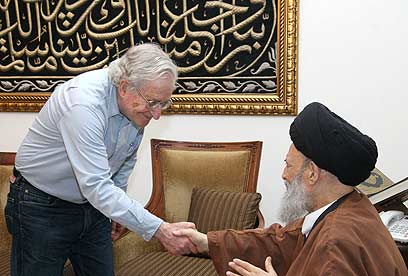
Chomsky met with Sheikh Fadlallah, the "spiritual" leader of Hezbollah, yesterday in Lebanon.

Ynet reports of Chomsky:
Jewish-American linguist Noam Chomsky met with the spiritual leader of the Shiite Muslims in Lebanon, Sheikh Muhammad Hussein Fadlallah, on Thursday and told him that if Israel felt backed against a wall it could turn aggressive. 
It is not possible to foresee what Israel will do, because if it feels besieged it could turn aggressive, Chomsky said. Israelis' actions are based on a persecution complex, meaning that aggression would not be an option again except out of a "mentality of madness" which rules many in Israel.
The picture below is of Chomsky shaking hands with Fadlallah.


Among Chomsky's other activities during his trip to Lebanon was attending the inauguration of Hezbollah's "tourist complex" in southern Lebanon.
Jewish-American scholar and activist attends to the inauguration ceremony of Hezbollah's 'Tourist Complex' in Mlita in southern Lebanon on May 21, 2010. The Hezbollah Shiite militia inaugurated a 'tourist complex' displaying its own heavy weapons and those left by Israel, to mark the 10th anniversary of Israel's pullout from south Lebanon....

As part of events marking the tenth anniversary of Israel's withdrawal from south Lebanon, Hezbollah inaugurated Friday a permanent war museum, complete with war booty captured from Israeli soldiers, replicas of guerrillas in action on the battle field and in underground tunnels, and a memorial for its war dead.
Strangely enough, Jeffrey Goldberg, in a 2002 article in the New Yorker about Hezbollah, wrote that Fadlallah said to him:
Al Manar would not rule out broadcasting comments from non-Israeli Jews. “There would be one or two we would put on our shows. For example, we would like to have Noam Chomsky.”
This was not the first time Chomsky had met with leaders of Hezbollah. In 2006, he visited Lebanon for the first time, gave two lectures at the American University of Beirut, visited the Sabra and Shatilla Palestinian refugee camps, met with Walid Jumblatt and leaders of the Communist Party, as well as meeting with Hassan Nasrallah, the leader of Hezbollah.

Assaf Kfoury, who helped organize his trip in 2006, wrote about Chomsky's meeting with Nasrallah:
May 11, Hizbullah headquarters, Beirut. We meet Sayyid Hassan Nasrallah, the head of Hizbullah, in a heavily fortified compound. Hizbullah has widespread popular support, with representation in the Lebanese parliament and the council of ministers, largely the result of its role in the successful resistance to the Israeli occupation of southern Lebanon in the 1990's. Nevertheless, American government officials -- from Condoleezza Rice, David Welch, Elliott Abrams, Jeffrey Feltman and on down -- routinely visit other Lebanese politicians and dignitaries, never Nasrallah, and they portray Hizbullah as a band of terrorists. The value of this meeting with Noam is as much in what Nasrallah has to say as in the public recognition by a public American, admittedly the most dissident of them, of Hizbullah's role in Lebanon and the Middle East at large. Nasrallah recognizes the value of trying to break the official American embargo: He has no objection to Noam quoting him on anything he has said, and his last question to Noam is a request for advice on what Hizbullah can do to counter the pernicious propaganda in the US.

In response, Noam points out the importance of separating policies emanating from Washington from public opinion in the US, with the latter often at odds with the former. Given the nature of electoral politics today in the US, he also points out that officials in Washington are usually elected by a minority of the population and represent two parties that are virtually indistinguishable on fundamental issues, and hence the importance of reaching out to the US public ahead of policy makers who are beholden to corporate interests.

Nasrallah covers a wide range of issues in his presentation, including the arms of Hizbullah, which the US and its allies have demanded be relinquished. Nasrallah presents the issue of the arms in the context of a strategy to defend southern Lebanon which, he argues, concerns all Lebanese and not only Hizbullah. After the meeting, to the pack of journalists and TV crews waiting outside, Noam declares: "I think Nasrallah has a reasoned and persuasive argument that the arms should be in the hands of Hizbullah as a deterrent to potential aggression, and there are plenty of background reasons for that ..." Enough to feed the right-wing rumor mill for a long time to come.
Indeed. I can see why Israeli officials would think it not in Israel's interest to let Chomsky into the country, given his open support for Hezbollah, which has been building up quite an arsenal of missiles since the second Lebanon war in the summer of 2006.

Wednesday, May 26, 2010

Believing two impossible things before dinner

A couple of astonishing things I learned from Jeffrey Goldberg today:

1. If Jane Harman's opponent in the Democratic primary in California (36th congressional district) wins the nomination, I would be severely tempted to give money to her Republican opponent. Goldberg interviewed her opponent, Marcy Winograd, and writes, "I spoke with Winograd by telephone a few days ago. In our conversation, she said [s]he personally supports the replacement of Israel with a bi-national state; she also argued that the U.S. should engage Iran in "people-to-people" diplomacy; that aerospace companies in her district should re-orient themselves away from manufacturing weapons and to the pursuit of green technologies; and she suggested that Henry Waxman is treasonous."

Her views on Israel and Zionism:
JG: Go this Henry Waxman question. Are you for a bi-national state or are you for a two-state solution?

MW: I consider myself a realist, okay? I'm Jewish. I've labeled myself as a Jewish woman of conscience who is compelled to speak out because of the suffering in the world. I support peace, so whatever both sides can agree to, which would probably be an agreement on a mutual exchange of territory, I would fully support, because I want peace. However, and let me share this with you, I grew up in a strong Zionist family, I sang at my brother's Bar Mitzvah, I sent my daughter to Jewish pre-school, I went to Israel when I was in my 20s. That's my background, and all that being said, I know that Israel was born on land where a million Palestinians lived. For many Jews the birth of Israel is a celebration, but for the Palestinians it was the nakba, a catastrophe. There's no safety or security in barring people from their homeland. Ultimately, Jews and Palestinians need to learn to live together, just as they lived in peace for many years.

JG: Can you be a liberal and a Zionist at the same time?

MW: Well, there's a less-harmful Zionism. I don't see Zionism as liberal. Zionism categorizes Jews as a race, which makes it easier for Jews to be targeted.

JG: Zionism doesn't categorize Jews as a race, it categorizes Jews as a nation.

MW: To me, there's no safety in creating a nation predicated on either racial or ethnic supremacy.

JG: How did you come to this view?

MW: I've been torn about this for a long time, and not really wanting to look at it, which a lot of Jews probably feel, wanting to turn away from it because it's too painful. It's too tied to our identity, to our neighborhoods, to our whole orientation. My primary concern is peace. I don't feel comfortable advocating for a country based on ethnic and racial supremacy. Personally, I'm a believer in equality, one voice, one vote, Israelis and Palestinians, one voice, one vote, that's my personal position.

JG: Eventual bi-nationalism.
Like Goldberg, I would vigorously disagree with anyone who says that Zionism is predicated on racial superiority - this is the kind of talking point beloved by the antisemites who write for Dissident Voice. Another indication of her left-wing radicalism on the topic of Israel is that she spoke at a "Friends of Sabeel" conference in Pasadena in 2008. Rob Eshman of the Jewish Journal reported on this speech:
In that speech, Winograd said she not only opposes a two-state solution, she supports the end of Israel as a Jewish state “Not only do I think a two-state solution is unrealistic,” Winograd said, “but also fundamentally wrong, because it only reinforces heightened nationalism. You cannot establish a democracy in a state founded on the institutionalized superiority or exclusivity of one of [sic] religion, ethnicity or culture. I do not support the notion of an Islamic state or a Christian state any more than I support a Jewish state." Winograd went on to accuse Israel of “crimes against humanity,” “institutional racism” and “extermination.”
2. In an article entitled Human Rights Watch's Priorities, but which is mostly about Peter Beinart's article on Liberal Zionism, he cites an interesting article from Foreign Policy. According to this article, for Human Rights Watch and Amnesty International, the United States was the top country written about during the 1990s. James Ron and Howard Ramos reported the following on November 3, 2009 on the Foreign Policy website:
We listed each organization's top 10 "hit list" of countries reported on for the 1990s. Human Rights Watch's most written on countries were, in descending order, the United States, Turkey, Indonesia, China, Russia, India, the Federal Republic of Yugoslavia, Sudan, Israel, and Burma. Amnesty's hit list from 1991 to 2000 was similar, including the United States, Israel, Indonesia, Turkey, China, the Federal Republic of Yugoslavia, Britain, India, Russia, Rwanda, and Burundi (there were 11 countries because of one tie). Size seemed to matter, since large countries such as China, the United States, and India received more scrutiny than others. Policy relevance and newsworthiness also counted for something, pushing Turkey, a key NATO ally, to center stage.

Yet these lists were also notable for the countries they did not include. When we used data on poverty, repression, and conflict to identify some of the worst places on earth, we found that few of these countries were covered much by either Amnesty or Human Rights Watch.

At first, this seemed puzzling; why would the watchdogs neglect authoritarians? We asked both Human Rights Watch and Amnesty, and received similar replies. In some cases, staffers said, access to human rights victims in authoritarian countries was impossible, since the country's borders were sealed or the repression was too harsh (think North Korea or Uzbekistan). In other instances, neglected countries were simply too small, poor, or unnewsworthy to inspire much media interest. With few journalists urgently demanding information about Niger, it made little sense to invest substantial reporting and advocacy resources there.

Their study doesn't cover the 2000s, but it's hard to imagine that either the United States or Israel has fallen very far in the dubious standings of these two "human rights" organizations. I find it unbelievable that the United States, which is a democratic country with a very open media, belongs at the top of the list of human rights offenders. We certainly violate human rights in a host of ways - but more than Iran? Venezuela? China? North Korea? It's ridiculous that the U.S. is at the top of the list. Guess who I'm not ever going to give any money to!

Friday, May 14, 2010

Pat Buchanan, translated from the German once again

Molly Ivins' famous quip about Pat Buchanan proves to be true again: it sounded better in the original German.

While Diane Butler Bass writes a sad, elegaic, pseudo-liberal lament for upcoming lack of Protestants on the Supreme Court, Pat Buchanan comes right out with an antisemitic screed Are liberals anti-WASP?:
Indeed, of the last seven justices nominated by Democrats JFK, LBJ, Bill Clinton and Barack Obama, one was black, Marshall; one was Puerto Rican, Sonia Sotomayor. The other five were Jews: Arthur Goldberg, Abe Fortas, Ruth Bader Ginsberg, Stephen Breyer and Elena Kagan.
If Kagan is confirmed, Jews, who represent less than 2 percent of the U.S. population, will have 33 percent of the Supreme Court seats....
If Kagan is confirmed, the Court will consist of three Jews and six Catholics (who represent not quite a fourth of the country), but not a single Protestant, though Protestants remain half the nation and our founding faith.
If Kagan is confirmed, three of the four justices nominated by Democratic presidents will be from New York City: Kagan from the Upper West Side, Sotomayor from the Bronx, Ruth Bader Ginsburg from Brooklyn. Breyer is from San Francisco.
Is there a reason that this aging America Firster is still considered a credible source of opinions by MSNBC, the supposed liberal cable network? (This column was published on World Net Daily, Human Events, Townhall.com).

Update: Continuing on this bigoted theme, see Bishop Harry Jackson, who is an African American pastor of Hope Christian Church in Washington, DC, and has appeared on many right-wing talk shows, writes on Townhall.com:
"The nomination of Elena Kagan for Supreme Court should outrage evangelical Protestants." He's really angry about anti-religious movies and books (by people like Bill Maher and Richard Dawkins). "Against the backdrop of the religious mis-education of the nation, evangelical Christians must embrace (once and for all) that they must let their voices be heard in politics, the arts, and every arena of our culture. Although Catholics are well represented on the Supreme Court, there will likely be important cases that will need the insight of unbiased evangelicals to create an atmosphere for true justice." 
"Unbiased evangelicals"? Better - "bigoted evangelicals," like himself.

Some other notices of Buchanan's antisemitism:

Charles Johnson (of LGF) on True/Slant
Rick Ungar on True/Slant
Jason Linkins of Huffington Post
Rachel Slajda of Talking Points Memo
Maureen O'Connor of Gawker
David Weigel at the Washington Post writes:
Let's put this in context.
Buchanan has been clamoring for more whites to get Supreme Court seats for four decades, and in 1971 he wrote this in a memo to President Richard Nixon.
Italian Americans, unlike blacks, have never had a Supreme Court member — they are deeply concerned with their “criminal” image; they do not dislike the President. Give those fellows the “Jewish seat” or the “black seat” on the Court when it becomes available.
The court now has two Italian American members, so Buchanan revisits his obsession to make a tiresome argument -- that Obama is passing over theoretically qualified white candidates and that, hint hint, this provides an opening for conservatives.
"Neither Obama nominee is academically distinguished," writes Buchanan of Sonia Sotomayor and Elena Kagan, both of whom graduated summa cum laude from Princeton University.
Really, it's such a thin and weakly argued column, coming from such a place of bias, that I don't forsee many smart conservatives looking to it for advice on how to oppose Kagan.