Tuesday, May 01, 2012

Celebrating May Day in Israel


This morning I was listening to Reshet Bet (Israel Radio) and heard the Internationale sung in Hebrew, and then interviews with some of the Knesset members from the Hadash party. The word Hadash in Hebrew means "new," and it's also an acronym for the name of the party - HaHazit HaDemokratit LeShalom VeLeShivion - The Democratic Front for Peace and Equality. The party was formed in 1977 out of the Israeli Communist Party and other left-wing Israeli groups. It is a joint Arab-Jewish party and currently has four members in the Knesset: Afou Agbaria, Mohammed Barakeh, Dov Khenin, and Hanna Swaid. Barakeh is the leader of the party.

This evening, as I was cooking dinner and feeling rather tired, I turned on Army Radio (Galei Tzahal), and discovered that they were broadcasting a program about Leon Trotsky! I haven't listened carefully to the whole program, but thus far it has included a survey of Trotsky's life, his role in the Bolshevik Revolution, his role as head of the Red Army, and of course his assassination by agents of Stalin in 1940. The talking is interspersed with rather outrageous music (for example a band called Baba Yaga singing what I think was the Internationale in Russian a heavy metal style, another group singing Bob Dylan's song "With God on our Side" in Hebrew - that was actually pretty funny). The program is taking place at a bar called "Barbi" in Tel Aviv.

From the advertisement on the Galei Zahal web site (Life of Others presents an evening with Trotsky):
On the first of May 2012 at 7:30 p.m. an evening program of the program "Life of Others" on Galei Zahal will be devoted to the daring revolutionary and persecuted fighter Leon Trotsky. This is a special evening, one-time, and out of the ordinary which combines live musical performances, mini-lectures of six minutes, video clips - all under the direction of the radio broadcaster Eran Sabag....

On the basis of the social protest awakening last year, we decided to devote the program to Leon Trotsky, the Soviet communist revolutionary, in order to try to remember and understand the revolutionary ideas that succeeded and that failed in the 20th century.
Also tonight, there was a May Day march in Tel Aviv, organized by a coalition of left-wing groups and parties.

Monday, April 30, 2012

Yom ha-Atzmaut


Israeli flag hanging from my mirpeset (porch)
On Wednesday night, as I wrote in my last post, I was visiting friends in Tzur Hadassah and spent the end of Yom ha-Zikaron with them.

Yom ha-Atzmaut officially begins with a special national ceremony at 8:00 pm - the lighting of 12 torches at Har Herzl in Jerusalem. I watched part of the ceremony with my friends, something I hadn't done before during my previous visits to Israel. It was interesting. Apparently, every year there is a different theme and the organizers choose people connected to that theme to light the torches. The theme this year was water, so people from organizations that have something to do with water (like Mekorot, the national water carrier) or activists from groups that work for clean water (like the Society for the Protection of Nature) were chosen. Each person was introduced, then stepped forward, said a few words ending with "to the splendor of the state of Israel" (לתפארת מדינת ישראל), and then lit the torch.

After watching the torch-lighting, we went to the center of Tzur Hadassah and encountered the popular celebration of the day - complete with children spraying each other with shaving cream (fortunately not aiming mostly at adults), people wearing blinking glasses, headdresses, and even earrings, and holding enormous plastic hammers. (I remember, many years ago on Yom ha-Atzmaut going out to the center of town in Jerusalem and buying little plastic hammers that made a boink sound when you hit someone with them - they are apparently now passé, I didn't see any in Tzur Hadassah). There was entertainment - music and dance - and lots of people milling around. After a while the dance performances stopped, and there was another torch-lighting ceremony, this time by local people in education. And immediately afterward, fireworks!

 Little birds in the garden of my apartment building.
The next morning I got up relatively late and lazed around and took some photos of my garden.

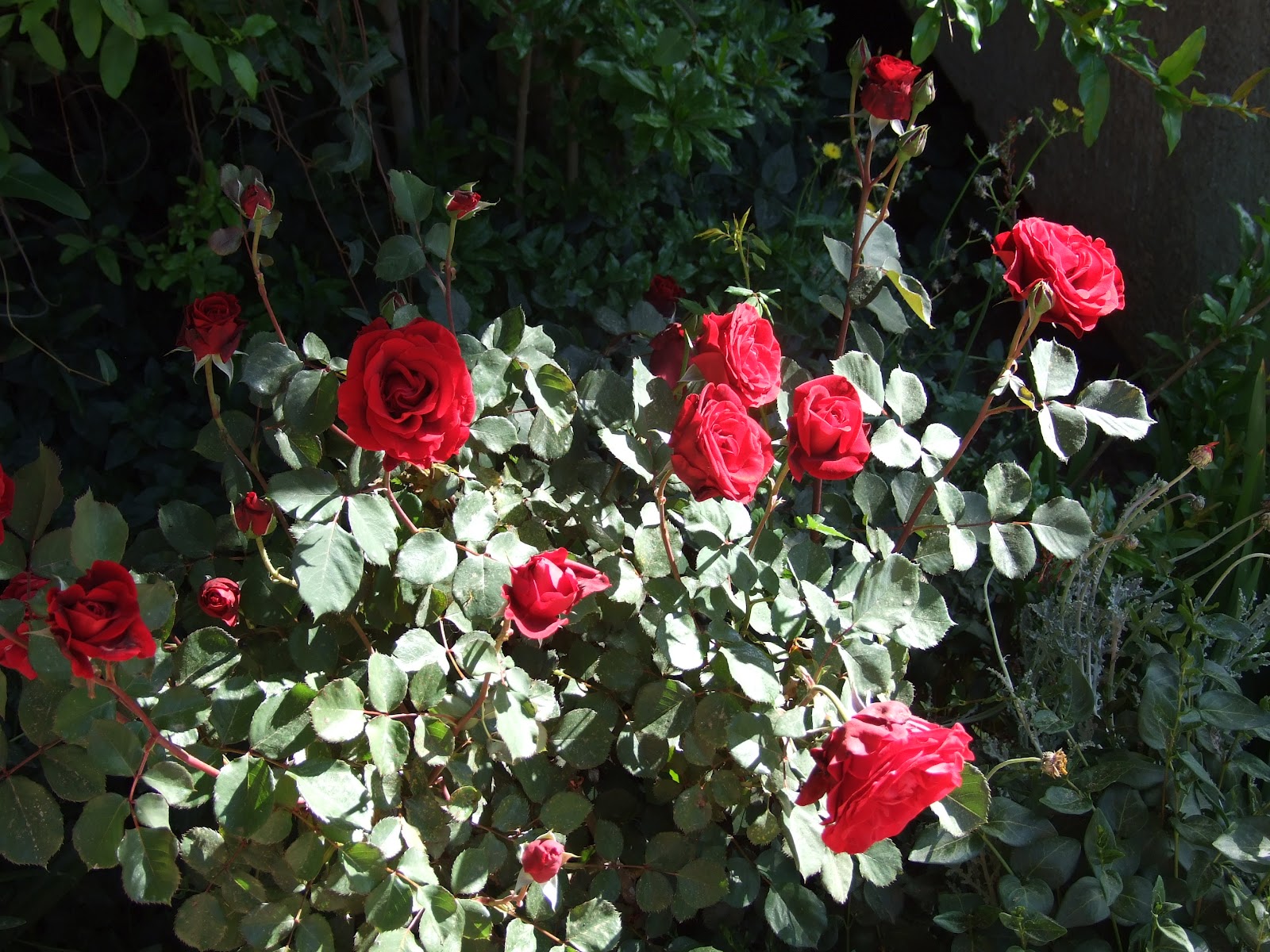
Some of the beautiful roses in the garden.
Around 11 am I went to see other friends to have brunch with them on their porch. One of the great Israeli traditions on Yom ha-Atzmaut is to go out into the country and have a barbecue (or a mangal), but we didn't do that - we had bagels & lox.

Another traditional activity is a flyby by Israeli Air Force planes - we saw some big helicopters flying over the President's house (where there was a ceremony honoring the 100 best soldiers in the army), a formation of five planes together, and then some time later, a formation of four planes with exhaust trails making big circles in the sky (I didn't get any photos of them).

Three military helicopters flying over the President's Residence at the time of a ceremony honoring outstanding Israeli soldiers.
Five Israeli Air Force planes flying in formation over the skies of Jerusalem.
Then, later in the afternoon, we went out for our own visit to the countryside, for a hike and not a mangal. We went to a place called Hirbet Madras, which has several archaeological sites from the Second Temple period - first century BCE and CE, and into the early 2nd century. Below are photos of this beautiful area of the country and some of the archaeological sites.
Foothills of the Judean Hills, near Givat Yeshayahu, in the Adullam Park.

Looking across the Green Line, towards a large Jewish town/settlement, I don't know which one. The Green Line refers to the border between Israeli-held and Jordanian held areas of Palestine at the end of the 1948 War. Jordan named the area they occupied the West Bank (since Jordan was mostly on the east bank of the Jordan River, this was a way to integrate it into Jordan). In 1967 Israel conquered the West Bank.

Fig tree growing at the bottom of the entrance to caves where Jews hid from the Romans during the Bar Kochba revolt in the second century CE.

"Pyramid" over a Jewish burial cave, probably from the first century BC or CE

Cutting hay in the fields near Tzafririm.

The moshav of Zafririm.

Grasses drying in the late spring heat.

Looking towards fields from the Adullam Park.

Inside Jewish tomb from the end of the first century CE - on the right is an ossuary and its cover. An ossuary is a stone box where the bones were put a year after the burial in the cave, after the flesh had fallen off the bones.
Entrance of the Jewish burial cave - notice the round stone, which was rolled in front of the cave after burial. It was destroyed by vandals 15 years ago and recently restored.


Yom ha-Zikaron - Day of Remembrance

The day before Independence Day is Yom ha-Zikaron (יום הזיכרון) - Israel's day of remembrance for those who died in wars or terrorist attacks. It's a very somber day, in what felt like a more personal way than Yom ha-Shoah, which happened the previous week on Thursday. Beginning a few days beforehand, Israeli radio and television stations started to broadcast stories about fallen soldiers and those who died in terrorist attacks. On the day itself, that is all that was broadcast. I usually listen to Reshet Bet, which is the news station of Israel Radio (something like NPR in the US but more closely tied to the government), and from Tuesday afternoon onwards and throughout Wednesday they broadcast a series of stories about individuals and groups who had died, and interviewed survivors of various battles from the War of Independence onward, as well as families who had a relative who had died in battle or in a terrorist attack, and survivors of terrorist attacks. Sometimes I had to turn off the radio because it was simply too sad.

Yom ha-Zikaron began on Tuesday evening with a siren at 8:00 p.m., lasting for one minute. Immediately afterwards the official remembrance ceremony began at the Kotel (Western Wall). President Peres spoke, and I think Netanyahu did also. The El Malei Rahamim (God, full of compassion) prayer, with its mournful tune, was sung, as it always is during the remembrance of the dead.

The next morning when I got up I listened to more stories and then went out to do some shopping. As I was standing on Emek Refaim St. the morning siren went off at 11:00 a.m. Everything stopped - the cars in the street, pedestrians, people on bicycles. The cars stopped and the drivers got out and stood next to them. Pedestrians stopped in their tracks and from what I could see most people were bowing their heads. Oddly enough, two people continued - one a pedestrian, who was walking on the side of the street opposite from me. Then a motorbike appeared and kept weaving around all of the stopped cars as well as a bus and a big truck, and then disappearing north up the street. It's very unusual for that to happen, as far as I know, at least among most Israeli Jews - Arabs generally don't stop for the siren, nor do anti-Zionist haredi Jews, who don't respect the official celebration or commemorative days of the state, since they don't recognize its legitimacy. Nonetheless, it was very eerie to see all the people just stopped, without the usual traffic sounds, and the loud siren in our ears.

In the afternoon I went with a friend to Tzur Hadassah, which is a small community in the Judean hills not far from Jerusalem. I spent the evening with them, first celebrating their son's sixth birthday, and then going to a special service for the end of Yom ha-Zikaron. It was held at the house of Rabbi Levi Cooper, who is the rabbi of the small Orthodox synagogue Ha-Tzur ve-ha-Tzohar (the link is to an article in Hebrew on Ynet). The service is based on one written for the Chief Rabbinate of Israel for Yom Ha-Atzmaut, but it had definitely had some non-traditional aspects. We began by singing sad songs, which was followed by a brief video interview of the widow of a soldier who had died in the second Lebanon War in 2006 - he threw himself on a grenade to save the lives of his men. The songs then became happier as we approached Yom ha-Atzmaut. This part of the service ended with the recital of several psalms. For the first one, each congregant, first the men and then the women, recited the verses in turn. (Since this is an Orthodox shul, I hadn't expected the women to be asked!). Then the rabbi blew the shofar, and began the evening service (Ma'ariv). Prayers were sung with tunes from celebratory Israeli songs. It was a very moving service. I hadn't known what to expect at all, since I've never been to one of these services.

Life in Israel

I just got home from having a very nice dinner with a friend, turned on the radio to listen to a news-talk program, and then at 9:30 there was a brief interruption - "Color Red alarm in Sderot, Color Red alarm in Sderot." "Color Red" (צבע אדום) is the name for the warning system that sounds when a rocket is launched towards one of the southern communities from Gaza. I haven't heard anything more, if there was a rocket or not. (Sderot is very close to the border with Gaza).

Friday, April 27, 2012

More on British POWs at Auschwitz, including the father of Shimon Peres

The Jewish Chronicle has another article about the British soldiers held near Auschwitz:

As many as 1,400 British prisoners arrived at Auschwitz towards the end of 1943 and hundreds were forced to work at the IG Farben chemical factory....
In mid-1944, the POW camp was moved directly adjacent to the plant and was therefore in direct view of Auschwitz III (Buna-Monowitz). British prisoners therefore witnessed the routine brutality meted out to the Jewish slave labourers including those hanged from the gates of the camp as an example to others. At times the "kriegies", as the POWs were known, and the "stripies", as they called the Jewish prisoners, worked together, formed friendships and exchanged information. Thus it was that the British soldiers discovered the source of the sickly-sweet burning smell that hung over the camp. 
Another amazing piece of information revealed by the JC:
Yitzhak Persky, the father of Israeli President Shimon Peres, was held at Camp E715, as the British camp at Auschwitz was known. 
From another article at the JC:
Mr Persky joined the British army on the outbreak of war as a combat engineer or "sapper". He was first captured in Greece, but escaped and spent a year alone hiding in monasteries. The Greek underground later led him to other escaped British prisoners, reported to include Sergeant-Major Charlie Coward, an escape specialist whose exploits were later celebrated in the film The Password is Courage. A failed attempt to reach the Turkish coast led to a further capture and after serving time in a series of POW war camps, Mr Persky found himself in E715.
Another article tells more about the British POWs - 
The British prisoners of war (POWs) who were housed in the E715 prisoner of war camp at Auschwitz between September 1943 and January 1945 were forced to work at the I.G. Farben construction site. According to the Geneva Convention, it was not acceptable to have them produce war materiel. When that led some to protest their use in gasoline production, the I.G. Farben camp manager in charge, Gerhard Ritter, made it clear to them with his pistol that it was he who decided how the Geneva Convention was interpreted in Auschwitz.

The British POWs had to work about 12 hours a day, and days off work were few in number. They were deployed in a wide variety of work detachments, in some cases also as skilled workers. Many British POWs sabotaged the German war efforts as they worked. For example, they improperly laid cables or pipelines for the power plant of I.G. Auschwitz, and they damaged freight cars when working in the freight depot. The extent to which the British sabotage actions succeeded in delaying the building of the plant is unclear, however....

In general, the British POWs received better treatment than all the other groups of forced laborers of I.G. Auschwitz. Since the Germans treated Allied servicemen in accordance with the Geneva Convention, the British POWs had a right to receive food parcels from the Red Cross, correspond with their family members, and have visits from Red Cross representatives. Thanks to the food parcels, the British POWs had a relatively good diet. Thus they could forego the soup they received in I.G. Auschwitz and give it to individual concentration camp inmates.
Another longer article gives more information - The British Connection to Auschwitz.

British prisoners of war were imprisoned at Auschwitz and were visited by the Red Cross

Martin Bright, of the Jewish Chronicle (UK), has written an article about British POWs imprisoned at Auschwitz during WWII. The POW camp was called E715 and housed about 1,000 British and Commonwealth soldiers. They were not treated like the Jews - they received Red Cross food packages and were protected by the Geneva Conventions. (Soldiers from Western armies were generally treated this way by the Germans when they were captured - Soviet POWs on the other hand were starved to death and worked as slave laborers, and more than 3 million of them died at the hands of the Nazis). Another POW camp was at Teschen, about fifty miles away from Auschwitz. (For more on the British POWs, see a January 14, 2010 article in the JC by Simon Round - "Revealed: The British Troops Imprisoned at Auschwitz").

The most amazing fact in this article, in my opinion, is this:
The Red Cross visited Auschwitz in the summer of 1944 and in September reported the concerns of Sergeant-Major Lowe, the British camp leader - or "Man of Confidence" - at Teschen.
"Spontaneously, the principal Man of Confidence at Teschen asked us if we were well-informed about the 'shower room'. Indeed the rumour runs that in [Auschwitz] a very modern shower room exists where the detainees will be gassed in series... This was impossible to prove. The detainees themselves did not talk about it."
The Red Cross visited Auschwitz in the summer of 1944?! I presume he means they visited the E715 POW camp, not the extermination camp itself. Nonetheless, they were quite close to the extermination camp, as is apparent from Bright's article. Bright writes about the British POWs:
They knew about the summary executions, they could hear the sounds of mistreatment and see the physical condition of the "stripeys", as the Jewish inmates were known to them. They could also smell the burning flesh from the crematoria at Auschwitz-Birkenau and those who did manage to speak to Jewish prisoners heard about the "showers".
And if the POWs could hear the sounds and see the physical conditions of the Jewish inmates, and smell the burningn flesh, so could the Red Cross visitors. Did they make this information known publicly? Did they press the Nazis to visit the extermination camp itself? Their record is otherwise not very good, as is shown by the evidence of the Red Cross visit to Theresienstadt also in the summer of 1944.

The Danish Red Cross and the International Red Cross sent 3 delegates to Theresienstadt to examine the camp on June 23, 1944. They were allowed in at the insistence of the Danish government, which wanted the Red Cross to gather information about Danish Jewish prisoners in the camp (they had been sent there in October 1943). The Nazis prepared the camp before they arrived and created an elaborate Potemkin village, presenting it as a model village where a soccer game was being played and the children's opera Brundibar was presented. The International Red Cross inspectors were taken in and did not report anything untoward at the camp. (Information from the US Holocaust Memorial Museum website - Theresienstadt: Red Cross Visit).

When I visited Theresienstadt in the summer of 2005, I was taken aback to see that at the Small Fortress, which was used by the Gestapo for political prisoners as well as Jews, that the slogan "Arbeit Macht Frei" had been painted at the entrance of the prison. Did the Red Cross not see this part of the camp? If they did go there, did they wonder about the strange slogan?


New Review of the Jewish Annotated New Testament

How Jewish Is the New Testament?

Review is by James D. G. Gunn, who is an Emeritus professor at Durham in England.

A tale of two protests on Israel Independence Day, 2012

Can someone tell me why one of these protests was allowed to happen while the other was suppressed by the police? The violent one was not suppressed, while the peaceful one was prevented by the police, who kept the activists from leaving their office, and arrested three of them.

Neturei Karta 

Members of radical anti-Zionist sect take to streets in Bnei Brak, torch Israeli flags while country celebrates 64th Independence Day
Kobi Nahshoni
While the State of Israel celebrated 64 years of independence, a group of Neturei Karta demonstrators burned Israeli flags in Bnei Brak.

An eyewitness told Ynet that several members of the anti-Zionist Jewish sect rioted in front of the Lithuanian Yeshiva and set Israeli flags on fire, while calling out slogans against Israel. According to the eyewitness, dozens of Bnei Brak residents gathered around the demonstrators and protested against their anti-Israel behavior.

Neturei Karta demonstrators burn Israeli flags (Photo: Yisrael Cohen)
Several of the Yeshiva students confronted the protesters until they eventually left the premises.

One radical haredi activist told Ynet that he and his friends have been trying to expand their protest outside of Jerusalem. He expressed his satisfaction with the groups' protest in Bnei Brak.
"We will continue to express our anti-Zionist and anti-Israel views. It is our truth," he said.

Zochrot

Jack Khoury
Members of the leftist organization Zochrot were attempting to distribute flyers containing the names of Palestinian villages that were evacuated or destroyed in 1948, when they were held indoors by Tel Aviv police for almost four hours.
Israel Police prohibited members of a left-wing NGO from exiting a Tel Aviv building on the eve of Israel's Independence Day, activists said, claiming that the lockdown was meant to prevent them from distributing postcards concerning the displacement of Palestinians during the War of Independence in 1948.

According to the report, members of Zochrot – an NGO working to inform the Israeli public of what the Palestinians call the Nakba, or, the Palestinian disaster in 1948 – police officers surrounded the group's offices, and barred the doors for four hours on Wednesday.

The activists planned to hand out postcards in Hebrew, Arabic, and English during Independence Day celebrations in Tel Aviv's Rabin Square, which cite the names of villages from which Palestinians were uprooted and which were destroyed in 1948.

Liat Rosenberg, the NGO's director general, said that "as we were about to step out of the offices, at around 10:30 P.M., we discovered, to our dismay, that the police were already surrounding the building and had closed all the exits."

"The senior police staff at the scene made it clear that they were determined not to allow us to 'disrupt public order,' and so did not permit us to leave the premises," Rosenberg added.

According to the head of Zochrot, the 15 activists were trapped inside the buildings for close to four hours, with police officials indicating that they would allow them to leave if they agreed to hand over the materials, presented their identification, and agree to being questioned and searched.

"At the corner of Ibn Gabirol and Mane streets tonight, silencing entered a whole new realm, with a bitter taste of dark regimes," Rosenberg said.

An attorney present at the scene told the police officers that they had no cause to ask the activists to identify themselves, and warned that she could file a complaint for false imprisonment.

During a verbal exchange between activists and police, three NGO members were arrested, including Yuval Halprin, who wasn't inside the building, but who chose to read out the names of Palestinian villages in central Israel from outside the offices.

Eitan Bornstein, Zochrot's spokesman, told Haaretz that the incident represented a severe aggravation of the police's and the establishment in general, saying: "What we sought to do was to hand out postcards, not anything violent. There were people threatening to beat us, and they weren’t arrested."

Zochrot announced that the NGO would file a suit against the police for false imprisoning on Sunday.

The Association for Civil Rights in Israel (ACRI) called the incident political persecution with the aid of the police, adding that, "needless to say, the police's activities had no legal grounds."

"Freedom of speech isn't suspected for Independence Day," ACRI spokesman Hagai Elad said.

Tel Aviv District police responded, calling the events an “illegal protest that was not authorized by the police.” Police representatives stated: “The police did not allow the protesters to reach the central event, display signs and create provocation, but did allow them to protest in an area far away from the central Independence Day event. Three protesters that caused a disturbance were arrested on suspicion for disrupting the peace.”

Thursday, April 26, 2012

Israel Independence Day


Apparently for the last several years Google has made a doodle for Israel Independence Day - and this is this year's doodle - children stringing up flags in honor of the day.

Later this morning I'm going over to friends for a brunch, and then in the afternoon we're going on a hike to a beautiful place, which are plentiful in Israel.

Yesterday was Yom Ha-Zikkaron (Israel's remembrance day for those killed in war and terrorist attacks), and Independence Day started last night at 8 pm.

Friday, April 20, 2012

Israeli Conservative Movement finally approves ordination of gay rabbis

Finally - the Israeli Conservative Movement approves ordination of gay rabbis
Israel's Masorti (Conservative) Movement decided to approve the ordination of homosexual rabbis, in a dramatic vote on Thursday. The Schechter Rabbinical Seminary, affiliated with the movement, will admit gay and lesbian students for training as spiritual leaders as of the upcoming school year.

In doing so the Israeli Conservative Movement is joining the American branch of the movement, whose rabbinical seminaries have been admitting gay students for some years.

The question whether or not to ordain gay and lesbian rabbis has been rattling the Conservative Movement in Israel and the U.S. for the past decade. Unlike the Reform movement that took to the question with ease, deciding firmly on the acceptance of gay rabbis. The Conservative Movement, whose rabbis see themselves bound to Jewish law, has been caught up in heated debate over the subject.

Years of discussion led to two contradictory religious rulings in 2006, one requiring the ordination of gay and lesbian rabbis and another banning any such act. The two rabbinical seminaries affiliated with the movement in the U.S. move the ruling allowing the ordination, while the seminaries in Jerusalem and Buenos Aires adopted the ban on ordination. The issue nearly caused a rift in the movement.

The debate continued to wage at the Schechter Rabbinical Seminary, with two female rabbis quitting the institute, one in opposition to the ordination of gay rabbis; the other over the hesitation shown by the organization in accepting gay and lesbian students into its ranks.
I don't know who the rabbi was who quit over the hesitation of Schechter to ordain openly gay students, but I think the rabbi who resigned was Einat Ramon, who opposed the ordination of openly gay and lesbian students, and who even thought that there was no place for gay and lesbian Jews in the Masorti movement in Israel.
On Thursday, the institute’s general council held another vote on the subject. Out of the 18 rabbis that attended, all voted to admit homosexual students, with one rabbi abstaining.

Rabbi Mauricio Balter, President of the Israeli Conservative Movement Rabbinical Assembly expressed his support of the move.

“I see it as a very important development in Jewish law,” Rabbi Balter told Haaretz, adding: “It is the right thing to do. We were all made in the image of God, and as such we are all made equal. For me this is a very important value. I always said we should admit gay and lesbians into our ranks.”

“I’m glad we had the vote and that it went the way it did,” Rabbi Balter continued. “The decision to hold a vote was correct as can be seen by the fact that there wasn’t a single dissenting vote,” he said....

People working at the seminary admitted that over the years, members of the American Conservative Movement have been applying pressure to accept gay and lesbian students, as the American seminaries have been doing for some years now.

The institute also stressed that the decision was mostly a formality since it had never checked for the sexual orientation of its applicants.
When Einat Ramon was dean of the rabbinical school, I have my doubts that Schechter didn't check people's sexual orientation. Her opposition to the ordination of gay and lesbian students was loud and clear. When she was dean, in 2007, she wrote in an article in the Washington Jewish Week (April 12, 2007):
As dean of the Schechter (Masorti) Rabbinical Seminary in Jerusalem, I recently announced my decision to accept only students who believe in the importance of the intimate relationship between a man and a woman in the confines of the Jewish institution of marriage and to serve, to the best of their ability, as role models in that regard.
Ynet also reports about the policy statement she made in March, 2007, forbidding the ordination of openly gay students:
Rabbi Einat Ramon, Dean of the Conservative Movement's Schechter Rabbinical Seminary in Jerusalem, announced that there will be no change in the admissions policy of the Schechter Rabbinical Seminary in response to a recent decision by the Committee on Jewish Law and Standards (CJLS) of the Rabbinical Assembly in New York that would permit the ordination of practicing gay and lesbian rabbis and pave the way for the sanctification of same-sex commitment ceremonies.

The CJLS, the Conservative Movement's North American halachic authority, voted to endorse two proposals on this issue in December 2006: The decision that ordination of practicing gay and lesbian rabbis is not permitted by Jewish Law (Rabbi Joel Roth,), and the decision permitting the ordination of practicing gay and lesbian rabbis (Rabbi Elliot Dorff and two colleagues).

Since Conservative Judaism is a pluralistic movement, when the CJLS votes to approve two conflicting opinions in this way, each local rabbi is authorized to choose which opinion to follow.

Although the Israel branch of the Conservative Movement has long asserted its independence in matters of Jewish Law, Rabbi Ramon felt that in light of the discussions in North America generated by the split CJLS decision, it was important to clarify the policy of the Schechter Rabbinical Seminary.

In doing so, she was acting on the authority vested in her by the school's Executive Committee, chaired by Rabbi Hanan Alexander, Professor and Chair of the Department of Education at the University of Haifa. In upholding the status quo, Ramon is in agreement with Rabbi Roth's opinion, which was also endorsed by Rabbi David Golinkin, President and Professor of Jewish Law at the Schechter Institute of Jewish Studies in Jerusalem.

In a position paper that Rabbi Ramon distributed to the Executive Committee, she called attention to the historic centrality of heterosexual marriage in Jewish life.

“Jewish theology regards the union between a man a woman who are sexually and emotionally different from one another as a complementary covenant of friendship and intimacy, which forms the basis for procreation and childrearing. This is why Jewish law has so fervently opposed sexual relations between members of the same sex”, she explained, “and why the heterosexual family has played such a vital role throughout the ages in the transmission of Jewish values and the survival of the Jewish people.”

"I have great respect for Conservative rabbis who have chosen to follow a different opinion," said Rabbi Ramon, "and for the Reform Movement in Judaism which has long admitted candidates to its rabbinical schools who are practicing gays and lesbians or who favor same-sex commitment ceremonies. However, Jewish Law has traditionally prohibited homosexuality and only sanctifies sexual relations between members of the opposite sex."
I wonder if Rabbi Golinkin (with whom I studied Talmud in the late 1980s at Midreshet Yerushalayim, housed at Schechter) has changed his mind, or if he was the one person who voted to abstain in the vote that just happened this last Thursday.

In an article in the Forward, December 7, 2009, "Uncertain Territory: Conservative Movement's Pioneering Gay Rabbinical Students Tread Carefully in Israel," two students from JTS are quoted about their nervousness at having to go to Schechter for their third year of rabbinical studies.
Chesir-Teran, a former attorney who entered the seminary at the age of 36, recalled one meeting that he, Weininger and Nevins had in New York with Rabbi Einat Ramon, then dean of Machon Schechter’s Rabbinical School. Upon being assured gay students would be treated equally when they came to Schechter, Chesir-Teran said he told Ramon, “I’m assuming that means we’re going to be allowed to lead services and read from the Torah like everyone else,” Her answer, he recalled, was, “I don’t know. I have to get back to you.”

Ramon later confirmed in an email to Nevins that the gay students would, indeed, be allowed to do so. But the equivocation, said Chesir-Teran, was another “red flag” that made him leery about going there.

Ramon’s public pronouncements against gay ordination also stoked the two students’ concerns. In a Washington Jewish Week opinion piece shortly after the committee’s historic vote, Ramon, explaining her opposition to the change, avowed, “Judaism has always been clear and unambivalent toward the centrality of the heterosexual family.” And in a September 2007 policy statement, Ramon wrote, “If we permit [gay marriage and ordination of gay rabbis], we should, in all intellectual fairness, permit also all other forms of prohibited sexual activity and allow the marriage of brothers to their sisters.”

Ramon, who still teaches at Schechter, left her position as dean this past September. And though no one claims the move was connected to her pronouncements on gay ordination, supporters of the historic change say Ramon’s departure has eased the atmosphere for gay and lesbian students at Schechter considerably.

Ramon declined to comment for this article. “I have written and said what I had to say,” she told the Forward.

Nevertheless, during her tenure, the relationship between the two schools was sometimes strained. For example, Schechter put its foot down in March 2008, when several JTS students studying there sought to mark the one-year anniversary of the change in JTS’s admissions policy. The students invited Yonatan Gher, then the incoming director of the gay community center Jerusalem Open House, to speak about his experience as a gay man in the Israeli Conservative movement. But after a dispute with Ramon and others in the administration, the students were forced to hold the event off campus.

Nevins cringed when asked about this event. “That was an incident where no one was at their best,” he acknowledged. “It was a very painful moment.”
Ynet wrote about the March 2008 incident:
A group of 10 visiting American rabbinical students studying at the Schechter Institute of Jewish Studies (SIJS) in Jerusalem asked to hold a special event marking the one-year anniversary of the groundbreaking decision by the Jewish Theological Seminary, the movement's flagship rabbinic school in New York, to accept gay and lesbian rabbinical and cantorial students.

Israeli students at the school objected, however, noting that holding such an event would contradict a halachic ruling stipulated by the Conservative movement in Israel. Rabbi Dr. Einat Ramon, dean of the Schechter Rabbinical Seminary, met with the students and asked that the event also be sensitive to the Israeli Conservative movement’s point of view.

The American students refused, however, and ultimately a decision was reached to hold the event outside the school. Ramon assured the students that no other school activities would take place at the same time.

The anniversary ceremony eventually took place last Wednesday at the Valley of Rehavya in Jerusalem, and included not only the American students but some of their Israeli counterparts as well. Also attending the event were the director-general of the Jerusalem Open House For Pride and Tolerance, and member of Kehillat Tiferet Shalom, affiliated with the Masorti movement, Yonatan Gher, who spoke about the unique problems faced by Conservative gays and lesbians.

Gher viewed the Schechter’s Institute’s insistence in presenting both the viewpoints of the American and Israeli contingents of the conservative movement during the ceremony as utterly preposterous. “`Would one invite the (vehemently anti-Zionist) Satmar Hasidism to a ceremony marking Israel’s 60th anniversary?” he mused.

Some, however, harbor a far more positive view of the compromise offered by the institute.

“The Schechter Institute, its leadership and most of its student body adamantly object, purely from a halachic point of view, to the ordination of gays and lesbians,” said Dubi Hayun, one of the teachers at the school. “The American students' request is thus utterly disrespectful. It is tantamount to coming to a vegetarian’s home and eating a big, fat steak.”

Hayun also stated that he has nothing against gays and lesbians, and objects to their ordination purely from a halachic point of view. “Gays should, and must, receive equal rights from the state, it is wrong not to do so. However, one cannot circumvent halacha, or Jewish law, as painful as that decision may be.”

The SIJS noted put out a press release stating that “the institute decided to grant equal forum to the perspectives prevalent within the Conservative movement in the true spirit of the school, and our Jewish sages who respected each other’s rulings and opinions in spite of conflicts and disagreements.

"The Schechter Institute wants to provide a warm and welcoming environment for all of its students, but also adheres to the moral-halachic principle of 'a person should not deviate from the set ways of a place because of argument' (Mishna Pesachim 4:1). This means that one is obligated to respect the religious customs of a place that hosts him in order to preserve peace and harmony.”

Although Schechter has now voted to ordain gay students, I wonder if there will still be problems with faculty members or fellow students who still oppose it. (Although I suppose the same issue might have arisen at the other rabbinical schools that have begun to admit gay students - JTS and the Ziegler School in Los Angeles).

In any case - Kol ha-Kavod!

Thursday, April 19, 2012

Yom ha-Shoah - יום השואה

Today is Yom HaShoah - the day in commemoration of the Holocaust, which is observed very solemnly in Israel. This morning, at 10 am, the siren went off for two minutes of silent contemplation. Last night all restaurants and other places of entertainment were closed, and the official state observance was held at Yad Vashem, the Holocaust memorial museum in Jerusalem. Prime Minister Netanyahu spoke.

Last night I went to a memorial and discussion at Kehillat Yedidya that was dedicated to Raoul Wallenburg, the Swedish diplomat who saved thousands of Jews in Budapest from destruction in 1944. He himself was arrested by the Russians when they conquered the city and was never heard from again. The Swedish consul-general, Professor Shlomo Stern, who was saved from death by Wallenburg, and Eli Yosef, who works for the international foundation for the memory of Wallenburg, all spoke. Stern's talk was the most moving, since he spoke personally about how he and his family were saved by Wallenburg.

Today members of the Knesset (Israeli Parliament) read aloud the names of family members or people from their communities who perished in the Holocaust.
Prime Minister Binyamin Netanyahu, President Shimon Peres, Knesset Speaker Reuven Rivlin, ministers, MKs and other government officials read names of those who perished in the Holocaust during the Knesset's memorial ceremony on Thursday.

The ceremony is called "Every Man Has a Name" (לא כל איש יש שם) after a poem by Zelda that was inspired by the Holocaust. Twelfth Knesset speaker Dov Shilanksy, a Holocaust survivor, initiated the ceremony in 1989.

Peres told the story of his birthplace, Vishniev, which was then part of Poland but is now Belarus. His mother had five siblings, all of whom moved to Israel, except for her brother Michael Meltzer, who stayed behind to take care of his parents. All three were killed, along with the rest of the town's residents, who Nazis locked in a wooden synagogue, which they then burned down. Anyone who tried to escape the synagogue was shot.

"No house, no school, no cemetery remained in Vishniev," Peres said. "Nothing was left."

Knesset Speaker Reuven Rivlin pointed out that the name-reading ceremony "becomes more important every year as the amount of witnesses among us becomes less and less." Rivlin read the names of the Jews from the town of Shklov, Belarus, from which his mother's family hales, that were murdered by the Nazis. He explained that the Jewish community in Shklov was established in the 16th century, and on the evening following Yom Kippur 1941, residents of the Shklov Ghetto were taken to concentration camps.

The Knesset Speaker pointed out that there are victims of the Nazis whose names will never be known, such as the infant son of Aharon and Ivgenya Kapsitzky and other young children from Shklov.

Netanyahu said that this year's ceremony was the first that his father-in-law, Shmuel Ben-Artzi, who passed away in November, did not attend.

"He would listen closely, because he thought this was a way to give expression to the souls that were lost," Netanyahu said. "He saw the loss as something both personal and national, in dimensions that cannot be described."

The prime minister read a poem Ben-Artzi wrote in memory of his hometown, Bilgoraj, in which he "expressed his pain over the Holocaust."

Opposition leader Shaul Mofaz read names of Jews killed in the Farhoud, a Nazi-inspired pogrom in Baghdad in 1941, adding that "the State of Israel must do everything to make sure the events of the Holocaust, the genocide, do not repeat themselves."

Supreme Court Justice Elyakim Rubinstein read names of his family members, as did Intelligence Minister Dan Meridor, Transportation Minister Yisrael Katz, Justice Minister Ya'akov Neeman and Deputy Foreign Minister Danny Ayalon. Deputy Education Minister Menahem Eliezer Moses choked back tears as he read the names of 70 members of his father's family who perished in Auschwitz.

Education Minister Gideon Sa'ar honored Janusz Korczak, the Polish-Jewish educator who directed an orphanage and stayed with the orphans when they were sent to the Treblinka extermination camp.

Communications Minister Moshe Kahlon and Deputy Minister for the Advancement of Youth, Women and Students Gila Gamliel read names of those who perished in concentration camps in Libya, where their families come from.

MKs from Likud, Kadima, Labor, National Union and Shas read names. MKs Tzipi Hotovely (Likud) and Avraham Michaeli (Shas) told of family members from Georgia who were forced to fight in the Red Army, and never returned. MK Amir Peretz (Labor) honored Jews from Morocco who perished in Europe.

MK Ronnie Bar-On (Kadima) concluded his name-reading with a quote from Deuteronomy: "Remember what Amalek did to you on your way out of Egypt…that he struck those of you who were hindmost, all the weaklings at the rear, when you were faint and exhausted, and he did not fear God…God gives you rest from all your enemies around, in the Land that God gives you as an inheritance to possess it…you shall not forget."

At the beginning of the ceremony, the IDF rabbinical chorus sang Zelda's poem "Every Man Has a Name," followed by the lighting of six candles by survivors, the heads of the Knesset Caucus for Holocaust Survivors MKs Zevulun Orlev (Habayit Hayehudi) and Ze'ev Bielski (Kadima), as well as MK Ruhama Avrahal-Balila (Kadima) and her son, an IDF officer. Then, Ashkenazi Chief Rabbi Yona Metzger, Sephardic Chief Rabbi Shlomo Amar and IDF Chief Cantor Shai Abramson read psalms and prayers.