Tuesday, May 01, 2012

Celebrating May Day in Israel


This morning I was listening to Reshet Bet (Israel Radio) and heard the Internationale sung in Hebrew, and then interviews with some of the Knesset members from the Hadash party. The word Hadash in Hebrew means "new," and it's also an acronym for the name of the party - HaHazit HaDemokratit LeShalom VeLeShivion - The Democratic Front for Peace and Equality. The party was formed in 1977 out of the Israeli Communist Party and other left-wing Israeli groups. It is a joint Arab-Jewish party and currently has four members in the Knesset: Afou Agbaria, Mohammed Barakeh, Dov Khenin, and Hanna Swaid. Barakeh is the leader of the party.

This evening, as I was cooking dinner and feeling rather tired, I turned on Army Radio (Galei Tzahal), and discovered that they were broadcasting a program about Leon Trotsky! I haven't listened carefully to the whole program, but thus far it has included a survey of Trotsky's life, his role in the Bolshevik Revolution, his role as head of the Red Army, and of course his assassination by agents of Stalin in 1940. The talking is interspersed with rather outrageous music (for example a band called Baba Yaga singing what I think was the Internationale in Russian a heavy metal style, another group singing Bob Dylan's song "With God on our Side" in Hebrew - that was actually pretty funny). The program is taking place at a bar called "Barbi" in Tel Aviv.

From the advertisement on the Galei Zahal web site (Life of Others presents an evening with Trotsky):
On the first of May 2012 at 7:30 p.m. an evening program of the program "Life of Others" on Galei Zahal will be devoted to the daring revolutionary and persecuted fighter Leon Trotsky. This is a special evening, one-time, and out of the ordinary which combines live musical performances, mini-lectures of six minutes, video clips - all under the direction of the radio broadcaster Eran Sabag....

On the basis of the social protest awakening last year, we decided to devote the program to Leon Trotsky, the Soviet communist revolutionary, in order to try to remember and understand the revolutionary ideas that succeeded and that failed in the 20th century.
Also tonight, there was a May Day march in Tel Aviv, organized by a coalition of left-wing groups and parties.

Monday, April 30, 2012

Yom ha-Atzmaut


Israeli flag hanging from my mirpeset (porch)
On Wednesday night, as I wrote in my last post, I was visiting friends in Tzur Hadassah and spent the end of Yom ha-Zikaron with them.

Yom ha-Atzmaut officially begins with a special national ceremony at 8:00 pm - the lighting of 12 torches at Har Herzl in Jerusalem. I watched part of the ceremony with my friends, something I hadn't done before during my previous visits to Israel. It was interesting. Apparently, every year there is a different theme and the organizers choose people connected to that theme to light the torches. The theme this year was water, so people from organizations that have something to do with water (like Mekorot, the national water carrier) or activists from groups that work for clean water (like the Society for the Protection of Nature) were chosen. Each person was introduced, then stepped forward, said a few words ending with "to the splendor of the state of Israel" (לתפארת מדינת ישראל), and then lit the torch.

After watching the torch-lighting, we went to the center of Tzur Hadassah and encountered the popular celebration of the day - complete with children spraying each other with shaving cream (fortunately not aiming mostly at adults), people wearing blinking glasses, headdresses, and even earrings, and holding enormous plastic hammers. (I remember, many years ago on Yom ha-Atzmaut going out to the center of town in Jerusalem and buying little plastic hammers that made a boink sound when you hit someone with them - they are apparently now passé, I didn't see any in Tzur Hadassah). There was entertainment - music and dance - and lots of people milling around. After a while the dance performances stopped, and there was another torch-lighting ceremony, this time by local people in education. And immediately afterward, fireworks!

 Little birds in the garden of my apartment building.
The next morning I got up relatively late and lazed around and took some photos of my garden.

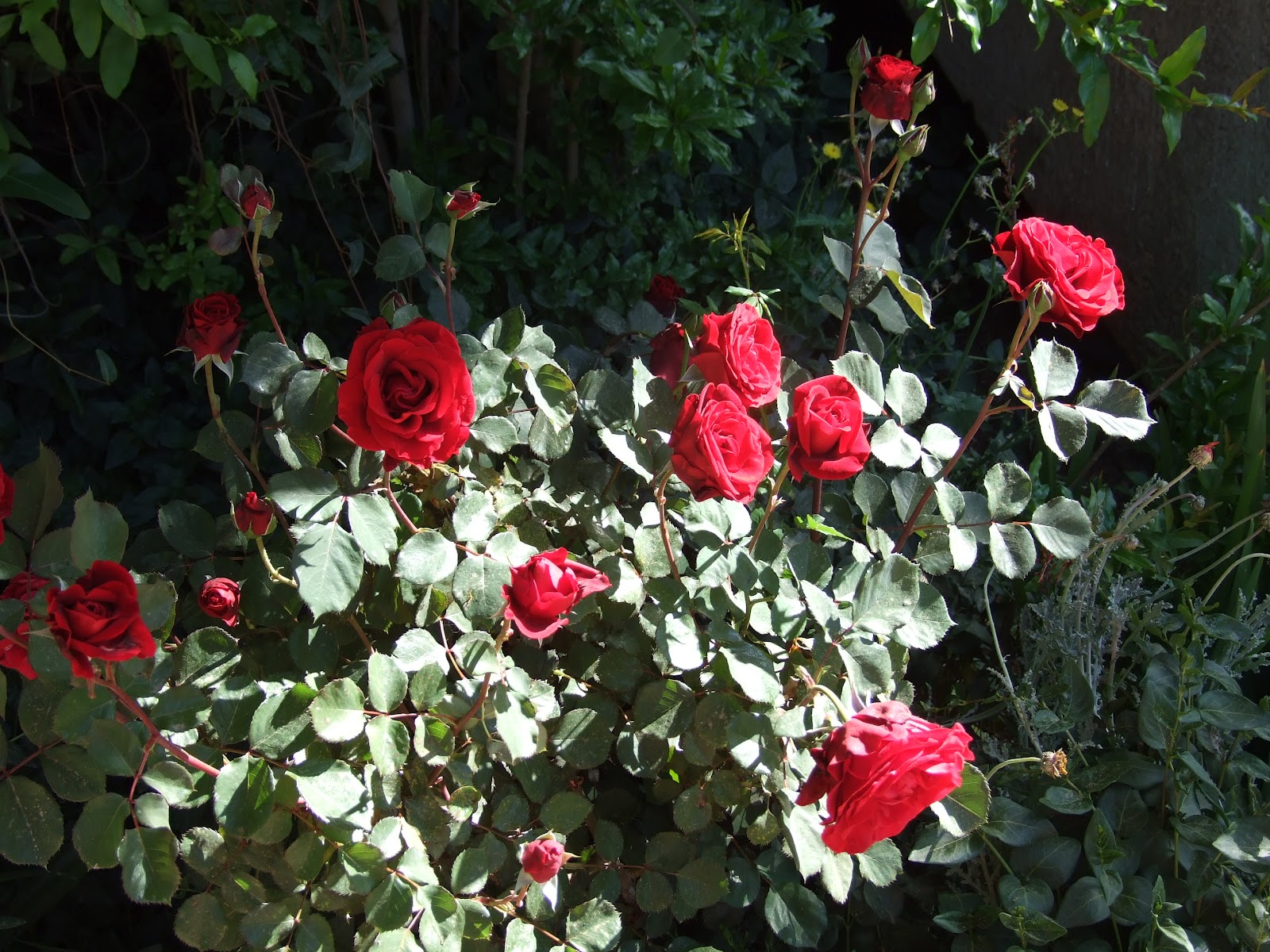
Some of the beautiful roses in the garden.
Around 11 am I went to see other friends to have brunch with them on their porch. One of the great Israeli traditions on Yom ha-Atzmaut is to go out into the country and have a barbecue (or a mangal), but we didn't do that - we had bagels & lox.

Another traditional activity is a flyby by Israeli Air Force planes - we saw some big helicopters flying over the President's house (where there was a ceremony honoring the 100 best soldiers in the army), a formation of five planes together, and then some time later, a formation of four planes with exhaust trails making big circles in the sky (I didn't get any photos of them).

Three military helicopters flying over the President's Residence at the time of a ceremony honoring outstanding Israeli soldiers.
Five Israeli Air Force planes flying in formation over the skies of Jerusalem.
Then, later in the afternoon, we went out for our own visit to the countryside, for a hike and not a mangal. We went to a place called Hirbet Madras, which has several archaeological sites from the Second Temple period - first century BCE and CE, and into the early 2nd century. Below are photos of this beautiful area of the country and some of the archaeological sites.
Foothills of the Judean Hills, near Givat Yeshayahu, in the Adullam Park.

Looking across the Green Line, towards a large Jewish town/settlement, I don't know which one. The Green Line refers to the border between Israeli-held and Jordanian held areas of Palestine at the end of the 1948 War. Jordan named the area they occupied the West Bank (since Jordan was mostly on the east bank of the Jordan River, this was a way to integrate it into Jordan). In 1967 Israel conquered the West Bank.

Fig tree growing at the bottom of the entrance to caves where Jews hid from the Romans during the Bar Kochba revolt in the second century CE.

"Pyramid" over a Jewish burial cave, probably from the first century BC or CE

Cutting hay in the fields near Tzafririm.

The moshav of Zafririm.

Grasses drying in the late spring heat.

Looking towards fields from the Adullam Park.

Inside Jewish tomb from the end of the first century CE - on the right is an ossuary and its cover. An ossuary is a stone box where the bones were put a year after the burial in the cave, after the flesh had fallen off the bones.
Entrance of the Jewish burial cave - notice the round stone, which was rolled in front of the cave after burial. It was destroyed by vandals 15 years ago and recently restored.


Yom ha-Zikaron - Day of Remembrance

The day before Independence Day is Yom ha-Zikaron (יום הזיכרון) - Israel's day of remembrance for those who died in wars or terrorist attacks. It's a very somber day, in what felt like a more personal way than Yom ha-Shoah, which happened the previous week on Thursday. Beginning a few days beforehand, Israeli radio and television stations started to broadcast stories about fallen soldiers and those who died in terrorist attacks. On the day itself, that is all that was broadcast. I usually listen to Reshet Bet, which is the news station of Israel Radio (something like NPR in the US but more closely tied to the government), and from Tuesday afternoon onwards and throughout Wednesday they broadcast a series of stories about individuals and groups who had died, and interviewed survivors of various battles from the War of Independence onward, as well as families who had a relative who had died in battle or in a terrorist attack, and survivors of terrorist attacks. Sometimes I had to turn off the radio because it was simply too sad.

Yom ha-Zikaron began on Tuesday evening with a siren at 8:00 p.m., lasting for one minute. Immediately afterwards the official remembrance ceremony began at the Kotel (Western Wall). President Peres spoke, and I think Netanyahu did also. The El Malei Rahamim (God, full of compassion) prayer, with its mournful tune, was sung, as it always is during the remembrance of the dead.

The next morning when I got up I listened to more stories and then went out to do some shopping. As I was standing on Emek Refaim St. the morning siren went off at 11:00 a.m. Everything stopped - the cars in the street, pedestrians, people on bicycles. The cars stopped and the drivers got out and stood next to them. Pedestrians stopped in their tracks and from what I could see most people were bowing their heads. Oddly enough, two people continued - one a pedestrian, who was walking on the side of the street opposite from me. Then a motorbike appeared and kept weaving around all of the stopped cars as well as a bus and a big truck, and then disappearing north up the street. It's very unusual for that to happen, as far as I know, at least among most Israeli Jews - Arabs generally don't stop for the siren, nor do anti-Zionist haredi Jews, who don't respect the official celebration or commemorative days of the state, since they don't recognize its legitimacy. Nonetheless, it was very eerie to see all the people just stopped, without the usual traffic sounds, and the loud siren in our ears.

In the afternoon I went with a friend to Tzur Hadassah, which is a small community in the Judean hills not far from Jerusalem. I spent the evening with them, first celebrating their son's sixth birthday, and then going to a special service for the end of Yom ha-Zikaron. It was held at the house of Rabbi Levi Cooper, who is the rabbi of the small Orthodox synagogue Ha-Tzur ve-ha-Tzohar (the link is to an article in Hebrew on Ynet). The service is based on one written for the Chief Rabbinate of Israel for Yom Ha-Atzmaut, but it had definitely had some non-traditional aspects. We began by singing sad songs, which was followed by a brief video interview of the widow of a soldier who had died in the second Lebanon War in 2006 - he threw himself on a grenade to save the lives of his men. The songs then became happier as we approached Yom ha-Atzmaut. This part of the service ended with the recital of several psalms. For the first one, each congregant, first the men and then the women, recited the verses in turn. (Since this is an Orthodox shul, I hadn't expected the women to be asked!). Then the rabbi blew the shofar, and began the evening service (Ma'ariv). Prayers were sung with tunes from celebratory Israeli songs. It was a very moving service. I hadn't known what to expect at all, since I've never been to one of these services.

Life in Israel

I just got home from having a very nice dinner with a friend, turned on the radio to listen to a news-talk program, and then at 9:30 there was a brief interruption - "Color Red alarm in Sderot, Color Red alarm in Sderot." "Color Red" (צבע אדום) is the name for the warning system that sounds when a rocket is launched towards one of the southern communities from Gaza. I haven't heard anything more, if there was a rocket or not. (Sderot is very close to the border with Gaza).