Sunday, July 14, 2013

More on Semitic cats

I should be heading off to the library to work on my chapter on Testament of Job, Joseph and Aseneth, and Philo, instead of writing blog posts, but when it comes to cats, it's hard to resist.

My cat Zachary, a North American cat
One of the commenters on my earlier blogpost about cat names pointed me to an interesting article by John Huehnergard on Semitic (in particular, Arabic) names for cats. The article is entitled "Qitta: Arabic Cats," in a Festschrift for Wolfhart Heinrichs, Classical Arabic Humanities in Their Own Terms (Leiden: Brill, 2008), 407-418.

On page 407, he says that "while a common word for 'dog' appears in nearly all of the Semitic languages, allowing us to reconstruct a Proto-Semitic word *kalb-, there is no pan-Semitic word for 'cat'; instead, a variety of terms is attested." The situation is similar in Indo-European. He posits that this is because the cat was domesticated so much more recently than that the dog, and says that "It is generally agreed that the cat was first domesticated in Egypt, some four thousand years ago." Recent genetic studies, however, have shown that cats were domesticated about 10,000 years ago, at about the dawn of agriculture (as I have posted earlier in this blog).

On page 408, he uses a delightful story to illustrate the wide variety of terms for cats in Arabic: sinnawr, hirr, qitt, daywan, hayda, haytal, dam. The article then goes on to discuss these and several more.

One name for cats in Arabic is bass or biss - meaning "cat" and "sound made to a cat." As he comments, "They are similar, of course, to English puss (also in other Germanic languages) and to Berber muss (found also in Moroccan Arabic), all of which are probably onomatopoetic imitations of feline hissing."

On page 408, he writes about the word haytal, and he speculates that the word might be connected to Mishnaic and later Hebrew hatul (חתול) and Jewish Aramaic htula (חתולא). "All of these may
have been influenced by medieval Latin cat(t)ulus 'kitten,' i.e., small cat(t)us."

Another name is sinnawr. As he writes (p. 411), "Several eastern Aramaic dialects, namely, Syriac, Babylonian Jewish Aramaic, and Mandaic, have a form sun(n)ara 'cat'. This form is a metathetic variant of surana, which is also attested in Babylonian Aramaic. The latter first appears in the consonantal writing srn in the eighth century BCE Aramaic inscription from Sefire, where it probably denoted a local wildcat; it occurs in a curse formula alongside other animals that frequented abandoned sites:
May Arpad become a tell for [the inhabitants of the si,] the gazelle, the fox, the hare, the wildcat (srn), the owl, [...] and the magpie.
On page 412 he writes that the earliest attested Semitic word for "(wild)cat," Akkadian suranum, appears in an Old Babylonian text from the time of Hammurapi (early 18th century BCE). In Old Akkadian texts from the third millennium BCE, suranum is a personal name.

On page 413 he writes about qitt(a), dialectically qatt and qutt. This name is connected with Syriac qatta/qattu and "unavoidably, it seems, with Greek kattos, katta, and Latin cat(t)us, catta from the early centuries C.E. (the latter replacing feles when the domestic cat was introduced into Rome) and the wide array of similar forms in European languages." Some of the Arabic lexicographers considered the word qitt already to be a borrowed word. This word was not borrowed from Egyptian, where the word was miw, with Coptic emou - as he says, miw is imitative, and seems to me to be like our English word miaow, for the sound a cat makes. On page 414 he comments that one of the Arabic terms for cat is al-ma'i'a or al-ma'iyya - "the form of a participle of the onomatopoetic verb ma'a, 'to mew.'" It might also reflect the ancient Egyptian miw.

Saturday, July 13, 2013

The Templers: How the German Colony (and Emek Refaim) got their names

The BBC News magazine has a fascinating article today on the "Templers: German settlers who left their mark on Palestine."
In the late 19th Century a group of German Christians called the Templers settled in the Holy Land on a religious mission. What began with success though ended three generations later, destroyed by the rise of Nazism and the war.

Kurt Eppinger's community of German Christians arrived in the Holy Land to carry out a messianic plan - but after less than a century its members were sent into exile, the vision of their founding fathers brought to an abrupt and unhappy end.

The Germans were no longer welcome in what had been first a part of the Ottoman Empire, then British Mandate Palestine and would soon become Israel.

"On 3 September 1939, we were listening to the BBC and my father said: 'War has been declared' - and the next minute there was a knock at the door and a policeman came and took my father and all the men in the colony away."

Aged 14 at the time, Kurt was part of a Christian group called the Templers. He lived in a settlement in Jerusalem - the district still known as the German Colony today.

By the late 1940s though, the entire Templer community of seven settlements across Palestine had been deported, never to return.

They had landed two generations earlier, led by Christoph Hoffmann, a Protestant theologian from Ludwigsburg in Wuerttemberg, who believed the Second Coming of Christ could be hastened by building a spiritual Kingdom of God in the Holy Land.

Kurt's grandfather, Christian, was among several dozen people who joined Hoffmann in relocating from Germany to Haifa in Palestine in 1869.

Hoffmann had split from the Lutheran Evangelical Church in 1861, taking his cue from New Testament concepts of Christians as "temples" embodying God's spirit, and as a community acting together to build God's "temple" among mankind.

But building a community in what was then a neglected land was an immensely difficult endeavour. Much of the ground was swamp, malaria was rife and infant mortality was high.

"The Templers saw 'Zion' [Biblical synonym for Jerusalem and the Holy Land] as their second homeland," says David Kroyanker, author of The German Colony and Emek Refaim Street. "But it was like being on the moon - they came from a very developed country to nowhere....

Symbols of their fervent religious beliefs are still evident in the Jerusalem neighbourhood where the Templers began to settle in 1873. They named the district Emek Refaim (Valley of Refaim) after a place in the Bible, and verses from the Scriptures, inscribed in Gothic lettering, survive on the lintels of their former homes.

Most of the buildings, with their distinctive red-tiled roofs and green shutters, are intact (protected by a preservation order) and lend the district a continental elegance which has helped make it one of Jerusalem's most expensive areas....

Rosemarie Hahn, who was born in the Jerusalem colony in 1928, recalls the period with a deep sense of nostalgia.

"I have only happy memories," she says, her German accent, like Kurt's, still discernible. "For us as children it was like living in our own homeland - we didn't know anything else. We were friends with everybody - my best friends in kindergarten were a Jewish girl and an Arab girl. English, Jewish, Arab, Armenian - everybody was accepted into our school. But that changed after 1934. My Jewish friend was taken out of school, and my brother had a Jewish friend who never came back - because of the politics."

By this time, the Nazi party had risen to power in Germany and the ripples had spread to expatriate communities, including in Palestine. A branch was established in Haifa by Templer Karl Ruff in 1933, and other Templer colonies followed, including Jerusalem.

While National Socialism caught the imagination of many of the younger, less religious Templers, it met resistance from the older generation.

"The older Templers were afraid that the Fuehrer would overtake Jesus ideologically," says Mr Kroyanker. Many of the young people were easily influenced by Nazism - there were many young Templers who studied in Germany at the time... and when they came back they were very excited about Nazism. At the beginning there was some sort of disagreement between the older generation and the newer generation, and in the end the newer generation won the battle."

In Jerusalem, a teacher at one of the Templer schools, Ludwig Buchhalter, became the local party chief and led efforts to ensure Nazism permeated all aspects of German life there.

The British Boy Scouts and Girl Guides which operated in the German Colony were replaced by the Hitler Youth and League of German Maidens. Workers joined the Nazi Labour Organisation and party members greeted each other in the street with "Heil Hitler" and a Nazi salute.

Under pressure from Buchhalter, some Germans boycotted Jewish businesses in Jerusalem (while Jews did the same in return)....

The extent to which the Templers as a whole adopted Nazism is a matter of historical debate. While some were enthusiastic followers, others were less committed, and among others still there was defiance and resistance.

"You can find dozens of those who were really active and you can find those who were going with the stream and others who were afraid not to go into the party, exactly as you could find in Germany," says Dr Eisler.

Figures vary, but according to Heidemarie Wawrzyn, whose book Nazis in the Holy Land 1933-1948 is due to be published next week, about 75% of Germans in Palestine who belonged to the Nazi party, or were in some way associated with it, were Templers. She says more than 42% of all Templers participated in Nazi activities in Palestine.

As war loomed in Europe, once again the position of the Templers in Palestine became insecure. In August 1939, all eligible Germans in Palestine received call-up papers from Germany, and by the end of the month some 249 had left to join the Wehrmacht.

On 3 September 1939, when Britain (along with France) declared war on Germany, all Germans in Palestine were, for the second time, classed as enemy aliens and four Templer settlements were sealed off and turned into internment camps.

Men of military age, including the fathers of Kurt and Rosemarie, were sent to a prison near Acre, while their families were ordered into the camps. For the next two years at least, the Templers were allowed to function as agricultural communities behind barbed wire and under guard, but it was the beginning of the end.

In July 1941, more than 500 were deported to Australia, while between 1941 and 1944 400 more were repatriated to Germany by train as part of three exchanges with the Nazis for Jews held in ghettos and camps.

A few hundred Templers remained in Palestine after the war but there was no chance of rebuilding their former communities. A Jewish insurgency was under way to force out the British and in 1946 the assassination by Jewish militants of the former Templer mayor of Sarona, Gotthilf Wagner, sent shockwaves through the depleted community.

Contemporary reports say Wagner was targeted because he had been a prominent Nazi. Sieger Hahn, Wagner's foster son, says Wagner was killed because he was an "obstacle" to the purchase of land from the Germans.

With the killing of two more Templers by members of the Haganah (Jewish fighting force) in 1948, the British authorities evacuated almost all the remaining members to an internment camp in Cyprus.

The last group of about 20-30 elderly and infirm people was given shelter in the Sisters of St Charles Borromeo convent in Jerusalem, but in 1949 some of them too were ordered to leave the country - now the State of Israel - accused of having belonged to the Nazi party. The last Templers left in April 1950.


Jerusalem crescent moon - Av 6, Ramadan 4

I was sitting on my porch this late Shabbat afternoon, listening to the people in our yard and across the street talking, playing soccer, yelling, dogs barking, and the like, when I looked up and saw the crescent moon. Today is the sixth day of the Hebrew month Av. The first day, which is celebrated as the holiday of Rosh Hodesh, was last Monday.

Ramadan began here in Jerusalem on Wednesday (July 10), so this is the 4th day of Ramadan, and the breaking of the fast celebrations come after sunset. According to the Islamic Finder website, which gives the prayer times for Jerusalem, the fast can be broken at the time of the evening prayer, at 7:49 pm tonight, which is about 20 minutes ago. Sunset in Jerusalem tonight is 7:46. The fast began this morning at 4:07 am.

The Jewish fast of the 9th of Av goes from shortly before sunset on Monday, July 15th, to after dark on the evening of Tuesday, July 16th, so this year both Jews and Muslims will be fasting on the same day (although the Ramadan fast is only during daylight hours).


Did Israel bomb Syria a fourth time? Will Syria react?

There's an article on the Haaretz website today about the mysterious bombing of Latakia, Syria, that happened on July 5.  The target was apparently Russian-made Yakhont anti-ship missiles, which the IDF sees as a threat to Israel. It wasn't clear last week what had happened, but there were reports that "fighter jets" were seen over the city. Yesterday, CNN reported, on the basis of interviews with three US officials who were not named, that Israel had bombed the site. If this report is correct, it will be the fourth time this year that Israel has attacked a Syrian site. After the third one, Assad threatened that if Israel attacked again, he would respond militarily.

The question I have is - why would American officials spill the news to CNN? What possible interest does the US have in provoking fighting between Israel and Syria? If Israel in fact bombed these missiles in Latakia, and subsequently both Syria and Israel studiously avoided saying anything about it in public, what purpose is there in revealing the information? One could say the same about the alleged Israeli destruction of a Syrian nuclear reactor a few years ago. Both Israel and Syria kept their mouths shut (what I recall is that the North Koreans protested the bombing at the time, which was curious, but became clear later on when it came out that they had probably built it for the Syrians). It was US officials, again, who revealed that Israel had hit the reactor - but why? Was it in the interest of the US to reveal this information? Why?

And now that this report is out there - what will Syria do? The Haaretz report comments:
If indeed it was Israel that attacked last week, the attack has largely flown under the radar, at least until the CNN report. After the two suspected Israeli attacks in May, Assad clearly stated that he would not ignore another Israeli infraction, and Israel would pay a heavy price for any attack. Assad hinted then that he was considering opening a terror front in the Golan Heights. The fact remains that if CNN is correct regarding the identity of last week’s attacker, Assad must know it as well, and if he chooses to ignore this attack as well, we can learn that he still has no intention of directly confronting Israel, despite his aggressive declarations. Assad’s silence relies upon his ability to comprehensively deny the attack, much like in the past, and totally ignore the violation of Syrian sovereignty.
     
The CNN report makes comprehensive denial rather difficult – but it comes rather late, more than a week after the incident took place. During the coming days, it remains to be seen if Assad, who is concentrating all his efforts at putting down the fierce rebellion within Syria, will chose to ignore this latest attack, believing that slight humiliation in the media is still preferable to a direct confrontation with Israel.
I hope that Assad decides that it's best to ignore this report and not attack Israel - I have a personal interest in this, since I'm in Jerusalem until early August, and even if I weren't here, I certainly wouldn't want Israel to get involved in the Syrian civil war.

Ibishblog

If you want to read intelligent and passionate commentary on Palestinians, the Arab world in general, Egypt, Syria, and a lot of other things, you should be reading Hussein Ibish, who blogs at Ibishblog, and is employed by the American Task Force for Palestine. See here for his bio.

Understanding Joseph Massad on homophobia and gay rights

In a column published on his blog on February 4, 2010, Hussein Ibish provides a lucid explanation of Joseph Massad's take on homophobia and gay rights. What he writes makes far more sense that what I have read by Massad himself. I don't agree with Massad, but Ibish has explained where he's coming from and equally important, what is wrong and problematic in his stance towards gay and lesbian people living in the Arab world.

Friday, July 12, 2013

Photos from Jerusalem

Today I went to the renovated old Jerusalem train station (now called the תחנה ראשונה or "First Station"). Instead of the moldering old train station, there are now several restaurants, carts for people selling jewelry and other crafts, a farmers' market on Fridays, and places for kids to play. I had lunch with a friend at Landwer's Cafe and we walked around and looked at the stalls. Most of these photos are from today's visit and then my walk back home along the railroad trail.

The first photo, however, is from a couple of weeks ago, on the full moon. It's the view of the full moon from the garden of my apartment building.


This is one of the stands in the farmers' market.

 Graffiti on an electric box along the rail trail.


People walking and cycling down the trail.


A monastery next to the trail.


Some nice purple flowers.


Banners marking the trail just before you get to the Tahanah.


A pomegranate tree.


A nice house along the way.


Some pretty flowers.


Another interesting looking house.


More flowers.


Tiles attached to a wall made by students from the Studio for Ceramics.


Masaryk 12.


Pretty white flowers at 12 Harakevet, house of the Dayyan family.


Tile plaque on the home of the Schur family.


Numbered stones - I have no idea why.


A view down the trail towards Gilo (I think).


More graffiti - an Israeli soldier on a skateboard.


Israeli flag dangling from a balcony.


Inside a garden.


Poster on the outside of a synagogue, advertising the yearly pilgrimage to Uman, where Rabbi Nahman of Bratslav is buried.


A daisy, in the garden of the apartment complex where I'm staying.


The entrance to the garden in front of my building.


Sunday, July 07, 2013

What are the different names for "cat" in different languages?

A couple of days, Haaretz's Word of the Day was Khatool, meaning "cat." I have no idea if the article's discussion of the word "cat" is at all accurate, linguistically speaking, but it's fun.
Every language of mankind has a word for cat and most are of striking similarity. in fact there seem to be two main groups, apparently stemming from two ancient roots. In fact, the words for cat are so alike that they could serve as an argument for the postulated Ur-language– the "monogenesis" theory that there was an ancient proto-tongue spoken by an early clan of humans, which fathered the nations of man around today. 
As that clan scattered through the eons, with descendants slowly spreading around the globe, the theory says, their languages evolved. 
Of course, we can never know if there was a single proto-language, but it is fun to postulate, and how else did so many peoples on the planet wind up with such similar words for cat? 
The two roots, which seem to stretch back into eons long gone, are qat and mao. We can also give honorable mention to pusi. 
The common Hebrew term for cat is, as said, khatool– see the khat? The formal Arabic is qot (or qet); the vernacular Arabic is biss (shades of puss!), and the English is – figure it out for yourself. The ancient Assyrians and the Asturians called it the qatoo. 
Over the millennia the oo seems to have disappeared. Today's French has chat, German has katze, Greek has gata and Icelandic has kottur. Catalan settles for gat, like modern Arabic, and the Basque language that is said to be unique calls the noble animal the catua. [For another article on different cat names in European languages, see Etymon - cat].
Seeing a pattern here? Moving down to the African languages, we find katti in Nyanja, elkati in Zulu and pakka in Swahili. 
As for the second root, some mainly Asian tongues seem to have derived their word for cat from the meow: the Sanskrit call the cat marjara, while Mandarin goes straight for mao. (There you thought you were saying of your kid, "He's the cat's meow," but all along you were saying, "He's the cat's communist dictator".) 
Of course, where you have two peoples you have three opinions and somebody at some time evidently had an original mind. Gujaratis are among the minority that preserved neither the qat sound nor the musical meow, instead calling the cat biladi – the Hindi is billi. Tamils call it poonai. Go figure. 
Gypsies call the cat muca, preserving the meow and the ca. Romanian and Samoan lean towards the pusi section of cat words. 
The Japanese word for a generic cat is neko, also commonly known as yamaneko. Which brings us to the Iriomote-yamaneko, an exceptionally rare and primitive wildcat found on the remote island of Iriomote (sometimes also called yamamaya – there's that mao – which means "the cat in the mountain." Some call it yamapikarya – "that which shines on the mountain." Yeah.)
There's a problem with this idea when it comes to the Semitic languages. I can see how Hebrew khatool is related, in some fashion, to Arabic qot, although where did the ool part of the word come from? (Perhaps the oo is from Assyrian - but the l?). So how do we have shunra, in Aramaic? It's not related to any of the three basic words for cat in the world, at least according to this article.

When looking at the Wiktionary article on "cat" in Syriac, the mystery appears to be solved. The word for cat in Akkadian is shuranu, in Arabic it's sinnawr (this must be only one of the Arabic names for cat, because above the Arabic word for cat is qot or biss). (See also the entry in the Comprehensive Aramaic Lexicon).

Tuesday, July 02, 2013

Lilith, women, and magic

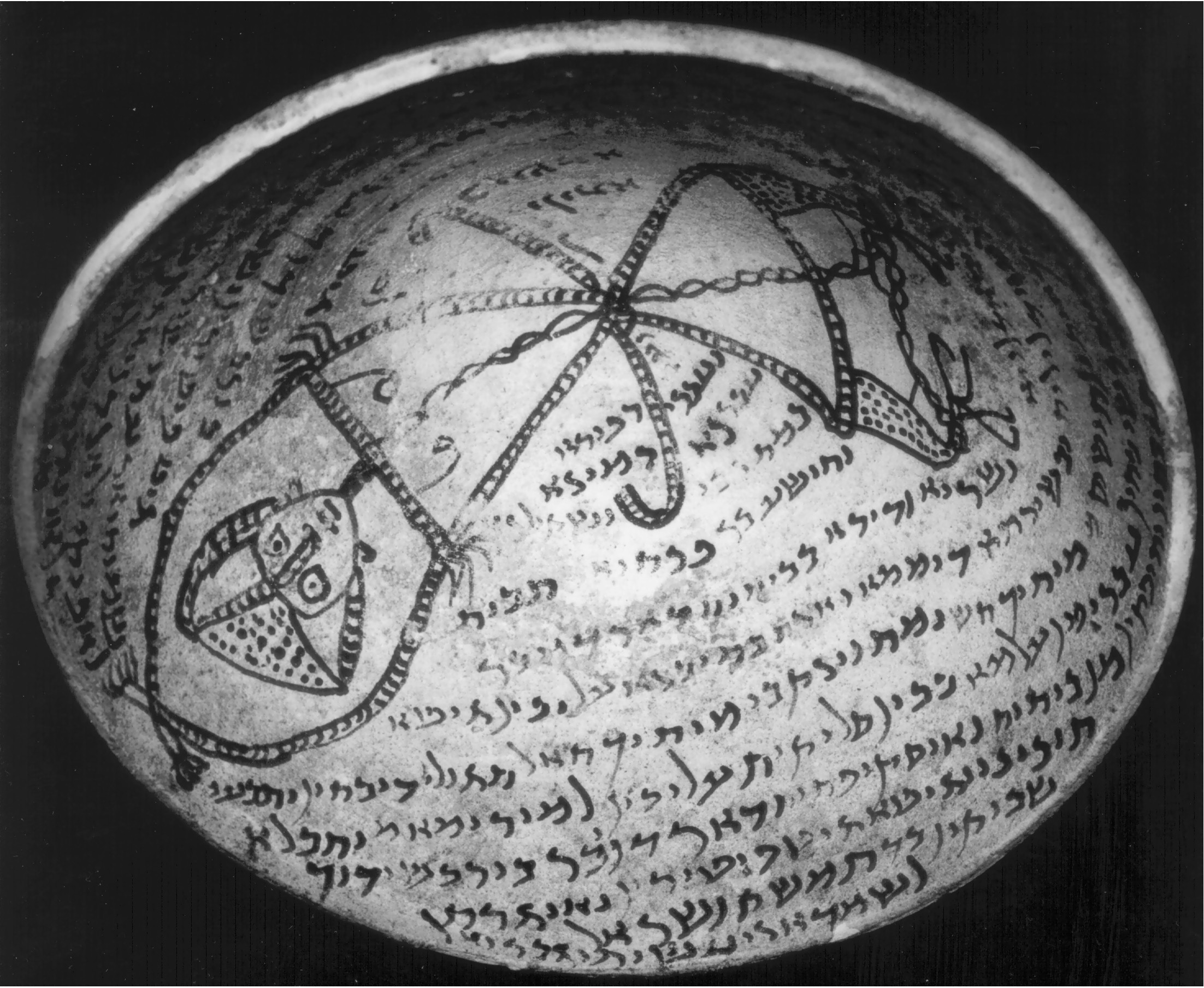
Last night, I gave a talk on "Women in early Jewish magic" at the Conservative Center in downtown Jerusalem. I talked about my research, with an emphasis on the figure of Em, the mother or foster-mother of Abaye, the fourth century Amora from Babylonia, who is knowledgeable about many matters of health and illness, and is also an expert on incantations and the use of amulets. I compared her with some of the women who are named in the Aramaic incantation bowls, looking at one bowl in particular, Bowl #17 in James Montgomery's Aramaic Incantation Texts (1913, available in full text online), where Komish bat Makhlafta exorcises the liliths from her household by means of divorce formulas known from the get, the Jewish divorce document. The point of the talk was to show how rabbis in the Talmud both blamed women for being involved in sorcery and were at the same time willing to learn from Em on healing and the use of amulets and incantations, and to compare her to a woman known from a non-rabbinic Babylonian text who uses rabbinic ritual formulas to rid her household from demons.

It turned out that at the same time I was giving the talk, Israel's television Channel One was broadcasting a television show where I appear, talking about Lilith!

Today, in the National Library, Professor David Weiss Halivni, whom I first met when had a postdoctoral fellowship at Columbia from 1996-1998, and who now lives in Israel and comes to the Judaica Reading Room of the National Library to do research, came up to me and said that he saw me on Israel television yesterday, just before the Channel One news. This was very surprising, to say the least.

It turned out that episode 9 of season 3 of the "Naked Archaeologist" (made by Simcha Jacobovici in 2010) was shown last night on Channel One. (A trailer for the episode is available on Youtube). It was called "Queen of the Night" and is about Lilith. I was interviewed for the show a few years ago, when I was in Jerusalem, talking about a variety of things, including the image of Lilith in the Alphabet of Ben Sira - as both a demon and as a rebellious woman whom some contemporary feminists take as a role model. I also talked about how Lilith is blamed for the death of children and for seducing men in their sleep.

The show interviews Dr. Dan Levene, who teaches at the University of Southampton and has written extensively about the Aramaic incantation bowls. The show (not Dr. Levene) claims that all the magic bowls were found at Nippur (which is not true, although later in the show Jacobovici says that all the bowls are from Babylon, which is true), and that after the Iraq War, hundreds of the bowls, looted from Iraq, made their way to the antiquities markets in Jerusalem (I don't know if this is true). Jacobovici is shown in an antiquities shop in the Old City looking at one bowl. It's not particularly visible on the screen. The owner of the shop says that of course it's authentic, but we have no way of knowing that.

At this point, Jacobovici says, "This is kabbalah!" and an image of the kabbalistic Tree of Life is shown on the screen. In fact, the Aramaic bowls have nothing to do with medieval kabbalah. Jacobovici then turns to the question of how the image of Lilith found its way into Christian art. He shows us a medieval carving somewhere in Europe depicting the creation scene, with Lilith coming out of the top of the Tree of Knowledge in between Adam and Eve; her top is a beautiful woman, while below she is a snake, wrapped around Adam and Eve. He finds the source of this image in the Gnostic texts from Nag Hammadi, by equating Lilith with Sophia in Gnostic mythology. As far as I know, there is no relation whatsoever between Lilith and Sophia!

In between the interviews there are lots of clips from what look like movies from the 1940s and 50s depicting vampy actresses (who I suppose are supposed to be Lilith), kitschy images of ghosts, and other irrelevant images that jazz the show up. Jacobovici does present some of the research on Lilith accurately, but the show is marred by the mistakes he makes and his attempts to create links where none exist. It's entertainment, not archaeology or scholarship.

If you'd like to see a photo of an incantation bowl, here's one that Dan Levene has published (I took the image from this site that he maintains: http://www.edshare.soton.ac.uk/5331/2/M59B.JPG):

This bowl is from Dan Levene, 2003, A Corpus of Magic Bowls: Incantation Texts in Jewish Aramaic from Late Antiquity, New York pp. 31-38

Sunday, June 30, 2013

Anti-Morsi demonstrations in Cairo tonight

Amazing pictures from Cairo tonight of the anti-Morsi demonstrations:
In front of the presidential palace
Evening prayer among the anti-Morsi demonstrators in Tahrir Square
The poster says: "The Brotherhood are Arab Zionists and American clients."

How do people convince themselves that the Muslim Brotherhood, which calls for the destruction of Israel, are Arab Zionists?! Or is this just a code - the word "Zionists" just means "total evil," so it's what you call your bitterest enemy?

Wednesday, June 26, 2013

DOMA is dead!

The Supreme Court just struck down the Defense of Marriage Act, passed in 1996 and signed by Bill Clinton.

From the New York Times:
The Supreme Court ruled Wednesday that a 1996 law denying federal benefits to legally married same-sex couples is unconstitutional, in a sign of how rapidly the national debate over gay rights has shifted. 
The decision was five to four, with Justice Anthony M. Kennedy writing the majority opinion, which the four liberal-leaning justices joined. (Read the decision.) 
“The federal statute is invalid, for no legitimate purpose overcomes the purpose and effect to disparage and injure those whom the State, by its marriage laws, sought to protect in personhood and dignity,” Justice Kennedy wrote. “By seeking to displace this protection and treating those persons as living in marriages less respected than others.
Chief Justice John G. Roberts was in the minority, as were Justices Antonin Scalia, Clarence Thomas and Samuel Alito. 
The ruling overturned the Defense of Marriage Act, which passed with bipartisan support and President Bill Clinton signed.

Tuesday, June 25, 2013

Ken Loach and the Jerusalem International Film Festival

When I was perusing the site of the Jerusalem International Film Festival, which is starting next Thursday (July 4) and ending on July 13, I noticed that a film by Ken Loach, the British director, will be screened: "The Spirit of '45." It will be shown twice, on July 11 at 4 pm and on July 12 at 8 pm. I was quite surprised to notice that his film will be screened at the festival, since he has signed on to the international boycott campaign against Israel. In 2006, he wrote, in a statement published on the Electronic Intifada website: 
I support the call by Palestinian film-makers, artists and others to boycott state sponsored Israeli cultural institutions and urge others to join their campaign. 
Palestinians are driven to call for this boycott after forty years of the occupation of their land, destruction of their homes and the kidnapping and murder of their civilians.
They have no immediate hope that this oppression will end. 
As British citizens we have to acknowledge our own responsibility. We must condemn the British and US governments for supporting and arming Israel. We must also oppose the terrorist activities of the British and US governments in pursuing their illegal wars and occupations. 
However, it is impossible to ignore the appeals of Palestinian comrades. 
Consequently, I would decline any invitation to the Haifa Film Festival or other such occasions. 
Best Wishes, 
Ken Loach
In 2009, he withdrew a film of his from the Melbourne international film festival, "following our discovery that the festival was part-sponsored by the Israeli state." He wrote (together with the producer and screenwriter of the film): "We feel duty bound to take advice from those living at the sharp end inside the occupied territories. We would also encourage other filmmakers and actors invited to festivals to check for Israeli state backing before attending, and if so, to respect the boycott. Israeli filmmakers are not the target. State involvement is."

I wonder if he is aware that his film is scheduled to be shown in a couple of weeks in the Jerusalem International Film Festival? The festival is certainly sponsored by the Israeli state, in the sense that it is partially state funded. One year when I went to the opening film, the surprise guest of honor was Shimon Peres, the president of Israel.

Or is it possible that he has changed his mind and decided that the BDS movement is a waste of energy and that it will never change Israeli policy? One can only hope.

Sunday, June 23, 2013

Trains, No Trains, and Trains Again - in Jerusalem

I'm staying in a neighborhood in Jerusalem called "Katamon" (the name is Arabic, but it comes from Greek, and means "below the monastery" - the monastery in question is on the hill at the top of a close neighborhood called San Simon). During the Ottoman period, in the late 19th century, the rail track was laid between Jaffa, on the coast, and Jerusalem, with the final station being on Emek Refaim St., and the line was officially inaugurated in September 1892. In 1920 the entire line was rebuilt by the British army. The last train on the line ran in 1998. When I was living in Israel from 1987-89, and then again in 1992-93, I used to hear the train pass by every day, and it was a comforting sound - I like hearing the train whistle. The train was re-opened in 2005, but the final stop in Jerusalem was no longer on Hebron Road, but in Malcha, in the southern part of the city.

So what to do with the old rail line? One proposal was to pave it over and create yet another big highway crossing through Jerusalem - something which would have divided a number of neighborhoods in half (the Katamonim, Baka, and the German Colony). The mayor of Jerusalem, Uri Lupolianski, was determined to build this highway, but he was turned out of office in 2008 by Nir Barakat, who agreed with neighborhood activists in the Katamonim that the rail line should be turned into a rail park. The rail park was finished earlier this year and it's a very nice place to take a walk, ride a bicycle, hang out with the kids, jog, and meet your neighbors from the surrounding neighborhoods.

A view from the Rail Trail looking south. I'm not sure what the hills in the distance are.
On the rail trail parallel to Emek Refaim.
Flowers along the path.
Jerusalem now has another train - the light rail, which was inaugurated in the fall of 2011. The route goes from Mt. Herzl in the western part of the city, to the center of the city on Jaffa Road, and all the way north to Shuafat, Beit Hanina, and Pisgat Zeev. Shuafat and Beit Hanina are Arab neighborhoods in the northeast and Pisgat Zeev is a Jewish neighborhood built since 1967 (actually, I've read that it's not entirely Jewish now, because east Jerusalem Palestinians have been moving in to some apartments there). The light rail crosses over the Green Line - the ceasefire lines from the 1948 war that determined the border between Israeli-controlled west Jerusalem and Jordanian-controlled east Jerusalem for 19 years. I haven't been all the way on the light rail but a few days ago I took it from Givat ha-Mivtar, not far from the Hebrew University at Mt. Scopus, to the big intersection of Jaffa St. and King George St. The next two photos are of people on the light rail.


The next photo is of Jaffa Road with the light rail in the distance coming from the Old City.


The photo below is of the intersection of Jaffa Road and King George. Notice the graphical sign for the light rail on the pole above the traffic light.


King George Street is named for King George V, who was the British monarch in 1924 when the street was dedicated. Below is the dedicatory plaque.


Herbert Samuel was the first British High Commissioner for Palestine - he was Jewish; under him was Ronald Storrs, a Christian and British official, who among other things decreed that all buildings in Jerusalem should be faced with Jerusalem stone; and under him was the mayor, a Muslim, Ragheb El Nashashibi, from one of the old Jerusalem Palestinian families who had been officials under the Ottomans for a couple of a centuries (other families were the Dajanis, the Husseinis, and the Khalidis). This seeming portrait of interfaith and communal harmony was not true then and is certainly not true now, even though everyone takes the light rail through the city.

Thursday, June 20, 2013

Buddhists, Myanmar, Incitement to Murder, and Responsibility for one's own actions

There are times when I despair of the intelligence of human beings, even those who comment on New York Times articles! The article Extremism Rises Among Myanmar Buddhists Wary of Muslim Minority is about a Buddhist monk named Ashin Wirathu who gives wild, inciting speeches against the Muslims of Myanmar.
“You can be full of kindness and love, but you cannot sleep next to a mad dog,” Ashin Wirathu said, referring to Muslims. “I call them troublemakers, because they are troublemakers,” Ashin Wirathu told a reporter after his two-hour sermon. “I am proud to be called a radical Buddhist.”
In Myanmar in the last year, "images of rampaging Burmese Buddhists carrying swords and the vituperative sermons of monks like Ashin Wirathu have underlined the rise of extreme Buddhism in Myanmar — and revealed a darker side of the country’s greater freedoms after decades of military rule. Buddhist lynch mobs have killed more than 200 Muslims and forced more than 150,000 people, mostly Muslims, from their homes."
What began last year on the fringes of Burmese society has grown into a nationwide movement whose agenda now includes boycotts of Muslim-made goods. Its message is spreading through regular sermons across the country that draw thousands of people and through widely distributed DVDs of those talks. Buddhist monasteries associated with the movement are also opening community centers and a Sunday school program for 60,000 Buddhist children nationwide.

In [Ashin Wirathu's] recent sermon, he described the reported massacre of schoolchildren and other Muslim inhabitants in the central city of Meiktila in March, documented by a human rights group, as a show of strength.

“If we are weak,” he said, “our land will become Muslim.”

Buddhism would seem to have a secure place in Myanmar. Nine in 10 people are Buddhist, as are nearly all the top leaders in the business world, the government, the military and the police. Estimates of the Muslim minority range from 4 percent to 8 percent of Myanmar’s roughly 55 million people while the rest are mostly Christian or Hindu.....

Ashin Sanda Wara, the head of a monastic school in Yangon, says the monks in the country are divided nearly equally between moderates and extremists. He considers himself in the moderate camp. But as a measure of the deeply ingrained suspicions toward Muslims in the society, he said he was “afraid of Muslims because their population is increasing so rapidly.”

Ashin Wirathu has tapped into that anxiety, which some describe as the “demographic pressures” coming from neighboring Bangladesh. There is wide disdain in Myanmar for a group of about one million stateless Muslims, who call themselves Rohingya, some of whom migrated from Bangladesh. Clashes between the Rohingya and Buddhists last year in western Myanmar roiled the Buddhist community and appear to have played a role in later outbreaks of violence throughout the country. Ashin Wirathu said they served as his inspiration to spread his teachings.

The theme song to Ashin Wirathu’s movement speaks of people who “live in our land, drink our water, and are ungrateful to us.”

“We will build a fence with our bones if necessary,” runs the song’s refrain. Muslims are not explicitly mentioned in the song but Ashin Wirathu said the lyrics refer to them. Pamphlets handed out at his sermon demonizing Muslims said that “Myanmar is currently facing a most dangerous and fearful poison that is severe enough to eradicate all civilization.”.... 
Stickers with the movement’s logo are now ubiquitous nationwide on cars, motorcycles and shops. The movement has also begun a signature campaign calling for a ban on interfaith marriages, and pamphlets are distributed at sermons listing brands and shops to be avoided. 
When I read this story, I was struck by several similarities to events that in the past have led to genocide against ethnic groups who are defined as "other" and then dehumanized. Here we have a charismatic leader preaching against Muslims, calling them "mad dogs." He calls them "a most dangerous and fearful poison." He exaggerates the number of Muslims in the country, even though they are a small minority. He is leading a movement that calls for boycotts of Muslim-made goods and for banning interreligious marriages. He is rapidly creating schools and community centers that spread his message of hatred towards Muslims. Fortunately, he is not the only voice in Myanmar - there are people, including other leaders of Buddhist monks, who are speaking out against him. But the central government is not working very vigorously to suppress attacks against Muslims, and in many of these attacks, riot police stood and watched attacks upon Muslims.

When I read the comments to this story in the Times, I hoped for reasoned, rational discussion, condemnation of violence against innocent people, speculation on why this is happening now in Myanmar.

But no. Very few people in the comments to this article wrote rational, peaceful responses.

There were some Buddhists who wrote that this behavior is not supported by the teachings of the Buddha:
It is difficult at any time to talk about "true" Buddhism or what is and isn't Buddhist practice. As a Buddhist I have always been careful to not criticize other Buddhist groups, but, in this case, this is not Buddhist. I can only believe the Buddhists of Burma who are spreading hate have lost their way. There is nothing in Buddhism to justify what is occurring in Burma. Though we typically avoid labels of good and bad we must also call actions which are harmful as evil even if it is only a creation of the mind. Injustice and hate must not be tolerated even from supposed fellow Buddhists.
I understand the impulse behind a comment like this - those of us who find a particular religion spiritually uplifting and enriching, and who experience it as teaching us how to behave better towards other people, find it very difficult to imagine how people who also belong to our religion can engage in acts of violence and hatred in the name of that religion, which leads to us declaring certain people as "not Buddhist" or "not Jewish" or "not Muslim." I don't think we should say that, however, because it's an evasion of responsibility. As a Jew, can I honestly say that there is nothing in Judaism that could serve as a resource for people who wish to hate and murder? No, I cannot. Simply reading the book of Joshua shows that a devotion to the God of Israel can lead to killing the "other." Fortunately, the rabbis of the Talmud did not take the book of Joshua as an exemplar for how Jews should act in the future.

Then there were quite a few people who wrote that, somehow, the fact that Muslims in other countries are violent to non-Muslims, or oppress non-Muslims, justifies violence and murder against the Muslims who live in Myanmar. One of them wrote:
Hatred is a bad thing, clearly. But recent history and current events also show us that control of affairs by Muslims is to be avoided; there are simply too many extremists in those ranks, hostile to women, hostile to peace, hostile to what we know as basic civilized society. Therefore, I would agree that resisting Muslim influence in one's home affairs is understandable.
When challenged, this writer responded:
....I am AGAINST extremism and violence. But I am not against being hostile to a negative force. It is not politically correct to say this, perhaps, but there is something innately wrong and violent in the current make-up of the Islamic religion. Everyone knows this. There is a pure stream of goodness in every religion, but that stream is running pretty narrow in Islam right now, globally speaking.
She may think that she's against extremism and violence, but she's actually justifying it, when it is done against Muslims.

Another commenter wrote:
These Buddhists are treating their Muslim minority exactly the same way Muslims treat religious minorities everywhere they hold sway. Hardly surprising, and extremely difficult to get outraged about.
This is the argument that really gets to me. Does the oppression of non-Muslims in countries like Saudi Arabia (which does not allow the public expression of any religion except for Islam, which oppresses the Shi'ite minority, etc.) justify killing Muslims in an entirely different country who are not guilty of any of the things that the Saudis are doing? What happened to the idea that people should be held responsible for the things they themselves have done, not for things that other people who share one characteristic with them (in this case religion) have done? I'm sure that the people who write these comments would be outraged by the biblical command that someone who has committed a crime should be punished in the same way he or she has injured the other person (the lex talionis, or eye for an eye). But "eye for an eye" punishment at least has the virtue of punishing the person who committed the crime, and not other people who are related in some way to the offender.

Saturday, June 15, 2013

Jerusalem Light Festival

This is the time of the year when the city of Jerusalem puts on a plethora of public events. Just ending this week was the Jerusalem Light Festival - light installations installed throughout the Old City. On Thursday night I went to the festival with a friend and we saw some pretty interesting images.


This photo is of the beginning of one of the routes (which we didn't follow) - the Hebrew reads "The Ghosts' Quarter" (in imitation of the names of the quarters in the Old City - e.g., the Jewish Quarter, or the Armenian Quarter).


This was a display at the end of the road that runs through the Armenian Quarter.


This was a giant, lit-up, sculpture of a woman, close to Zion Gate.

The next few photos were of an installation on the inside of the wall surrounding the Old City, close to the parking lot in the Jewish Quarter. The letters are in Hebrew and Arabic, both spelling out the word "light" in their respective languages - or in Hebrew and nur in Arabic.


Sunday, June 02, 2013

I'm going to Israel!

I'm going to Israel on Tuesday, and will be there until August 5, working on finishing my book, Angels' Tongues and Witches' Curses: Jewish Women and Ritual Power in Late Antiquity. When I was in Israel last year I wrote most of it, and now I have to finish chapter 5 and write the introductory chapter. I'll be staying in Jerusalem and spending most of my work time in the National Library. If any of my academic readers will be in Israel for the summer, please look me up.