The FBI has put up on its website all of the Hate Crime Statistics reports since 1996. I took a look at all of them for the purpose of comparing the hate crimes reported against Jews and Muslims over that time period, and discovered that there is a big change in the number of crimes against Muslims in 2001 - which is no surprise. I assume that most of them were committed after the 9/11/01 attacks. The level of hate crimes against Muslims drops in subsequent years, but remains higher than the pre-2001 rate.
Because I can't figure out how to put a table into this posting, I'll give the statistics this way:
For the entire period of 1996-2006, the average number of crimes against persons (Jews) was 408, with the highest year being 2002 (485). The largest number by far of such crimes were intimidation, followed by simple assault and then aggravated assault.
For this same period, the average number of crimes against property (Jewish) was 684, with the highest being 775 in 1996. The largest number by far of such crimes were damage/destruction/vandalism.
For Muslims over the same period, I've broken it down into pre-2001 and post-2001 periods. Pre-2001, the average number of crimes against persons (Muslims) was 19. Against Muslim property it was 11.4.
Post-2001, the average number of crimes against persons (Muslims) was 153, with the highest year being 2001, with 389. Of those, 296 were intimidation, 27 were aggravated assault, and 66 were simple assault. Post 2001, the average number of crimes against property (Muslim) was 79, with the highest figure also being in 2001, with 155.
From a comparison of these statistics we can see that in all of these years, numbers of property crimes against Jews exceeded crimes against persons (Jews) by 63% to 37%. For Muslims pre-2001, the ratio was the opposite: property crime was 37%, crimes against persons was 63%. Post-2001 the ratio is almost the same: 66% against persons, 34% against property.
Thursday, November 29, 2007


Thursday, November 22, 2007
More on hate crime statistics
Arash Kamangir has some good questions on his blog about the latest FBI statistics. He pointed out that to make a true comparison between anti-Jewish and anti-Muslim hate crimes, we would have to scale the results by population.
Wikipedia provides a useful survey of population estimates for American Jews, ranging from about 6.4 to 7.4 million according to the latest surveys.
It is harder to figure out how many American Muslims there are. One estimate, which I found on the "Islam 101" website estimates that as of 1991 there were between 5 and 8 million Muslims in the U.S.
The Religious Tolerance website provides estimates from several surveys. The numbers range from about 1.6 million to 12 million. The first four estimates, which are based on survey research, range up to a high of 2 million - as of 2000/2001.
An interesting article by Jane I. Smith on the U.S. State Department website gives estimates of from 2 million to 7 million. Smith is a well-respected scholar of Islamic studies who teaches at Hartford Seminary in Hartford, Connecticut. She remarks:
When I originally wrote, I had the higher estimates of Muslim population in the U.S. in mind - about 6 million in fact - so I thought that the comparative figures for Jews and Muslims victimized by hate crimes were roughly proportional by population, thus meaning that Jews were victimized more by hate crimes than Muslims. However, if we compare the lower estimates of Jewish population (6.4 million) with the lower estimate of Muslim population (2 million), then we get a different picture, as Arash points out.
And the hate crime statistics are not the only way to measure prejudice. Another way is to measure whether people would vote for a person of a particular religion. In a 2006 poll done by Rasmussen Reports, 61% of likely voters said that they would not vote for a Muslim candidate. 43% said that they would not vote for a Mormon candidate. 60% said they would not vote for an atheist. Unfortunately, this poll didn't ask about Jewish candidates.
The latest ADL poll on anti-semitic attitudes shows that 15% of the American population holds strongly anti-semitic beliefs. A 1999 Gallup poll reported that only 6% would refuse to vote for a Jewish candidate for President.
Wikipedia provides a useful survey of population estimates for American Jews, ranging from about 6.4 to 7.4 million according to the latest surveys.
It is harder to figure out how many American Muslims there are. One estimate, which I found on the "Islam 101" website estimates that as of 1991 there were between 5 and 8 million Muslims in the U.S.
The Religious Tolerance website provides estimates from several surveys. The numbers range from about 1.6 million to 12 million. The first four estimates, which are based on survey research, range up to a high of 2 million - as of 2000/2001.
An interesting article by Jane I. Smith on the U.S. State Department website gives estimates of from 2 million to 7 million. Smith is a well-respected scholar of Islamic studies who teaches at Hartford Seminary in Hartford, Connecticut. She remarks:
It is very difficult to estimate the precise number of Muslims currently living in the United States. Muslims tend to put the number somewhat higher than non-Muslim scholars and demographers; the estimated figures range widely - from around two million in one study to as many as seven million. There are several reasons for the varying estimates. First, because the U.S. Constitution mandates a separation of church and state that is reflected in American law, U.S. Census Bureau survey forms do not ask recipients about their religion. Neither does the U.S. Immigration Service collect information on the religion of immigrants. Many mosques in the United States do not have formal membership policies, and they seldom keep accurate attendance figures. In the words of University of Chicago religion scholar Martin Marty, "Counting noses has come to depend on two sources. One source is poll-takers calling during the dinner hour to ask, `What is your religious preference?' The other source is religious leaders, on both the local and the national scene. People who respond to telephone interviewers may have all kinds of motives for declaring themselves as part of this or that group, or no group at all. And people who report on the size of their congregations, denominations, and cohorts also have a variety of motives." The end result is that there is no official count of Muslims in the United States nor is there a number that is commonly accepted by all who have studied the question.
When I originally wrote, I had the higher estimates of Muslim population in the U.S. in mind - about 6 million in fact - so I thought that the comparative figures for Jews and Muslims victimized by hate crimes were roughly proportional by population, thus meaning that Jews were victimized more by hate crimes than Muslims. However, if we compare the lower estimates of Jewish population (6.4 million) with the lower estimate of Muslim population (2 million), then we get a different picture, as Arash points out.
And the hate crime statistics are not the only way to measure prejudice. Another way is to measure whether people would vote for a person of a particular religion. In a 2006 poll done by Rasmussen Reports, 61% of likely voters said that they would not vote for a Muslim candidate. 43% said that they would not vote for a Mormon candidate. 60% said they would not vote for an atheist. Unfortunately, this poll didn't ask about Jewish candidates.
The latest ADL poll on anti-semitic attitudes shows that 15% of the American population holds strongly anti-semitic beliefs. A 1999 Gallup poll reported that only 6% would refuse to vote for a Jewish candidate for President.
Tuesday, November 20, 2007
2006 Hate Crime Statistics
The FBI has released the report on 2006 Hate Crime Statistics, and it is very interesting to examine those hate crimes based on the religious identity of the victim. Of the 9080 hate crimes, 1597 were motivated by religion, and of those 1027 were anti-Jewish (64% of crimes based on religion of victim; 11% of total hate crimes). 191 were anti-Muslim (11%; 2% of total hate crimes).
Specific crimes against persons:
aggravated assault
anti-Jewish: 22
anti-Muslim: 24
simple assault
anti-Jewish: 58
anti-Muslim: 30
intimidation
anti-Jewish: 244
anti-Muslim: 79
Specific crimes against property:
robbery
anti-Jewish: 1
anti-Muslim: 1
larceny-theft
anti-Jewish: 13
anti-Muslim: 0
destruction/damage/vandalism
anti-Jewish: 672
anti-Muslim: 51
Thus, in the most serious category of crimes against persons (aggravated assault), the number of anti-Jewish and anti-Muslim offenses is almost identical, but in all other categories, especially intimidation and destruction/damage/vandalism, the number of incidents directed against Jews is far larger. It strikes me that these figures belie the claim that Islamophobia is a much greater danger than anti-semitism in the United States. If that were true, it would mean that far more Muslims than Jews would be victims of hate crimes.
Of all groups in the American population, blacks are the group with the highest number of hate crimes against them: 3136 (34%), then whites (1008; 11%), then Jews (11%), then gay men (881; 10%), and then Hispanics (770; 8%). From these statistics, we can see that the hatreds rampant in the United States are really the old tried and true ones - anti-black racism, anti-semitism, homophobia, and anti-immigrant sentiments.
Update:
I was just looking again at the FBI statistics - they are by no means complete, because some cities and states have no reporting of hate crimes. Look, for example, at the state of Alabama. There is only one hate crime reported for the entire state for 2006. For comparison, compare the reporting for New Jersey: a total of 759 hate crimes. There are no statistics whatsoever for Mississippi, for another example. According to the FBI website, however, the agencies reporting on hate crimes in their jurisdictions represent 85% of the U.S. population (255 million people).
Specific crimes against persons:
aggravated assault
anti-Jewish: 22
anti-Muslim: 24
simple assault
anti-Jewish: 58
anti-Muslim: 30
intimidation
anti-Jewish: 244
anti-Muslim: 79
Specific crimes against property:
robbery
anti-Jewish: 1
anti-Muslim: 1
larceny-theft
anti-Jewish: 13
anti-Muslim: 0
destruction/damage/vandalism
anti-Jewish: 672
anti-Muslim: 51
Thus, in the most serious category of crimes against persons (aggravated assault), the number of anti-Jewish and anti-Muslim offenses is almost identical, but in all other categories, especially intimidation and destruction/damage/vandalism, the number of incidents directed against Jews is far larger. It strikes me that these figures belie the claim that Islamophobia is a much greater danger than anti-semitism in the United States. If that were true, it would mean that far more Muslims than Jews would be victims of hate crimes.
Of all groups in the American population, blacks are the group with the highest number of hate crimes against them: 3136 (34%), then whites (1008; 11%), then Jews (11%), then gay men (881; 10%), and then Hispanics (770; 8%). From these statistics, we can see that the hatreds rampant in the United States are really the old tried and true ones - anti-black racism, anti-semitism, homophobia, and anti-immigrant sentiments.
Update:
I was just looking again at the FBI statistics - they are by no means complete, because some cities and states have no reporting of hate crimes. Look, for example, at the state of Alabama. There is only one hate crime reported for the entire state for 2006. For comparison, compare the reporting for New Jersey: a total of 759 hate crimes. There are no statistics whatsoever for Mississippi, for another example. According to the FBI website, however, the agencies reporting on hate crimes in their jurisdictions represent 85% of the U.S. population (255 million people).
Sunday, November 18, 2007
Jerusalem on Google Earth
Some more Google Earth images. The first one is of the neighborhood I've lived in Jerusalem - Emek Refaim. The second is of the Old City - you can see the Temple Mount and the Dome of the Rock on the right hand side of the photo.


Google Earth image - Liepaja
I was using Google Earth yesterday and found the city of Liepaja, Latvia - I was trying to find the street (Barena iela) that my grandfather's uncle and aunt had lived on before the Nazi invasion in 1941. I wasn't able to find it - perhaps it's too small a street to be marked on the map yet - but I did wander around Liepaja (virtually). And then today I discovered that it's possible to save a JPEG of Google Earth images. I've got a shot of a residential area of Liepaja from the air.

North of the city, along the sea, is a memorial to the Jews murdered at the Skede dunes in December of 1941 (likely including my grandfather's aunt). This is is the location of the dunes.

And go to this photo to see picture of the memorial itself.
Rita Bogdanova has written a moving memoir of her return to Liepaja after so many years. It includes a photo of the Skede dunes.
Brian Friedman wrote an account of what happened at the killing fields of Skede (warning - graphic photographs) as well as about his visit to Liepaja and attendance at the dedication of the Skede memorial in 2005. He also has more pictures of the dunes and of the memorial itself.

North of the city, along the sea, is a memorial to the Jews murdered at the Skede dunes in December of 1941 (likely including my grandfather's aunt). This is is the location of the dunes.

And go to this photo to see picture of the memorial itself.
Rita Bogdanova has written a moving memoir of her return to Liepaja after so many years. It includes a photo of the Skede dunes.
Brian Friedman wrote an account of what happened at the killing fields of Skede (warning - graphic photographs) as well as about his visit to Liepaja and attendance at the dedication of the Skede memorial in 2005. He also has more pictures of the dunes and of the memorial itself.
Wednesday, November 07, 2007
House Approves Ban on Anti-Gay Discrimination
When I was at the gym earlier today I was watching CNN and they were reporting something about the House bill to ban anti-gay discrimination in employment - but I didn't realize that the House had passed the bill today, 235-184. It now goes to the Senate, where it will also hopefully pass.
House Approves Ban on Anti-Gay Discrimination - New York Times: "The House approved a bill this evening granting broad protections against discrimination in the workplace for gay men, lesbians and bisexuals, a measure that supporters praised as the most important civil rights legislation since the adoption of the Americans with Disabilities Act in 1990 but that opponents said would result in unnecessary lawsuits."
Pretty amazing. I remember in the mid-1970s that when the first open lesbian, Elaine Noble, was elected to the Massachusetts House of Representatives, she received a great deal of abuse on the floor of the House from other representatives. Noble said in a recent interview that once she was elected, "It really got harder in terms of the threats and being a target that was readily available to people." It is quite astonishing how far we have come in thirty years.
House Approves Ban on Anti-Gay Discrimination - New York Times: "The House approved a bill this evening granting broad protections against discrimination in the workplace for gay men, lesbians and bisexuals, a measure that supporters praised as the most important civil rights legislation since the adoption of the Americans with Disabilities Act in 1990 but that opponents said would result in unnecessary lawsuits."
Pretty amazing. I remember in the mid-1970s that when the first open lesbian, Elaine Noble, was elected to the Massachusetts House of Representatives, she received a great deal of abuse on the floor of the House from other representatives. Noble said in a recent interview that once she was elected, "It really got harder in terms of the threats and being a target that was readily available to people." It is quite astonishing how far we have come in thirty years.
Reply to McGowan
The The Ithaca Journal just published my letter in reply to McGowan, I'm happy to say.
Those who call themselves “Holocaust revisionists” do not make use of the accepted canons of historical research and analysis — they distort physical evidence (for example, by claiming that the gas chambers at Auschwitz were not used for the murder of human beings) and misuse documentary evidence (for example, by misquoting sources or using partial quotations of German documents that refer to the mass murders of Jews). It is thus very appropriate to call them deniers and not mere “revisionists.”It's satisfying to see my response to his nonsense in print.
“Revisionist conclusions are despised” not because they contradict the “Holocaust story” but because they are false and tendentious misreadings of history. Those who engage in such “revisionism” are motivated by virulent anti-semitism, as one can tell by inspecting the Web sites of Holocaust deniers such as Ernst Zundel or the Committee for Open Debate on the Holocaust. Hidden behind the letter's anti-Israel claims is a typical anti-semitic contention — that unchecked Jewish power forced the U.S. to invade Iraq. This letter deserves to be dismissed by the intelligent readers of The Ithaca Journal.
Sunday, October 28, 2007
On the Contrary
Another posting by Daniel McGowan makes his Holocaust denial more apparent. He says:
When Elie Wiesel took Oprah Winfrey to Auschwitz, the choreography was perfect. Jewish suffering was paramount; remember the six million, the gas chambers, the Zyklon B, the death marches, and "Arbeit Macht Frei."Wiesel *chose* to leave Auschwitz with the Nazis?! Wiesel (and his father) were forced by the SS guards on the death march to Germany. No prisoner in Auschwitz had a "choice" about where to go as long as the Nazi guards were in control.
Ignore the facts that none of Wiesel's family was gassed, that 50 million non-Jews were killed, that Wiesel chose to leave Auschwitz with the Nazis rather than be liberated by the Russians as was Anne Frank's father. And certainly ignore the ethnic cleansing and murder of perhaps two million Germans, mostly civilians, after the war.
Saturday, October 27, 2007
Who is Ernst Zundel?
For more information on Zundel, the Canadian court judgement against him is very useful. It is available at Court Judgement. Zundel has been a Holocaust denier for several decades and was deported from Canada based on his intimate connections with violent anti-semites and racists.
Some excerpts from the judgement:
Zundel is the type of man that McGowan is proud to be associated with - and contrary to his assertions that Zundel is a pacifist and has no malicious goals, it is clear that he is motivated by virulent anti-semitism and has done his best through decades of action to propagate the anti-semitic and racist Nazi message.
Some excerpts from the judgement:
ANALYSIS
[23] Pursuant to the Security Intelligence Report of which Mr. Zündel was provided a summary, White Supremacists are defined as racists, neo-Nazis and anti-Semites who use violence to achieve their political objectives. Leading White Supremacists may inspire others to use or threaten use of violence. Mr. Zündel is viewed by White Supremacists as a leader of international significance and was viewed as the patriarch of the Movement in Canada for decades. Mr. Zündel is one of the world's most prominent distributors of revisionist neo-Nazi propaganda through the use of facsimiles, courier, telephone, mail, media, shortwave radio transmissions, satellite videos and the Internet, through his website the Zundelsite, which is a platform for financing and contains White Supremacist documents as well as hyperlinks to other White Supremacist websites. The Security Intelligence Report concludes that based on the evidence that has been provided, Mr. Zündel is playing a critical role in the Movement, both in Canada and internationally.
[24] Documents issued by Mr. Zündel over the years show his intention to destabilize the legal and legitimate democratic government of Germany. The evidence also demonstrates a clear determination to disseminate copious amounts of documentation and information from Canada to Germany, using Canadian soil to advance his goal of undermining the German government.
[25] Furthermore, the Ministers have provided public and in camera evidence that Mr. Zündel has extensive involvement with contacts within the violent, racist, right wing movement. These contacts encompass individuals and organizations in Canada and abroad.
[26] Mr. Zündel has always supported the ideology of the White Supremacist Movement, one which is based on the fundamental belief that the white race is an endangered species in need of protection as a result of non-Whites and Jews seeking to attack the foundation of western civilization. Blacks in particular are seen as intellectually inferior, while Jews are viewed as conspiring to gain control of the world through manipulation of financial markets, the spread of communism, pornography and general moral degeneracy. The government is viewed with suspicion as it is seen to be controlled by a Jewish conspiracy referred to as zionist occupation government (ZOG). These fundamental beliefs lead to antisemitic, racist, anti-immigration, anti-democratic, anti-human rights and anti-homosexual attitudes.
[27] The Nazi Party under Adolf Hitler in Germany in the 1930s and 1940s is notoriously well known; what is less known, is the Canadian version which was developed over the 1940s and the 1950s under Adrien Arcand, who promoted Hitler as a saviour of Christianity and formed the Parti national social chrétien in the 1930s. That party then merged with the Canadian Nationalist Party from the West to form the National Unity Party. Later in the 1960s, the Canadian Nazi Party became the National Socialist Party and Mr. Zündel explained how he was influenced by Mr. Arcand himself whom he met when he arrived in Canada in the 1950s. At the conclusion of World War II, the enthusiasm of those Nazi parties around the world was greatly reduced; nevertheless, there still remained some desire to support this neo-Nazi approach. Mr. Zündel is among the few people that worked hard to maintain that support and who went to great lengths to try and establish some credibility to the neo-Nazi movement. He also tried by all means possible to develop and maintain a global network of all groups that have an interest in the same right wing extremist neo-Nazi mind-set.
Zundel is the type of man that McGowan is proud to be associated with - and contrary to his assertions that Zundel is a pacifist and has no malicious goals, it is clear that he is motivated by virulent anti-semitism and has done his best through decades of action to propagate the anti-semitic and racist Nazi message.
Daniel McGowan - Holocaust Denial
In today's Ithaca Journal, probably in response to Lipstadt's talk, Daniel McGowan, emeritus professor of economics at Hobart and William Smith College in Geneva, New York, had a letter published putting forth the classic arguments of Holocaust deniers - that the "Final Solution" was not extermination, that there were no gas chambers used by the Nazis, and that fewer than 6 million Jews were killed. He argues these points as part of his attack on the state of Israel: "The Holocaust narrative makes Jews the ultimate victim no matter how they dehumanize or ethnically cleanse the Palestinian people." He also claims that the "Holocaust narrative of industrialized extermination has been an important tool to drive the United States into Iraq and now into Iran." I'm not going to argue against his pseudo-historical claims, because I agree with Lipstadt that there is no point in arguing about the Holocaust with deniers.
Instead, I'd like to point out some of McGowan's other writings, available on the internet, which make clear how he has become enmeshed in the Holocaust denial movement.
1. "What does Holocaust denial really mean?" - Denial. This letter is posted on the "Zundelsite" - dedicated to the defense of Ernst Zündel, who is currently in prison in Germany for Holocaust denial. This letter is more explicit than the one published in the Ithaca Journal. Among other things, he says, "Is it really 'beyond international discourse' to question the efficacy and the forensic evidence of homicidal gas chambers? If other myths, like making soap from human fat, have been dismissed as Allied war propaganda, why is it 'unacceptable behavior' to ask if the gas chamber at Dachau was not reconstructed by the Americans because no other homicidal gas chamber could be found and used as evidence at the Nuremburg trials?"
2. Similar letter published on the website of CODOH ("Committee for Open Debate on the Holocaust") - Denial. CODOH says that the Holocaust must be "debated," meaning that the usual canons of historical research must be abandoned for the pseudo-scientific arguments put forth by deniers. In this letter McGowan writes: "Are these revisionist contentions so odious as to cause those who believe them to be reviled, beaten, and imprisoned? More importantly, is it possible that revisionist contentions are true, or even partially true, and that they are despised because they contradict the story of the Holocaust, a story which has been elevated to the level of a religion in hundreds of films, memorials, museums, and docudramas?"
3. The same letter appears under the title European Union to Penalize Holocaust Deniers.
4. A Visit in Prison with Ernst Zuendel. In December of 2006, McGowan visited Zundel in prison in Germany. This is his account of the visit.
More on Zundel - Zundel deported to Germany and Zundel sentenced to five years in prison in Germany.
Instead, I'd like to point out some of McGowan's other writings, available on the internet, which make clear how he has become enmeshed in the Holocaust denial movement.
1. "What does Holocaust denial really mean?" - Denial. This letter is posted on the "Zundelsite" - dedicated to the defense of Ernst Zündel, who is currently in prison in Germany for Holocaust denial. This letter is more explicit than the one published in the Ithaca Journal. Among other things, he says, "Is it really 'beyond international discourse' to question the efficacy and the forensic evidence of homicidal gas chambers? If other myths, like making soap from human fat, have been dismissed as Allied war propaganda, why is it 'unacceptable behavior' to ask if the gas chamber at Dachau was not reconstructed by the Americans because no other homicidal gas chamber could be found and used as evidence at the Nuremburg trials?"
2. Similar letter published on the website of CODOH ("Committee for Open Debate on the Holocaust") - Denial. CODOH says that the Holocaust must be "debated," meaning that the usual canons of historical research must be abandoned for the pseudo-scientific arguments put forth by deniers. In this letter McGowan writes: "Are these revisionist contentions so odious as to cause those who believe them to be reviled, beaten, and imprisoned? More importantly, is it possible that revisionist contentions are true, or even partially true, and that they are despised because they contradict the story of the Holocaust, a story which has been elevated to the level of a religion in hundreds of films, memorials, museums, and docudramas?"
3. The same letter appears under the title European Union to Penalize Holocaust Deniers.
4. A Visit in Prison with Ernst Zuendel. In December of 2006, McGowan visited Zundel in prison in Germany. This is his account of the visit.
More on Zundel - Zundel deported to Germany and Zundel sentenced to five years in prison in Germany.
Lipstadt's talk
Professor Lipstadt's talk on Thursday night was excellent and very well-attended. Many students and community members came to hear her clear and cogent account of her libel trial in England, when David Irving, a notorious Holocaust denier, sued her for libel for calling him a Holocaust denier. One of the most interesting parts of her presentation was the description of the strategy that she and her legal team devised to counter Irving. They decided that since the Holocaust is a well-known and documented historical event, they did not need to prove that it occurred in order to defeat Irving. Instead, they decided to demonstrate how Irving misused evidence, misquoted sources, invented incidents, and engaged in other techniques to distort history. Scholars went through Irving's books exhaustively and checked all of his footnotes, which revealed that he systematically distorted his sources in order to support his own conclusions. His aim was to prove that Hitler knew nothing of the Holocaust and in fact tried to prevent it - something which all reputable historians know is utter nonsense. The judge in the case decided for Lipstadt based on this argument.
She also spoke of the emotional burden the case imposed on her. Many survivors of the Holocaust and their children saw her as their standard-bearer for the truth, and she felt even more responsible because of this to win the case on their behalf. Her talk was moving and I am glad that we were able to bring her to Ithaca College.
She also spoke of the emotional burden the case imposed on her. Many survivors of the Holocaust and their children saw her as their standard-bearer for the truth, and she felt even more responsible because of this to win the case on their behalf. Her talk was moving and I am glad that we were able to bring her to Ithaca College.
Tuesday, October 23, 2007
Deborah Lipstadt in Ithaca
Dr. Deborah Lipstadt will be speaking on Thursday evening at Ithaca College on "Holocaust Denial: A New Form of Anti-Semitism." She'll be speaking at 7:15 p.m. in the Klingenstein Lounge. The Jewish Studies Program is bringing her and we're really looking forward to her visit.
Saturday, October 13, 2007
"Political Correctness"
A great op-ed by Doris Lessing, in today's New York Times is a great antidote to another op-ed earlier in the week by Slavoj Zizek on Tibet and China. Some particularly juicy paragraphs from Lessing:
To return to Zizek's op-ed - it strikes me an attempt at a sophisticated defense of the Chinese government's policy to suppress Tibetan culture. (I don't think it's actually sophisticated because his purpose comes out pretty clearly). He uses a common rhetorical technique - since Western countries did it before, it must not be so bad, and in any case, since we are also guilty, we have no basis to criticize non-Westerners for doing something that we currently find repugnant.
His second rhetorical device involves smearing the subject of his polemic - Tibetan Buddhism. He says:
Then there is the matter of what the present Dalai Lama has to say about democracy. On his official website, there is a quotation from a recent speech:
A successor to “commitment” is “raising consciousness.” This is double-edged. The people whose consciousness is being raised may be given information they most desperately lack and need, may be given moral support they need. But the process nearly always means that the pupil gets only the propaganda the instructor approves of. “Raising consciousness,” like “commitment,” like “political correctness,” is a continuation of that old bully, the party line.As an undergraduate at UC Santa Cruz in the late 1970s, I was surfeited with the type of political correctness she calls "raising consciousness" - in several course in the sociology and women's studies departments I took courses that were designed to indoctrinate the students in the instructor's New Left political beliefs - rather than in teaching us how to think critically about the topics of the courses. As a professor now I try to avoid indoctrinating my students. I'm sure that I don't always succeed, but I think it's much more important to teach students critical thinking skills, how to examine evidence, primary documents, and make good arguments.
A very common way of thinking in literary criticism is not seen as a consequence of Communism, but it is. Every writer has the experience of being told that a novel, a story, is “about” something or other. I wrote a story, “The Fifth Child,” which was at once pigeonholed as being about the Palestinian problem, genetic research, feminism, anti-Semitism and so on.....
A professor friend describes how when students kept walking out of classes on genetics and boycotting visiting lecturers whose points of view did not coincide with their ideology, he invited them to his study for discussion and for viewing a video of the actual facts. Half a dozen youngsters in their uniform of jeans and T-shirts filed in, sat down, kept silent while he reasoned with them, kept their eyes down while he ran the video and then, as one person, marched out. A demonstration — they might very well have been shocked to hear — which was a mirror of Communist behavior, an acting out, a visual representation of the closed minds of young Communist activists.
To return to Zizek's op-ed - it strikes me an attempt at a sophisticated defense of the Chinese government's policy to suppress Tibetan culture. (I don't think it's actually sophisticated because his purpose comes out pretty clearly). He uses a common rhetorical technique - since Western countries did it before, it must not be so bad, and in any case, since we are also guilty, we have no basis to criticize non-Westerners for doing something that we currently find repugnant.
Before we explode in rage that Chinese Communist totalitarianism now wants to control even the lives of its subjects after their deaths, we should remember that such measures are not unknown to European history. The Peace of Augsburg in 1555, the first step toward the Peace of Westphalia in 1648 that ended the Thirty Years’ War, declared the local prince’s religion to be the official faith of a region or country (“cuius regio, eius religio”). The goal was to end violence between German Catholics and Lutherans, but it also meant that when a new ruler of a different religion took power, large groups had to convert. Thus the first big institutional move toward religious tolerance in modern Europe involved a paradox of the same type as that of Order No. 5: your religious belief, a matter of your innermost spiritual experience, is regulated by the whims of your secular leader.Therefore, it's not so bad that the Chinese have a systematic policy to destroy Tibetan Buddhist culture and religion - it's no worse than what happened between Catholics and Protestants, and since that was so successful in Europe, it probably won't be so bad in Tibet. This, of course, completely ignores the historical context, in which Tibet was militarily conquered by China, leading to the deaths of thousands of Tibetans, the closing of the monestaries, etc.
His second rhetorical device involves smearing the subject of his polemic - Tibetan Buddhism. He says:
In the same vein, the problem with Tibetan Buddhism resides in an obvious fact that many Western enthusiasts conveniently forget: the traditional political structure of Tibet is theocracy, with the Dalai Lama at the center. He unites religious and secular power — so when we are talking about the reincarnation of the Dalai Lama, we are taking about choosing a head of state. It is strange to hear self-described democracy advocates who denounce Chinese persecution of followers of the Dalai Lama — a non-democratically elected leader if there ever was one.So that means that one can only denounce persecution of other people if they are already perfect? So then, to take another example, it's okay for the Egyptian government to torture members of the Muslim Brotherhood whom it has imprisoned because after all they also represent a theocratic political movement? It seems to me that regardless of one's own beliefs, it's still wrong to invade a country and suppress its religious culture. Zizek was opposed to the U.S. invasion of Iraq on the same anti-imperialist grounds - but does anti-imperialism only matter when the empire is western?
Then there is the matter of what the present Dalai Lama has to say about democracy. On his official website, there is a quotation from a recent speech:
Madrid, Spain, 9 September 2007 (AP) - The Dalai Lama, the exiled spiritual leader of Tibetan Buddhists, defended democracy as a means of decision-making for his native Tibet at a press conference Sunday in the Spanish city of Barcelona. The exiled leader, who is in Spain to open a new Tibet House Foundation headquarters, said it was up to the Spanish people to resolve their own regional issues.In an article from 1993 on the same website, lays out plans for a democratic Tibet:
"I think that is up to you, no?" the Dalai Lama said when asked how Spanish regions could best achieve self-determination. "Democracy allows for freedom of expression and for the free election of parties," he said. He also said his own fate was up to the people of Tibet. "The future of the Dalai Lama will depend on what the people of Tibet want," he said.
I have long looked forward to the time when we could devise a political system, suited both to our traditions and to the demands of the modern world. A democracy that has nonviolence and peace at its roots. We have recently embarked on changes that will further democratize and strengthen our administration in exile. For many reasons, I have decided that I will not be the head of, or play any role in the government when Tibet becomes independent. The future head of the Tibetan Government must be someone popularly elected by the people. There are many advantages to such a step and it will enable us to become a true and complete democracy. I hope that these moves will allow the people of Tibet to have a clear say in determining the future of their country.Since this article was written almost fifteen years ago, it seems to me that if Zizek really wanted to know what the Dalai Lama and Tibetans in exile thought about democracy, he could have found out as easily as I just did - by Googling "Dalai Lama" and "democracy." Or perhaps he could actually have done some research into the history of Tibet, the Dalai Lama, and the development of the Tibetan exile community. But instead, it was much easier simply to use simple rhetorical technques that are designed to stop his readers' actually thinking about the subject he has raised.
Thursday, October 11, 2007
Ann Coulter - Jews need to be perfected
What I don't understand about Ann Coulter is in what way is she actually a Christian? She claims to be a Christian, and says that Jews (and presumably everyone else) should convert to Christianity - but what does she think Christianity is? I don't see any way in which she is following the example of Jesus. When I open up the New Testament, the emphasis I see in the teachings of Jesus is love of neighbor, the principle of non-retaliation, concern for the poor and the weak - not at all the agenda that Coulter is pushing.
That aside, her comments are interesting because they echo the message of Jews for Jesus and other Messianic Jewish groups that converting to Christianity does not mean one is leaving Judaism, but has become a "completed Jew."
It's also interesting that she says "we think Jews go to heaven," when people Falwell specifically denied that Jews (or any other non-Christian) would go to heaven.
That aside, her comments are interesting because they echo the message of Jews for Jesus and other Messianic Jewish groups that converting to Christianity does not mean one is leaving Judaism, but has become a "completed Jew."
No, we think - we just want Jews to be perfected, as they say....
Yes. That is what Christianity is. We believe the Old Testament, but ours is more like Federal Express. You have to obey laws. We know we're all sinners - but that is what Christians consider themselves: perfected Jews. We believe the Old Testament. As you know from the Old Testament, God was constantly getting fed up with humans for not being able to, you know, live up to all the laws. What Christians believe - this is just a statement of what the New Testament is - is that that's why Christ came and died for our sins. Christians believe the Old Testament. You don't believe our testament....
This is what Christians consider themselves, because our testament is the continuation of your testament. You know that. So we think Jews go to heaven. I mean, [Rev. Jerry] Falwell himself said that, but you have to follow laws. Ours is "Christ died for our sins." We consider ourselves perfected Christians. For me to say that for you to become a Christian is to become a perfected Christian is not offensive at all.
It's also interesting that she says "we think Jews go to heaven," when people Falwell specifically denied that Jews (or any other non-Christian) would go to heaven.
Saturday, October 06, 2007
More on "Talmudic Discussion"
The Jewish Week provides the context for McCain's remark about "Talmudic Discussion":
Jewish Democrats, however, blasted McCain for his original comments on Beliefnet and for a subsequent clarification, reported by the Associated Press. In the latter statement he said "All I can say is that maybe I should have kept my comments to the fact that I'm a practicing Christian, I respect all religions and beliefs, and that I support the principles, the values of the Founding Fathers. Perhaps I should have couched my remarks to that rather than getting into, as I say, a Talmudic discussion."I still wonder why McCain chose that particular expression - a Freudian slip, perhaps?
Mandaeans in Iraq
Today's New York Times has another chilling story - this time an op-ed piece by Nathaniel Deutch, of Swarthmore College, about the Mandaeans of Iraq. He begins by saying:
Of the 60,000 Mandaeans who were in Iraq in 2003, before the U.S. invasion, only 5,000 remain - the rest have fled to neighboring countries. Their homeland is in the marshes of southern Iraq, and they have no other place where they can find refuge. Deutch calls for the U.S. to take in all of the Mandaeans, so that their unique and ancient culture can be saved. Mandaean refugees in other Middle Eastern countries have been converting to Islam or Christianity so that they can get help.
April DeConick, of Rice University, has written in her blog about the dangers the Mandaeans are suffering in Iraq, and also has useful suggestions for letters that can be sent to Congress about them - Information about Mandaeans.
THE United States didn’t set out to eradicate the Mandeans, one of the oldest, smallest and least understood of the many minorities in Iraq. This extinction in the making has simply been another unfortunate and entirely unintended consequence of our invasion of Iraq — though that will be of little comfort to the Mandeans, whose 2,000-year-old culture is in grave danger of disappearing from the face of the earth.
The Mandeans are the only surviving Gnostics from antiquity, cousins of the people who produced the Nag Hammadi writings like the Gospel of Thomas, a work that sheds invaluable light on the many ways in which Jesus was perceived in the early Christian period. The Mandeans have their own language (Mandaic, a form of Aramaic close to the dialect of the Babylonian Talmud), an impressive body of literature, and a treasury of cultural and religious traditions amassed over two millennia of living in the southern marshes of present-day Iraq and Iran.
Of the 60,000 Mandaeans who were in Iraq in 2003, before the U.S. invasion, only 5,000 remain - the rest have fled to neighboring countries. Their homeland is in the marshes of southern Iraq, and they have no other place where they can find refuge. Deutch calls for the U.S. to take in all of the Mandaeans, so that their unique and ancient culture can be saved. Mandaean refugees in other Middle Eastern countries have been converting to Islam or Christianity so that they can get help.
April DeConick, of Rice University, has written in her blog about the dangers the Mandaeans are suffering in Iraq, and also has useful suggestions for letters that can be sent to Congress about them - Information about Mandaeans.
Holocaust in Ukraine
Fr. Patrick Desbois, a Catholic priest has been documenting the Holocaust in Ukraine by interviewing people who were only children or teenagers at the time who witnessed the mass shootings that killed almost 1.5 million Jews.
In the New York Times story, there is a slideshow of photographs, showing Fr. Desbois, some of the people he has interviewed, and the sites of the mass graves, including some that have been opened, where it is possible to see skeletons lying at the bottom of the grave.
It is a quietly chilling story. For more information, go to Witness to Genocide.
Over four years, Father Desbois has videotaped more than 700 interviews with witnesses and bystanders and has identified more than 600 common graves of Jews, most of them previously unknown. He also has gathered material evidence of the execution of Jews from 1941 to 1944, the “Holocaust of bullets” as it is called.
In the New York Times story, there is a slideshow of photographs, showing Fr. Desbois, some of the people he has interviewed, and the sites of the mass graves, including some that have been opened, where it is possible to see skeletons lying at the bottom of the grave.
It is a quietly chilling story. For more information, go to Witness to Genocide.
Tuesday, October 02, 2007
More on "G-d"
Carla Sulzbach, one of my correspondents, sent me many useful links on the topic of why people use "G-d" instead of "God." One of them is a scholarly explanation for why Jews use this circumlocution (and others, like "Hashem" or "Adonai") - an article by B. Barry Levy in the Edah Journal - Fixing God's Name.
She also sent me a couple of references that might explain why some Christian students use "G-d," which point to an origin among messianic Jewish congregations. The two links she sent are from blogs written by people who heartily disapprove of this practice - Philip Johnson and Dan Phillips. These are written by two conservative Christians who think that it's silly, and perhaps even sinful, for Christians not to spell the word with all its letters in English. If you're curious about the theological reasons, read their posts and the comments that are attached to them.
She also sent me a couple of references that might explain why some Christian students use "G-d," which point to an origin among messianic Jewish congregations. The two links she sent are from blogs written by people who heartily disapprove of this practice - Philip Johnson and Dan Phillips. These are written by two conservative Christians who think that it's silly, and perhaps even sinful, for Christians not to spell the word with all its letters in English. If you're curious about the theological reasons, read their posts and the comments that are attached to them.
Monday, October 01, 2007
"It's almost Talmudic"
Jews and Muslims criticized McCain's remarks on the U.S. as a "Christian nation."
The American Jewish Committee has criticized McCain for his remarks: "'To argue that America is a Christian nation, or that persons of a particular faith should by reason of their faith not seek high office, puts the very character of our country at stake,' Jeffrey Sinensky, the group's general counsel, said Monday in a statement."
But Joe Lieberman came out in defense of McCain: "I have known John McCain very well for many years and I know that he does not have a bigoted bone in his body. I know that he is fair and just to all Americans regardless of their faith."
Then in response to the criticism of him, McCain made a very strange remark: "It's almost Talmudic. We are a nation that was based on Judeo-Christian values. That means respect for all of human rights and dignity. That's my principle values and ideas, and that's what I think motivated our founding fathers."
What is "almost Talmudic"? The criticism of him? He doesn't seem to be using the word in a very complimentary sense.
Abe Foxman of the ADL also criticized McCain: "“We would have thought that a senator as experienced and respected as John McCain would place himself above such divisive appeals to religious intolerance. His remarks were inaccurate and ill-advised for any candidate seeking to lead a nation as religiously diverse as ours.”
It will be interesting to see if any Christian groups come out in criticism of McCain's remarks.
The American Jewish Committee has criticized McCain for his remarks: "'To argue that America is a Christian nation, or that persons of a particular faith should by reason of their faith not seek high office, puts the very character of our country at stake,' Jeffrey Sinensky, the group's general counsel, said Monday in a statement."
But Joe Lieberman came out in defense of McCain: "I have known John McCain very well for many years and I know that he does not have a bigoted bone in his body. I know that he is fair and just to all Americans regardless of their faith."
Then in response to the criticism of him, McCain made a very strange remark: "It's almost Talmudic. We are a nation that was based on Judeo-Christian values. That means respect for all of human rights and dignity. That's my principle values and ideas, and that's what I think motivated our founding fathers."
What is "almost Talmudic"? The criticism of him? He doesn't seem to be using the word in a very complimentary sense.
Abe Foxman of the ADL also criticized McCain: "“We would have thought that a senator as experienced and respected as John McCain would place himself above such divisive appeals to religious intolerance. His remarks were inaccurate and ill-advised for any candidate seeking to lead a nation as religiously diverse as ours.”
It will be interesting to see if any Christian groups come out in criticism of McCain's remarks.
Critique of McCain
Good critique of McCain by David Kuo, who used to work in the White House office of "faith-based" initiatives. The comments to the post are also quite good, on the whole. A commenter brings up an earlier occasion (when McCain was a Congressman) when he asserted in an equally intolerant way that the U.S. is a Christian nation.
McCain - only a Christian can be President
So apparently John McCain now thinks that only a Christian should be President of the United States: "But, no, I just have to say in all candor that since this nation was founded primarily on Christian principles.... personally, I prefer someone who I know who has a solid grounding in my faith. But that doesn't mean that I'm sure that someone who is Muslim would not make a good president. I don't say that we would rule out under any circumstances someone of a different faith. I just would--I just feel that that's an important part of our qualifications to lead." Hasn't McCain ever read the Constitution, which bans a religious test for office? He also seems to have forgotten that his good friend, Joe Lieberman, an Orthodox Jew, ran for the Democratic nomination for President four years ago, and was on the ballot eight years ago. Would he disqualify Lieberman because he's a Jew and not a Christian?
He also says: "But I think the number one issue people should make [in the] selection of the President of the United States is, 'Will this person carry on in the Judeo Christian principled tradition that has made this nation the greatest experiment in the history of mankind?'" Such pabulum coming from an intelligent man - wouldn't more important questions be: what will the new President do about Iraq? How will the new President deal with global warming? with the deteriorating infrastructure in the U.S.? with our lousy schools and the way we've fallen way behind in science education? with continuing racial inequality and an outrageous poverty rate for the richest country in the world?
He also seems to have a misconception about who exactly it was who wrote the words to the poem that's on the Statue of Liberty: "I would probably have to say yes, that the Constitution established the United States of America as a Christian nation. But I say that in the broadest sense. The lady that holds her lamp beside the golden door doesn't say, 'I only welcome Christians.' We welcome the poor, the tired, the huddled masses. But when they come here they know that they are in a nation founded on Christian principles." Emma Lazarus was a Jewish immigrant whom I assume did not come to the U.S. thinking that that her words would be twisted in this fashion to support the idea that the U.S. is a Christian nation (something that, by the way, is found nowhere in the Constitution).
There was a time that I contemplated voting for McCain if he was running for President. That time is long past, and with these words, he certainly shows how he's trying to sell his soul to the religious right.
He also says: "But I think the number one issue people should make [in the] selection of the President of the United States is, 'Will this person carry on in the Judeo Christian principled tradition that has made this nation the greatest experiment in the history of mankind?'" Such pabulum coming from an intelligent man - wouldn't more important questions be: what will the new President do about Iraq? How will the new President deal with global warming? with the deteriorating infrastructure in the U.S.? with our lousy schools and the way we've fallen way behind in science education? with continuing racial inequality and an outrageous poverty rate for the richest country in the world?
He also seems to have a misconception about who exactly it was who wrote the words to the poem that's on the Statue of Liberty: "I would probably have to say yes, that the Constitution established the United States of America as a Christian nation. But I say that in the broadest sense. The lady that holds her lamp beside the golden door doesn't say, 'I only welcome Christians.' We welcome the poor, the tired, the huddled masses. But when they come here they know that they are in a nation founded on Christian principles." Emma Lazarus was a Jewish immigrant whom I assume did not come to the U.S. thinking that that her words would be twisted in this fashion to support the idea that the U.S. is a Christian nation (something that, by the way, is found nowhere in the Constitution).
There was a time that I contemplated voting for McCain if he was running for President. That time is long past, and with these words, he certainly shows how he's trying to sell his soul to the religious right.
Thursday, September 27, 2007
"G-d"
Many religious Jews will spell the English word "God" with a dash in it - "G-d." I believe that this has developed from the use of replacement names (כינויים)for the divine name in Hebrew, for example using the Hebrew for "Lord" (Adonai) instead of YHWH. Even "Adonai" has now become too sacred to say in ordinary (non-prayer) speech, so people will now replace it with "Ha-shem" ("The Name").
This is something I used to do, when I was an undergraduate, but stopped doing - but I still will not write out the divine name in Hebrew (I'll use the English transcription instead), and in classes I generally don't use the modern scholarly reconstruction of the pronunciation, "Yahweh," unless when I'm talking about the Documentary Hypothesis in my Hebrew Scriptures class.
Many of my Jewish students will write "G-d" or even "Ha-shem" in their papers, which doesn't surprise me, but I noticed a few years ago that some of my Christian students also wrote "G-d." I've asked them in the past why they write the name that way and have gotten various answers. I've now just encountered the same usage on the internet, in an article about an entirely different topic - Reihan Salam's column on Facebook etiquette on Slate.com.
A Christian wrote to him objecting to his flippant invocation of Allah:
Reihan Salam doesn't comment on the writer's use of "G-d" but it really struck me. I am wondering how common this is among Christians, and what rationale people have heard for writing this way? Is it something they picked up from Jewish friends? Is this something that pastors or priests are now teaching their parishioners? And if so, what is their rationale?
Any answers from my readers would be welcome - I'm also curious to know if other professors have noticed the same thing in student papers.
This is something I used to do, when I was an undergraduate, but stopped doing - but I still will not write out the divine name in Hebrew (I'll use the English transcription instead), and in classes I generally don't use the modern scholarly reconstruction of the pronunciation, "Yahweh," unless when I'm talking about the Documentary Hypothesis in my Hebrew Scriptures class.
Many of my Jewish students will write "G-d" or even "Ha-shem" in their papers, which doesn't surprise me, but I noticed a few years ago that some of my Christian students also wrote "G-d." I've asked them in the past why they write the name that way and have gotten various answers. I've now just encountered the same usage on the internet, in an article about an entirely different topic - Reihan Salam's column on Facebook etiquette on Slate.com.
A Christian wrote to him objecting to his flippant invocation of Allah:
I find the example you used to show how to reject friend requests just felt wrong. I'm a Christian, not Muslim—but I never would speak so flippantly about one of G-ds commands. I do respect that Christians are told not to be friends with "the world," and Muslim faith I think commands the same, but "sorry, man Allah commands it" seems like you're using G-d as an 'excuse' ... would you really want someone to say something like that if they weren't Muslim? Wouldn't that show enormous disrespect for your G-d? Not to mention should a Muslim say it! Please, can you consider this? Thank you.
Reihan Salam doesn't comment on the writer's use of "G-d" but it really struck me. I am wondering how common this is among Christians, and what rationale people have heard for writing this way? Is it something they picked up from Jewish friends? Is this something that pastors or priests are now teaching their parishioners? And if so, what is their rationale?
Any answers from my readers would be welcome - I'm also curious to know if other professors have noticed the same thing in student papers.
Sunday, September 09, 2007
Approaching another September 11
W.H. Auden's words in his poem "September, 1939," still resonate for me as also evoking September 11, 2001.
And is our decade any less low and dishonest than the one that came before us? On the one hand, the false promises of the Bush administration, which I once believed, that the fight against Al-Qaeda and Islamist terrorism is the same as the war in Iraq against the evil regime of Saddam Hussein. On the other hand, those intellectuals and academics who equate the Bush Administration with fascism and see the United States as the root of all evil. The Bush administration has done the more damage in material terms - in lives lost both of countless innocent Iraqis and of American and other coalition soldiers, the social fabric of Iraq destroyed, the physical infrastructure mortally damaged - not to speak of the damage to the reputation of the United States around the world when we countenance torture and murder. But all that does not make the regime of Saddam any less evil - the regime which itself drove a deep wedge in Iraqi society between Sunnis and Shi'ites and which thus is one of the chief contributors to the violence between them today. The response I prefer is one that I find in reading the Euston Manifesto or the blogs of various left-wing British bloggers (some of whom supported the war in Iraq, some of whom opposed it) - people who recognize real fascism when they see it, and who know that you do not extol the Iraqi so-called resistance just because it kills American soldiers.
I think that Auden is correct about German society - but his last two lines here are too facile. Just because the reparations imposed on the Germans after WWI were unjust and a terrible burden for the defeated nation, does not mean that Germany would inevitably have turned to Nazism.
The strength of Collective Man - perhaps one could condemn the World Trade Center towers for manifesting this, but it seems to me that much else was going on in those buildings, including the lives of many immigrants who found in them the work they needed to survive. Perhaps words like these could be used by people like Ward Churchill to condemn the people who worked in the buildings as part of "world imperialism," but the way he talked about them came too close to the old canards about New York City being the center of "Jewish world finance."
Indeed, we do cling to the average day - our government has never asked anything of we civilians to assist in this war, excep perhaps to put up with the indignities of modern air travel. Taxes were not raised to pay for the wars in Afghanistan or Iraq - in fact, they were lowered, as if we really could have both guns and butter.
I don't think that Auden is right when he says there is no such thing as the state - clearly it exists, and provides the political framework of our lives. On the other hand, it shouldn't be worshiped - perhaps that's what he meant. No one does live alone - despite our attempts to deify individualism in this country, we are all part of the same interconnected web.
And even though our world - this country, the fortunes of Iraq, the situation of Israel in the middle east - seems to becoming ever bleaker, he is right to hope for an "affirming flame" in the midst of darkness. Of course, Auden puts it much better than my prose paraphrase....
I sit in one of the dives
On Fifty-second Street
Uncertain and afraid
As the clever hopes expire
Of a low dishonest decade:
Waves of anger and fear
Circulate over the bright
And darkened lands of the earth,
Obsessing our private lives;
The unmentionable odour of death
Offends the September night.
And is our decade any less low and dishonest than the one that came before us? On the one hand, the false promises of the Bush administration, which I once believed, that the fight against Al-Qaeda and Islamist terrorism is the same as the war in Iraq against the evil regime of Saddam Hussein. On the other hand, those intellectuals and academics who equate the Bush Administration with fascism and see the United States as the root of all evil. The Bush administration has done the more damage in material terms - in lives lost both of countless innocent Iraqis and of American and other coalition soldiers, the social fabric of Iraq destroyed, the physical infrastructure mortally damaged - not to speak of the damage to the reputation of the United States around the world when we countenance torture and murder. But all that does not make the regime of Saddam any less evil - the regime which itself drove a deep wedge in Iraqi society between Sunnis and Shi'ites and which thus is one of the chief contributors to the violence between them today. The response I prefer is one that I find in reading the Euston Manifesto or the blogs of various left-wing British bloggers (some of whom supported the war in Iraq, some of whom opposed it) - people who recognize real fascism when they see it, and who know that you do not extol the Iraqi so-called resistance just because it kills American soldiers.
Accurate scholarship can
Unearth the whole offence
From Luther until now
That has driven a culture mad,
Find what occurred at Linz,
What huge imago made
A psychopathic god:
I and the public know
What all schoolchildren learn,
Those to whom evil is done
Do evil in return.
I think that Auden is correct about German society - but his last two lines here are too facile. Just because the reparations imposed on the Germans after WWI were unjust and a terrible burden for the defeated nation, does not mean that Germany would inevitably have turned to Nazism.
Exiled Thucydides knew
All that a speech can say
About Democracy,
And what dictators do,
The elderly rubbish they talk
To an apathetic grave;
Analysed all in his book,
The enlightenment driven away,
The habit-forming pain,
Mismanagement and grief:
We must suffer them all again.
Into this neutral air
Where blind skyscrapers use
Their full height to proclaim
The strength of Collective Man,
Each language pours its vain
Competitive excuse:
But who can live for long
In an euphoric dream;
Out of the mirror they stare,
Imperialism's face
And the international wrong.
The strength of Collective Man - perhaps one could condemn the World Trade Center towers for manifesting this, but it seems to me that much else was going on in those buildings, including the lives of many immigrants who found in them the work they needed to survive. Perhaps words like these could be used by people like Ward Churchill to condemn the people who worked in the buildings as part of "world imperialism," but the way he talked about them came too close to the old canards about New York City being the center of "Jewish world finance."
Faces along the bar
Cling to their average day:
The lights must never go out,
The music must always play,
All the conventions conspire
To make this fort assume
The furniture of home;
Lest we should see where we are,
Lost in a haunted wood,
Children afraid of the night
Who have never been happy or good.
Indeed, we do cling to the average day - our government has never asked anything of we civilians to assist in this war, excep perhaps to put up with the indignities of modern air travel. Taxes were not raised to pay for the wars in Afghanistan or Iraq - in fact, they were lowered, as if we really could have both guns and butter.
The windiest militant trash
Important Persons shout
Is not so crude as our wish:
What mad Nijinsky wrote
About Diaghilev
Is true of the normal heart;
For the error bred in the bone
Of each woman and each man
Craves what it cannot have,
Not universal love
But to be loved alone.
From the conservative dark
Into the ethical life
The dense commuters come,
Repeating their morning vow;
'I will be true to the wife,
I'll concentrate more on my work,'
And helpless governors wake
To resume their compulsory game:
Who can release them now,
Who can reach the dead,
Who can speak for the dumb?
All I have is a voice
To undo the folded lie,
The romantic lie in the brain
Of the sensual man-in-the-street
And the lie of Authority
Whose buildings grope the sky:
There is no such thing as the State
And no one exists alone;
Hunger allows no choice
To the citizen or the police;
We must love one another or die.
I don't think that Auden is right when he says there is no such thing as the state - clearly it exists, and provides the political framework of our lives. On the other hand, it shouldn't be worshiped - perhaps that's what he meant. No one does live alone - despite our attempts to deify individualism in this country, we are all part of the same interconnected web.
Defenseless under the night
Our world in stupor lies;
Yet, dotted everywhere,
Ironic points of light
Flash out wherever the Just
Exchange their messages:
May I, composed like them
Of Eros and of dust,
Beleaguered by the same
Negation and despair,
Show an affirming flame.
And even though our world - this country, the fortunes of Iraq, the situation of Israel in the middle east - seems to becoming ever bleaker, he is right to hope for an "affirming flame" in the midst of darkness. Of course, Auden puts it much better than my prose paraphrase....
Friday, August 03, 2007
Views from my windows
I'm leaving Israel in only a couple of days - unfortunately, I must return to the U.S. and to my job and the mounds of work it requires. But in the meantime, here are some views from the windows of my apartment. I was inspired to do this by Andrew Sullivan's long-running series of photos of window views sent to him by readers from around the world. I also thought of doing this early this morning. It was a very cool and pleasant night in Jerusalem - the heat wave of last week finally broke - and I left the windows open and the fan off. I woke up at about 5:45 a.m., which is about the time of sunrise. I got up and looked out the window of my bedroom and saw a several cats sitting and cleaning themselves, including one cute pair next to a tree, one of whom was licking the other. I should have taken a photo then, but instead I went back to sleep. When I woke again several hours later, when it was already much warmer, I looked out the window and saw one pair of cats, one switching its tail, the other, younger one, chasing the tail. When the older cat got tired of this she jumped up and pounced on the kitten and they rolled around for a while in the dirt. Very sweet.
 So here's a picture out that window into the yard between my apartment building and the next one.
 View out the dining room
 View out the kitchen window
 View out living room window
 View out bathroom window
 So here's a picture out that window into the yard between my apartment building and the next one.
 View out the dining room
 View out the kitchen window
 View out living room window
 View out bathroom window
Travels around the world

This cartoon from Ted Rall expresses perfectly what people say to me every time I decide to go to Israel....
Sunday, July 29, 2007
Evangelicals who support a Palestinian state
This is a very interesting development - Coalition of Evangelicals Voices Support for Palestinian State. This is the first time I have heard of any public statement by evangelical Christians in the United States that supports both an Israeli and a Palestinian state. Here are excerpts from their letter to President Bush.
It's about time that a moderate evangelical voice spoke up in opposition to people like John Hagee, who said in response to this letter that:
Hagee's group, Christians United for Israel, was recently exposed in a video that's travelling the web. Max Blumenthal of Huffington Post visited the most recent CUFI conference in Washington, D.C., and produced Rapture Ready: The Unauthorized Christians United for Israell Tour.
Blumenthal writes about CUFI's agenda:
The most repugnant part of the video comes when Joe Lieberman, modern Orthodox Jewish Senator from Connecticut, extolls Hagee as a "modern-day Moses." To think that I once supported Lieberman for President!
I think that this is particularly important because it shows that evangelical Christianity is not wedded to one particular political stance - right-wing Republicanism. It is also important because it demonstrates how cynically people like Hagee are using Jews like Lieberman (and vice versa). Hagee really would like to see Lieberman convert to Christianity, but he won't say it in public because he wants to use Lieberman to push his own end-times theology. Lieberman won't admit how crazy Hagee's theology is, and how dangerous it is for Jews, because he wants Hagee's support for Israel. For him, it's not important what a person's motivation is for supporting Israel - the support is the only important thing, even if barely under the surface what the support really means is the desire to see all the Jews gathered into Israel at the location of the last battle where most of them will be killed. He and other Jewish leaders like him (David Harris of the American Jewish Committee for one - I heard him speak last year in Ithaca) don't take the evangelicals' theology seriously because they are so eager for their support of Israel. I think that they are making a historic mistake in not delving deeper into these particular evangelicals' motives and theology, and I don't really understand it, given how sensitive they usually are to any hints of anti-semitism. And what could be more anti-Jewish than crafting a vision of the end-time that results in the deaths of most of the Jews of the world?
We write as evangelical Christian leaders in the United States to thank you for your efforts (including the major address on July 16) to reinvigorate the Israeli-Palestinian negotiations to achieve a lasting peace in the region. We affirm your clear call for a two-state solution....
We also write to correct a serious misperception among some people including some U.S. policymakers that all American evangelicals are opposed to a two-state solution and creation of a new Palestinian state that includes the vast majority of the West Bank. Nothing could be further from the truth. We, who sign this letter, represent large numbers of evangelicals throughout the U.S. who support justice for both Israelis and Palestinians....
As evangelical Christians, we embrace the biblical promise to Abraham: "I will bless those who bless you." (Genesis 12:3). And precisely as evangelical Christians committed to the full teaching of the Scriptures, we know that blessing and loving people (including Jews and the present State of Israel) does not mean withholding criticism when it is warranted. Genuine love and genuine blessing means acting in ways that promote the genuine and long-term well being of our neighbors. Perhaps the best way we can bless Israel is to encourage her to remember, as she deals with her neighbor Palestinians, the profound teaching on justice that the Hebrew prophets proclaimed so forcefully as an inestimably precious gift to the whole world.
Historical honesty compels us to recognize that both Israelis and Palestinians have legitimate rights stretching back for millennia to the lands of Israel/Palestine. Both Israelis and Palestinians have committed violence and injustice against each other. The only way to bring the tragic cycle of violence to an end is for Israelis and Palestinians to negotiate a just, lasting agreement that guarantees both sides viable, independent, secure states. To achieve that goal, both sides must give up some of their competing, incompatible claims. Israelis and Palestinians must both accept each other's right to exist.
It's about time that a moderate evangelical voice spoke up in opposition to people like John Hagee, who said in response to this letter that:
Bible-believing evangelicals will scoff at that message. Christians United for Israel is opposed to America pressuring Israel to give up more land to anyone for any reason. What has the policy of appeasement ever produced for Israel that was beneficial?....
God gave to Abraham, Isaac and Jacob a covenant in the Book of Genesis for the land of Israel that is eternal and unbreakable, and that covenant is still intact.... The Palestinian people have never owned the land of Israel, never existed as an autonomous society. There is no Palestinian language. There is no Palestinian currency. And to say that Palestinians have a right to that land historically is an historical fraud.
Hagee's group, Christians United for Israel, was recently exposed in a video that's travelling the web. Max Blumenthal of Huffington Post visited the most recent CUFI conference in Washington, D.C., and produced Rapture Ready: The Unauthorized Christians United for Israell Tour.
Blumenthal writes about CUFI's agenda:
But CUFI has an ulterior agenda: its support for Israel derives from the belief of Hagee and his flock that Jesus will return to Jerusalem after the battle of Armageddon and cleanse the earth of evil. In the end, all the non-believers - Jews, Muslims, Hindus, mainline Christians, etc. - must convert or suffer the torture of eternal damnation. Over a dozen CUFI members eagerly revealed to me their excitement at the prospect of Armageddon occurring tomorrow. Among the rapture ready was Republican Former House Majority Leader Tom DeLay.
The most repugnant part of the video comes when Joe Lieberman, modern Orthodox Jewish Senator from Connecticut, extolls Hagee as a "modern-day Moses." To think that I once supported Lieberman for President!
I think that this is particularly important because it shows that evangelical Christianity is not wedded to one particular political stance - right-wing Republicanism. It is also important because it demonstrates how cynically people like Hagee are using Jews like Lieberman (and vice versa). Hagee really would like to see Lieberman convert to Christianity, but he won't say it in public because he wants to use Lieberman to push his own end-times theology. Lieberman won't admit how crazy Hagee's theology is, and how dangerous it is for Jews, because he wants Hagee's support for Israel. For him, it's not important what a person's motivation is for supporting Israel - the support is the only important thing, even if barely under the surface what the support really means is the desire to see all the Jews gathered into Israel at the location of the last battle where most of them will be killed. He and other Jewish leaders like him (David Harris of the American Jewish Committee for one - I heard him speak last year in Ithaca) don't take the evangelicals' theology seriously because they are so eager for their support of Israel. I think that they are making a historic mistake in not delving deeper into these particular evangelicals' motives and theology, and I don't really understand it, given how sensitive they usually are to any hints of anti-semitism. And what could be more anti-Jewish than crafting a vision of the end-time that results in the deaths of most of the Jews of the world?
Friday, July 27, 2007
Visit to the Temple Mount
About a week ago, I paid a visit to the Temple Mount, called in Hebrew הר הבית ("mountain of the House" - the House being the Jerusalem Temple that was destroyed in 70 C.E. by the Roman legions, during the Great Revolt against Roman rule). In Arabic it is the "Noble Sanctuary," referring to the Al Aksa Mosque, built on the southern side of the great platform that forms the Mount. The Dome of the Rock was built over a large rock further north, on a spot that some people believe was also the site of the Holy of Holies of the Temple. The big platform was constructed during the reign of Herod the Great, when the Temple was renovated. What is called the "Western Wall" (called הכותל המערבי in Hebrew) is part of the western retaining wall of the Temple Mount, built at the time of the expansion of the platform in order to help support the platform. It is not a remnant of the Second Temple. As Jim Davila has frequently written, many Muslims today (in particular, many Palestinians, including the Islamic Movement in Israel) deny the historical basis for the Jewish claim to the Temple Mount, probably due to the extended political struggle between Jews and Palestinians. Nonetheless, as he points out, the historical basis of the existence of the first and second Temples is irrefutable, and is known from Muslim as well as Jewish (and other) sources. (Karen Armstrong's book on Jerusalem has a wonderful chapter on how the first Muslim conquerors of Jerusalem recognized that the Temple had once stood on the Mount and that this is one important reason that they honored the place and even built the Al Aksa mosque and the Dome of the Rock there).
It is possible for non-Muslims to go up to the Mount for only a limited period each day (not during the time of Muslim prayers), and I managed to get to the Old City at the right time to go up the ramp to the Mughrabi Gate, just to the south of the Western Wall plaza. Before 2000 one could go into Al Aksa Mosque and the Dome of the Rock as a tourist (upon payment for an entrance ticket), but since then the Waqf (the Islamic trust that controls the Mount) doesn't permit non-Muslims into the Muslim holy places. (This is as a result of the Second Intifada that broke out after Ariel Sharon went to the Temple Mount in late September 2000). I'd been up to the Mount once since then, a couple of years ago, but unfortunately didn't bring my camera that day. This time, however, I brought my camera, so I can show all my readers (all four of you?) some of the beauties of the Mount.
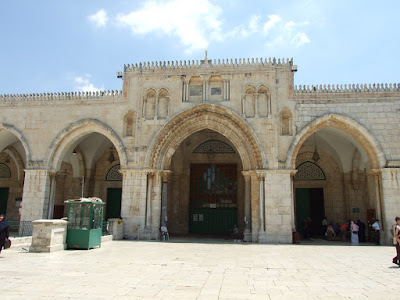
Front Entrance of Al Aksa Mosque
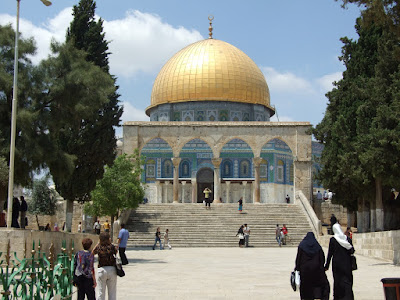
Steps leading up to the Dome of the Rock
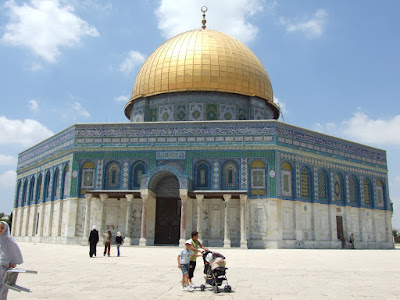
Entrance to Dome of the Rock
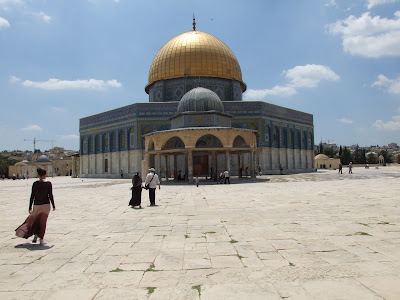
Dome of the Rock from the eastern side.
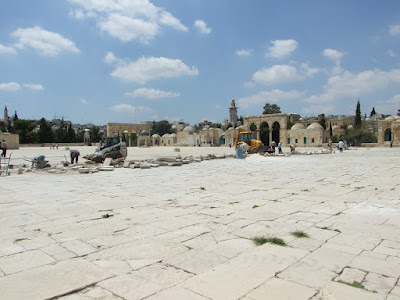
Trench being built across the platform northward of the Dome of the Rock - without any archaeological supervision by the Israel Antiquities Authority, which is generally required by Israeli law, but which is not enforced on the Temple Mount because of the political situation.
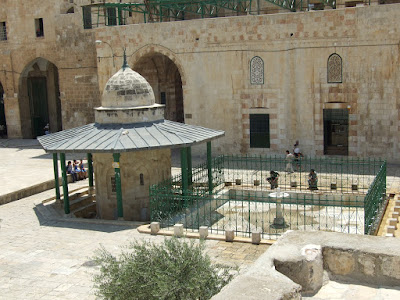
Fountain for ablutions - down steps from the main platform on the western side.
Olive tree next to ablution fountain
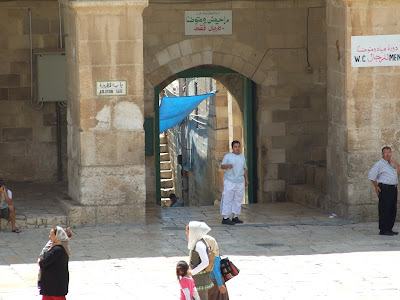
Ablution Gate, going into the Muslim Quarter of the Old City
It is possible for non-Muslims to go up to the Mount for only a limited period each day (not during the time of Muslim prayers), and I managed to get to the Old City at the right time to go up the ramp to the Mughrabi Gate, just to the south of the Western Wall plaza. Before 2000 one could go into Al Aksa Mosque and the Dome of the Rock as a tourist (upon payment for an entrance ticket), but since then the Waqf (the Islamic trust that controls the Mount) doesn't permit non-Muslims into the Muslim holy places. (This is as a result of the Second Intifada that broke out after Ariel Sharon went to the Temple Mount in late September 2000). I'd been up to the Mount once since then, a couple of years ago, but unfortunately didn't bring my camera that day. This time, however, I brought my camera, so I can show all my readers (all four of you?) some of the beauties of the Mount.
Front Entrance of Al Aksa Mosque
Steps leading up to the Dome of the Rock
Entrance to Dome of the Rock
Dome of the Rock from the eastern side.
Trench being built across the platform northward of the Dome of the Rock - without any archaeological supervision by the Israel Antiquities Authority, which is generally required by Israeli law, but which is not enforced on the Temple Mount because of the political situation.
Fountain for ablutions - down steps from the main platform on the western side.
Olive tree next to ablution fountain
Ablution Gate, going into the Muslim Quarter of the Old City
Wednesday, July 25, 2007
Ward Churchill - fired from University of Colorado
A lovely piece of academic news - Ward Churchill has just been fired from his job at the University of Colorado:
the spotlight on Churchill revealed numerous complaints of academic misconduct that had been raised by other academics, but never addressed by CU. He was accused of plagiarism, inventing historical incidents and ghostwriting essays which he then cited in his footnotes in support of his own views.I wrote previously about Churchill in 2005: Ward Churchill posts. It's good to see that Churchill's lies and distortions have finally been proven in the light of day.
Those allegations were the ones that brought dismissal today.
Wednesday, July 18, 2007
Second Lebanon War
I'm listening right now to Mabat, the 9:00 p.m. news show on Channel 1, and they're speaking about the new report that the State Comptroller just issued on the conduct of the war on the homefront. The report reveals that the Israeli government was almost entirely unprepared for the effect of the war on the residents of the north (both Jews and Arabs, although the Arab municipalities were even less prepared than the Jewish ones). There were not enough bomb shelters, local municipalities were left to their own devices to protect their citizens, the Israeli Police (instead of the IDF - the army) took charge of the homefront (even though there is a Home Front Command), and the people who should have planned ahead of time failed catastrophically. The report blasts the prime minister, Ehud Olmert, the former defense minister Amir Peretz, the former army chief of staff Dan Halutz (the latter two have resigned), and the head of the Home Front Command, Yitzhak Gershon (who still has his job). Ehud Olmert has responded by attacking the report - not by considering the criticisms and trying to remedy the problems.
One of the things that have become clear to me since I got here this summer is how badly the the government failed in protecting the citizens in the north. When reading about the war last summer, this was not clear to me. Since I've gotten here I've heard and read many stories about how little faith Israeli citizens have in their government as a result of the experience of last summer, when the government did not succeed in helping people who needed it. (One thing that came up in today's Haaretz article on the subject was that during the war the government refused to hold an official discussion about whether and how to evacuate citizens in the north - despite the fact that hundreds of thousands of people on their own fled to stay with people in the center and south of the country).
Another thing is that whenever I read about the war, no one views it as a victory for Israel - they see it as a defeat, and one that does not harken well for the future.
One of the things that have become clear to me since I got here this summer is how badly the the government failed in protecting the citizens in the north. When reading about the war last summer, this was not clear to me. Since I've gotten here I've heard and read many stories about how little faith Israeli citizens have in their government as a result of the experience of last summer, when the government did not succeed in helping people who needed it. (One thing that came up in today's Haaretz article on the subject was that during the war the government refused to hold an official discussion about whether and how to evacuate citizens in the north - despite the fact that hundreds of thousands of people on their own fled to stay with people in the center and south of the country).
Another thing is that whenever I read about the war, no one views it as a victory for Israel - they see it as a defeat, and one that does not harken well for the future.
Monday, July 16, 2007
Continued walk down Kovshei Katamon St.
The porch of a house on Kovshei Katamon St.

An Israeli flag, looking somewhat delapidated, hanging from a flagpole of the Reut School.

The wall of the soccer field next to the park on Elazar ha-Modai St. - note the interesting graffitti.

A photo of my friend's dog in the park - isn't she cute?

And finally, a rosebush in the yard of my friend's apartment building.


An Israeli flag, looking somewhat delapidated, hanging from a flagpole of the Reut School.

The wall of the soccer field next to the park on Elazar ha-Modai St. - note the interesting graffitti.

A photo of my friend's dog in the park - isn't she cute?

And finally, a rosebush in the yard of my friend's apartment building.

Walking down Kovshei Katamon St.
I took a walk down from my apartment to a friend's house, and I took a few photos on my way. I walked down a street called "Kovshei Kataman" (in Hebrew: כובשי קטמון) - which means "Conquerors of Kataman" St. The name comes from the 1948 war, when this neighborhood was conquered by the Palmach even before the declaration of the state.
The first photo is of the little market that's closest to my house: Deli Market.

Here's the stop for the #13 bus, which goes to the center of the city and then to Mahaneh Yehudah.

This is Halperin St., which goes down from Palmach to Ha-Lamed Heh St. As you can see, it's not really a street.

This is the roundabout where Kovshei Katamon meets several other streets, including Rachel Imenu. A few years ago the city put up this curious little sculpture installation of little chairs. Whenever I walk by here late on a Friday night, all of the chairs are being used by groups of religious girls out schmoozing on Shabbat evening.

Here's some more of the chairs.

The first photo is of the little market that's closest to my house: Deli Market.

Here's the stop for the #13 bus, which goes to the center of the city and then to Mahaneh Yehudah.

This is Halperin St., which goes down from Palmach to Ha-Lamed Heh St. As you can see, it's not really a street.

This is the roundabout where Kovshei Katamon meets several other streets, including Rachel Imenu. A few years ago the city put up this curious little sculpture installation of little chairs. Whenever I walk by here late on a Friday night, all of the chairs are being used by groups of religious girls out schmoozing on Shabbat evening.

Here's some more of the chairs.

Gershom Scholem Library
I’m just sitting here and staring out the window of the Gershom Scholem library at the trees on the Givat Ram campus – an assortment of Mediterranean (palm trees) as well as some evergreens that I don’t think are native here. You enter this part of the campus by getting off the bus right after a small parking lot. The entire campus is enclosed by a fence (as are all the other universities in Israel, for security reasons). You have to show some form of identification to the first guard, who is toting a submachine gun. To get in, you must go through the security checkpoint – guards go through purses and briefcases with computers in them, and you have to walk through a metal detector as well. Then, you walk across a broad swathe of green lawn which runs down between university buildings to the National and University Library. There is a winding path that goes across the grass, where in the last year a delightful four-part sculptural exhibit has been added showing the common birds of Israel, both migratory and resident. Israel, since it is between Africa, Asia, and Europe, is a wonderful place to observe the migrating birds in spring and fall – the Huleh valley is especially good. Unfortunately, since this is summer, you just see the resident birds.
Inside the library building there are several sub-collections, including the reading rooms on the second floor – including the general reading room and the Judaica reading room, which is the other place where I hang out. I’ve been coming to this library probably since 1988, when I was writing a big paper for a course I was taking on the Hekhalot literature, which eventually became the topic of my dissertation. I spent 1992-93 here (mostly in the Scholem library) working on the research for my dissertation, and I was here again 1998-99 on a fellowship. I don’t know if this is absolutely the best library in the world for Jewish studies research, but it is certainly among the best. You can’t go into the stacks of the National Library – you have to order books using little slips of paper, which are whisked downstairs where the books are. The books then come up to one of the reading rooms or the circulation desk on the first floor – carried by a dumbwaiter from the basement. The system certainly hasn’t been changed since I first started coming here, and I would guess it’s the same one they’ve been using since the library was built, sometime in the 1960s, I think. Most books that I need, however, are in the Judaica Reading Room or the Scholem Library. The basis of the Scholem Library is Gershom Scholem’s personal collection, mostly centering on Jewish mysticism, magic, and philosophy, but including a great deal else in Jewish studies (for example, a set of the Talmud). The collection has been added to – both by purchase and because the scholars who work in here give copies of their books and articles to the library (for example, I gave the library a copy of my dissertation and also to the published book that came out of the dissertation). It is definitely a great place to work.
Inside the library building there are several sub-collections, including the reading rooms on the second floor – including the general reading room and the Judaica reading room, which is the other place where I hang out. I’ve been coming to this library probably since 1988, when I was writing a big paper for a course I was taking on the Hekhalot literature, which eventually became the topic of my dissertation. I spent 1992-93 here (mostly in the Scholem library) working on the research for my dissertation, and I was here again 1998-99 on a fellowship. I don’t know if this is absolutely the best library in the world for Jewish studies research, but it is certainly among the best. You can’t go into the stacks of the National Library – you have to order books using little slips of paper, which are whisked downstairs where the books are. The books then come up to one of the reading rooms or the circulation desk on the first floor – carried by a dumbwaiter from the basement. The system certainly hasn’t been changed since I first started coming here, and I would guess it’s the same one they’ve been using since the library was built, sometime in the 1960s, I think. Most books that I need, however, are in the Judaica Reading Room or the Scholem Library. The basis of the Scholem Library is Gershom Scholem’s personal collection, mostly centering on Jewish mysticism, magic, and philosophy, but including a great deal else in Jewish studies (for example, a set of the Talmud). The collection has been added to – both by purchase and because the scholars who work in here give copies of their books and articles to the library (for example, I gave the library a copy of my dissertation and also to the published book that came out of the dissertation). It is definitely a great place to work.
Thursday, July 12, 2007
Crossing Borders
I saw a good movie a couple of nights ago, also as part of the Jerusalem Film Festival, called “Crossing Borders.” It was in Arabic, with Hebrew subtitles (as a result, I followed most of it but sometimes couldn’t keep up with the subtitles). The movie followed two Israeli Arab women who live in Arab towns in the Galilee (in the part of the country called the “Triangle,” which is more Arab than Jewish). One of them was in a fairly traditional marriage, with several children – for the first part of the movie it mainly showed her cooking for the family and visitors.
Her husband was involved with a group called Ta’ayush, which is a joint Arab-Jewish political organization that is concerned with providing aid and support to Palestinians in the occupied territories. The movie showed him going to Ta’ayush demonstrations and other activities (such as helping Palestinians to harvest their olive trees), and then calling his wife and asking her to cook for him and all the Ta’ayush members he was about to bring home for a meal.
As the movie progresses, his wife gets increasingly angry at him. She married him when she was fairly young, and his political involvement opened her eyes to the political situation of Arabs in Israel. She eventually becomes part of a women’s organization, and as the movie ends, it seems likely that they will divorce.
The other woman who is featured is a single woman, a teacher in the local school, who is a member of Hadash, the Israeli communist party (which is largely, although not completely Arab). She is running on the Hadash slate for a seat on the local council. We see her campaigning, in particular against candidates from the Islamic movement slate. The day of the elections, there are processions through town by the Islamic movement - cars driving down the street with green flags, honking horns, and also fireworks – so we already get the idea that the communists won't be successful (and in fact, they aren't).
She talks about her life as a single woman in a society which says that everyone should marry, especially women - but she doesn't want to because she likes her freedom. She talks rather bitterly about the influence of Islam on the situation of women. In one scene she is driving around her town passing by the local coffeehouses, which she says she really can’t go to because that is where the men hang out. Instead, she goes to Kfar Saba (a Jewish Israeli town) to hang out in the cafes – but the movie never shows her interacting with anyone there. She is also involved in Ta’ayush, and we see her also in the occupied territories, assisting an elderly man whom Israeli soldiers are not permitting to go through a checkpoint. The film was interesting to watch, but a bit hard to follow, and I think it was necessary to know a lot about Israeli society to understand it.
Her husband was involved with a group called Ta’ayush, which is a joint Arab-Jewish political organization that is concerned with providing aid and support to Palestinians in the occupied territories. The movie showed him going to Ta’ayush demonstrations and other activities (such as helping Palestinians to harvest their olive trees), and then calling his wife and asking her to cook for him and all the Ta’ayush members he was about to bring home for a meal.
As the movie progresses, his wife gets increasingly angry at him. She married him when she was fairly young, and his political involvement opened her eyes to the political situation of Arabs in Israel. She eventually becomes part of a women’s organization, and as the movie ends, it seems likely that they will divorce.
The other woman who is featured is a single woman, a teacher in the local school, who is a member of Hadash, the Israeli communist party (which is largely, although not completely Arab). She is running on the Hadash slate for a seat on the local council. We see her campaigning, in particular against candidates from the Islamic movement slate. The day of the elections, there are processions through town by the Islamic movement - cars driving down the street with green flags, honking horns, and also fireworks – so we already get the idea that the communists won't be successful (and in fact, they aren't).
She talks about her life as a single woman in a society which says that everyone should marry, especially women - but she doesn't want to because she likes her freedom. She talks rather bitterly about the influence of Islam on the situation of women. In one scene she is driving around her town passing by the local coffeehouses, which she says she really can’t go to because that is where the men hang out. Instead, she goes to Kfar Saba (a Jewish Israeli town) to hang out in the cafes – but the movie never shows her interacting with anyone there. She is also involved in Ta’ayush, and we see her also in the occupied territories, assisting an elderly man whom Israeli soldiers are not permitting to go through a checkpoint. The film was interesting to watch, but a bit hard to follow, and I think it was necessary to know a lot about Israeli society to understand it.
Tuesday, July 10, 2007
Religious experience and mysticism
April DeConick, in her excellent Forbidden Gospels Blog, has an interesting discussion of a new article by Peter Schäfer on the question of religious experience and mystical texts. As April notes, in his writing on the Hekhalot literature Schäfer has usually emphasized the importance of viewing early Jewish mystical literature as coming out of an "exegetical impulse" and not out of personal religious experience. While I agree with Schäfer that we need to look at both the ritual (usually called "magical") and the mystical aspects of the Hekhalot literature, I think that he goes overboard in his emphasis on exegesis. I agree with April in her approach: "My own approach is to consider the intersection of these two aspects, and to take very seriously the mystical tradition as a living practiced religious tradition." Anyway, read her blog posting - it's a very interesting and worthwile discussion of how to define early Jewish (and Christian) mysticism.
Darfur - The Devil Came on Horseback
Tonight I went to the Jerusalem Film Festival and saw a very affecting film - The Devil Came on Horseback. It's about Brian Steidle, an American who went to Sudan in 2004 as an observer of the ceasefire between southern Sudan and the government in the north, and who ended up being a witness to the genocide that was just starting in Darfur. He worked for the African Union documenting the genocide, but because he had no power to intervene at all, he eventually quit and since then has been trying to get the word out about what's going on and trying to influence the U.S. government to act. The film showed harrowing photographs that he took of the results of the Janjaweed attacks on Darfur villages - entire villages completely burned down, bodies of people murdered in many different ways, including being burned alive by the Janjaweed. (The film is called "The Devil Came on Horseback" because the word Janjaweed refers to "devils on horseback" - the Arab militias which are trained, armed, and funded by the central government in order to ethnically cleanse Darfur).
Steidle and the film's producer were at the film tonight, as well as a man named Ismael - a Darfur refugee who has just entered Israel eight days ago with his family from Egypt. He spoke very eloquently about his situation - he and his family (wife and four children) have been in Egypt for four years after fleeing Sudan. He left Egypt because the Egyptian government has treated the Darfur (and other African refugees) very poorly (not a surprise, it treats its own citizens very badly).
Steidle said, in answer to a question from the audience, that about 90% of the villages in Darfur have been destroyed by the Janjaweed, about half a million people have been killed (don't believe the statistics you read in the newspapers that say 200,000 have been killed - that figure is very out of date), 2-4 million are refugees either in Chad, the Central African Republic, or internally in Sudan itself. About a million of the internal refugees are living in refugee camps where they are getting no aid whatsoever from relief agencies, because the Sudanese government refuses to let them enter. He said that what has gone on up to now is "Stage 1" of the genocide, and now "Stage 2" is beginning in these inaccessible refugee camps - at least 300 people a day are dying of starvation and illness, which means at the current rate of death over a 100,000 people will die in the next year in these camps.
For a couple of years African refugees from Darfur and elsewhere in Africa have been slipping into Israel over the border with Egypt, and there are currently around 1200 Darfur refugees here. The Israeli government has been shamefully incompetent in dealing with them (see also this article on government plans to deport African refugees back to Egypt) - the military, who finds them on the border, tries to pass them to the police, who then dump them in Beersheva, which doesn't have enough resources on its own to take care of them, and private individuals, kibbutzim, and businesses have ended up helping them. Some heroic students in Beersheva and elsewhere have also been helping them out. Tonight at the film screening a student named Tali was there, informing people about a group of the Darfur refugees who have been sent by the Beersheva municipality to Jerusalem in order to arouse the action of the national government. They are currently camping outside the Knesset in the Wohl Rose Garden. She came and told the audience that they need blankets and diapers for the children, and even more than that, pressure on the government to make it help these refugees.
Even though I love Israel, it is very disheartening to see how miserable this current government is - this is only the latest demonstration of its incompetence and hard-heartedness. (For another example - the government still has not managed to renovate the bomb shelters in the north after last year's war or in Sederot, which still suffers from ongoing Qassam rocket attacks from Gaza). Prime Minister Olmert, who should have resigned last summer after the catastrophic war with Hizbollah, is still hanging on. Every day when I open the newspaper or listen to the radio there is another disgusting scandal being revealed, or other repulsive government conduct. (Tonight, for example, I saw on the Mabat news at 9:00 that a lawyer who was in the Knesset today physically attacked an MK for something he had said). What gives one hope is to see that there are still people in this country who care and have the moral backbone to do something when they see injustice being committed in front of their eyes.
Steidle and the film's producer were at the film tonight, as well as a man named Ismael - a Darfur refugee who has just entered Israel eight days ago with his family from Egypt. He spoke very eloquently about his situation - he and his family (wife and four children) have been in Egypt for four years after fleeing Sudan. He left Egypt because the Egyptian government has treated the Darfur (and other African refugees) very poorly (not a surprise, it treats its own citizens very badly).
Steidle said, in answer to a question from the audience, that about 90% of the villages in Darfur have been destroyed by the Janjaweed, about half a million people have been killed (don't believe the statistics you read in the newspapers that say 200,000 have been killed - that figure is very out of date), 2-4 million are refugees either in Chad, the Central African Republic, or internally in Sudan itself. About a million of the internal refugees are living in refugee camps where they are getting no aid whatsoever from relief agencies, because the Sudanese government refuses to let them enter. He said that what has gone on up to now is "Stage 1" of the genocide, and now "Stage 2" is beginning in these inaccessible refugee camps - at least 300 people a day are dying of starvation and illness, which means at the current rate of death over a 100,000 people will die in the next year in these camps.
For a couple of years African refugees from Darfur and elsewhere in Africa have been slipping into Israel over the border with Egypt, and there are currently around 1200 Darfur refugees here. The Israeli government has been shamefully incompetent in dealing with them (see also this article on government plans to deport African refugees back to Egypt) - the military, who finds them on the border, tries to pass them to the police, who then dump them in Beersheva, which doesn't have enough resources on its own to take care of them, and private individuals, kibbutzim, and businesses have ended up helping them. Some heroic students in Beersheva and elsewhere have also been helping them out. Tonight at the film screening a student named Tali was there, informing people about a group of the Darfur refugees who have been sent by the Beersheva municipality to Jerusalem in order to arouse the action of the national government. They are currently camping outside the Knesset in the Wohl Rose Garden. She came and told the audience that they need blankets and diapers for the children, and even more than that, pressure on the government to make it help these refugees.
Even though I love Israel, it is very disheartening to see how miserable this current government is - this is only the latest demonstration of its incompetence and hard-heartedness. (For another example - the government still has not managed to renovate the bomb shelters in the north after last year's war or in Sederot, which still suffers from ongoing Qassam rocket attacks from Gaza). Prime Minister Olmert, who should have resigned last summer after the catastrophic war with Hizbollah, is still hanging on. Every day when I open the newspaper or listen to the radio there is another disgusting scandal being revealed, or other repulsive government conduct. (Tonight, for example, I saw on the Mabat news at 9:00 that a lawyer who was in the Knesset today physically attacked an MK for something he had said). What gives one hope is to see that there are still people in this country who care and have the moral backbone to do something when they see injustice being committed in front of their eyes.
Monday, July 09, 2007
What are Syria's intentions?
A couple of pieces of "interesting" news in relation to Syria:
In a Ynet story, it says Lebanon 'to erupt in 1 week.'
It certainly sounds as if something might happen in Lebanon vis-a-vis Syria very soon, but Israeli Prime Minister Olmert is speaking softly to the Syrians at the moment:
In a Ynet story, it says Lebanon 'to erupt in 1 week.'
Syria has called on its citizens to leave Lebanon ahead of an expected "eruption" in that country, Arab and Iranian press reports have said. The media reports were translated and made available by MEMRI in a special dispatch on Sunday. "In the past few days, Arab and Iranian media reports have pointed to the possibility that Lebanon's current political crisis may become a violent conflict after July 15, 2007," the MEMRI dispatch said. July 15 comes one day before a special UN Security Council meeting which is expected to discuss the possibility of stationing international experts on the Syria-Lebanon border, in order monitor the ongoing illegal cross border arms traffic to Hizbullah, thought to be originating from Iran and Syria. The UN Security Council is also expected to meet next week to discuss a key report on the assassination of former Lebanese Prime Minister Rafik Hariri, a development which may bode badly for Syria.Also, Syrian troops penetrate 3 kilometers into Lebanese territories.
"On July 5, 2007, the Iranian news agency IRNA reported that Syrian authorities had instructed all Syrian citizens residing in Lebanon to return to their country by July 15, 2007. The next day, the Israeli Arab daily Al-Sinara similarly reported, on the authority of a Lebanese source close to Damascus, that Syria was planning to remove its citizens from Lebanon. Also on July 5, the Lebanese daily Al-Liwa reported rumors that Syrian workers were leaving Lebanon at the request of the Syrian authorities. In addition, the Syrian government daily Al-Thawra reported that Syrian universities would accept Syrian students who were leaving Lebanon due to the instability there," MEMRI said in its report.
Syrian troops on Thursday reportedly have penetrated three kilometers into Lebanese territories, taking up positions in the mountains near Yanta in east Lebanon's Bekaa Valley. The daily Al Mustaqbal, citing sources who confirmed the cross-border penetration, did not say when the procedure in the Fahs Hill overlooking Deir al-Ashaer in the Rashaya province took place. The sources said Syrian troops, backed by bulldozers, were fortifying positions "in more than one area" along the Lebanese border, erecting earth mounds and digging "hundreds" of trenches and individual bunkers."As Michael Totten commented, "If Israel sent the IDF three kilometers into Lebanon and started digging trenches and building bunkers it would make news all over the world. But Syria does it and everyone shrugs. Hardly anyone even knows it happened at all."
It certainly sounds as if something might happen in Lebanon vis-a-vis Syria very soon, but Israeli Prime Minister Olmert is speaking softly to the Syrians at the moment:
'Come to Jerusalem to talk' was the message of Prime Minister Ehud Olmert to Syrian President Bashar Assad, in an historic interview to Saudi satellite station Al Arabiya, aired by Channel 10 Monday evening. In his first appearance on a major Arabic news station in over six years, Olmert, speaking in an office adorned with the blue and white Israeli flag, told his Hebrew-speaking interviewer: "Bashar Assad, you know … You know I am ready to hold direct negotiations with you and you also know that it's you who insists on speaking to the Americans. The American president says: 'I don't want to stand between Bashar Assad and Ehud Olmert. If you want to talk, sit down and talk." Assad has "heard many things from me already," Olmert added. When asked where he would hold such talks with Assad, Olmert said "any place he [Assad] would agree to meet," hinting that Assad would even be welcome in Jerusalem.
Subscribe to:
Posts (Atom)