Friday, May 13, 2022

The funeral of Shireen Abu Akleh - comments by Daniel Seidemann

 Daniel Seidemann, on Twitter (https://twitter.com/DanielSeidemann/status/1525121381486186498)

1/

The dissonance among the press reports relating to the events surrounding today's funeral of Shireen Abu Akleh is stunning. The Arab language and international press, showing the footage express shock at the aggression of the Police.

2/

The Arab/int'l press place the violence on same occupation-continuum that led to the killing of Abu Akleh.
A small number of independent Israeli journalists concur & report accordingly.
A larger number of mainstream Israeli journalists are reporting it as a hasbara disaster.

3/
However, TV/Radio news report the funeral and the funeral procession as a large Israeli/Police success. "Minor incidents, it could have been much worse". Chapeau. By sinking deeper into occupation-denial, we are untethering from the rest of the world and how we're perceived.

4/ (https://twitter.com/DanielSeidemann/status/1525121381486186498)As usual, the superb reportage of @SuleimanMas1 who reports for Israeli State News, the heart of MLM, is a rare exception. There are a number of others.
1/4 לא מצליח להבין את התנהלות משטרת ירושלים באירוע הזה. בהודעה רשמית של המשטרה נכתב שמשתתפי הלוויה זרקו אבנים וחפצים לעבר השוטרים בתחילת מסע הלוויה, ולכן השוטרים ״נאלצו להדוף אותם״. חזרתי לשידור החי מתחילת הלוויה ואני מצרף אותו כאן. רואים בבירור שהמשתתפים בלוויה מנסים לצאת מבית>>

1/4 fails to understand the conduct of the Jerusalem police in this incident. An official police statement said that the participants in the funeral had thrown stones and objects at the police at the beginning of the funeral procession, so the police "had to fend them off." I went back to the live broadcast from the beginning of the funeral and I attach it here. It is clear that the participants in the funeral are trying to leave the hospital > >

2/4 החולים כשהם נושאים את הארון של שירין אבו עאקלה. השוטרים נראים כשהם חוסמים את הלוויה, מכים את המשתתפים באלות, ואז רואים את זריקת הבקבוקים והחפצים. זה מתווסף להגעת השוטרים לבית משפחת אבו עאקלה ביום שהיא נהרגה והבקשה שלהם לפזר את ההמולה בתוך הבית ולהוריד את דגלי פלסטין>>
2/4 
carrying the coffin of Sheerin Abu Akala. The cops are seen blocking the funeral, beating the participants with batons, and then one sees the bottles and belongings being thrown. This is in addition to the arrival of the police at the home of the Abu Akala family on the day she was killed and their request to disperse the commotion inside the house and lower the Palestinian flags > >
3/4 ״בשל פגיעה בסדר הציבורי״.בשורה התחתונה, למשטרת ירושלים יש זכויות רבות בתקופה האחרונה: השקט בשער שכם ברמדאן, >>
בהודעה נכתב גם שנשמעו קריאות הסתה. הקריאות שאני שומע בוידאו הן: ״ברוח בדם נפדה את שירין. ברוח בדם נפדה את השהיד. אללה אכבר. תגבירו את קריאותכם, מי שקורא לא מת״.
3/4 "Due to violation of public order". The announcement also said that cries of incitement were heard. The cries I hear in the video are: 'With blood and spirit we will redeem Sheerin. With blood and spirit we will redeem the martyr. Allahu Akbar. Increase your cries, whoever cries out is not dead. ' Bottom line, the Jerusalem police have had many rights [I'm not sure this is the right translation] in recent times: the silence at the Nablus Gate during Ramadan, > >

4/4 הטיפול בהפרות הסדר במסגד אל אקצא, שבר האור שעברה בשקט יחסי. האירוע הזה מתנהל רע מתחילתו ועד סופו, וחבל.
4/4 The treatment of riots at the Al-Aqsa Mosque, which broke the light relatively quietly. This incident is going badly from start to finish, which is a shame.
5/
One of the leitmotifs in the reporting is whether the Police was aggressive enough, or too tolerant, in their reaction to the flying of Palestinian flags during the procession. I heard no one state the simple truth: flying the Palestinian flag is legal under Israeli Law


Sunday, April 17, 2022

African American Jewish food traditions on Passover

Yesterday, NPR aired a lovely interview with Michael Twitty and Rabbi Sandra Lawson on African American Jewish food traditions on Passover: How Black American Jews Incorporate their food traditions into their Passover seders.

Michael Twitty

Rabbi Sandra Lawson


Tonight, across the world, Jewish families and friends will gather for the second night of Passover. Many will hold a Seder, a ritual meal where the story of the liberation of the Hebrew slaves from bondage in Egypt is retold. For Jews around the world, it's a time to honor their faith and make the celebration their own by bringing their own cultural and food traditions to the table. And that's also true of African American Jews, for whom the Passover story resonates on multiple levels.

To hear more about this, we called Michael Twitty. He is a James Beard Award-winning author and food historian. And Rabbi Sandra Lawson, director of Racial Diversity, Equity and Inclusion at Reconstructing Judaism. Michael Twitty and Rabbi Lawson, welcome. And thank you so much for joining us.

The forsythia in my garden (Pesach 5782)


Tuesday, March 29, 2022

The Middle East Studies Association Chooses BDS over Academic Freedom

The Middle East Studies Association (MESA) recently endorsed the BDS (boycott, divest, sanctions) movement against Israel, reversing its 2005 resolution opposing academic boycotts. The following statement was published today by the Alliance for Academic Freedom, and is cross posted from The Third Narrative. I'm on the Executive Committee of the AAF.

By Alliance for Academic Freedom

MIDDLE EAST STUDIES ASSOCIATION VIOLATES FUNDAMENTAL ACADEMIC FREEDOM PRINCIPLES WITH BDS ENDORSEMENT

The Alliance for Academic Freedom (AAF) condemns the March 24, 2022 vote by the Middle East Studies Association (MESA) to join the campaign of Boycotts, Divestment, and Sanctions (BDS) targeting the state of Israel. Academic freedom cannot exist where entire peoples or nations are effectively excommunicated from the global community of scholars and barred from the inherently collaborative work of research and teaching. By calling for an academic as well as cultural and economic boycotts of Israel, BDS restricts legitimate intellectual exchange with Israeli scholars, students, and institutions, and violates the most basic tenets of academic freedom; now, by endorsing BDS, MESA has embraced this violation. In doing so, it tramples on the rights of those who study or teach about the Middle East and North Africa, of all Israeli scholars and students, and of scholars around the world who collaborate with Israelis.

As we stated in our December 2021 statement on MESA, the organization itself had previously in 2005, through its own Committee on Academic Freedom, pointed to “the principles of academic freedom and the free exchange of information and ideas” as grounds for condemning academic boycotts such as BDS. At the time, MESA’s committee said, “We especially oppose penalizing entire segments of an academic community for any reason whatsoever.” That 2005 position was correct, we noted, because “free exchanges between faculty members and students worldwide are essential to the unfettered advancement of knowledge and to the viability of higher education.” International research collaborations, international conferences, study-abroad programs, and peer review of publications and appointments are just a few among the many activities that inevitably entail international cooperation among individuals and institutions. To ostracize an entire nation, its people, and its educational institutions because of political disagreements is to discriminate on the basis of nationality, which in this case also has the effect of discriminating on the basis of ethnicity and religion.

MESA’s abandonment of a principled position in favor of a politicized approach does not bode well for the organization, which in recent years has lost both institutional members and credibility in the eyes of many scholars. A professional society must be a home for scholars of all political persuasions.

As an organization, the AAF supports the national aspirations of Israelis and Palestinians alike. The full realization of those aspirations will come only with increased communication, interaction, and scholarly collaboration—not from the restriction of opportunities for such exchange.

On Behalf of the AAF Executive Committee: Susana Cavallo, David Greenberg, Rebecca Lesses, Jeffry Mallow, Sharon Musher, Cary Nelson (Chair), Kenneth Stern

Thursday, March 10, 2022

How do you know when a war begins? Syria and Ukraine.


WHAT does it feel like when a war begins? When does life as you know it implode? How do you know when it is time to pack up your home and your family and leave your country? Or if you decide not to, why? 
-- Janine di Giovanni, 2012

I've been spending a lot of time reading about the war in Ukraine, which is beginning to resemble the Syrian war in many sad and destructive ways. The Russians bombed the child and maternity hospital in Mariupol yesterday, as they also destroyed so many hospitals in Syria. I was just looked back at my many blog entries, searching for an article I read then about the shock of war beginning.

In 2012, I was in Israel on sabbatical from January to the beginning of August. Bashar al-Assad was already slaughtering his own people. Janine di Giovanni's article, "Life During Wartime," made chills go down my spine. I was safe in Jerusalem, but Syria was so close.

di Giovanni writes about the moment when the war finally arrived in Damascus, 17 months after it had begun in Deraa, with the arrests of children who had painted anti-regime messages on a school.
WHAT does it feel like when a war begins? When does life as you know it implode? How do you know when it is time to pack up your home and your family and leave your country? Or if you decide not to, why?
For ordinary people, war starts with a jolt: one day you are busy with dentist appointments or arranging ballet lessons for your daughter, and then the curtain drops. One moment the daily routine grinds on; A.T.M.’s work and cellphones function. Then, suddenly, everything stops.
Barricades go up. Soldiers are recruited and neighbors work to form their own defense. Ministers are assassinated and the country falls into chaos. Fathers disappear. The banks close and money and culture and life as people knew it vanishes. In Damascus, this moment has come.

War starts very suddenly:

I know about the velocity of war. In all of the wars I have covered — including in Bosnia, Iraq, Afghanistan, Sierra Leone, Chechnya, Kosovo — the moments in which everything changes from normal to extremely abnormal share a similar quality. One evening in Abidjan, Ivory Coast, in 2002, for example, I went to bed after dinner at a lavish French restaurant. When I woke up, there was no telephone service and no radio broadcast in the capital; “rebels” occupied the television station and flares shot through the sky. In my garden I could smell both the scent of mango trees and the smell of burning homes. My neighborhood was on fire. The 24-hour gap between peace and wartime gave me enough time to gather my passport, computer and favorite photos and flee to a hotel in the center of the city. I never returned to my beloved house with the mango trees.

The malign Russian role in the Syrian war had already begun - not with Russian soldier and aircraft, but with the UN:

As Russia continues to veto Security Council efforts to sanction and reproach President Bashar al-Assad, friends in Syria e-mail and tweet about assassinations, brutal killings, doctors torturing victims.

Russia now also stymies any Security Council actions with its vetoes. 

We have been here before in Europe.

Thirteen years ago [now 23 years ago], [UN Secretary General] Mr. Annan issued a report to the General Assembly on the failure of the international community to prevent the massacre of Bosnians at Srebrenica. He called it “a horror without parallel in the history of Europe since the Second World War.” 

We now have another unparalleled horror in European history. I've been struck by how many commentators write about the Russian war on Ukraine as if it's the only violent European episode since 1945. In the meantime, Russia has waged war in many other countries (just as the US has), and is now using the same tactics in Ukraine as it did in Syria and Chechnya.

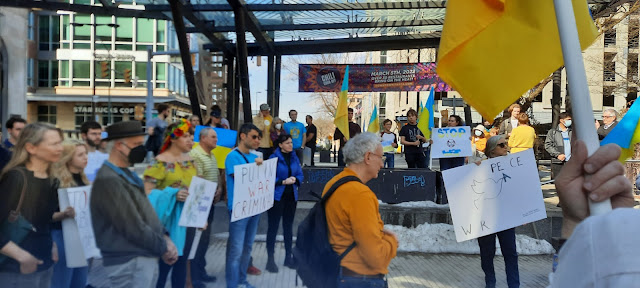
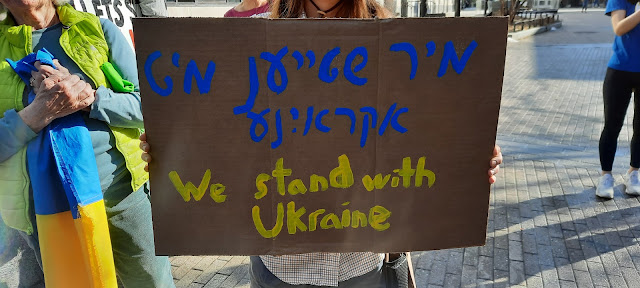
Last weekend, there were two rallies in Ithaca in support of Ukraine. One, at noon on Sunday, March 6, was organized by Codepink in coalition with other dubious organizations, like Stop the War UK and the No to NATO Network. I don't know what the signs were in Ithaca, but looking at photos of other rallies sponsored by this coalition, it's clear that they blamed NATO just as much as Russia for the war. The slogan on one Codepink poster: "Stop the war in Ukraine, No to NATO expansion." Another sign - "NATO is the problem."

The second rally, at 2:00 pm, was organized by Ukrainians in Ithaca. I went to the second one, since I actually wanted to support Ukraine.

Monday, December 20, 2021

IN DEFENSE OF ACADEMIC FREEDOM AND AGAINST THE BDS RESOLUTION AT THE MIDDLE EASTERN STUDIES ASSOCIATION

From the Alliance for Academic Freedom (AAF), which is part of the Third Narrative, a project of Ameinu (left-wing Zionist organization that supports a two-state solution of the Israeli-Palestinian conflict and works for social justice in the United States and Israel). I'm on the executive committee of the AAF, and this is a joint statement between the AAF and some members of the Middle East Studies Association, opposing an upcoming BDS resolution now being submitted for a vote by all members of MESA. I urge any of my readers who are members of MESA to vote no on the resolution.

We write as members of the Middle East Studies Association (MESA) alongside the Alliance for Academic Freedom (AAF), a group of more than 200 liberal and progressive scholars committed to upholding academic freedom and free speech in campus debates surrounding Israel and Palestine, supportive of both peoples’ national aspirations, and opposed to Israeli occupation of the West Bank. We deplore the vote by the 2021 annual MESA meeting that calls on its members to endorse a comprehensive academic boycott of Israeli universities. The resolution has been submitted to all MESA members for a vote. MESA represents faculty who teach and conduct research on the Middle East and North Africa.

With this action, MESA decisively overturns the very guiding principle of academic freedom it previous sought to uphold. In 2005 it made that commitment explicit in much the same political context. That year MESA’s Committee on Academic Freedom condemned the British Association of University Teachers (AUT) call for its members to “refrain from participation in any form of academic and cultural cooperation or joint projects” with Haifa University or Bar Ilan University in Israel. It did so, it said, because of its “deep commitment” to “the principles of academic freedom and the free exchange of information and ideas,” principles no less vital today than they were in 2005. That was the year as well that the American Association of University Professors (AAUP) drafted its formal policy opposing all academic boycotts.

There has long been agreement by most academics, including many who criticize Israeli government policy, and even some who sees themselves as anti-Zionists, that boycotts of universities anywhere imperil the core principle of academic freedom, which mandates that free exchanges between faculty members and students worldwide are essential to the unfettered advancement of knowledge and to the viability of higher education. Ideas do not respect international borders; their merit is not determined by national identity.

MESA repeats the false claim by the BDS movement that it is possible to boycott academic institutions without also boycotting the students, staff, and faculty who constitute those institutions. Yet international research collaborations, international conferences, study abroad programs, and peer review of publications and appointments are just a few among the many activities that inevitably entail international cooperation among individuals and institutions. Some faculty refuse to write letters of recommendation for students wishing to study in Israel. The idea that people can be cleanly separated from their colleges and universities and harm restricted to the institutions alone is a damaging and deceptive fiction. All the activities listed here, moreover, are themselves protected by academic freedom. Either that principle stands and is universally honored or it ceases to be the governing principle of higher education worldwide. We must continue to condemn failures to uphold that most basic value. And thus we condemn the MESA resolution that abridges it. In 2005 MESA regarded the AUT boycott as an effort at once “to boycott these universities and blacklist their faculty.”

The current resolution asserts that Israeli universities are “imbricated” in the country’s military policies and practices and considers that justification for boycotting them. But academic freedom gives both individual faculty members and groups of faculty the right to engage in military research or research with military applications if they choose to do so. People in military service in many countries take college courses during and after their military service That is true for both Israel and the United States.

In 2005 MESA said “we especially oppose penalizing entire segments of an academic community for any reason whatsoever. We find thoroughly objectionable the call of the AUT to refrain from any and all scholarly interaction with the entire professional staff of two universities because of the policies of the state in which they are situated.” MESA has thus already provided excellent arguments in opposition to its present proposal. Moreover, at that time MESA was honest about the impact of academic boycotts. That honesty is now in danger as well.

Signed by the Executive Committee of the AAF alongside a group of MESA members: Susana Cavallo (AAF), Donna Robinson Divine (MESA), Robert Freedman (MESA), David Greenberg (AAF), Bat-Zion Klorman-Eraqi (MESA), Rebecca Lesses (AAF), Jeffry Mallow (AAF), Sharon Musher (AAF), Cary Nelson (AAF, chair), Itamar Radai (MESA), Arieh Saposnik (MESA), Kenneth Stern (AAF)

About the Alliance for Academic Freedom (AAF)
The AAF, part of The Third Narrative initiative, consists of liberal and progressive scholars dedicated to combating academic boycotts and blacklists, defending freedom of expression and promoting empathy in the debate over Israelis and Palestinians. For the AAF’s statement of principles, click here.

Wednesday, November 17, 2021

Arrest of student at Texas State University accused of arson at Austin, TX, synagogue

 Texas State student faces federal charges after allegedly setting fire to Austin synagogue

A Texas State student was federally charged with arson after allegedly setting an intentional fire at the Congregation Beth Israel synagogue in Austin, according to U.S. District Court records.

Austin Fire Department Arson investigators deemed the fire was intentionally set around 9 p.m. on Oct. 31. Franklin Barrett Sechriest, the 18-year-old charged with the crime, is a criminal justice freshman at Texas State.

The FBI was authorized to search and seizure Sechriest's San Marcos residence and vehicle on Nov. 10. The report states investigators found a credit card with the same account number as a card used at a sporting goods store in Buda, Texas to purchase a five-gallon VP Racing Fuel utility jug. 

After searching the vehicle, investigators say they recovered three glass bottles, three bottles of lighter fluid, a lighter and an orange stormproof match case with matches. Investigators also found three anti-Semitic stickers in the vehicle.

Sechriest's journal was also found with a statement “I set a synagogue on fire” under an entry dated Oct. 31, 2021.

Investigators identified burn patterns consistent with the use of a liquid accelerant. Surveillance footage overlooking the synagogue's administration office reveals Sechriest wearing a face covering and carrying a container similar to a five-gallon VP Racing Fuel utility jug and a roll of toilet paper, according to court records.

That same Halloween weekend, residents throughout Hays County reported receiving anti-Semitic letters in plastic bags with pebbles. Hays County Judge Ruben Becerra issued a series of tweets condemning the letters and said the behavior was not acceptable.

In a statement to The University Star, Texas State said it will continue to assist the FBI and Austin Fire Department in the ongoing investigation involving Sechriest. 

"Our university decries this hateful act of bigotry and violence and all the anti-Semitic events perpetrated recently in Austin, San Antonio, and San Marcos. The Texas State University community stands in solidarity with our Jewish students, faculty, staff, alumni, and community members who have been impacted," Texas State said in its statement.

Investigators say the fire caused $25,000 worth of damages to the synagogue. The fire destroyed the synagogue's historic doors and caused damage to the building's exterior along with its stained-glass windows. No one was injured from the fire. 

In a public statement, Congregation Beth Israel Senior Rabbi Steve Folberg said the synagogue is grateful to the Austin Fire Department, Austin Police Department and the Federal Bureau of Investigation for investigating the incident. 

“It gives us some sense of relief to learn of this arrest, but we are staying vigilant. Across Central Texas and beyond, we are seeing a spike in attacks against Jews," Folberg said. "We denounce all acts of bigotry and violence, especially those motivated by blind hatred of any of the proud and distinctive communities that enrich our civic life. We will remain strong and vigilant in the ongoing work of justice, safety and peace for ourselves and all our neighbors." 

The Congregation Beth Israel is accepting donations to assist with the damages. For more information visit its website

I wonder if this student also sent the antisemitic letters to Jews in the area. 

Thursday, November 11, 2021

Jewish residents in Austin, TX sent antisemitic letters blaming them for Covid

A new example of antisemitism connected to Covid, in Austin, Texas:

Jewish residents in an Austin neighborhood were sent antisemitic letters blaming them for Covid

A string of antisemitic attacks has taken place over the last few days across Texas and in Austin. In the latest incident, several people in an Austin neighborhood received hateful letters at their homes. The letters received by Jewish residents in Hays County were sealed in a plastic bag filled with small rocks, Hays County Judge Ruben Becerra said Sunday, according to the Austin American-Statesman.  

The letters blamed Jewish community members for the novel coronavirus pandemic. “Every single aspect of the COVID agenda is Jewish,” the letters read. They also named Jewish scientists and pointed fingers at leaders at the Centers for Disease Control and Prevention that are Jewish.

“Negative actions motivated in bias is an attack against an entire community and not just an attack on a single person,” Becerra wrote on Twitter. “This behavior is not acceptable.”

According to the Austin American-Statesman, Chabad of San Marcos, the only Jewish center in the county, offered guidance and support to members who were targeted.  


After receiving multiple calls from people who were upset regarding the incident, Rabbi Ari Weingarten said he is working with community leaders to “heal spirits” and remind them that “unity is key.” Since the eight nights of  Hanukkah begin Nov. 28, community menorah lighting events have been scheduled. “The message of Hanukkah is that light is stronger than dark and good prevails,” Weingarten said.

While the Hays County Sheriff’s Office said the letter distribution does not qualify as a criminal offense, it said it is aware propaganda is being anonymously distributed. The FBI, however, noted that is is prepared to investigate should the need arise.

“We are aware of the incidents and are in regular contact with local authorities,” the FBI said in a statement regarding the letters, according to the Hays Free Press. “If in the course of the local investigation, information comes to light of a federal violation, the FBI is prepared to investigate. “

According to the Anti-Defamation League in Austin, 17 antisemitic incidents have been reported in the past 10 days in Texas. This includes an incident in which Austin’s Congregation Beth Israel synagogue was set on fire Sunday night, While the damage was contained to the exterior of the building, fire officials said they are looking for a man seen carrying a five-gallon container then fleeing the scene in a car after starting the fire.

Additionally, in October about a dozen people displayed an antisemitic banner from the heavily trafficked North MoPac Boulevard overpass, and displayed similar posters in the East Sixth Street entertainment area, the Houston Chronicle reported. In the same week, an Austin school building was also vandalized with swastikas, homophobic slogans, and racist slurs.

Community leaders and others condemned the actions, including the Austin City Council and mayor.

“When we see acts of hate, they're jarring. They're hurtful, and they are scary. But they are not surprising," Austin Mayor Steve Adler said, according to the Houston Chronicle. “Because there are people who do hateful and horrible, wrongful things."

 “The danger is that hate spreads,” he cautioned.   

See also: Residents in Hays County were sent antisemitic letters 

See also: https://www.statesman.com/story/news/2021/11/04/jewish-hays-county-residents-face-antisemitism-follow-austin-discrimination/6285536001/

H/T: Eric Ward on Twitter: https://twitter.com/BulldogShadow/status/1457802421774610439 


Tuesday, July 20, 2021

Wildfire's orange sun during a late afternoon thunderstorm in Ithaca

This morning, when I got up and looked out my window to the east, I saw an orange sun against clouds and haze. The smoke from wildfires in Canada and further west has reached New York, and filled our atmosphere with fine particles that can damage the lungs. I was reminded of last September, when I was visiting Massachusetts, and the same orange sun greeted us in the morning and set in the evening. The photos here are taken in the late afternoon, during a thunderstorm.
 
As I discovered last year my phone's camera "corrected" the image and eliminated the orange sun itself, just leaving orange light around it. This first photo shows the sun peaking through the leaves (while it was raining hard at the same time!). You can't see the sun itself, but the orange light around it. I took this photo outside, standing on the stairs going into the side porch.


This photo was taken from the kitchen window, and you can see the orange penumbra around the sun.


T

This is a closeup of some pottery on the windowsill above the sink. The little cup on the left was made by a potter I know here - showing a little robin. The bowl in the middle is mine, and shows a strange red bird. My carving skills aren't as good as my fellow potter's.

Thursday, June 03, 2021

Anti-Zionism in women's and gender studies departments and programs

"The national effort to organize an entire academic discipline around anti-Zionism represents a new and dangerous phase in the politicization of academe, argues Cary Nelson."

Excellent op-ed in Inside Higher Ed by Cary Nelson on an extreme anti-Israel statement signed by more than a hundred women's and gender studies departments and programs.

On May 21, the day after a ceasefire was announced in the latest war between Gaza and Israel, a coalition of women’s and gender studies departments and programs made it clear that, for their part, the war of words, at least, will not stop. More than 100 such academic programs signed a statement condemning Israel’s “indiscriminate bombing” of Gaza, thereby endorsing the accusation that Israel’s conduct constitutes a war crime. Academic freedom protects the right individual faculty have to take aggressive political stands. But departments and programs speak for the institution. A department’s adoption of a controversial political stance has implications for all who work with that department.

The statement in question, “Gender Studies Departments in Solidarity With Palestinian Feminist Collective,” is far from the generic, anodyne calls for decency, sensitivity or basic fairness that university bodies often issue. On the contrary, it uses incendiary rhetoric not just to support the rights of Palestinians but also to condemn Israel by taking sides in the political struggle: “We do not subscribe to a ‘both sides’ rhetoric that erases the military, economic, media, and global power that Israel has over Palestine.” The statement characterizes the current war as part of an ethnic cleansing program that began in 1947, thereby condemning Israel’s whole history. By declaring “we call for the end of Israel’s military occupation of Palestine and for the Palestinian right to return to their homes,” they make clear that their attack on “settler colonialism” applies not just to the West Bank but to Israel within its pre-1967 boundaries as well. “This is not a ‘conflict’ that is too ‘controversial and complex’ to assess,” it concludes.

Read the whole op-ed in Inside Higher Ed.

Thursday, May 20, 2021

Each person is an entire world

When will the hideous war between Israel and Hamas end? I read story after story of whole families in Gaza being destroyed by Israeli bombing. I read story after story of Israelis running for their lives to the shelters. "Only" twelve people in Israel have been killed Hamas rockets - but each person is a whole world, in Gaza and in Israel.

In both the Qur'an and the Mishnah it says:

Mishnah Sanhedrin 4:5:
Therefore one single person (adam) was created, to teach you that one who destroys a human life is considered by Scripture to have destroyed a whole world. And anyone who saves a human life is considered to have sustained an entire world.

Qur'an surah 5, ayah 32:
On account of [his deed - of Cain, who killed Abel], We decreed to the Children of Israel that if anyone kills a person – unless in retribution for murder or spreading corruption in the land – it is as if he kills all mankind, while if any saves a life it is as if he saves the lives of all mankind.


Thursday, April 08, 2021

Yom Ha-Shoah - Mordekhai Falkon (originally published on April 25, 2006)

(Originally published on Tuesday, April 25, 2006)

Since today is Yom Ha-Shoah - the day of remembrance of the Holocaust - I thought I would mention briefly my grandfather's uncle, Mordekhai Falkon, who was murdered by the Nazis in Liepaja, Latvia (known also as Libau, Latvia), in the summer of 1941. Mordekhai corresponded with my grandfather, Mark Falcon Lesses, from the mid-1930s through March 18, 1940 (just before the Russian conquest of Latvia). My grandfather was a doctor, living in Boston, Massachusetts, with my grandmother and their two children. He was contacted by Mordekhai Falkon and by another relative living in Jelgava, Latvia, Sima Shlosberg - both sought affidavits so that they could immigrate to the United States.

This is the text of Mordekhai's last letter (that is, the last one that I know of, which was saved by my grandmother for many years after my grandfather died).
Liepaja, 18th March 1940
My dear Nephew,

Not being sure, that my letter written about two weeks before, will reach you, I write you today again. My wife has been sick for a long time, but now she is again well up. Also I am well, but since January the 1st I left all my business and since then I am nothing doing.

I am thanking you very much for your kind will to help me get into U.S., but as long as it is possible to live here, I should not leave our old home. Should unforeseen circumstances induce me to leave, I shall not fail to inform you in right time. All papers received from you I delivered to the U.S. Consulate, which will inform me, when my turn will come.

I hope you and your family are all well and I shall be glad to hear from you as often as possible.

With kindest regards from me and my wife

Your uncle
M. Falkon

[on the back of the envelope is stamped: Stockholm 20.3.40]
For the text of Mordekhai's other letters, see Letters from the Past. You can also find there letters from Sima Shlosberg and from Mordekhai's sister, Gittel Falkon Kagan, who lived in Moscow.

As I found out from subsequent correspondence with a relative, Sima survived the war. She married and lived in St. Petersburg, Russia, for many years, before dying in the mid-1980s. We do not know what happened to Gittel and her family in Russia, because there has been no contact since the late 1930s with them.

According to the extensive database of Libau Jews developed by Edward Anders and his co-workers, Mordekhai was likely killed in July, 1941. As soon as the Nazis entered Libau on June 29, 1941, they began killing Jews. Mordekhai's wife, Dobra, was killed on December 15, 1941, along with almost 3,000 other Libau Jews during three days of murder at the Skede dunes along the coast, about 15 km north of Libau. (For photographs of the killings, see Skede executions. Warning: graphic and disturbing photographs; the story of the photographs can be found on the Yad Vashem site). Mordekhai's son, Abram, and his two children, Betje and Genia, were also killed in 1941.

May they rest in peace.

Monday, January 04, 2021

Each person's death diminishes me

Every day I check the website of the Tompkins County Health Department to read the latest report on Covid in this area. I check the number of new cases, the total number of people who are currently infected, and any deaths. For a long time there were two deaths - two people who had been brought to our local hospital from New York City during the height of the pandemic in the spring and had died here. 

Then there was one death of a 95 year old man. 

And then we started hearing about infections among people at the local nursing homes - first of all, Oak Hill Manor. It became clear, eventually, that all of the residents were infected. Twelve residents have now died - twelve of our elders, of people beloved by their families, by their friends, by the people who worked with them at Oak Hill. We then, recently, heard about people who tested positive for Covid at Beechtree, another local nursing home.

In the last two days there have been reports of two additional deaths, one, yesterday, at an unnamed nursing home, and one, today, of a resident of Tompkins County, who was not living in a nursing home. Now a total of sixteen people in Tompkins County have died of Covid, all but two in a nursing home.

When the Health Department reports on the deaths, they never give the name of the person who has died. I look in the obituaries in the Ithaca Journal, but often there's very little information provided about those who have passed away. I understand the concern for privacy, and that it's up to the family to reveal when a loved one has died of Covid (or any other cause). I still wish I knew the person's name, and something about their life.

Why? As John Donne wrote: "because each man's death diminishes me."

Just before the passage in which that sentence appears, he writes, using a beautiful simile in which every human being is likened to a page in one volume: 

[A]ll mankind is of one author, and is one volume; when one man dies, one chapter is not torn out of the book, but translated into a better language; and every chapter must be so translated; God employs several translators; some pieces are translated by age, some by sickness, some by war, some by justice; but God's hand is in every translation, and his hand shall bind up all our scattered leaves again for that library where every book shall lie open to one another.

Each of us is "translated," that is, dies at God's hand, by old age, or illness, or in war, or by the operation of justice.

We all belong to one another. None of us is separated from the other. When one of us passes away from the world, we have all lost something. When one of us enters into the world, we have all gained something, a new person whom we may come to know and love. 

As Donne writes:

No man is an island, entire of itself; every man is a piece of the continent, a part of the main. If a clod be washed away by the sea, Europe is the less, as well as if a promontory were, as well as if a manor of thy friend's or of thine own were: any man's death diminishes me, because I am involved in mankind, and therefore never send to know for whom the bells tolls; it tolls for thee.

The quotations from Donne are from Devotions upon Emergent Occasions, published in 1624, Meditation 17.

Monday, December 21, 2020

Grand Conjunction of Jupiter and Saturn in Ithaca, New York

Jupiter and Saturn in conjunction.

Tonight is the Grand Conjunction of Jupiter and Saturn in the sky, as viewed from the Earth. They look really close to us, but in actuality they're hundreds of millions of miles away from each other. But they look cool.

Unfortunately, in Ithaca, New York, it's usually cloudy in the winter, and often raining or snowing. Tonight is a typical cloudy Ithaca night. So we can't see the Great Conjunction in the sky. We can see it, however, down the street from me.

One of my neighbors has created an entire solar system, from the Sun to Pluto, out of various translucent materials, and has hung them around his house, just down the street from me. We usually see them hitched to bicycles or on the backs of the bike riders as they wheel through the neighborhood on Halloween. Tonight Bike Walk Tompkins did have a celebratory bike ride, but without Dave's planets. 


Earth, Mercury, the Sun, Jupiter, and Saturn

Mars

Pluto, with Jupiter and Saturn in the background.


Friday, December 11, 2020

A song for Hanukkah, for our current darkness and fear


The Israeli children's Hanukkah song Banu Hoshech Le-garesh, as performed by Divahn (led by Galeet Dardashti), on their latest album Shalhevet.

Lyrics

We've come to banish the darkness
In our hands are light and fire
Each alone is a small light
But together we are a great radiance

Turn back darkness
Far away, blackness (of night)
Turn back from before the light

Turn back darkness
Far away, blackness (of night)
Turn back from before the light

Divahn and Galeet Dardashti

Iranian-descended singer Galeet Dardashti leads the all-female power-house Middle Eastern Jewish ensemble, Divahn. The New York City-based group has gained an international following with its fresh and fiery renditions of traditional and original Sephardi/Mizrahi Jewish songs: lush string arrangements, eclectic Indian, Middle Eastern, and Latin percussion, and vocals spanning Hebrew, Judeo-Spanish, Persian, Arabic, and Aramaic. “Divahn,” a word common to Hebrew, Persian, and Arabic, means a collection of songs or poetry. Through its music, Divahn underscores common ground between diverse Middle Eastern cultures and religions.

Divahn's new album, Shalhavet, was released in early March, 2020. The album release party, at Joe's Pub, was recorded and can be viewed here. The tour that was planned was cancelled due to Covid.

I first encountered this song in Israel more than thirty years ago - not at a children's party, but at left-wing anti-occupation demonstrations during the first intifada. I didn't know it was a Hanukkah song. I thought it was a political song against the darkness of oppression! I think it's equally good as a children's song and as a song against oppression - in our hands are light and fire, against the darkness, and we can turn darkness towards light if we all work together.

At the album release, Galeet explains the meaning of the song for her and why they recorded it.

Shabbat Shalom and Happy Hanukkah!


Wednesday, December 09, 2020

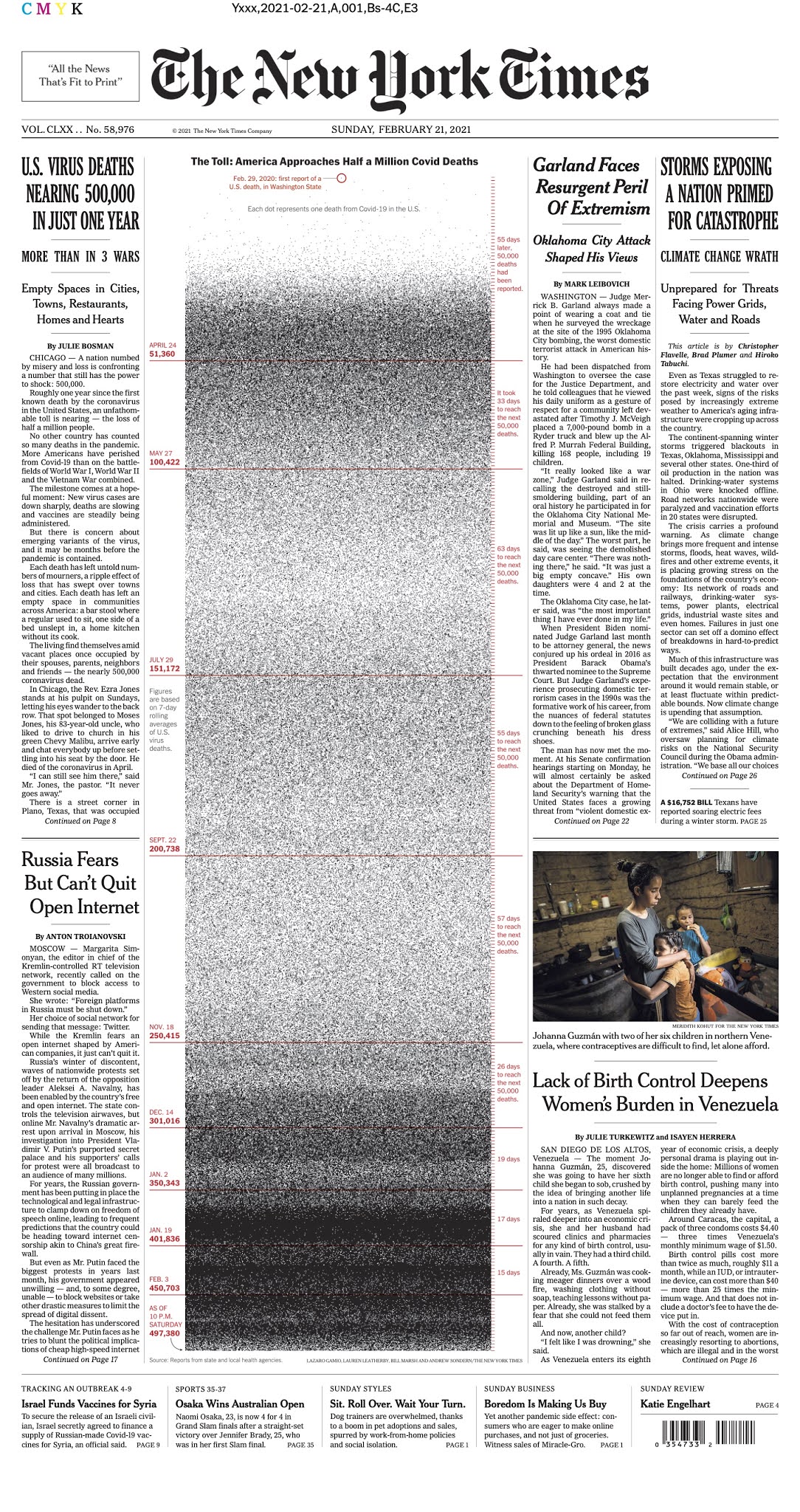
296,698 people have died of Covid-19 in the United States, as of today.

Today (December 9) it is reported that at least 3,243 people died of Coronavirus in the United States, according to Worldometer. In each of twenty states, more than 50 people died of the virus. This is the most reported in a single day, since the beginning of the pandemic. We've surpassed the level of illness that existed in the spring, and there's no sign of the toll lessening.


Update for December 10 - 3,105 people died of Covid, for a total of 299,738.


Update for December 11 - 3,042 people died of Covid, for a total of 302,773.


Update for December 12 - 2,038 deaths, for a total of 305,081 Americans.


Update for December 13 - 1,379 deaths, for a total of 306,459 Americans who have died of Covid.


Saturday, December 05, 2020

The Helix Nebula

Looking like a great celestial eye, this is the Helix Nebula. Discovered 200 years ago, it is a planetary nebula located in the constellation Aquarius. One of the closest to the Earth of all the bright planetary nebulae.

📷 NASA's Hubble telescope
(Image posted in the Nature Revives 2020 Facebook group).


Pottery masks for sale - Ithaca, New York


In January of 2016 I started to make pottery. I had made pottery when I was a teenager, along with other crafts, but stopped when I graduated from high school. I was inspired to start making pottery again because of a friend of mine who had many hobbies, and enjoyed them greatly. I realized that I didn't have any hobbies, and that I wanted to do something creative that appealed to my artistic side. I took classes at the Clay School of Ithaca, and I got hooked. I started with throwing on the wheel, but I never managed to get as good at it as I felt I needed to be, and took a handbuilding class and discovered that I enjoyed it much more. 


In 2015, on a visit to Israel, I went to an exhibit at the Israel Museum in Jerusalem that displayed ancient stone masks from the Neolithic period. I became fascinated and started to make my own - first trying to copy the Neolithic masks and then creating my own designs based on the stone masks but in my own style.


I'm now selling these masks at a local pottery pop-up store (open until December 23). If you're interested in looking at them in person, they're being sold in the back room at Buffalo Street Books, in the Dewitt Mall, which is open from 12:00-4:00 pm.