Word of the day / Hadarat nashim הדרת נשים: A good article in Haaretz explaining the grammar of the fairly new expression used to refer to the exclusion of women.
When the issue of discrimination against women exploded on the Israeli scene last winter, mixing long-simmering issues like sex-segregated busing and the absence of women from billboards in Jerusalem with new trends like ultra-Orthodox men spitting at young girls in Beit Shemesh, the phrase of choice in the local media was not “aflaya” (af-la-YA) or “discrimination,” but “hadarat nashim” (hah-dah-RAHT nah-SHEEM), literally meaning “the exclusion of women,” referring to women and girls being excluded from the public domain.
Showing posts with label women. Show all posts
Showing posts with label women. Show all posts
Monday, August 27, 2012


Monday, December 22, 2008
Khaye, the Daughter of Yiftach
I'm in the midst of grading final exams for my Hebrew Scriptures course, and one of the questions that I set the students was an analysis of the story of Yiftach and his daughter, one of the most troubling stories in the Bible, in Judges 11. Yiftach makes a vow to sacrifice the first thing that comes out of his house if he is victorious in his battle against the Ammonites. He is victorious, and when he comes home, his daughter, who is his only child, runs out dancing with timbrels to greet him. It is she whom he must sacrifice. He does not retract his vow, and the implication at the end of the story is that he sacrificed her, after she spent two months in the hills mourning her virginity with her friends.
There is no moral condemnation of Yiftach in the story, as there is also no moral condemnation of Abraham in Genesis 22 when he prepares to sacrifice his son Isaac. In both cases, God has commanded or permitted the sacrifice of the child. The difference, of course, is that Yiftach actually goes through with it.
The story depicts the daughter of Yiftach as acquiescing in her father's vow. She says, "You have opened your mouth to YHWH - do to me according to what came out of your mouth, since YHWH has wreaked vengeance on your enemies, on the Ammonites." Since God has fulfilled his side of the vow - it was he who brought the Ammonites defeat at the hands of Yiftach - then Yiftach has to fulfill his side of the vow, and bring the sacrifice.
Would she really have acquiesced so calmly? (She is calm - her father is upset, panicked). My students, in their essays, explain her agreement with her father as submission to his will as the patriarch of the family who is due his daughter's obedience. I resist this interpretation - frankly, it seems tragic and sad that a young woman could agree to her own destruction.
So I have written a poem to express my own feelings about this story.
An Only Daughter
“To God Himself she is an only daughter”
an only daughter – bas-yekhide
who sits at God’s right hand,
his sister Khaye, green eyes and black braids*
Who else is an only daughter?
“She was his only daughter; aside from her he had neither son nor daughter”
And what did he say about her?
“Whatever comes, indeed comes, out of the doors of my house to greet me when I return in peace from the sons of Ammon will be for YHWH and I will raise it up as something raised-up.”
But it was not peace, it was war
He did not return in peace from the sons of Ammon,
He returned in war –
“He struck them from Aroer up to Minnit, twenty cities, as far as Avel-Keramim, a very great blow, and the sons of Ammon were subdued before the sons of Israel.”
“I opened my mouth to YHWH, and I cannot go back”
His name is Opener and indeed he opened the way but could not return on it
She was his troubler who brought him low
It’s almost as if I’m an observer now – the old weary grizzled man, the young girl with the drum in her hand, the men behind him unloading the donkeys
As he spoke, he slid his hand onto the hilt of his sword and pulled it out of the scabbard
then he was standing holding it almost at her throat
I don’t know how I was able to say it, I don’t remember how I was so calm
“Let this thing be done for me; let me alone two months and I will go and descend upon the hills, and I will weep for my virginity, I and my friends.”
the men behind him took the load off the donkeys
Opener/Yiftach left the sword in the dust
He walked through the doors of his house
But the other girl? That one,
O, she returned to her father’s house, and
he did to her as he had vowed
“My sister Khaye with her eyes of green
A German burned her in Treblinka.”
And the four days of mourning of the daughters of Israel?
the tenth of Tevet, the twenty-seventh of Nissan, the seventeenth of Tammuz, and the ninth of Av
Note: Khaye is a reference to a poem by Binem Heller, "My Sister Khaye," which was written in memory of his sister who died at Treblinka. It was set to music by Chava Alberstein for her recording "The Well," which she did with the Klezmatics.
There is no moral condemnation of Yiftach in the story, as there is also no moral condemnation of Abraham in Genesis 22 when he prepares to sacrifice his son Isaac. In both cases, God has commanded or permitted the sacrifice of the child. The difference, of course, is that Yiftach actually goes through with it.
The story depicts the daughter of Yiftach as acquiescing in her father's vow. She says, "You have opened your mouth to YHWH - do to me according to what came out of your mouth, since YHWH has wreaked vengeance on your enemies, on the Ammonites." Since God has fulfilled his side of the vow - it was he who brought the Ammonites defeat at the hands of Yiftach - then Yiftach has to fulfill his side of the vow, and bring the sacrifice.
Would she really have acquiesced so calmly? (She is calm - her father is upset, panicked). My students, in their essays, explain her agreement with her father as submission to his will as the patriarch of the family who is due his daughter's obedience. I resist this interpretation - frankly, it seems tragic and sad that a young woman could agree to her own destruction.
So I have written a poem to express my own feelings about this story.
An Only Daughter
“To God Himself she is an only daughter”
an only daughter – bas-yekhide
who sits at God’s right hand,
his sister Khaye, green eyes and black braids*
Who else is an only daughter?
“She was his only daughter; aside from her he had neither son nor daughter”
And what did he say about her?
“Whatever comes, indeed comes, out of the doors of my house to greet me when I return in peace from the sons of Ammon will be for YHWH and I will raise it up as something raised-up.”
But it was not peace, it was war
He did not return in peace from the sons of Ammon,
He returned in war –
“He struck them from Aroer up to Minnit, twenty cities, as far as Avel-Keramim, a very great blow, and the sons of Ammon were subdued before the sons of Israel.”
I didn’t hear the old man’s words when he made his vowWhat did he say when he saw it was his daughter, his only daughter?
He was in the Fortress of Gilead
but our house was in the Land of Good.
I don’t know why he went back there – his brothers used to call him
the Son of the Whore, the Son of the Other Woman
What did he owe them?
But when they called, he came
He still wanted them to give him his true inheritance
So he agreed to that strange scheme
To fight the sons of Ammon
And get what in return?
To be a judge – “his hand against every man, and every man’s hand against him”
“I opened my mouth to YHWH, and I cannot go back”
His name is Opener and indeed he opened the way but could not return on it
She was his troubler who brought him low
I danced out of the house with the drums in my handI look back on that scene from a great distance now
when I heard that Abba was returning
at last, from all the wars
Maybe this time he would stay in the Good Land
He was wearing his armor, with his sword on his hip
He looked at me,
suddenly, his eyes opened wide and he said,
“Alas, my daughter! I opened my mouth to YHWH, and I cannot go back.”
Go back from what? I opened my mouth to ask Abba,
and then I saw the sword in his hand
His eyes weren’t looking at me anymore
But at the tip of that sword
It’s almost as if I’m an observer now – the old weary grizzled man, the young girl with the drum in her hand, the men behind him unloading the donkeys
As he spoke, he slid his hand onto the hilt of his sword and pulled it out of the scabbard
then he was standing holding it almost at her throat
I don’t know how I was able to say it, I don’t remember how I was so calm
“Let this thing be done for me; let me alone two months and I will go and descend upon the hills, and I will weep for my virginity, I and my friends.”
He looked at the sword in his handSudden movement –
The men behind him froze, the ropes in their hands falling to the ground
He looked down again at me
I was such a little gir
The sword fell, its tip digging into the ground
the men behind him took the load off the donkeys
Opener/Yiftach left the sword in the dust
He walked through the doors of his house
And I?Sometimes it is possible to change the ending of the story
I went into the hills
I descended into the hills
And I never came back.
But the other girl? That one,
O, she returned to her father’s house, and
he did to her as he had vowed
“My sister Khaye with her eyes of green
A German burned her in Treblinka.”
And the four days of mourning of the daughters of Israel?
the tenth of Tevet, the twenty-seventh of Nissan, the seventeenth of Tammuz, and the ninth of Av
Note: Khaye is a reference to a poem by Binem Heller, "My Sister Khaye," which was written in memory of his sister who died at Treblinka. It was set to music by Chava Alberstein for her recording "The Well," which she did with the Klezmatics.
Wednesday, September 03, 2008
Photos of Western Wall
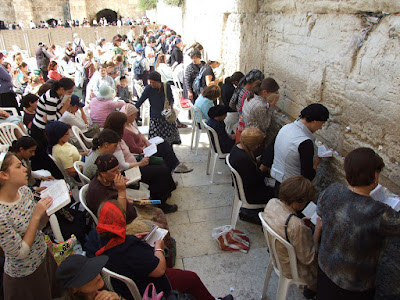
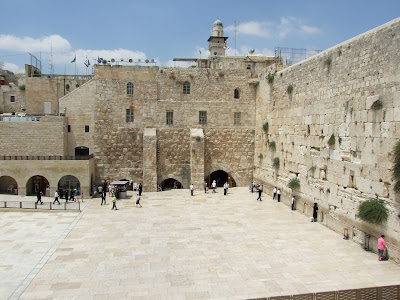
And now, down from the Temple Mount, a couple of photos of the Western Wall - first the women's side (which you'll notice is much smaller than the men's) and then the men's side.
 |
| From Old City of Jerusalem |
 |
| From Old City of Jerusalem |
Subscribe to:
Posts (Atom)