Sunday, February 05, 2006

Mahmood's Den on the cartoons

Mahmood, of Mahmood's Den, gives a very interesting response to the cartoons.
The main thing is the prohibition by Islam on representing the prophets graphically, possibly for fear of some people using that graphic as an idol, hence promoting idolatry practices rather than praying to Allah alone.

These cartoons not only represented the prophet, but made fun of, and denigrated him; that's double trouble.

As every Muslim is brought up to respect not only our prophet but also all those who have been sent by Allah to disperse His religions, and that we do not represent the prophet in any way, shape or form, they were insulted by the caricatures which were seen as the height of blasphemy.

Now as WE revere the prophet of Islam (pbuh) and do not represent him and hold him at the highest platform, and as we hold the other prophets at the same level of love and respect, we expect that everyone else in the world to hold our prophet in the same light. Reciprocal respect, if you like, was a "given" to us.

These cartoons shocked Muslims because we were slapped in the face. That respect, it was found, was not reciprocal at all, but one sided.

Now the way that Muslims went about dealing with this situation is, to me, farcical.

Yes, we should hold the prophet at the highest level of love and affection. Yes, we should defend him and his reputation, but the level that most of the protests I've seen, the worst of which was paradoxically in London, proves the point of those cartoons without a shadow of a doubt: Islam is a religion of hate and violence.

These protests and the way this situation was handled is completely wrong. We - continue to preach - that we have the higher moral hand, that our religion is the religion of peace, that our religion is the highest form of moral contract, yet, we go about the streets in droves holding up placards DEMANDING the death and torture of ANYONE who denigrates our religion and its symbols! Why should anyone respect us if this is the way we go about things?

These protests demanding violence, to me, is a complete moral bancruptcy of those taking part in those protests AND of their particular understanding of Islam.

I keep saying, so what if a dimwitted cartoonist, or Nazi or racist or a stupid person drew a cartoon or swore at our religious symbols or misrepresented them? Is that going to reduce our symbols' place in our and hundreds of millions of Muslims' hearts? Is that going to change their greatness? Of course not. So why was this situation blown up out of all rational repercussions?

I think this situation was used to divert the Muslim nation's attention from the real problems festering in its midst. And these things - a full 5 months after being published - were picked up and used, abused, to do just that.

Forget the festering corruption, negligible education, unemployment, squandering of opportunities, injustice, restriction of speech, restriction of expression, and the hundreds of other bad things we go through on a daily basis, and hang them all on a bunch of Danish cartoonists.

I don't buy it.

These cartoons or the hundreds of thousands of ones which probably have been drawn and are more offensive than the original 12 published because of the brouhaha we created will not negate nor lessen my love and respect for a great man sent by Allah as a saviour of the world.

What DOES offend me greatly however is the once again hijacking of my religion, this time universally by all sects, to show the world that it is ugly, intolerant, and violent.
I would like to make it clear that I don't endorse the sentiments reflected by some of the cartoons published by the Danish newspaper. (Some of them are actually poking fun at the newspaper itself). When I first read selections of the Qur'an as a graduate student in religion, I was very moved - the Qur'an retells many stories from the Hebrew Scriptures, and also refers to later rabbinic traditions (for example, the statement that "he who kills one person, it is as if he has destroyed an entire world").

There was something very similar religiously to what I was accustomed to finding in Judaism - concern for the weak and the poor, the necessity to seek justice, strict insistence on the oneness of God, and the importance of prophecy. The first part of the Muslim confession of faith - the shehadah - is something that Jews would have no problem saying: "There is no god but God." (Compare the sh'ma: "Hear O Israel, the Lord is our God, the Lord alone").

The portrayal of Muhammed in the Qur'an bears striking similarities to the depiction of prophets in the Bible. I don't see any reason to mock or condemn the figure of Muhammed as he is known from the Qur'an, and it makes sense to me why Muslims revere him.

Like Mahmood with some of his fellow Muslims, I have been enraged and saddened when I feel that fellow Jews are trying to hijack my religion and turn it into an excuse for hatred and violence. A number of years ago, when I was living in Israel, one Shabbat afternoon I was visiting someone in the Old City of Jerusalem. The guests went up on to the roof, where we had a clear view of the Western Wall and the Temple Mount - the place sacred to Jews because it is where the Temple stood until it was destroyed by the Romans in the year 70 C.E. It is also a place holy to Muslims - the Al-Aqsa Mosque and the Dome of the Rock are located there. The Dome of the Rock may stand on the spot where the Temple once stood. If you have never seen it, it is a beautiful building, with a golden dome and tiled walls. I was standing next to a young religious Jewish man, an American who was studying in Jerusalem, and we were both looking at the Temple Mount. I said to him something like - isn't it a beautiful building? He pointed to the Dome of the Rock and made as if to shoot at it. He said that it would be good if it were destroyed, so that the Temple could be rebuilt on the spot. I said, but aren't they (Muslims) also human beings, made in the image of God (implying that many people would be killed if the mosques on the Temple Mount were destroyed)? He allowed as they might be, but my words clearly had no effect on his desire to destroy the Dome of the Rock.

I don't see that there's any place in Judaism for this kind of hatred and incitement to violence. Unfortunately not all Jews agree with me on this point.

Other cartoons

Here are some examples of recent anti-semitic cartoons in the Saudi Press, courtesy of The Religious Policeman.

And see this list of recent anti-semitic press reports from the Arab and Muslim world:

Iran TV Discussion on the Myth of the Gas Chambers and the Truth of Protocols of the Elders of Zion; ‘The Only Solution for This Cancerous Tumor [Israel] is Surgery’ (from January 5, 2006).

U.S.-Based Saudi Professor & Former U.N. Fellow in Interview with Iranian State Media: ‘I Agree Wholeheartedly with President Ahmadinejad… There was No Such Thing as the Holocaust’; The Americans are Digging Their Own Grave and Eventually Will Collapse Just as the Soviet Union Collapsed. This was from an interview on Iranian state media.

Iranian TV Blood Libel: Jewish Rabbis Killed Hundreds of European Children to use Their Blood for Passover Holiday & Discussion on Holocaust Denial.

MEMRI also lists articles by Arab and Muslim writers who OPPOSE the use of anti-semitism - it's not just a one-sided story.

But why isn't the U.S. State Department issuing prominent statements about the plethora of anti-semitic stories, TV broadcasts, etc., on the media of the Arab and Muslim world?

Cartoon Context

Andrew Sullivan on the caricatures of Muhammed (he has several good posts on this topic) - "Islamists and Muslims are in a violent uproar about the publication of truly conventional political cartoons featuring the prophet Muhammed. Here are some other cartoons recently printed in the Arab, Muslim press. They are no different than Nazi propaganda in their unvarnished anti-Semitism. And I would defend the right of every one of those papers to publish them. Why, then, cannot Muslims return the favor? What is it about contemporary Islam that seems to make it clearly incompatible wih Western freedom of speech? In that may lie the answer to the most pressing question facing the West today: the illiberal, fanatical religious enemy within."

There are some Muslims who do return the favor (of tolerating even offensive speech), such as the Religious Policeman - alas, they are not the ones in power.

Saturday, February 04, 2006

Violence and Cartoons

This is unbelievable - Embassies in Syria Are Burned in Furor Over Prophet Cartoon. The Danish and Norwegian embassies in Damascus were burned down by mobs in protest against the caricatures of Muhammed published first by Danish and then by Norwegian newspapers.

The Vatican also made an unhelpful statement: "deploring the violence" but saying that freedom of speech "cannot entail the right to offend the religious sentiment of believers." This strikes me as highly self-serving, coming from the Vatican - is Catholicism immune from criticism and mockery? I daresay they would have closed down the exhibit in New York City that showed a few years ago, which included a painting by an African Catholic that depicted elephant dung on the Virgin Mary's breast.

The U.S. State Department also said that about the cartoons: "We find them offensive, and we certainly understand why Muslims would find these images offensive." They did say, at least, "We vigorously defend the right of individuals to express points of view."

The leader of Hamas said that the cartoonists should be murdered.

In South Africa, a court forbade Sunday newspapers from reprinting the cartoons.

As far as I know, no American newspaper has reprinted the cartoons - and NPR, which I've been listening to, is not publishing them on the website article about them, using the excuse that it's not necessary to do so in order to tell the story. (An article in today's New York Times discusses how American newspapers and broadcast media generally decided not to show images of the cartoons)

I first heard about the cartoons not from the public media, but from the Religious Policeman blog. The RP is a Saudi, currently living in Britain, who engages in fearless criticism and mockery of his own government and its religious pretensions. He talks about how this whole controversy is fanned by governments in the Middle East in order to distract people from thinking about the real problems in their lives caused by their dictatorial and oppressive governments. He accuses the Saudi government of raising rage about the cartoons to fever pitch in order to direct public attention away from the recent stampede at the Hajj in which hundreds of pilgrims died.

I must say, I think there is a great deal of hypocrisy surrounding this issue. Press and other media in Arab and Muslim countries publish and broadcast anti-semitic cartoons, articles, television series, etc. - which don't just make fun of Jews and Judaism, but defame Jews and spread outright lies, along with denying that the Holocaust occurred (e.g., President Ahmadinejad of Iran). Why hasn't there been a worldwide outrage at this continuous defamation of Jews? The American and European press certainly don't constantly run articles about widespread official anti-semitism in Arab and Muslim countries.

The other thing that offends me is the idea that religion and religious people should be shielded from mockery or otherwise offensive speech. As I've said before, religion, like anything else, is open for criticism, mockery, etc. I don't like it when people mock practices and beliefs that I consider sacred, but that is part of what it means to live in a free society. If Christopher Hitchens writes an article denouncing a particular practice associated with Jewish circumcision, I don't think he should be told to shut up because it might offend my religious sensibilities. Why has religion come to acquire this quality that it is above criticism?

And I speak as a religious person, not as an atheist.

UPDATE, Sunday morning - The Danish Embassy in Beirut was burned by a mob today.

Wednesday, February 01, 2006

Hamas and Us

I received a different perspective on the Hamas victory from a friend involved with the Coalition of Women for Peace group in Israel - Gila Svirsky.
1) Who’s to blame?

Listening to the reactions of passersby at the recent Jerusalem vigil of Women in Black, you would think it was our peaceful little group that put the Hamas into power. This stems from Israeli right-wing politicians who are asserting that Hamas won because of the Gaza withdrawal and other conciliatory overtures, i.e., “rewarding terrorism”. Indeed, Bibi Netanyahu & co. are delighted with the Hamas victory, on which they can now build a fear-saturated election campaign, and return voters to the fold who lately had slipped into something more moderate.

But here’s my take on what made Hamas victorious in the recent elections: Israel’s failure to sit down and negotiate an end to the occupation. This is often phrased as “the failure of Fatah to make progress on peace”, but they amount to the same thing: the Fatah failed because Israel refused to offer any reward for moderation, refusing to sit down and negotiate with them.

And what about the corruption claim – that voting for Hamas was also a vote against the corruption of the Fatah politicians? This may have played a role for some voters, but since when does corruption bring down a politician? Certainly not in Israel, where Sharon’s corruption has been an open book, but forgiven by those who support his politics. Corruption is tolerated when approval ratings are high in other respects. The corruption of the previous Palestinian government would have been overlooked, had the politicians only managed to show some progress on ending the occupation.

2) When terrorists become politicians

I remember standing on the balcony of my home in Jerusalem on a lovely May morning of 1977 and gasping when I heard who had won the Israeli election: Menahem Begin, former head of a Jewish terrorist organization that had killed 91 civilians by bombing the King David Hotel in 1946. And then it was Begin who returned the Sinai Peninsula and negotiated peace with Egypt. In 2001, Israel elected Ariel Sharon, responsible for blood-soaked episodes in Qibiya, Beirut, Gaza, Sabra and Shatila, and more. And then it was Sharon who returned Gaza – imperfect, but a singularly important precedent.

I condemn terrorism, whether ‘rogue’ or state sanctioned, and I would never have voted for Hamas (or Begin or Sharon). But who is better positioned than Hamas to reach a compromise peace agreement? We have the mirror image of Israel in the Palestinian election: Just as the Israeli right (Begin and Sharon) could more easily make concessions than Yitzhak Rabin, who had to fight our right wing all the way, so too the Hamas can mobilize more support for concessions than the more moderate Fatah could now undertake.

3) About creeping fundamentalism

Yes, I am worried about Hamas rule, particularly its domestic agenda in Palestine: I worry about women, non-Muslims, journalists, gays, people in the arts, and all those who benefit from the open society. To what extent will the Hamas increase the role of Shari’a (Muslim) law in civilian life? Or religious education in the schools? On the other hand, it’s quite evident that Palestinians have experienced democracy and will not easily tolerate a closing of their society.

I take heart from this week’s survey of the Palestinian population, published in the Palestinian Authority’s Al-Hayat Al-Jadeeda and reported in the Jerusalem Post: 84% of Palestinians support a peace deal with Israel. In case you wondered if this includes the Hamas, 75% of Hamas voters are opposed to calls for the destruction of Israel. The Hamas knows that seculars comprise a large portion of their constituency.

4) And who benefits from ending foreign aid?

So along come American and Israeli politicians advocating for a policy that would isolate and punish the Palestinians by withholding financial aid. Everyone knows this would destabilize the fragile economy, harm the innocent (but not the politicians), and foster increasing bitterness against the secular west. A much more reasonable approach would be to extend support and see how responsibly Hamas uses it. Or does someone have an interest in sowing chaos in the Palestinian territories?

Yes, I too would like to demand a renunciation of terrorism and violence as a precondition for talking …I’d like to demand it from both sides. But realistically this has to be done as part of the negotiations.
I can understand her argument - it makes sense politically. But nonetheless I find it repugnant to think that American taxpayer dollars could get to Hamas.

"Virtual Talmud"

I got an e-mail from someone at Beliefnet, telling me about a new blog they're hosting - "Virtual Talmud." Here's the info.:

Q: Take three rabbis, turn them into bloggers, and what do you get?
A: Virtual Talmud!

"For the sake of heaven," no Jewish blog should be without a link to this novel forum. Virtual Talmud.

And who can resist a blog with headlines like: "The Commandment Pat Robertson Forgot," "Can Alito See the Shades of Gray?" and "Abramoff Fails the Shanda Test."

About Virtual Talmud:
In the spirit of the rabbinic tradition, Beliefnet has asked three rabbis to create a virtual Talmud, blogging on Judaism and the world today. Unlike the talmudic arguments of old, the interactivity of Virtual Talmud makes it possible for any member of our community to talk back to the learned teachers and to each other.

Meet our bloggers:
Rabbi Susan Grossman, a Conservative rabbi, is the rabbi of Beth Shalom Congregation in Columbia, Maryland. Rabbi Eliyahu Stern, an Orthodox rabbi, received rabbinic ordination and an M.A. in Talmud from Yeshiva University. Rabbi Joshua Waxman, a Reconstructionist rabbi, is the spiritual leader of Or Hadash: A Reconstructionist Congregation, located in Fort Washington, PA.

Sunday, January 29, 2006

Kosher money or non-kosher money?

Wow, did you hear that there's kosher money and non-kosher money? Heshy (of Heshy's House fame) just visited Israel and gave people the choice of being paid in kosher or non-kosher money. Guess which is which? It's not what you expect!

Nice to have something amusing to blog about!

Saturday, January 28, 2006

Hanna Siniora on Hamas

Another voice on the Hamas victory - from Hanna Siniora, the Palestinian co-leader of IPCRI:

For Hamas in opposition it was always easy to criticize. Now Hamas has a heavy of load of responsibility and duties to shoulder, on one hand they have to steer the ship of state to safety and to independence. As a religious fundamentalist movement they have to negotiate with Israel and be accepted by the West. Is Hamas able to modify its ideology? Or are they going to stick rigidly to its platform?

In the election campaign, Hamas managed to send signals of flexibility, they discarded the slogan calling for the destruction of Israel, Hamas announced its readiness to negotiate directly with Israel. They entered the democratic process of elections based on the Oslo agreements, while declaring that Oslo is dead. But what was important, tangible and real, and they continue to adhere the ceasefire.

Hamas, in a similar manner to the PLO before it is undergoing a process of transformation, history is repeating itself. Hamas is obliged to uphold its promises and pledges to its public to steer the ship of state to safety, to reexamine its platform, this is not going to happen overnight. In this process, it is a do or die situation, they have the responsibility of delivering the people from the burden of occupation as well as implementing their social and economic program. Militancy and armed confrontation of the occupation are not the tools of Hamas at the head of the PA they have also to change otherwise they will be isolated. The EU have to again be the vehicle in a similar role they played in the past with the PLO, the EU started it with the Venice declaration of 1980, the USA followed suit in the waning days of the Reagan administration and Israel through the Oslo Accords. Hamas also must reciprocate otherwise it will be ostracized and isolated. It is Hamas'’ turn to demonstrate flexibility and responsibility. Israel too can play an important role and profit from Hamas emerging as the leading power in the Palestinian political system. Israel has the ability to accelerate the Hamas movement towards moderation by adopting reciprocal and not unilateral steps. Israel by its actions can either drive Hamas deeper into the jungle or thus explode the fragile ceasefire or Israel and Hamas together can exploit the new situation to lead toward and political settlement.


Siniora seems to think that Hamas is in a process of transformation - I certainly hope that he is correct.

Selections from the Hamas Charter

The Hamas Charter details Hamas' enmity not only for the state of Israel and the Zionist movement, but also for the Jewish people.

Some quotations:

"For our struggle against the Jews is extremely wide-ranging and grave, so much so that it will need all the loyal efforts we can wield, to be followed by further steps and reinforced by successive battalions from the multifarious Arab and Islamic world, until the enemies are defeated and Allah’s victory prevails."

The Charter quotes a hadith often cited by anti-Israel and anti-semitic Jihadist groups:

"the Hamas has been looking forward to implement Allah’s promise whatever time it might take. The prophet, prayer and peace be upon him, said: 'The time will not come until Muslims will fight the Jews (and kill them); until the Jews hide behind rocks and trees, which will cry: O Muslim! there is a Jew hiding behind me, come on and kill him! This will not apply to the Gharqad, which is a Jewish tree' (cited by Bukhari and Muslim)."

The basic reason that Hamas cannot moderate, if it persists with its current charter, is found in Part III, Article Eleven: "The Islamic Resistance Movement believes that the land of Palestine has been an Islamic Waqf throughout the generations and until the Day of Resurrection, no one can renounce it or part of it, or abandon it or part of it."

On the possibility of peaceful solutions:

"[Peace] initiatives, the so-called peaceful solutions, and the international conferences to resolve the Palestinian problem, are all contrary to the beliefs of the Islamic Resistance Movement. For renouncing any part of Palestine means renouncing part of the religion; the nationalism of the Islamic Resistance Movement is part of its faith, the movement educates its members to adhere to its principles and to raise the banner of Allah over their homeland as they fight their Jihad: 'Allah is the all-powerful, but most people are not aware.'"

In Article Seventeen, which deals with the role of Muslim women, the charter says that the enemies understand that women are crucial in the formation of the next generation, and that if they turn women away from Islam, they will have one. At this point, the Charter goes off into the nowhereland of anti-semitic propaganda:

"Therefore, you can see them making consistent efforts [in that direction] by way of publicity and movies, curricula of education and culture, using as their intermediaries their craftsmen who are part of the various Zionist Organizations which take on all sorts of names and shapes such as: the Freemasons, Rotary Clubs, gangs of spies and the like. All of them are nests of saboteurs and sabotage. Those Zionist organizations control vast material resources, which enable them to fulfill their mission amidst societies, with a view of implementing Zionist goals and sowing the concepts that can be of use to the enemy."

It is a standard part of anti-semitic fantasies to connect the Freemasons to the Jews; this theme is found in the Protocols of the Elders of Zion.

The Charter also uses another standard anti-semitic slur: equating Jews with Nazis. In Article Twenty, it accuses Israel of being "a vicious, Nazi-like enemy," and then goes on to say, "The Nazism of the Jews does not skip women and children, it scares everyone. They make war against people’s livelihood, plunder their moneys and threaten their honor. In their horrible actions they mistreat people like the most horrendous war criminals."

Article Twenty-two tells the history of Zionism according to the fantasies of anti-semitic groups, again, accusing the Freemasons, the Rotary Club, and also Lions Clubs and the B'nai B'rith of being part of the Zionist movement. The "enemies" are accused of being behind the French and Communist revolutions, World War I (in order to wipe out the caliphate - i.e., the Ottoman Empire), and WWII (to make lots of money), and the U.N. (to rule the world).

Article Twenty-Eight again accuses the Freemasons et al of being spies for Zionism. It accuses Zionism of distributing drugs to destroy Muslim society. This article also says: "Israel, by virtue of its being Jewish and of having a Jewish population, defies Islam and the Muslims."

Article Thirty-Two takes the Protocols of the Elders of Zion for a truthful historical source: "For Zionist scheming has no end, and after Palestine they will covet expansion from the Nile to the Euphrates. Only when they have completed digesting the area on which they will have laid their hand, they will look forward to more expansion, etc. Their scheme has been laid out in the Protocols of the Elders of Zion, and their present [conduct] is the best proof of what is said there."

Unless and until Hamas rewrites its charter, renounces the anti-semitic assumptions upon which its beliefs about Israel and Jews are based, and abandons the "armed struggle" against Israel, I don't see how we can view this as an organization that is becoming moderate.

Hamas Leader Sees No Change Toward Israelis

Despite the hopeful statements on the Hamas victory that I've been hearing from commentators on the radio and reading in the newspapers, Hamas Leader Sees No Change Toward Israelis.

The political leader of Hamas, Khaled Meshal, in Damascus, said that Hamas would not "submit to pressure to recognize Israel, because the occupation is illegitimate and we will not abandon our rights," nor would it disarm, but work to create a unified Palestinian army. He defended attacks on Israeli civilians.
....arguing against any fundamental changes are Hamas's deeply held religious views, as expressed in its charter, sermons and election platform. Those views suggest that the kind of transformation that the secular P.L.O. took 25 years to make will be highly unlikely for a fundamentalist religious organization that regards all Israeli territory as irrevocably Muslim land.... Yossi Alpher, co-editor of bitterlemons.org, said ""I think we have to take Hamas at its words and assume that as Islamicists, they have some core beliefs that won't change."

The most fundamental of those beliefs, says Hisham Ahmed, a political scientist at Birzeit University in Ramallah and a student of Hamas, is that the entire land of Palestine belongs to Allah and is Muslim holy land. The 9,000-word Hamas charter, written in 1988, is explicit about the struggle for Palestine as a religious obligation. It describes the land as a "waqf," or endowment, saying that Hamas "believes that the land of Palestine has been an Islamic waqf throughout the generations and until the Day of Resurrection, no one can renounce it or part of it, or abandon it or part of it."

In the charter, Hamas describes itself as "a distinct Palestinian Movement which owes its loyalty to Allah, derives from Islam its way of life and strives to raise the banner of Allah over every inch of Palestine."

It calls for the elimination of Israel and Jews from Islamic holy land and portrays the Jews as evil, citing a bizarre anti-Semitic version of history going back to the Crusades. It also includes a reference to the noted czarist forgery of a plan for world domination called "The Protocols of the Elders of Zion" and condemnation of supposedly Zionist organizations like the Rotary Club and the Masons. It describes the struggle against the Jews as a religious obligation for every Muslim, saying, "For our struggle against the Jews is extremely wide ranging and grave, so much so that it will need all the loyal efforts we can wield, to be followed by further steps and reinforced by successive battalions from the multifarious Arab and Islamic world, until the enemies are defeated and Allah's victory prevails."
While the Hamas election platform did not refer to seeking the destruction of Israel, this does not mean that the organization's goals have changed.
Despite the platform's relative moderation, a Hamas spokesman, Sami Abu Zuhri, vehemently denied any contradictions with the charter. "The platform refers to details and implementation methods for the next four years, while the charter lays out our permanent strategic views," he said....

But no Hamas leader or candidate is on record as sanctioning a permanent recognition of Israel's right to exist side by side with an independent Palestinian state, which has been the cornerstone assumption of peace negotiations since the Oslo accords in 1993. As Mr. Zahar also said, "We do not recognize the Israeli enemy, nor his right to be our neighbor, nor to stay, nor his ownership of any inch of land." Nor is any Hamas leader on record as expressing a willingness to disarm or to stop attacks on Israel and Israelis, or to make a distinction between Israeli soldiers and civilians, especially settlers living on occupied land, however defined.
Thus, I don't understand why people continue to be so optimistic that Hamas will moderate and be willing to speak to Israel. I don't see any evidence for this, unfortunately.

Thursday, January 26, 2006

Hamas victory

As Amir Oren of Haaretz says: "Hamas' victory in the Palestinian elections is one of the most important events in the history of the Middle East since the Six Day War. Not only does it change the picture, but also it puts it into a completely different frame. Palestine under Hamas rule puts an end not only to the road map and the Oslo process, but also to the formula embodied by UN Resolution 242: "land for peace" and an accompanying end to the conflict. Not only does it perpetuate the conflict, but also it reshapes it - from an Israeli-Palestinian conflict to a Jewish-Arab one, and even a Western-Muslim one. Such a conflict, backed by the global Jihad movement and Khomeinist Iran, has neither a solution nor an end."

He ends by saying: "Rabin brought Arafat. Arafat brought Benjamin Netanyahu and Sharon to power. Sharon brought Hamas. And Hamas will yet bring back Netanyahu - and the lion shall lie down with the lamb."

I know that today's Haaretz still says that Kadima will win the Israeli election, but I find this difficult to believe. I find it very likely that Netanyahu will win the election, or at least come very close to doing so.

This is a disaster.

Wednesday, January 25, 2006

Iranian blogger

Through Velveteen Rabbi I came across this blog by an Iranian, Hossein Derakhshan, now living in Toronto - Editor: Myself. It is a real relief to read a such a sane, peace-seeking person, a good antidote to Ahmedinejad. He's currently visiting Israel.

Thus shall it be done unto the man

An interesting literary point is made in this Haaretz article on Shaul Mofaz's recent remarks about Iran - Thus shall it be done unto the man.
Thus spake Shaul Mofaz at the Herzliya Conference on Saturday evening, in his appeal to Iranian President Mahmoud Ahmadinejad: "You would be advised to learn from history to see what became of tyrants like you who tried to annihilate the Jewish people. They only brought destruction upon their own people."

Addressing the Iranian people directly, Mofaz said, "Ahmadinejad, his hallucinatory statements, his criminal actions and his extreme views will bring disaster upon you. Do what you know to be right in order to prevent this."

Sound familiar?

In the Book of Esther, Haman's wife Zeresh warns her husband: "If Mordechai, before whom thou hast begun to fall, be of the seed of the Jews, thou shalt not prevail against him, but shalt surely fall before him." (Esther 6:13)

Since Mofaz thought it appropriate to mention his own Iranian background ("a native of the city in which I was born") in his appeal to Ahmadinejad, it is legitimate to point out the connection - at least the associative one - between the warnings that he sent to the Iranian people and the fate of the oppressors of the Jews in Persia as inscribed in Jewish tradition.
The Haaretz article then goes on to criticize Mofaz by saying that Mofaz's words "cause people to question their wisdom" and to ask "What is achieved by Israel explicitly threatening to destroy Iran?" I'm not so sure that's the import of his allusions to the story of Esther, since in that book, Haman and his supporters are destroyed - not the entire Persian Empire. Actually, in the end, Persia ends up with a Jewish queen. It also strikes me that Mofaz is using quasi-religious language to assert that no matter what the opponents of the Jewish people may try to do to them, they will somehow inevitably be defeated. While this may be a comforting statement from the religious point of view, I somehow doubt that it's necessarily true politically.

Sunday, January 22, 2006

Ahmadinejad meets radical Palestinian chiefs in Syria

I was kind of wondering why Ahmadinejad was in Syria - turns out he was meeting radical Palestinian chiefs in Syria.
Iranian President Mahmoud Ahmadinejad met in Damascus with the leaders of 10 radical Palestinian movements including Islamic Jihad and Hamas. Ahmadinejad said he "strongly supports the Palestinian people's struggle" during the meeting, according to Popular Front for the Liberation of Palestine (PFLP) official Maher Taher Friday. Taher said the militant chiefs pledged to Ahmadinejad that the "Palestinian resistance and struggle would continue" against Israel.

"We expressed our solidarity with Syria, which is under pressure due to its national positions, as well as with Iran which has the right to possess nuclear technology for peaceful purposes," he added. Islamic Jihad chief Abdullah Ramadan Shala, Hamas leader Khaled Meshaal and PFLP-GC leader Ahmed Jibril were among those at the meeting, Taher said.

The meeting came one day after Islamic Jihad claimed a suicide attack in Tel Aviv that wounded 19 people. Israel blamed Tehran and Damascus for supporting the attack. "The attack was financed by Tehran, planned in Syria and carried out by Palestinians," Israeli Defense Minister Shaul Mofaz was quoted as saying by a ministry official.

Syrian President Bashar al-Assad did not attend Ahmadinejad's meeting with the Palestinian chiefs, though he and Ahmadinejad met Thursday in Damascus as the two allies reaffirmed their ties amid increasing international pressure....

The ultra-conservative Iranian president has already faced international outcry over his comments describing Israel as a "tumor" that should be "wiped off the map." During his first visit to sole regional ally Syria since his shock election win in June, Ahmadinejad described Israeli Jews as "migrants" and asked if Europeans would be willing to accommodate them. "Give these migrants authorization to come into your countries and you will see that they no longer want to live in occupied (Palestinian) territory," Ahmadinejad said during a meeting with high-ranking Syrian officials.

"Are you prepared to open the doors of your country to migrants so that they can move freely throughout Europe? Are you going to guarantee their security and no longer engage in anti-Semitic repression if they come into your countries?" he asked, adding that he doubted Europeans' "sincerity."

'Divine mission' driving Iran's new leader

An exploration of Ahmadinejad's apocalyptic theology: 'Divine mission' driving Iran's new leader.
The most remarkable aspect of Mr Ahmadinejad's piety is his devotion to the Hidden Imam, the Messiah-like figure of Shia Islam, and the president's belief that his government must prepare the country for his return. One of the first acts of Mr Ahmadinejad's government was to donate about £10 million to the Jamkaran mosque, a popular pilgrimage site where the pious come to drop messages to the Hidden Imam into a holy well.

All streams of Islam believe in a divine saviour, known as the Mahdi, who will appear at the End of Days. A common rumour - denied by the government but widely believed - is that Mr Ahmadinejad and his cabinet have signed a "contract" pledging themselves to work for the return of the Mahdi and sent it to Jamkaran.

Iran's dominant "Twelver" sect believes this will be Mohammed ibn Hasan, regarded as the 12th Imam, or righteous descendant of the Prophet Mohammad. He is said to have gone into "occlusion" in the ninth century, at the age of five. His return will be preceded by cosmic chaos, war and bloodshed. After a cataclysmic confrontation with evil and darkness, the Mahdi will lead the world to an era of universal peace. This is similar to the Christian vision of the Apocalypse. Indeed, the Hidden Imam is expected to return in the company of Jesus.

Mr Ahmadinejad appears to believe that these events are close at hand and that ordinary mortals can influence the divine timetable.

The prospect of such a man obtaining nuclear weapons is worrying. The unspoken question is this: is Mr Ahmadinejad now tempting a clash with the West because he feels safe in the belief of the imminent return of the Hidden Imam? Worse, might he be trying to provoke chaos in the hope of hastening his reappearance?....

Its most remarkable manifestation came with Mr Ahmadinejad's international debut, his speech to the United Nations. World leaders had expected a conciliatory proposal to defuse the nuclear crisis after Teheran had restarted another part of its nuclear programme in August. Instead, they heard the president speak in apocalyptic terms of Iran struggling against an evil West that sought to promote "state terrorism", impose "the logic of the dark ages" and divide the world into "light and dark countries". The speech ended with the messianic appeal to God to "hasten the emergence of your last repository, the Promised One, that perfect and pure human being, the one that will fill this world with justice and peace".

In a video distributed by an Iranian web site in November, Mr Ahmadinejad described how one of his Iranian colleagues had claimed to have seen a glow of light around the president as he began his speech to the UN. "I felt it myself too," Mr Ahmadinejad recounts. "I felt that all of a sudden the atmosphere changed there. And for 27-28 minutes all the leaders did not blink…It's not an exaggeration, because I was looking. They were astonished, as if a hand held them there and made them sit. It had opened their eyes and ears for the message of the Islamic Republic."

Western officials said the real reason for any open-eyed stares from delegates was that "they couldn't believe what they were hearing from Ahmadinejad." Their sneaking suspicion is that Iran's president actually relishes a clash with the West in the conviction that it would rekindle the spirit of the Islamic revolution and - who knows - speed up the arrival of the Hidden Imam.
In the course on Biblical Interpretation that I'm co-teaching this semester, we're going to spend the last several weeks discussing apocalypticism in Judaism and Christianity - now I wonder if we should discuss Islam as well. I don't know much about Islamic apocalypticism - except what I read about in Gershom Gorenberg's book, The End of Days.

Iran and the Bomb

In tomorrow's Times, David Brooks lays out the four bad solutions to the current standoff with Iran - Hating the Bomb. Given my own political predilections, I would go with the "pre-emptionists," who include John McCain.
Pre-emptors would work with Europe and the U.N. to step up pressure on Iran, while making it clear the world is willing to do what it takes to halt the nuclear program. As McCain said on "Face the Nation": "There is only one thing worse than the United States exercising a military option. That is a nuclear-armed Iran."
But all of the options are bad.

The most recent statement by the Israeli Defense Minister on Iran:
Israel's Defense Minister Shaul Mofaz warned the people of Iran on Saturday that their president would bring disaster and suffering upon them if he continued to call for the destruction of the Jewish state. He also said Israel was preparing to protect itself if international diplomatic efforts failed to convince Iran to give up its nuclear program.

Speaking at the Herzliya conference, an annual gathering of politicians and academics, Iranian-born Mofaz said he knew a large portion of the Iranian people did not support President Mahmoud Ahmedinejad's ideology.

Mofaz addressed the Iranian people saying: "Ahmedinejad, his hallucinatory statements, his criminal actions and his extreme views will bring disaster upon you. Do what you understand needs to be done in order to prevent this.'' Mofaz, who was speaking in Hebrew, said Ahmedinejad should look at historical examples of others who tried to destroy the Jewish people.

"You, who are leading your country in an ideology of hatred, terror and anti-Semitism. You had better take a glance at history and see what became of tyrants like you who tried to annihilate the Jewish people. They only brought destruction upon their own people,'' he said.

Ahmedinejad has said that Israel should be :wiped off the map'' and has questioned whether the Holocaust took place.

Mofaz said that 2006 was a "year of transition'' during which Iran would not yet have a nuclear bomb, but that Israel would have to do all it could to make sure the United States and European nations maintained diplomatic pressure on the Iranians.

The United States and European Union want Iran's nuclear program to be referred to the U.N. Security Council, which has the power to impose sanctions, and accuse Tehran of seeking nuclear bombs. Iran says its nuclear program is purely for generating electricity.

"Israel's policy is ... to bring this hot potato to the Security Council to impose sanctions and invasive inspection,'' Mofaz said. He said Israel would nevertheless continue its preparations to protect itself if diplomatic means against Iran failed. "Israel must be capable of protecting itself and ... we are preparing for this,'' he said.
The stuff of nightmares.

And Ahmadinejad is up to his usual rhetoric:
In a new attack on the existence of Israel, Iranian President Mahmoud Ahmadinejad has challenged Europe to take back the Jews who emigrated to Israel, adding that no Jews would remain in Israel if Europe were to open its doors.

Ahmadinejad delivered the challenge after arriving in Syria for a two-day visit on Thursday. Addressing Europe, he asked: "Would you open the doors of your own countries to these (Jewish) immigrants so that they could travel to any part of Europe they chose?"

"Would you offer the necessary guarantees that you would provide for their security when they came to your countries and not allow another anti-Semitic wave in Europe?" he added in an apparent reference to recent attacks on Jewish cemeteries and properties in European states. [RL: or could this be a backdoor reference to the Holocaust that the AP reporter was too slow to pick up on?]

Ahmadinejad provoked an international outcries last year when he said Israel should be "wiped out" and that the Nazi Holocaust against Jews in World War II was a "myth."

In his comments in the Syrian capital, which Iran's official Islamic Republic News Agency reported Friday, Ahmadinejad forecast that the West would not answer the questions he had posed but would instead accuse him of "talking against global peace."

He said Europe should welcome Jewish people to prove its sincerity in supporting people's freedoms. He added he was confident that no Jews would remain in Israel if European countries allowed them to immigrate.
Among other things, it seems to have escaped Ahmadinejad's notice that about half of Israel's Jewish population is not of European descent, having left or been thrown out of Arab countries and Iran.

Every time Ahmadinejad says things like this, I am more attracted to the pre-emptionist option.

Saturday, January 21, 2006

A Web Witness to Iranian Brutality

Another great Anne Applebaum column, this time on A Web Witness to Iranian Brutality. Link from Normblog, at this point my favorite British blogger.

Tuesday, January 17, 2006

More from Mahmood's Den

Mahmood has a round-up of Bahraini blogs (done weekly for Global Voices), where he cites the responses of many Bahraini bloggers to the recent death of the son of the Bahraini king:
Practically every Bahraini blog offered condolences to his majesty the king of Bahrain on the tragic death of his 6th son: Shaikh Faisal, who was just 14 and died as a result of a car accident. Shaikh Faisal is remembered by his friends as an avid equestrian and is full of life. Some commentors however wanted to break the norm and politicise this tragic event, especially as controversial forums like the recently lauded BahrainOnline.org, which mysteriously is on a 4 day maintenance regime! Hassan Al-Khozai (Arabic) was disgusted by some of the black-hearted comments on 'some' Bahraini forums who seemed to revel in the extinguished young life just because it belonged to a royal, and this comes from someone who could only be described as opposition. However Hassan is certainly not unique in this respect, he has proven his humility just as other traditional government opponents have: Abdulhadi Khalaf, and Manama Republic have conveyed their condolences with the politeness, respect and humility this situation demands.
By the way, Global Voices is a fabulous way to keep track of blogs from all around the world. People from many countries provide a blog roundup once a week or whenever the fancy strikes them and thus give a lot of exposure to blogs others will never have heard of. (There hasn't been an Israeli blog roundup since early December 2005, and a lot has certainly happened since then!)

Monday, January 16, 2006

The Great War of 2007

If you want to be frightened about the possible consequences of Iran getting the bomb, read this article by the Harvard historian Niall Ferguson - The origins of the Great War of 2007 - and how it could have been prevented. He's writing as from 2011, after the end of the "Great War."

A couple of scary paragraphs:
So history repeated itself. As in the 1930s, an anti-Semitic demagogue broke his country's treaty obligations and armed for war. Having first tried appeasement, offering the Iranians economic incentives to desist, the West appealed to international agencies - the International Atomic Energy Agency and the United Nations Security Council. Thanks to China's veto, however, the UN produced nothing but empty resolutions and ineffectual sanctions, like the exclusion of Iran from the 2006 World Cup finals.

Only one man might have stiffened President Bush's resolve in the crisis: not Tony Blair, he had wrecked his domestic credibility over Iraq and was in any case on the point of retirement - Ariel Sharon. Yet he had been struck down by a stroke as the Iranian crisis came to a head. With Israel leaderless, Ahmadinejad had a free hand.

As in the 1930s, too, the West fell back on wishful thinking. Perhaps, some said, Ahmadinejad was only sabre-rattling because his domestic position was so weak. Perhaps his political rivals in the Iranian clergy were on the point of getting rid of him. In that case, the last thing the West should do was to take a tough line; that would only bolster Ahmadinejad by inflaming Iranian popular feeling. So in Washington and in London people crossed their fingers, hoping for the deus ex machina of a home-grown regime change in Teheran.
Hopefully an implausible scenario...

Saturday, January 14, 2006

On the death penalty

Norman Geras of Normblog cites an interesting quote by Sister Helen Prejean on her attendance at executions - Being there. She says, "I go there to be there for them. When they look in my face they see someone who cares about them and believes in their dignity. They know that I will tell their story. You have to steel yourself to be utterly thinking of them. It is afterwards that you vomit." She is, of course, the nun who is opposed to the death penalty and her work with men facing the death penalty was the subject of first her own book and then the movie Dead Man Walking. She has recently published another book on the death penalty, entitled The Death of Innocents.

An article about her in the Guardian (UK) says, "She has attended the executions of men she knows to be guilty of horrific crimes, but also of men she believes to be innocent, and prays with and counsels their families and those of victims. She believes that executions are morally wrong but the killing of the innocent, subjected often to a callous and stubborn judicial refusal over years properly to reinvestigate their cases after conviction, fills her with revulsion."

Her opinion of politicians and judges who use the Bible to justify executions:
Sister Helen is scathing about politicians and judges who use the Bible to justify executions. "I call it Christianity-lite. It's not real Christianity. Truly it is blasphemy. Jesus Christ is being held hostage by these people: his whole message is being perverted." ...

The book is fiercely critical of the supreme court justice Antonin Scalia, a Catholic who claims to be obeying biblical injunctions and the intentions of the 18th-century framers of the US constitution. Sister Helen has little more hope for Mr Bush's appointments to the supreme court - John Roberts, also a Catholic, and the nominee Samuel Alito.

"They come out of the same George Bush cookie cutter. They have a certain ideology and it is not one that will be on the side of standing up for people's rights. They are rightwing authoritarians. These people put on five pairs of white gloves when they are considering death penalty cases.

"They do not see the people they are dealing with as human. That's how Auschwitz happened."
I have mixed feelings about the death penalty. On the one hand, I find it revolting that the state may be killing innocent people - but on the other hand, the crimes that the guilty have committed are horrific and sicken me.

Even if it seems to me that someone deserves to die for his crimes, it is still something I find very troubling. I was very disturbed when Timothy McVeigh was executed for the Oklahoma City bombing, in which 168 people were killed. In part I was troubled because I supported his execution. I woke up that morning just at about the time of the execution and as I listened to the radio I had the sick feeling that I (and anyone else who supported his execution) was implicated in his death. I still am not sure what I think about the death penalty. It certainly does not seem to be a deterrent to violent crime, innocent people can be killed for acts they did not commit, and it is obvious that the death penalty is imposed very unequally across the U.S.

Thinking about this, I came across an interesting blog entry by Jay Lassiter - Everything I know about the death penalty, I learned from Pope John Paul II (typos corrected by me). He said about the late Pope's stance:
But when I heard Pope John Paul II discuss the death penalty in the context of forgiveness and vengeance, I was moved to revisit the issue (and my own ideas of forgiveness.) The Pope mentioned that support for the death penalty is generally rooted in desire for revenge. He acknowledged the legitimate urge for justice, but suggested that justice can never be achieved through vengeance. He admonished those who cite Biblical scripture to justify a pro-death penalty stance. According to the Pope, the oft-repeated proverb "an eye for an eye...." (Lev. 24:20) was not a recipe for vengeance, rather it meant to serve as a cautionary tale against the escalation of violence in general. The Pope also pointed out that Jesus' position on the death penalty was clear: rather than retaliation, we should "turn the other cheek" and extend our hand in healing, blessing, and forgiveness. (Matthew 5:38-55) ...

The Pope advanced the argument that when a prisoner (who poses no threat to society) is executed, it sends the message that life is worthless, thus we can view the death penalty as an injustice to the sanctity of life. I share the Pope's belief that execution does not end with the death of the criminal, but affects each and every one of us living in a society which justifies capital punishment. I admit it's instinctively pleasing to judge those who commit heinous crimes as worthless or "less-than" but we should resist this temptation. If we convince ourselves that some among us deserve death, then we forget that all of us deserve forgiveness and the grace to amend our lives. Fighting violence with violence for the sake of vengeance does not serve a useful role in this country. Nor does it allow society to cultivate less vengeful methods of dealing with violent crime.
It is interesting here that Lassiter brings in the themes of forgiveness and the importance of not treating fellow humans as if they were worthless. It is so easy for me to feel angry at people who commit horrible crimes that I forget my agreement with these elementary moral truths. The desire for revenge can certainly overwhelm one's moral judgement.

Alan Sable

I was thinking earlier tonight about my brief career as a student at UC Santa Cruz - 1977-79, studying psychology and women's studies. One of the courses I took was an introduction to sociology (or maybe it was a course in American sociology) by Professor Alan Sable. He was a radical professor, a Marxist, and an out gay man, and made his political opinions obvious in the classroom. He was not granted tenure by UC and during my first year at Santa Cruz there were a series of student demonstrations protesting this, in which I participated. The culmination of the demonstrations was a sit-in in the administration building over one weekend. The demonstrators left early Monday morning, before the building opened for business - the administration had announced that those sitting-in would be arrested if they stayed any longer. Despite our protests, Professor Sable was not reinstated, and ended up becoming a psychotherapist - he now works at the Gay Therapy Center of San Francisco as a marriage and family therapist with a primarily gay and lesbian clientele.

I found a long interview with him on the Santa Cruz web site, where he talks about the whole struggle for tenure and why he thinks he did not gain tenure - primarily because he was the first out gay professor on the UC campus, and also probably because of his political radicalism and internal faculty struggles over whether teaching or research was more important for gaining tenure. He was a very popular professor (hence the student support) - I remember students flocking to his courses, which were often conducted in a very personal manner. Santa Cruz at that time was a hotbed of political radicalism and activism (for all I know, it still is - there was an article in today's New York Times about protests against military recruiters there on April 5 of last year, and allegations that the student group that organized the protests was spied upon by the Pentagon), and demonstrating against Sable's dismissal was part of that.

In his class I recall writing a paper on the racial tensions during my high school years, and trying to explain them in terms learned from him about the American racial situation. I believe it was in his class that I first learned about the concept of "institutionalized racism" - that racism is not just a matter of personal bigotry, but is part of an entire institutional system of white supremacy.

I guess I would say that I learned a lot from him, but in retrospect I think that he went overboard in pushing his own political agenda on the students (despite the fact that what he said was often congruent with the opinions of the majority of students in his classes). It was hard to stand up and question the political positions he supported. As a teacher now, I think it's important for students to feel that they can speak up in class in disagreement with the teacher.

But on the other hand, it's apparent from the interview that many students did feel able to stand and speak in his class and say things that they had not been able to express in other places. He was part of the first wave of gay and lesbian professors on campuses, bringing awareness of gay and lesbian life into the classroom, supporting gay studies classes, supporting gay and lesbian students in organizing a gay student group - long before such a thing as "queer studies" gained the relative academic respectability it has now.

Blogging in the Arab world

Tomorrow's New York Times reports on the impact the web is having on politics in Bahrain - In Tiny Arab State, Web Takes on Ruling Elite. The article focuses on Ali Abudelemam, the author of Bahrain Online (Arabic). It's interesting to read in light of comments by Mahmood al-Yousif on his blog, Mahmood's Den about politics in Bahrain (his blog is in English, therefore I can read it!). Mahmood's latest posting is about the horrible loss of life in Mecca during the Hajj a few days ago - a mass stampede killed over 35 people.

A previous posting on Mahmood's Den covered the death in a traffic accident of the son of the king, Shaikh Faisal bin Hamad Al-Khalifa. It's interesting that Mahmood wrote very respectfully of the King of Bahrain, while some of his commenters were less deferential of the royal family. This is interesting in light of the fact that Mahmood himself is Shi'ite, while the royal family is Sunni (and 70% of the Bahraini population is Shi'ite) - and according to the Times article, there is a great deal of resentment among the Shi'ites because of discriminatory treatment of them by the government.

The Religious Policeman, a Saudi blogger who is very critical of the Saudi government, also blogged on the stampede in Mecca, a few days after predicting further disasters during the Hajj because of the enormous numbers of pilgrims who come each year. He writes: "There is something very eerie about writing about the dangers, and then seeing yet another repetition, once more the corpses being loaded into trucks. It just keeps happening again and again, like a bad nightmare." (RP was offline for a long time and recently started blogging again - he's not living in Saudi Arabia at the moment, which probably makes it easier and safer for him to blog).

Friday, January 06, 2006

Sharon's changes

I received an e-mail today from Gershon Baskin of IPCRI - an article he wrote for the Jerusalem Times (a Jerusalem Palestinian journal) on Sharon. Baskin writes:
Since the end of May 2003 I have added a quote of Ariel Sharon as part of my email signature. This is quite significant for me as no one more than Sharon personified almost everything that I was opposed to in Israel. This quote marked the real shift that Sharon underwent in the past few years.

In 1988 I launched the Israel/Palestine Center for Research and Information – IPCRI, based on the idea that the two-states for two peoples solution was the ultimate fulfillment of the national strategic interests of the Jewish people and the Palestinian people. At that time, less than 5% of Israelis supported this solution and many Israelis, particularly in the government and military, related to me as a traitor. The final rejection of the occupation by Sharon was my final vindication from the accusations of being a traitor. The quote reads as follows: “I think the idea that it is possible to continue keeping 3.5 million Palestinians under occupation - yes it is occupation, you might not like the word, but what is happening is occupation - is bad for Israel, and bad for the Palestinians, and bad for the Israeli economy. Controlling 3.5 million Palestinians cannot go on forever. You want to remain in Jenin, Nablus, Ramallah and Bethlehem?" Ariel Sharon, May 26, 2003
He goes on in the article to write about how Sharon's politics changed significantly, to the extent that he was willing to withdraw from Gaza and then leave the party he founded (Likud), founding a new centrist party, Kadima. He ends the article with these words:
It is really sad that Sharon is not witness to the overwhelming outpouring of good wishes that he is receiving from all over the country and the world. Sharon was one of the most hated politicians in the last decades both in Israel, the region and around the world. He is now regarded as a great statesman and leader. He certainly gained my respect for what he did this past year. His history will not be forgotten but he did leave the political arena with a different legacy – one that has brought new hope to the region.
I feel the same way. It never would have occurred to me in 1982, after the massacres at Sabra and Shatilla in Lebanon, that I would be sad at the news that Ariel Sharon had suffered a devastating stroke and was fighting for his life. (I just heard on the radio that he's been rushed back to the emergency room to reduce swelling in his brain - it looks bad).

Thursday, January 05, 2006

Pat Robertson on Ariel Sharon

And now, our own homegrown Taliban, Pat Robertson, blames Sharon stroke on policy of "dividing God's land". Via Media Matters:
From the January 5 edition of CBN's The 700 Club:

ROBERTSON: I have said last year that Israel was entering into the most dangerous period of its entire existence as a nation. That is intensifying this year with the loss of Sharon. Sharon was personally a very likeable person. I am sad to see him in this condition. But I think we need to look at the Bible and the Book of Joel. The prophet Joel makes it very clear that God has enmity against those who, quote, "divide my land." God considers this land to be his. You read the Bible, he says, "This is my land." And for any prime minister of Israel who decides he going carve it up and give it away, God says, "No. This is mine." And the same thing -- I had a wonderful meeting with Yitzhak Rabin in 1974. He was tragically assassinated, and it was terrible thing that happened, but nevertheless, he was dead. And now Ariel Sharon, who was again a very likeable person, a delightful person to be with. I prayed with him personally. But here he is at the point of death. He was dividing God's land, and I would say woe unto any prime minister of Israel who takes a similar course to appease the EU, the United Nations or United States of America. God said, "This land belongs to me, you better leave it alone."
This is the same man who blamed the 9/11 attacks on pagans, abortionists, feminists, gays, and lesbians, when on his show Jerry Falwell said that they "helped this happen."

More news on Sharon

This report from Haaretz about Sharon's condition says that he has "sustained vast brain damage as a result of his stroke and ensuing cerebral hemorrhage."

A public opinion survey conducted yesterday in Israel for Haaretz reports that Kadima (Sharon's party) would still win from 40-42 seats in the Knesset if Ehud Olmert or Shimon Peres led the party. Of course, it is still a couple of months until the elections, and who knows what will happen in the meantime.

Pulsa Denura, again

I was reading through my referral logs, and noticed that the most frequent search term that gets my blog is "pulsa denura" or "Ariel Sharon pulsa denura." I guess that people around the world (Russia, Hungary, Israel, Canada, and the U.S. according to their IP addresses) are wondering if Sharon's stroke is as a result of the supposed curse inflicted against him last summer by Rabbi Yossi Dayan and his band of fanatics. One referral is from Judapest, a blog in Hungarian, which I can't read, so I don't know if the posting is neutral, just about the curse, or if there's a political or religious slant to it.

In any case, although I study Jewish magic and mysticism, I do not believe that Sharon's stroke was caused by supernatural intervention - he, like the rest of us, is subject to all the frailties of the flesh, and has fallen victim to a natural weakness.

More on Sharon's stroke

In this article, the New York Times points out the difficulties In treating this type of stroke. It sounds very bad for Sharon.

I've been feeling kind of paralyzed since I heard the news of Sharon's stroke about 6:00 p.m. tonight - and sad. I am reminded somewhat of the night of Rabin's assassination, although that of course was death by violence, and this is not. That same feeling of being in limbo and not know what's going to happen next. Of being on a deathwatch, and waiting to hear the news.

When Sharon first became Prime Minister, in the wake of the beginning of the second intifada, I thought it was going to be a disaster for Israel (not that Ehud Barak did very well in dealing with the intifada). All I could remember was the massacres at Sabra and Shatilla refugee camps in Lebanon in 1982, when Sharon was Defense Minister and the Phalangist militia killed hundreds on his watch. But then when he actually became Prime Minister, he didn't seem that different from Barak - and gradually, he began to change, especially after the death of Arafat. The old warrior seemed to be recognizing the reality before his face - that Israel could not continue to occupy another people. I thought that he was very impressive last summer with the withdrawal from Gaza, and hoped that this was a harbinger of future withdrawals. Now, even if he survives, I can't imagine that he'll be able to continue to serve as Prime Minister, or to lead a party in the elections. Everything has been thrown up completely in the air.

There are Israeli politicians whose policies I agree with more than Sharon's - Amir Peretz for example - but he seemed the most likely to be able to get Israel out of a large part of the West Bank. I don't believe that anyone in Kadima will be able to take his place as a leader - no one else has his stature (except Peres, but Peres is no good at winning elections).

Wednesday, January 04, 2006

More on Sharon

Another report on Sharon says that he "was brought to Jerusalem's Hadassah Hospital from his ranch in the Negev desert, an official said. Channel 2 TV said Sharon was suffering from paralysis in his lower body and was taken into the hospital on a stretcher."

Sharon suffers second stroke

Ariel Sharon, the Israeli prime minister, suffers significant stroke, undergoing surgery for intra-cranial bleeding. "Dr. Shmuel Shapira of Hadassah Hospital told Channel 2 TV that Sharon suffered 'a massive stroke, he was taken to an operating room to drain the blood.'"

This is not good - Sharon is probably all that is keeping Kadima together (the new Israeli centrist party that is reckoned to receive about 40 mandates in the upcoming elections for the Knesset). At this point, Sharon's doctors "assessed that Sharon's chances of recovery may not be high. "

Tuesday, December 27, 2005

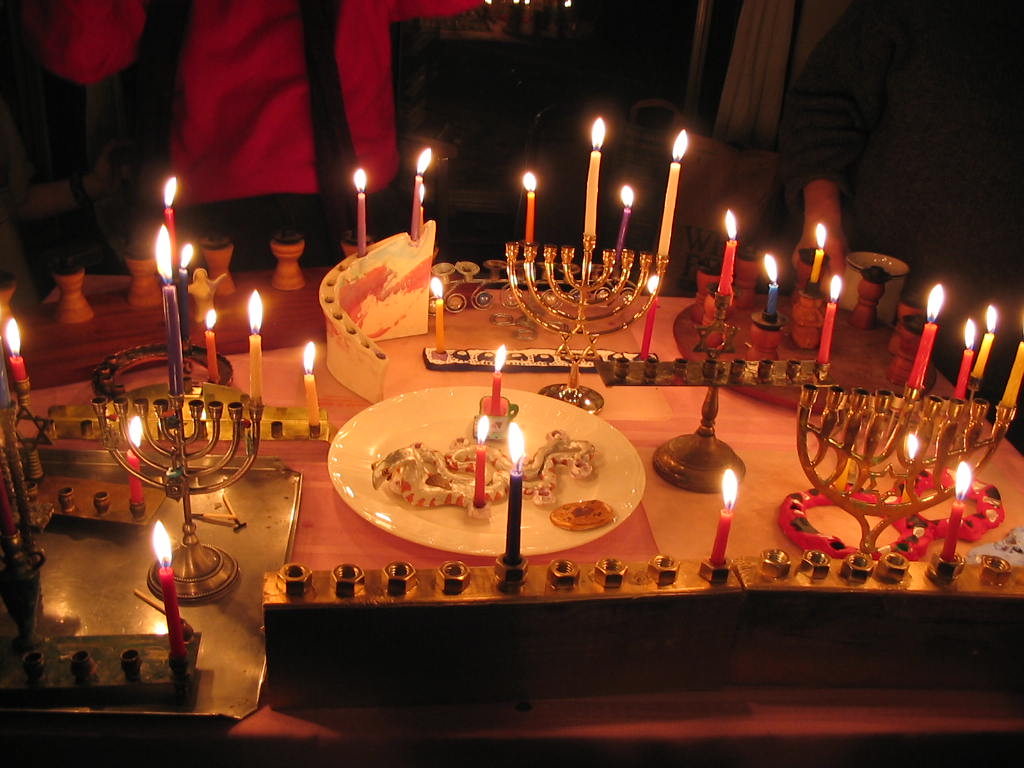
Hanukkah

Since the semester ended (but not, alas, the grading, which still isn't done!) I've been doing some traveling. I went to Washington, D.C., for the Association for Jewish Studies conference. I chaired a session on "Passages to Glory - Textual Ways of Transforming Experience Among Sectarians, Sages, and Early Jewish Mystics."
Do the verbal structures and literary devices of sectarian, rabbinic, and early Jewish mystical sources correspond to transformations of experience? Where such texts speak of heavenly journeys and glorifications, are they intended also to induce them? Were the wondrous perspectives produced by these texts experienced as actual, and how so? Our panel carries forward a conversation about Sectarians, Sages, and Early Jewish Mystics, once more comparing notes across the ages and sources - this time, on the relationship between text and experience.
There were four speakers: Jonah Steinberg, Alan Segal, Nehemia Polen, and Daphna Arbel. I also went to a number of other good sessions on quite a variety of topics - it's always fun to go to sessions not in my field. I stayed an extra day in Washington to go to an Ithaca College Jewish Studies event (meeting with alumni) and then drove up to Boston to see family and friends, which has been a lot of fun. I've gone several Hanukkah celebrations, including visiting my cousins in New Hampshire. And some Hanukkiah photos follow!

Havurat Shalom candle-lighting.


At my cousins'.


A little bit later in the evening....

Monday, December 12, 2005

Bloggers on Paul Mirecki

More bloggers on Paul Mirecki:

WITCH HUNT IN KANSAS. The author comments: "[Kansas Rep.] Landwehr is right about one thing. This all is religious bigotry. But the bigotry comes from her side. Right wing 'Christians' have been trying to force their fundamentalist religious beliefs on the people of Kansas for too long now. When someone stands up to them, they cry foul and hide behind some bizarre banner of religious persecution. It’s a joke, though not a very funny one. "

Mark Goodacre on Paul Mirecki: assault, the media, and protection. He says, "Perhaps because I am now in American higher education myself, I find this report pretty depressing. The thought that a professor has now had to absent himself from class because of media harrassment, and that his colleagues and students are being interviewed on his character and integrity, is a very unhappy situation. I have long since ceased from releasing any personal information (address, phone number etc.) on phone-books, the web and so on (and I am surprised that Mirecki has been less careful) and this story hardly discourages me from that kind of course of action."

John Wilkins of Evolving Thoughts, a postdoctoral research fellow in the philosophy and history of biology, writes:
1. ID [intelligent design] is mythology. It is not only not science, but it fulfils one of the major functions of a mythos - to organise and unify a community against outsiders. Mirecki was right to teach it that way, and right to put it in religious studies, for there is no other motivation or feature of ID than the religious.

2. Mirecki's email was obnoxious, but in no way unjustified or immoral or contrary to decent ethical standards. Religious people make much worse comments about "godless atheists" every day, and in America, they (and he) have that right constitutionally. The apology ought to have been enough to settle this, in a civilised nation. And it was in a private forum. He didn't broadcast it to the nation, Altevogt did. Is it a surprise that Mirecki thinks fundamentalists are often stupid bastards? I do, and many others, a lot of whom are Christians of a more reasonable kind, also do. So what is at issue? That he said to those he had a reasonable expectation shared those values what he thought? Bad man! Bad bad man!

3. Mirecki has academic freedom, or ought to, to teach what he wants without interference from lobby groups or the majority. His peers - those who are professionals in his discipline - are the ones who are fit to judge his actions; not some politician or religious opponent. Threatening the freedom of academics by withholding funding is the reason why universities got out from under church control in the first place.

Mark Maynard suggests, "Perhaps, it occurs to me, we’re entering an era in which the right not only demands more of a presence in academia (as we’re seeing more and more), but in which liberal faculty are 'held accountable' for their unpopular beliefs. This event in Kansas might not, in other words, be an isolated event - the work of 'a few bad apples.' It could be a harbinger of things to come." I certainly hope not, but it is also one of my fears.

And on Daily Kos, several postings about Paul Mirecki.

Sunday, December 11, 2005

More on Mirecki

Latest developments in the story about Paul Mirecki: Anti-creationism professor: Resignation was forced.

An interesting blog comment: Academic Freedom.

A professor at Johnson County Community College, in Overland Park, Kansas, Professor of Biology Paul Decelles has an interesting blog that addresses issues of intelligent design and academic freedom, and he has a number of posts about Mirecki. He seems like a sensible person and writes that "Now granted e-mails are not private but I doubt Mirecki is alone in having written inappropriate emails." Whatever else this case may be, it's also a renewed warning that one should not write in an e-mail anything you would not want printed on the front page of your local newspaper.

On the question of whether it's legitimate to mock other people's religious beliefs and practices. An interesting example is presented by J-Walk Blog, who makes fun of Orthodox Jews who don't use electricity on Sabbath and avoid doing so through various technical strategems, such as the Shabbat alarm clock. He refers to this and other devices that allow people to use electrical appliances on the Sabbath as "probably one of the most absurd religious practices of all time." A few weeks ago Christopher Hitchens wrote an article in Slate attacking the practice of metzitzah be-peh (defined as "after removing the foreskin of the penis, the practitioner, or mohel, sucks the blood from the wound to clean it"). Hitchens, in his inimitable fashion, lambasted those who engage in this practice as well as politicians who hesitate to condemn it (in this case, Mayor Michael Bloomberg of NYC).

Are either of these writers wrong to mock or criticize Jewish practices? Not in my opinion. As far as I'm concerned they're free to make fun of Judaism or any other religion. I'm also free to disagree with them and argue against them.

People who teach religion on the college level do not lose their right to free speech by virtue of their jobs - including mocking speech about others. I don't think there's a place for that in the classroom, but if a professor wishes to make fun of others outside of the classroom, why is that wrong? There are a lot of things that people say that I don't like, but that doesn't give me the right to stop them from saying them or to dismiss them from their jobs for saying them. My only concern is basically a pedagogical one - in the classroom, or in other professional capacities, professors should behave in a respectful fashion towards students, regardless of whether they agree with what those students are saying on intelligent design or anything else. I also think that professors should do their best to refrain from one-sided advocacy in the classroom. This doesn't mean that they should avoid controversial topics or keep silent about their own opinions, but that they should educate students that there is more than one side to most arguments, and that it is worth listening to several points of view and analyzing them.

Academic Freedom and Creationism

Jim Davila at PaleoJudaica just brought to my attention a disturbing series of events involving Professor Paul Mirecki of the University of Kansas. For a summary of what has happened to Mirecki, see this recent article from the Lawrence, Kansas, local newspaper - Embattled KU Professor. In short, he got into a lot of trouble for making intemperate remarks about creationists in on e-mail and on a discussion board, was forced to resign his position as chair of the religion department, and in addition, was beaten up by a couple of thugs who mentioned the controversy when attacking him (see Professor blasts KU, sheriff's investigation).

The remarks were made in connection with a course that he planned to offer (but eventually had to cancel) on creationism and intelligent design, entitled: "Special Topics in Religion: Intelligent Design, Creationism and other Religious Mythologies." One of his e-mail messages read: "The fundies (fundamentalists) want it all taught in a science class. But this will be a nice slap in their big, fat face by teaching it as a religious studies class under the category 'mythology.''' Even before the e-mail was published, his announcement that he was teaching the class seems to have angered many people who were offended that he was calling creationism and intelligent design mythologies. (See this WorldNetDaily article for an account by someone offended by Mirecki's remarks).

I find this whole story very disturbing. While Mirecki should certainly have been more careful in what he wrote on e-mail, he's certainly free to do so (given both the First Amendment and principles of academic freedom). The only genuine concern I could see is in how he would have taught the class - he should be respectful of all students and permit students who disagree with him to speak.

Some members of the Kansas State Legislature, however, seem to have a weak grasp of what academic freedom is, and what it means to teach religion at a university (as opposed to a seminary).
The university’s action [cancelling Mirecki's course] wasn’t enough for conservative lawmakers, who said they want to know whether professors teaching other courses are letting their biases get in the way. “This may show a bigger problem than just Professor Mirecki,” said Rep. Brenda Landwehr, a Wichita Republican. “It may show we’re not providing fair and balanced opportunities to our students.”

Landwehr has called for hearings when the Legislature resumes next month. She said she wants to know whether professors are exhibiting any intolerance, whether it’s religious, political or any other kind.

Landwehr also questioned whether Mirecki should be allowed to teach religious studies courses. “It’s hard to teach religion if you don’t believe in it,” she said.

Sen. Kay O’Connor, an Olathe Republican, said public universities should not condone anti-Christian talk by professors. “We’re not in the taxpayer-funded hatred business,” she said. “Why should taxpayers give him an opportunity to profess his hatred for Christians?”
Landwehr doesn't seem to understand that it's possible to teach all sorts of things one doesn't believe in. One doesn't have to be religious to teach about religion. Nor is it wrong to criticize (or even make fun of) people who belong to other religions and their religious practices. (I don't think mockery belongs in the classroom, however - that's advocacy, not education).

Aside from the issue of the intemperance of Mirecki's language, the most disturbing feature is the idea that a religion course is not the proper place to discuss creationism and intelligent design. This is exactly the place to discuss these two ideologies/theologies. In fact, on Wednesday, in my Hebrew Scripture class, I asked my students to bring in news stories that mentioned the Bible in reference to contemporary issues. In one section we spent a lot of time discussing creationism/intelligent design, both in connection to the case of the Dover School Board, in Dover, Pennsylvania, and in Kansas. We discussed (briefly) what creationism/intelligent design are, how creationism derives from the biblical account of creation, and how intelligent design is also a theological way of understanding how life has come to be. At some point I would like to teach a class on the Bible in American life and culture, and the creationism vs. evolution debate is an obvious place to start. Other professors at my college also discuss this issue, from other points of view (for example, it's addressed in the biological anthropology classes).

There are other courses at the University of Kansas that do address these issues without being attacked by religious conservatives.
Walter Dimmick, associate professor in the department of ecology and evolutionary biology, said he taught students in his introduction to evolutionary biology course about natural theology and beliefs at the time of Charles Darwin. These topics are a starting point to his course on evolution. “Young people need to have an understanding of what science is and what science is not,” Dimmick said. Dimmick, who has taught this introductory class for three years, has never stirred controversy in or out of the classroom. Part of this may be due to his approach. “It’s not my job to try and change their religious beliefs,” he said.
I agree with Dimmick on that last point. In my Hebrew Scripture class I certainly introduce students to theories about the Bible that they will not have encountered before - the most prominent example being the documentary hypothesis - but I certainly don't require them to swear allegiance to them. I want them to understand the theories, not have faith in them. I'm not in the business of telling students what their religious beliefs should be. But just presenting these theories, whose intellectual basis is that human beings wrote the biblical texts and that it's possible to investigate their origins through literary and historical analysis, can be upsetting to some students, and not only to students who are self-identified as fundamentalist Christians. I don't like upsetting the students, but I do believe that in order to teach the Bible in an intellectually honest way, it's necessary to teach critical theories about the composition of the Bible.

Friday, December 09, 2005

Our friend Ramsay Clark

Another good Hitchens column on Ramsey Clark, Saddam's chief apologist.

Our Friends, the Iranians, Take Two

At the Organization of the Islamic Conference meeting in Mecca, Saudi Arabia yesterday (Dec. 8, 2005), President Mahmoud Ahmadinejad of Iran denied that the Holocaust occurred and suggested that the state of Israel be moved to Europe.
"Some European countries insist on saying that during World War II, Hitler burned millions of Jews and put them in concentration camps. Any historian, commentator or scientist who doubts that is taken to prison or gets condemned. Let's assume what the Europeans say is true…. Let's give some land to the Zionists in Europe or in Germany or Austria. They faced injustice in Europe, so why do the repercussions fall on the Palestinians?"
It is comforting to see so many countries condemning Ahmadinejad's comments, but on the other hand, the Holocaust denial that he expresses appears on Iranian state television and in the popular media in many Muslim countries.

Tuesday, December 06, 2005

Mel Gibson Developing Holocaust Mini-Series

Is this bizarre, or what?.
Mr. Gibson's television production company will base the four-hour miniseries for ABC on the self-published memoir of Flory A. Van Beek, a Dutch Jew whose gentile neighbors hid her from the Nazis but who lost several relatives in concentration camps.

The project is in its early stages, so there is no guarantee that it will be completed. Mr. Gibson is not expected to act in the mini-series, nor is it certain that his name, rather than his company's, will be publicly attached to the final product, according to several people involved in developing it.

But Quinn Taylor, ABC's senior vice president for movies for television, acknowledged that the attention-getting value of having Mr. Gibson attached to a Holocaust project was a factor. "Controversy's publicity, and vice versa," Mr. Taylor said.
And I guess all we want is publicity, right? Well, it gets more twisted:
ABC brought in Con Artists [Gibson's production company] after an independent producer, Daniel Sladek, proposed a project to the network based on Ms. Van Beek's story. With her husband, Felix, she survived the sinking of a passenger ship by a German mine, followed by three years in hiding during the German occupation of the Netherlands, before going to the United States in 1948.

The network chose Mr. Gibson's company shortly after having rejected a pitch by Ms. Cotton of Con Artists for another Holocaust-related subject, Mr. Taylor said. "This has the middle, the love story, that the other one didn't have," he explained.

Mr. Sladek said ABC's motive in engaging Mr. Gibson - an Academy Award-winning producer and director whose "Passion" sold $370 million in tickets in the United States alone - was to win the largest possible audience. "I think that what ABC wants out of this is to build the biggest billboard imaginable in order to get everyone logically interested to tune in and watch this," Mr. Sladek said.
Well, it's good to get that out in the open - if we're going to have a movie on the Holocaust, it's got to have a love story, I guess so that the great American public doesn't have to focus on the fact that the Holocaust is not, really, you know, a love story! And we need that big billboard, so Gibson's the way to get it. This is about as crass as it gets!

Sunday, December 04, 2005

Saddam and Ramsey Clark

A couple of interesting new articles on Iraq. The first one, The Big Black Book of Horrors, is on a recently published book about the atrocities of Saddam Hussein's regime. Le Livre Noir de Saddam Hussein presents comprehensive evidence about the crimes against humanity presented by Saddam and his dictatorship.
"The first weapon of mass destruction was Saddam Hussein," writes Bernard Kouchner, who has been observing atrocities in Iraq since he led the first Medecins Sans Frontieres mission there in 1974. "Preserving the memory of the arbitrary arrests that Saddam's police conducted every morning, the horrible and humiliating torture, the organised rapes, the arbitrary executions and the prisons full of innocent people is not just a duty. Without that one cannot understand either what Saddam's dictatorship was or the urgent necessity to remove him."
While I do not think that reading this book would be very pleasant, I hope that it is soon translated into English, for the benefit of all the American anti-war activists who think that President Bush (for all his flaws) is worse than Saddam.

The second one is an opinion piece by Christopher Hitchens - Sticking Up for Saddam - Ramsey Clark admits that his client is guilty. Hitchens demonstrates just how deep into the slime Clark has sunk since his days as Attorney General for President Lyndon Johnson in the 1960s - representing the likes of Slobodan Milosevic and Saddam Hussein. Of course, even murderous dictators need competent counsel - but I would prefer that that counsel not justify their clients' crimes.

NPR this morning had a piece on Ramsay Clark in which they were trying their best to be absolutely even-handed, and unfortunately in doing so left out some of the damning evidence against him, including his association with the Workers World Party (the real force behind International ANSWER).

Escaping from the SBL

My way home from the SBL was much more eventful than I hoped it would be. When I finished loading up my car with luggage, I went to start it – and lo and behold! It did not start. Through pure coincidence, a car with someone from AAA was driving through the parking garage at just that moment, so I flagged him down and asked him if he could start my car. He did my best, but concluded that the car needed a new starter motor. I called AAA to get a tow-truck to take my car to the Honda dealership.

When the tow-truck arrived, it transpired that it was much too big to go down to the lower level of the parking garage. The tow-truck guy called a buddy of his from his shop. The buddy arrived in a two-tone car (the door was red, the rest of the car was blue). He towed my car out of the garage, and it was then put onto the enormous tow-truck. We drove to the shop (any hope of going to the Honda dealership was scotched by the two-truck driver). As we drove deeper into a run-down section of Philadelphia I wondered what was going to happen to my car. We drove into the lot (surrounded by a fence with razor wire on the top!), and he eased my car off the truck. I went into the office to talk to the manager. He promised to start working on it first thing the next morning. Then my eye wandered around the walls of the office – and fixed on two photographs of the Lubavitcher rebbe, and a prayer for a successful business, in Hebrew. Needless to say, this is not what I expected to find in a repair shop in urban Philadelphia. I asked the manager if the shop was owned by an Israeli. He said to me, “Is that a problem?” I said no, I had spent time in Israel. Then the guy sitting next to him spoke up – in Hebrew. I replied. His father owned the shop. After that I felt a bit more confident that my car would get fixed and that the repairs would cost a reasonable amount of money.

The next morning, the buddy from the shop drove my fixed car to the hotel where I was staying, and I went back to the shop to pay for the repairs – which were indeed at a very reasonable price. I got to meet the boss, who indeed spoke with an Israeli accent. It was an unexpectedly pleasant experience, despite the fact that I had to stay an extra night in Philadelphia and then had the truly tedious drive from Philly to Boston via the N.J. Turnpike, the GW Bridge, and I-95…. I hope never to do that again on the day before Thanksgiving!

Enoch/Metatron at the SBL

I attended the AAR/SBL meeting in Philadelphia the week before Thanksgiving, and was part of the book review session organized by the Early Jewish and Christian Mysticism section. I reviewed the new book by Andrei Orlov, The Enoch/Metatron Tradition, which traces the development of traditions about Enoch from the Bible through to the Zohar, concentrating mostly on Enoch traditions in Second Temple literature and 2 and 3 Enoch. What I found particularly helpful about the book was its treatment of 2 Enoch, which is extant only in Slavonic. My review began this way:
This is a fine book on the development of the figure of Enoch from early Mesopotamian traditions about the seventh antediluvian king, Enmeduranki, to the transformed Enoch-Metatron of the Hekhalot literature, especially in Sefer Hekhalot, (3 Enoch). Andrei Orlov comprehensively demonstrates how the roles and titles of Enoch developed from his first appearance in Genesis, when “God took him” (Gen. 5:24), through the five subsections of 1 Enoch (in many cases influenced by Mesopotamian traditions about the seventh antediluvian king, Enmeduranki), to the Slavonic apocalypse of Enoch (2 Enoch), which he dates to first century Alexandria, and finally to Sefer Hekhalot. The book examines the early Enochic booklets and then Sefer Hekhalot, only then turning back to the Slavonic apocalypse in order to show how the roles and titles there are an earlier version of what is found in 3 Enoch. The second part of the book addresses the question of how Enoch’s roles and titles developed in 2 Enoch as a result of polemics with several other important mediatorial figures: Adam, Moses, and Noah. This book is the first complete effort to show how the Slavonic apocalypse adumbrates several important roles and titles of Enoch that reach their full development in the Hekhalot literature. As such, it is particularly important for scholars like myself who do not have control of the Slavonic original of 2 Enoch and must rely upon translations. On important aspect of the book is that Orlov demonstrates that the Shi’ur Qomah tradition, the tradition that states that it is possible to measure the anthropomorphic body of God, found in the Hekhalot literature, is present in an early form in 2 Enoch.

The two sessions of the Early Jewish and Christian Mysticism section were very interesting, as was the opportunity to go out to dinner with members of the section on Saturday night (although the food did take forever to come!)

The conference was fun – I got to see friends I hadn’t seen in quite a while, some of whom I will see again at the Association for Jewish Studies meeting, which is happening during the third weekend in December in Washington, D.C. I spent a fair amount of the conference in the Book Exhibit, as I usually do, and brought home a haul of books that I hope will be useful for my research.

Sunday, November 27, 2005

MEMRI: Latest News

According to this November 23, 2005 report by MEMRI: Latest News, a delegation from the Presbyterian Church USA met with Hezbullah's commander in southern Lebanon.
On October 20, 2005, the Lebanese press reported that a delegation from the Presbyterian Church USA, headed by Father Nihad Tu'meh and with Robert Worley as its spokesman, visited southern Lebanon at the invitation of Hizbullah, and met there with the terrorist organization's commander in southern Lebanon, Nabil Qawuq.

During the meeting, Qawuq expressed his doubts about U.S. actions in the region and the intentions of the Bush administration. Worley, on his part, assured Qawuq that he was not defending the U.S. administration, that all delegation members had voted Democratic, and that the Presbyterian Church had been pressured by U.S. Jewish organizations because of its campaign to divest from corporations working with Israel.
A separate delegation of families of 9/11 victims met with the Deputy Head of Hizbullah, Sheik Naim Qassem. A report was aired on this meeting on November 11, 2005.
Anchor: Sheik Naim Qassem met with an American delegation which included family members of victims of the 9/11 bombings in New York City. The delegation members said that the purpose of the visit was to spread peace and to establish ties with various forces in different regions of the world, in order to stress the united stand against terrorism and aggression.

Sheik Qassem recalled Hizbullah’s communiqués condemning the New York attacks and the recent bombings in Jordan. He emphasized that state-sponsored terrorism and the terrorism of some groups throughout the world should be condemned because it goes against humanity, regardless of religion, language or geography.

I find it utterly amazing that anyone from a family that had lost a loved one on 9/11 would want to meet with the leader of an Islamist terrorist group. It is a shame that this report has not been more widely disseminated, and the names of those who met with the Hizbullah leader revealed.


In the beginning was Al-Aqsa

An interesting new book on the contemporary Muslim denial of the history of the Temple in Jerusalem, reviewed in Haaretz.
The historian Dr. Yitzhak Reiter, who is now publishing a book entitled "From Jerusalem to Mecca and Back - the Muslim Rallying Around Jerusalem," has been collating for years thousands of publications, religious legal rulings, statements and pronouncements of Muslim clergymen, historians, public figures and statesmen on the subject of Jerusalem. His book draws in great detail a portrait of the great Muslim denial, a denial of the Jewish connection to Jerusalem, the Temple Mount and to the Temple. This argument has strengthened in intensity since the Six-Day War.