Most Valuable Politician of the year? How about President Mahmoud Ahmadinejad of Iran, who has surged ahead for the 2005 MVP award in the few months he has been in office? He reminds a distracted world at crucial moments of the true nature of Iran's regime, of the abiding source of conflict in the Middle East and of the deeper meaning of global terrorism.
Racial and religious hatreds are at the core of these phenomena - and at the heart of Ahmadinejad's pledges to see Israel "wiped off the map" and to ensure that Arabs who recognize the Jewish state "burn in the fire of the Islamic nation's fury." His statements were reported in laudatory terms by Iranian state-run television Wednesday.
Even though the Persian chauvinists who took power in Tehran in 1979 have been more discreet in public in recent years, it is not news that they hate both Jews and Arabs - or that the sentiment is returned. If novelty there was, it lay in statements of condemnation that European governments issued as the inflammatory remarks spread around the globe.
Britain, France and Germany raced to distance themselves from Ahmadinejad's double-barreled anti-Semitic blast. They have been negotiating with his regime in hopes of rehabilitating it. A spiteful and belligerent speech the Iranian leader gave at the United Nations in mid-September had already signaled the enormousness of their task. But they persisted. Now even Russian Foreign Minister Sergei Lavrov, perhaps the coldest and most uncaring fish in international diplomacy, feels compelled to mutter that the Iranian firebrand's statements were "unacceptable."
The fates of Nazi Germany and Vichy France are not the only lessons available to Iranians - or for that matter to Israelis or Americans - of the bitter fruits of preaching and practicing racial hatred. In neighboring Iraq, a regime that committed genocide against the Kurdish tribesmen of the north and persecuted Shiite Arabs in the south lies in ruins and seems incapable of rising again.
Because Saddam Hussein would not leave them in the peace and isolation of their mountain redoubt, Iraq's Kurds went to war against Baghdad three decades ago. They deliberately set in motion the chain of events that were to bring an American invasion force to Baghdad to overthrow the dictator in 2003. While he could not foresee exactly how it would happen, the late Kurdish leader Mullah Mustafa Barzani told me in 1972 that it would. I was skeptical; he was right.
No political outcome can balance the scales of personal grief and loss brought by the loss of 2,000 and more American service personnel in Iraq since the invasion began. Human lives cannot be measured and counted as instruments or integers of policy or politics.
So the fact that Kurds live in freedom today from racial pogroms directed at them from Baghdad -- in large part because of U.S. protection and sacrifice -- can assuage no mother's grief or friend's anger over U.S. casualties. But neither can the positive change that American actions have brought simply be dismissed or ignored.
Barzani's son, Massoud, visited the White House last week to thank the American nation, through President Bush, for those sacrifices and to reiterate the Kurds' commitment to staying in a "federal" Iraq that institutionalizes their autonomy -- and survival. Federalism for the Kurds is not some legalistic ploy to maximize their share of oil reserves, or a thumb to stick in Arab eyes in revenge. It is a chance to live and to let live.
Mr. Ahmadinejad's principal rival for power, Ali Akbar Hashemi Rafsanjani, a former Iranian president who was defeated by Mr. Ahmadinejad in the election, continues to hold considerable power as leader of the nation's Expediency Council, which was created in 1988 to help resolve contentious legislative issues. The Europeans have been negotiating with envoys loyal to Mr. Rafsanjani for the last two years and hope that they or others like them will re-emerge in the future.
Indeed in the last few weeks, Iran's ruling clerics, who still hold most of the power, have moved to strip the presidency of some of its authority over international diplomacy and hand it over to the Expediency Council under Mr. Rafsanjani. If there is any hope in the West for a diplomatic solution, it thus rests with this turn of events.
Other things come back too. I remember now why it is hard to be a Jew. Not because of the many customs and laws, but because of the pain. It’s hard to read about young Israelis gunned down alongside a road outside Jerusalem, to see the photos of their beautiful, shining faces. It’s hard to face the hatred that inflates our enemies. The news from Israel is so often bad. Beyond bad; heartbreaking. James Joyce wrote: “history is a nightmare from which I am trying to awaken.” But we know there is no escape. Our history is indeed a nightmare, a revelation of the darkest pits of human evil. It’s hard to carry that weight. It’s hard to watch my husband clean his plate at every meal, and wonder if he does that because his father was starved in Auschwitz. That is a lot of pain to carry. It is hard to be a Jew. It’s hard to care and feel so much.
"The establishment of Zionist regime was a move by the world oppressor against the Islamic world," Mr. Ahmadinejad said, the news agency reported. "The skirmishes in the occupied land are part of the war of destiny. The outcome of hundreds of years of war will be defined in Palestinian land."
"One of our major concerns is now the potential spread of avian influenza through migratory birds to North and Eastern Africa," said Dr. Joseph Domenech, the chief veterinary officer at the United Nations Food and Agriculture Organization, which monitors the spread of the disease in animals.
If the disease touches down there, it could well become widespread in the environment and on farms before it is even detected, he said.
Also, because in poorer African nations people live in close proximity with animals, such a situation would provide a dangerous crucible for the mixing or the bird and human viruses, vastly increasing the risk that the avian virus could gain the ability to readily spread among humans.
"The close proximity between people and animals and insufficient surveillance and disease control capability in eastern African countries create an ideal breeding ground for the virus," Dr. Domenech said.
You did not see in those demonstrations, after all, many banners reading, "Support Iraq's New Constitution," "No to Jihad" or "Stop Suicide Bombers." The crimes committed daily against the Iraqi people by other Arabs who wish to re-enslave them seem to be of little interest to Michael Moore, Jane Fonda and their followers. Rage against the daily assaults on children, women, anyone, by Islamo-fascists and ordinary national fascists is not fashionable. Only alleged American crimes are cool to decry.
It's hard to think of a more graphic illustration of the horror the U.S.-led coalition is fighting in Iraq than the mass murder on Sept. 26, in which terrorists disguised as policemen (a New York Times headline called these butchers "fighters") burst into a primary school in Iskandaria, south of Baghdad, seized five teachers (all Shiites) and shot them dead. Children stood weeping through this atrocity.
Why do crimes like this make so little impression on those Americans and Europeans who want the coalition to abandon Iraq? The demonstrators think of themselves as moral, but it is hard to think of any policy more amoral than abandoning Iraq to such an enemy.
A year ago, a group of Swarthmore students decided to take on an unusual extracurricular activity: stopping genocide. Mark Hanis, one of the students, is Jewish and all four of his grandparents survived the Holocaust. He was troubled by the way generations of Americans acquiesced in one genocide after another - only to apologize afterward and pledge "Never Again." So Mr. Hanis and fellow students started to raise money to help provide security to stop the slaughter in Darfur. In particular, they wanted to help pay for African Union peacekeepers. Their Genocide Intervention Fund has now raised $250,000 and is about to hand over the first installment to the leaders of the African Union. The money may be used to pay for female African police officers to protect Darfur women from being raped. The Genocide Intervention Fund now has an all-star cast, including the backing of former White House officials, generals, and celebrities like Mia Farrow and Don Cheadle. Its spokeswoman, a Rwandan genocide survivor who is now a Swarthmore sophomore, introduced Bill Clinton at a student conference. It has opened a Washington office and is lobbying for the bipartisan Darfur Peace and Accountability Act, which calls for sanctions on Sudan and a no-fly zone. "We do lobby days, where we arrange for people to come to Washington to meet their Congressional offices and say, 'I've put $20 down to protect the people of Darfur. What are you doing?' " said Mr. Hanis, who graduated recently.
So far more than 100 colleges have raised money for the fund (www.genocideinterventionfund), and universities have become the center of the movement to stop the slaughter. A group started at Georgetown, Stand (Students Taking Action Now: Darfur), has chapters nationwide and across Canada, and Harvard led a divestment effort by having its endowment sell stock in companies that support the Sudanese government. In the long term, the organizers hope to encourage more education about genocide in American schools - California and a few other states have passed laws that public schools must include education about genocide - and to bolster an early warning system so that the world will respond to atrocities more promptly. "We're getting smarter at this," Mr. Hanis said. "We're building a permanent political constituency against genocide." He paused and added soberly: "Of course, there are lives lost every day."
So while President Bush is proving wimpish on genocide, the response of many ordinary Americans like Mr. Hanis has been inspiring. Aside from students, the leaders in the effort include Jewish and Armenian groups (the word genocide has special resonance for both) and religious groups. In Dallas, Temple Emanu-El started Dolls for Darfur, which has made thousands of tiny paper dolls representing the victims of Darfur. It has sent them to senators and is preparing "advocacy kits" to help people lobby for a sterner American response to the genocide (see Dolls for Darfur).
Then there are the big-hearted folks at Ginghamsburg Church, a large Methodist church in Tipp City, Ohio. After the pastor, Mike Slaughter, read about atrocities in Darfur, he decided to ask the congregation to spend only half as much on Christmas presents last year as they planned, and to donate the rest to victims in Darfur. The result, along with other fund-raising efforts, was $327,000 in donations; the congregation is planning the same campaign this Christmas. The money is being used to keep children alive and safe in South Darfur. "We recognize that this is only a pittance in the face of the entire crisis in Darfur," says Karen Smith, director of operations for the church. "However, if we can successfully engage other churches across the U.S. in this call so that they issue the same challenge to their constituents, the impact could truly be God-sized."
During the Holocaust, when Franklin Roosevelt was as uninterested in genocide as George W. Bush is today, Arthur Koestler referred to those who demanded action as "the screamers." Today, Mr. Hanis, Ms. Smith and others like them are "the screamers," and if it weren't for them the death toll in Darfur would be even higher. Countless thousands of survivors sitting in refugee camps owe their lives to screams coming from places like Swarthmore or Ginghamsburg.So out of the miasma of horror that is Darfur, something uplifting is taking place. Ordinary Americans are finding creative ways to respond to the slaughter, so that they personally inject meaning into those traditionally hollow words: Never Again.

The history of marginalizing black folk in America, especially poor ones, runs so deep that it occurs like second nature. It is one reason, say several prominent black intellectuals, that the response to the devastation of Katrina was so slow.The article also notes the racialized way that the photographs and news footage coming from New Orleans have been interpreted:
Racism runs "so deep that the folks who are slow to respond can't see it," says Russell Adams, professor of Afro-American studies at Howard University. "That's the unperceived character of racial behavior, of what I would call hidden racism where you don't know that this situation has a racial character to it, just like fish have trouble defining water."
This feeling of being disregarded is pervasive in the African American community, where old wounds still sting. Witness a "Saturday Night Live" skit from 1998, where Samuel L. Jackson and Tracy Morgan indulge in a bit of hyperbole, playing African Americans in the fifth class steerage of the Titanic. Everyone was rescued before them -- even the furniture.For another way of thinking about race, see these comments:
While that may have been comedy, its message is conveyed in all kinds of real-life ways. Deborah Willis, photographer and professor of the arts at New York University, laments some of the images coming out of New Orleans.
The frequent replay of what has become an iconic looting photo -- the guy with the flying braids and falling pants -- "desensitizes the viewer of finding compassion for what happened to the thousands of people who have died or who have suffered," she says.
It's an us-vs.-them kind of image, she says, and "a racialized image because of the way it's been used and reused over again."
Noel Ignatiev, author of "How the Irish Became White" and editor of Race Traitor, a journal dedicated to the "New Abolitionism," suggests that the nation is poised at a pivotal point. He sees an opportunity for a realignment of thinking.
"White is not a matter of color. White is a matter of a sense of entitlement, a sense they are or ought to be entitled to specially protected place in society," he says. "But there are plenty of white folks on the bottom rung of society, people for whom whiteness isn't doing much at all."
"Some may be awakening to the notion there's no use clinging to an identity that's doing them no good. If white folks start thinking of themselves as poor and dispossessed instead of privileged, it will change the way they act. We will see the beginnings of class conflict."
BATON ROUGE, La., Sept. 1 - It seemed a desperate echo of a bygone era, a mass of desperate-looking black folk on the run in the Deep South. Some without shoes. It was high noon Thursday at a rest stop on the edge of Baton Rouge when several buses pulled in, fresh from the calamity of Hurricane Katrina in New Orleans. Hundreds piled out, dragging themselves as if floating through some kind of thick liquid. They were exhausted, some crying.
"It was like going to hell and back," said Bernadette Washington, 38, a black homemaker from Orleans Parish who had slept under a bridge the night before with her five children and her husband. She sighed the familiar refrain, stinging as an old-time blues note: "All I have is the clothes on my back. And I been sleeping in them for three days."
While hundreds of thousands of people have been dislocated by Hurricane Katrina, the images that have filled the television screens have been mainly of black Americans - grieving, suffering, in some cases looting and desperately trying to leave New Orleans. Along with the intimate tales of family drama and survival being played out Thursday, there was no escaping that race had become a subtext to the unfolding drama of the hurricane's aftermath.
"To me," said Bernadette Washington, "it just seems like black people are marked. We have so many troubles and problems."
"After this," her husband, Brian Thomas, said, "I want to move my family to California."
"Some people there have not eaten or drunk water for three or four days, which is inexcusable," acknowledged Joseph W. Matthews, the director of the city's Office of Emergency Preparedness. "We need additional troops, food, water," Mr. Matthews begged, "and we need personnel, law enforcement. This has turned into a situation where the city is being run by thugs."
Col. Terry Ebbert, director of homeland security for New Orleans ... was particularly pungent in his criticism. Asserting that the whole recovery operation had been "carried on the backs of the little guys for four goddamn days," he said that "the rest of the goddamn nation can't get us any resources for security."
"We are like little birds with our mouths open, and you don't have to be very smart to know where to drop the worm," Colonel Ebbert said. "It's criminal within the confines of the United States that within one hour of the hurricane they weren't force-feeding us. It's like FEMA has never been to a hurricane." FEMA is the Federal Emergency Management Agency.
"We're just a bunch of rats," said Earle Young, 31, a cook who stood waiting in a throng of perhaps 10,000 outside the Superdome, waiting in the blazing sun for buses to take them away from the city. "That's how they've been treating us."
The effects of the disaster spilled out over the country. In Houston, the city began to grapple with the logistics of taking tens of thousands of refugees into the Astrodome, and San Antonio and Dallas each braced for the arrival of 25,000 more. Baton Rouge overnight replaced New Orleans as the most populous city in Louisiana and was bursting at the seams.
On the receiving end in Houston, though, the Astrodome looked at times like a squatters' camp in a war-torn country. The refugees from Louisiana, many dirty and hungry, wandered about aimlessly, checking bulletin boards for information about their relatives, queuing up for supplies and pay phones, mobbing Red Cross volunteers to obtain free T-shirts. Many found some conditions similar to those that they left behind at the Superdome, like clogged toilets and foul restrooms.
But in Houston, there were hot showers, crates of Bibles and stacks of pizzas, while in New Orleans, many refugees scrounged for diapers, water and basic survival.
Rodney Braxton, the chief lobbyist for New Orleans, said that many of the city's poorest residents "had nowhere to go outside the region and no way to get there. And there wasn't enough police power to go to each house to say, 'You have to go, come with me.' " In a city with so many residents living in poverty, the hurricane came at the worst possible time: the end of the month, when those depending on public assistance are waiting for their next checks to be mailed on the first of the month. Without the checks, many residents didn't have money for gas, bus fare or lodging. City officials said they provided free transportation from pick-up points publicized on television, radio and by people shouting through megaphones on the streets. In addition to the Superdome, officials opened schools and the convention center as shelters.
The chaotic disaster response came despite repeated efforts over many years to plan a coordinated defense if the worst should occur. As recently as July 2004, federal, state and local officials cooperated on the Hurricane Pam drill, which predicted 10 to 15 feet of water in parts of the city and the evacuation of one million people. Martha Madden, who was the Louisiana secretary of environmental quality from 1987-1988, said that the potential for disaster was always obvious and that "FEMA has known this for 20 years." "Hundreds and hundreds of thousands of dollars were spent, in studies, training and contingency plans, scenarios, all of that," said Ms. Madden, now a consultant in strategic planning. The Army Corps, she said, should have had arrangements in place with contractors who had emergency supplies at hand, like sandbags or concrete barriers, the way that environmental planners have contracts in place to handle oil spills and similar events.
Attorney-General Menahem Mazuz has decided not to press charges against a group of Jewish extremists who carried out an ancient curse ceremony meant to place a death wish on Prime Minister Ariel Sharon, since the appeal was to God and not to mankind, the Justice Ministry said Tuesday.
The decision by Israel's top law enforcement official was made after determining that the ceremony was an appeal for heavenly action against the prime minister, and as such could not be viewed in the legal sense as incitement to violence, according to a letter that Deputy State Attorney Shai Nitzan sent to MK Ran Cohen (Yahad).
Recently the Sub-committee of the Local Committee for Planning and Construction in Jerusalem has confirmed a plan to erect a Jewish neighbourhood in the Muslim Quarter of the Old City of Jerusalem. According to the plan, 30 housing units and a synagogue will be built to accommodate some 150 people. Professionals (BIMKOM - Planners for Planning Rights) warn of the implications of this plan:
The proposed plan violates the basic planning principles of all construction in the Old City:
1. Principles of preservation....
2. The Old City is the most densely inhabited place not only in Jerusalem but also in Israel....
3. In addition to the density, changing the open space, which is among the extremely few open spaces in the Old City, into a housing area will seriously harm the welfare of the people living there.
Besides the above planning drawbacks and the environmental implications, we recognize the political danger inherent in the plan. Building housing units for Jews in the Muslim Quarter has far-reaching implications over the delicate social fabric of the city. The Palestinians in East Jerusalem live in socio-economic distress, therefore a permanent presence of Jews in such a vicinity, in improved living conditions, would lead to provocation and a serious political and social crisis. Moreover, the proposed plan is also a continuation of a consistent Israeli policy whose purpose is a violation of the balance between Palestinians and Israelis in Jerusalem, creating by this policy a Jewish majority in East Jerusalem...
ACTION: WHAT YOU CAN DO:
One way to help change policy is to contact government representatives....
--Phone, fax, or email your representatives directly. If you are a U.S. resident or citizen, find your representative's contact information at www.senate.gov and www.house.gov. If you have the ability, one fax is generally worth about ten emails.
--To help us gauge the response, please send a cc of your messages to lucia@icahd.org.
--Please also contact Israeli policy makers:
Min. Interior Ophir Pines, fax: 03-763 2638/ 02-566-6376 or email pinespaz@knesset.gov.il..
Minister for Building & Infrastructure, Isaac Herzog, fax: 02-584-7033 and 02-582-4111
Director of Jerusalem District Planning, Ruth Yosef: fax: 02-624-1986 or phone: 02-629-0216
Jerusalem Mayor, Uri Lupoliansky, Fax: 02-629-6014
Rabbi Yehoshua Pollak, Chairman, Municipal Local Committee of Building & Planning: fax: 02-629-6178
Emails to Meir Margalit at meir@icahd.org will be hand delivered to the Municipality
SAMPLE LETTER:
Dear…….,
I was shocked to hear that the Sub-committee of the Local Committee for Planning and Construction in Jerusalem has confirmed a plan to erect a Jewish neighbourhood in the Muslim Quarter of the Old City of Jerusalem.According to the plan, 30 housing units and a synagogue will be built to accommodate some 150 people.
Besides the fact that building this settlement is illegal under international law, professionals (BIMKOM - Planners for Planning Rights) warn of the negative impact of the plan on the Old City.
The building of this settlement in the Muslim Quarter also has negative political implications for the delicate social fabric of the city between Palestinians and Jews.
I urge you to do everything in your ability to stop the building of this settlement.
Regards,
[Sign]
 This picture, from the AP, of "settlers attempting to destroy the minaret of an old mosque located inside Sa-Nur on Monday," shows further their lack of respect for their Palestinian neighbors. (One also has to wonder why Sa-Nur was built on that particular location). Other actions by settlers against Palestinians included:
On the eve of the evacuation of the northern West Bank settlements of Sa-Nur and Homesh, settlers before dawn on Monday vandalized property in at least eight Palestinian villages in the region, Palestinian witnesses said. In some instances, settlers reportedly marched through the villages with the aim of infiltrating Sa-Nur and Homesh, areas that have been sealed by security forces in the lead up to the evacuation. In other instances, the settlers reportedly entered the Palestinian villages with the sole aim of vandalizing property. Palestinian sources confirmed property was damaged but said there were no casualties.
In a separate incident, two Palestinians were lightly wounded late Monday evening when settlers threw stones at them near the Eli settlement located east of Ariel in the West Bank. Palestinians in Fendaqumiyah, located adjacent to Homesh, said armed settlers rode through the village before dawn Sunday on all-terrain vehicles, firing their weapons in the air. Sources said settlers also entered the villages of Kuchin and Madmah, located south of Nablus. Settlers in those villages threw stones and bottles at house windows and at cars.
Additional incidents were reported in Bazariyah, Burqa and Sabastiyah, located next to Karnei Shomron. Overnight Sunday, settlers reportedly took over a Palestinian family home in the village of Burqa and kicked the residents out for an hour as they destroyed furniture and smashed windows. Settlers also reportedly threw stones at residents in the village of Jit, located next to Kedumim. There were no casualties. The overnight incidents join other recent violent attacks on Palestinians, including the terror killing of four Palestinians laborers by a settler in the Shilo industrial area.

Israeli security forces seized control of the roof of Kfar Darom's synagogue Thursday evening, as they moved to oust die-hard protesters, hours after troops stormed the inside of the building to remove illegal infiltrators. Some 44 people were injured in the operation - 27 police officers, 14 protesters and 3 soldiers. The police officers were taken for tests at Soroka Medical Center in Be'er Sheva, after acid was thrown at then during the evacuation. One of the policemen sustained moderate to serious injuries when he slipped on oil thrown by protesters to deter security forces, and fell from the second story of the synagogue. Major General Dan Harel said several troops were wounded by acid and were sent to hospital. "What we saw here crossed all boundaries," he said. "Everybody who was now on the roof will be arrested and put in prison."
According to Weisgan’s friends, he was “depressed” over the disengagement. Well, what do you know—so is most of the country. No matter which side of the issue you’re on, what is happening in Israel right now is absolutely heartbreaking. But we don’t deal with sadness, depression and heartbreak by going out and committing murder. Anyone who practices such a hideous form of “therapy” is no better than the terrorists who, in order to sate their lust for blood and power, strap on explosive belts and blow themselves up amid crowds of innocent people.
The best Weisgan can now expect is a trial followed by a long prison term, possibly for life. But at least he will live, which is more than can be said of the four people whose lives he cut short today in cold blood.
An Israeli Jew killed three people and wounded three others Wednesday afternoon when he opened fire on a group of Palestinians in the industrial area of the West Bank settlement of Shiloh.
Asher Weisgan, a 38-year-old driver from Shvut Rahel in the West Bank, transported Palestinian workers to and from the industrial area daily. Wednesday afternoon, he picked up the workers to take them home, and stopped on the way out to ask a security guard for a cup of water.
He then stole the guard's weapon, shot the two Palestinian workers in his car at the time, and then ran into the industrial area, killing another worker on the way and wounding two others.
Prime Minister Ariel Sharon on Wednesday condemned a shooting attack by an Israeli Jew in the West Bank, in which three Palestinians were killed, saying that he regarded the attack "very gravely."
"I view this act of Jewish terror, which was aimed at innocent Palestinians with the twisted thinking that it would stop the disengagement plan, very gravely," Prime Minister Ariel Sharon said in a statement released by his office.
During the course of the bloody conflicts of recent years, approximately 30,000 inhabitants of the Gaza Strip have been uprooted from their homes. Entire Palestinian neighborhoods along the Philadelphi route in Rafah, at the edges of the Khan Yunis refugee camp, along the route to Netzarim and in the north on the edges of Beit Hanun have been turned into heaps of ruins by the Israel Defense Forces. The reason was an Israeli security need.
Thousands of Palestinian refugees, with only a few days' warning, and in some cases only a few hours, have had to evacuate their homes, which were demolished, and their fields and orchards, which have been razed. In at least two cases that were publicized, an Israeli bulldozer demolished a house with its tenants inside, two old people to whom no one had paid any attention, and they were buried under the ruins.
Repentance brings close those who are far away. Yesterday this one was hated before the Omnipresent - filthy, far away, an abomination. Today he is beloved and lovely, close and intimate. And thus you find that with the words that the Holy One sends away the sinners, He brings close those who repent, whether individuals or many people. As it is said, "In the place that it is said to them, 'you are not My people,' it is said to them, 'children of the living God.'"...
Yesterday this one was separated from the Lord, the God of Israel, as it is said, "Your sins separate you from your God." He cries out and is not answered... And today he cleaves to the Shekhinah, as it is said, "And you who cling to the Lord your God are alive here today." He cries out and is immediately answered.
- Maimonides, Mishneh Torah, Book of Knowledge, Laws of Repentance 7:6-7 (my translation).
In my eyes, the Gaza withdrawl is an act of Teshuva. The nation and the people are repenting for abiding 30 years of Jim Crow conditions in Yesha; and it is my abiding hope that a "treasure of gold" waits for the nation and the people who complete this process.
So I've given up. I'm going to let myself cry over the disengagement, that is, assuming I'm able to cry instead of just sit there all frozen. Because it's all about the same thing, isn't it. It's all about the exile, and about how God doesn't speak to us anymore, and how we have to try our best to carry out His will as well as we can interpret it, and about how unimaginably difficult, divisive, and painful that process can be.
Hashiveinu Hashem eilecha v'nashuva, chadesh yamenu k'kedem. (Lam. 5:21, translation above)
Religious Zionism has generated less violence than the Islamic movements because, until recently, Israel's actions were more or less in synch with its philosophy. There was little reason for Jewish extremists to engage in terrorism because they had the apparatus of the state at their disposal. As long as the settlements were expanding and the Palestinians being driven gradually out of Eretz Israel, there was no reason for violent opposition.
[F]or the first time, the proportion of Jews living in territories under the country's control has dropped below 50 percent, standing slightly more than 49 percent .The results are based on figures supplied by Israel and the Palestinian Authority's official statistics bureaus. According to the figures, following the upcoming disengagement, the proportion of Jews in territories under Israeli control will jump to 56.8 percent. As a result of this development, demographic expert Prof. Sergio Della Pergola of the Hebrew University said the country is ensured of a Jewish majority within its territories for the next 20 years.
Well, some people are doing their best to avoid the fact that a Jew killed other human beings in cold blood. I remember when Yitzhak Rabin was assassinated - I was in Israel, on a sherut (shared taxi) going to the airport (at the end of a week-long visit). We heard it on the radio, and one of my fellow Jewish passengers said that it couldn't possibly be a Jew who had done this.
And don't blame Ariel Sharon for this attack. Blame the extremists in the settler movement who have been engaging in the most over-the-top rhetoric possible for inciting someone like this. The people who compare the disengagement from Gaza to the deportations to the death camps create the atmosphere that makes people like this snap. If the disengagement is like sending people to the camps, then anything is justified to stop it. And let us also not forget that the perpetrator was a member of Kach, a banned organization in Israel that has advocated racism against Arabs for many years.
I remember one day in Jerusalem stumbling upon a Kach demonstration in the center of the city. I stood on the outskirts of the (thuggish) crowd to listen to Meir Kahane speak (this was in 1988, I think). He was speaking in the most disgusting way possible about Arabs and how there should be laws forbidding sexual relations between Jews and Arabs - shades of the Nuremberg laws. I left shaking with anger. Let's not pretend that we don't have racists among us.
And let us not forget the plots of the Jewish underground in the early 1980s to blow up the Temple Mount.


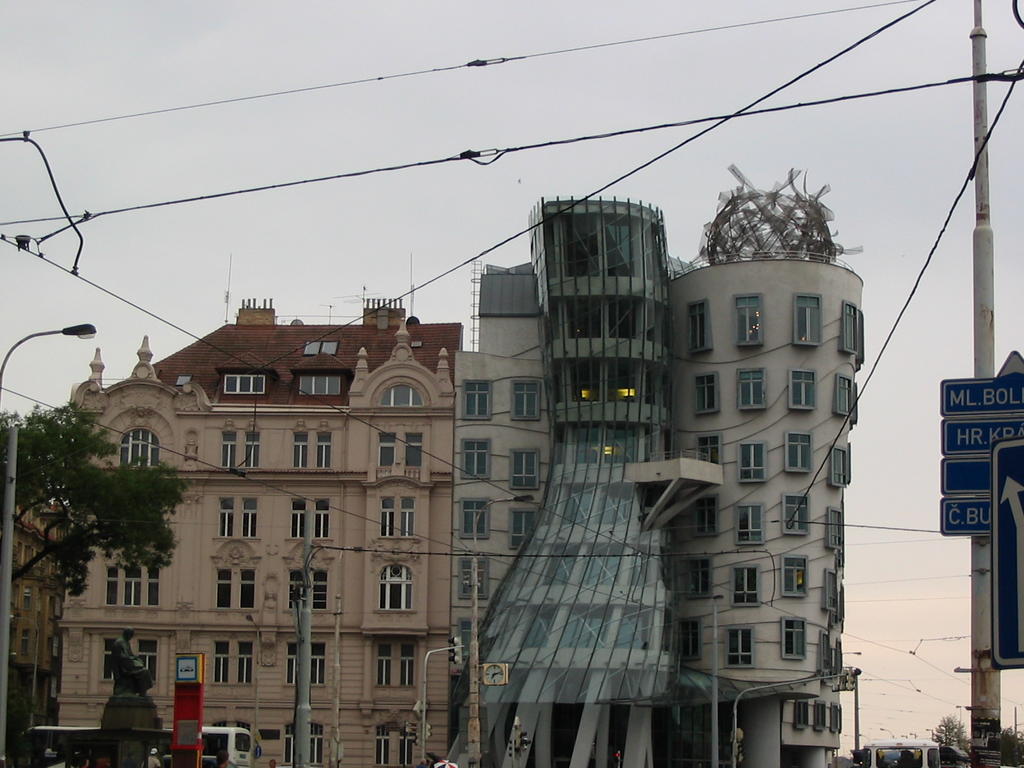
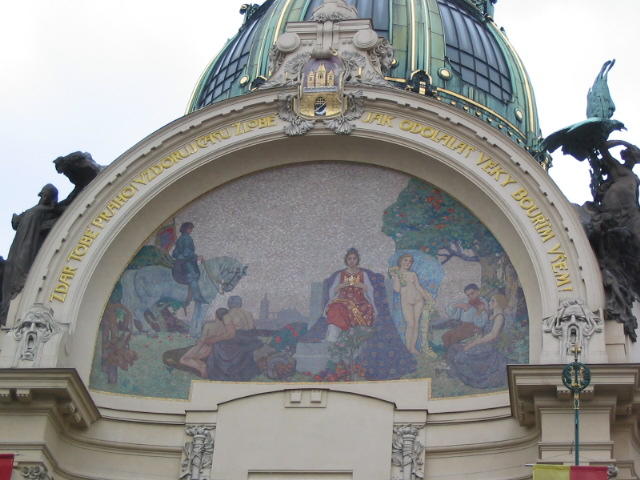 Another building was my favorite in Prague - the Obecni Dom (Municipal House), built in the early 20th century with much art nouveau decoration. This first photograph is of a mural just above the entrance to the building.
 The second photo is of the balcony over the entrance. Notice the symbol of Prague in the center of the balcony.
 The third photo is a detail in the stained glass of the entrance.
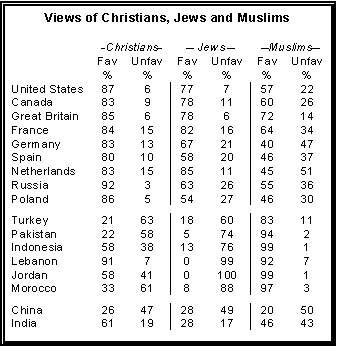
They demand the elimination of Israel; the withdrawal of all Westerners from Muslim countries, irrespective of the wishes of people and government; the establishment of effectively Taleban states and Sharia law in the Arab world en route to one caliphate of all Muslim nations.
From the mid 1990s onwards, statements from Al-Qaeda, gave very clear expression to this ideology: "Every Muslim, the minute he can start differentiating, carries hatred towards the Americans, Jews and Christians. This is part of our ideology. The creation of Israel is a crime and it has to be erased.
"You should know that targeting Americans and Jews and killing them anywhere you find them on the earth is one of the greatest duties and one of the best acts of piety you can offer to God Almighty." Just as great is their hatred for so-called apostate governments in Muslim countries. This is why mainstream Muslims are also regarded as legitimate targets.
This is what we are up against. It cannot be beaten except by confronting it, symptoms and causes, head-on. Without compromise and without delusion.
The extremist propaganda is cleverly aimed at their target audience. It plays on our tolerance and good nature.
It exploits the tendency to guilt of the developed world, as if it is our behaviour that should change, that if we only tried to work out and act on their grievances, we could lift this evil, that if we changed our behaviour, they would change theirs. This is a misunderstanding of a catastrophic order.
Their cause is not founded on an injustice. It is founded on a belief, one whose fanaticism is such it can't be moderated. It can't be remedied. It has to be stood up to.
If it is the plight of the Palestinians that drives them, why, every time it looks as if Israel and Palestine are making progress, does the same ideology perpetrate an outrage that turns hope back into despair?
If it is Afghanistan that motivates them, why blow up innocent Afghans on their way to their first ever election? If it is Iraq that motivates them, why is the same ideology killing Iraqis by terror in defiance of an elected Iraqi government?
What was September 11, 2001 the reprisal for? Why even after the first Madrid bomb (in March 2004) and the election of a new Spanish government, were they planning another atrocity when caught?
As the author says, “The purpose of the presentation is to graphically demonstrate al Qaeda’s ability to conduct mass casualty assaults on a global scale. This presentation by no means documents every single al Qaeda attack. For example, the murders of journalist Daniel Pearl in Pakistan and USAID executive Lawrence Foley in Jordan were excluded, as have smaller impact suicide attacks and beheadings by al Qaeda in Iraq and elsewhere. Al Qaeda's butchery in Iraq can fill a presentation of its own. Also, planned or foiled chemical attacks against Jordan, France and England, the assassination attempts on President Musharraf of Pakistan and numerous other incidents throughout the world have not been documented.
The facts presented speak for themselves.
There have been 30 major mass casualty attacks directed against the United States, Britain, France, Spain, Pakistan, Kenya, Tanzania, India, Iraq, Morocco, Yemen, Tunisia, Indonesia, Saudi Arabia, Turkey and North Osetia. 14 of the 30 attacks were conducted prior to the invasion of Iraq, making claims of the occupation of Iraq as a casus belli for al Qaeda’s terrorism to be disingenuous at best. 4,895 people have been killed in these attacks, and 12,345 plus have been wounded. The majority of the countries attacked are Muslim countries. And although not stated, the vast majority of the victims of al Qaeda's violence are Muslims.
The ideologues, leaders and foot soldiers of al Qaeda have no reservations about slaughtering the innocent. The majority of their attacks have been directed against civilian infrastructure such as embassies, consulates, shipping, transportation, hotels, resorts, nightclubs, bars, synagogues, churches, temples, mosques, markets, housing complexes, office buildings and schools. Each of al Qaeda's targets were purposefully selected and carefully timed to inflict mass casualties as well as to provide the maximum media exposure. The radical Islamists embrace Muslim casualties, as many are considered infidel for embracing Western culture and rejecting the “pure” Islam espoused by al Qaeda. This is an enemy that deserves no quarter.
Susan Levy, 53, a mother-of-two from Hertfordshire, north of London, was named by police while University College London (UCL) said its employee Gladys Wundowa had also been killed.And in the meantime, while people in London are mourning the dead, still searching for bodies, and doing their best to go forward leading normal lives, my local newspaper has printed its first letter blaming President Bush for the bombings....
Levy was on the Piccadilly line train that was hit between Russell Square and Kings Cross last Thursday. She had traveled to central London with her son James, 23, but they parted at Finsbury Park.
"We are all devastated by our loss,'' her husband Harry said in a statement. "She was a valued and respected member of her extended Jewish family and will be deeply mourned and sadly missed by us and her many friends. We are all distraught at her needless loss and our thoughts and prayers are also with the many other families affected by this horrendous tragedy.''
Wundowa, a cleaner at UCL, was killed in the bus explosion at Tavistock Square.
There was no mercy here, no compassion, just bloodlust and desire to reciprocate the deaths and injuries that England has helped the United States to commit in Iraq and Afghanistan. Between Bush's puerile, gung-ho cowboy rhetoric and Blair's sidekick acquiescence, thousands of innocent people have died, including U.S. soldiers whose better natures and love of their country caused them to enlist and protect because their leaders fed them lie after lie. Iraqi civilians watch their families being destroyed, see their homeland occupied and looted, and all without evident hope that reason and justice will prevail to protect those who deserve none of the violence, the everyday citizens of the world.The letter writer is avoiding the inconvenient fact that the September 11 attacks occurred before the U.S. invaded Afghanistan and Iraq. I don't quite see how those attacks could be blamed on our subsequent actions.


