Nicholas Kristoff has another column (from today's New York Times) on how the genocide is getting worse in Darfur. He points out that the Congress has cut out all funding for the 7,000 African Union peacekeepers (who are already too few really to do much to stop the genocide). Even though we decry this genocide, and call it what it is, we are not stopping it.
Since this column is behind the Times' subscriber firewall, I'm including the whole text.
NYALA, Sudan
Who would have thought that a genocide could become worse? But after two years of heartbreaking slaughter, rape and mayhem, the situation in Darfur is now spiraling downward. More villages are again being attacked and burned - over the last week thatch-roof huts have been burning near the town of Gereida and far to the northwest near Jebel Mun.
Aid workers have been stripped, beaten and robbed. A few more attacks on aid workers, and agencies may pull out - leaving the hapless people of Darfur with no buffer between themselves and the butchers. The international community has delegated security to the African Union, but its 7,000 troops can't even defend themselves, let alone protect civilians. One group of 18 peacekeepers was kidnapped last month, and then 20 soldiers sent to rescue them were kidnapped as well; four other soldiers and two contractors were killed in a separate incident.
What will happen if the situation continues to deteriorate sharply and aid groups pull out? The U.N. has estimated that the death toll could then rise to 100,000 a month. The turmoil has also infected neighboring Chad, which is inhabited by some of the same tribes as Sudan. Diplomats and U.N. officials are increasingly worried that Chad could tumble back into its own horrific civil war as well.
This downward spiral has happened because for more than two years, the international community has treated this as a tolerable genocide. In my next column, my last from Darfur, I'll outline the steps we need to take. But the essential starting point is outrage: a recognition that countering genocide must be a global priority.
It's true that a few hundred thousand deaths in Darfur - a good guess of the toll so far - might not amount to much in a world where two million a year die of malaria. But there is something special about genocide. When humans deliberately wipe out others because of their tribe or skin color, when babies succumb not to diarrhea but to bayonets and bonfires, that is not just one more tragedy. It is a monstrosity that demands a response from other humans. We demean our own humanity, and that of the victims, when we avert our eyes.
Already, large swaths of Darfur are so unsafe that they are "no go" areas for humanitarian organizations - meaning that we don't know what horrors are occurring in those areas. But we have some clues. There are widespread reports that the janjaweed, the government-backed Arab marauders who have been slaughtering members of several African tribes, sometimes find it convenient not to kill or expel every last African but to leave a few alive to grow vegetables and run markets. So they let some live in exchange for protection money or slave labor.
One Western aid worker in Darfur told me that she had visited an area controlled by janjaweed. In public, everyone insisted - meekly and fearfully - that everything was fine. Then she spoke privately to two sisters, both of the Fur tribe. They said that the local Fur were being enslaved by the janjaweed, forced to work in the fields and even to pay protection money every month just to be allowed to live. The two sisters said that they were forced to cook for the janjaweed troops and to accept being raped by them.
Finally, they said, their terrified father had summoned the courage to beg the janjaweed commander to let his daughters go. That's when the commander beheaded the father in front of his daughters. "They told me they just wanted to die," the aid worker remembered in frustration. "They're living like slaves, in complete and utter fear. And we can't do anything about it." That aid worker has found her own voice, by starting a blog called "Sleepless in Sudan" in which she describes what she sees around her. It sears at Sleepless in Sudan, without the self-censorship that aid groups routinely accept as the price for being permitted to save lives in Darfur.
Our leaders still haven't found their voices, though. Congress has even facilitated the genocide by lately cutting all funds for the African Union peacekeepers in Darfur; we urgently need to persuade Congress to restore that money. So what will it take? Will President Bush and other leaders discover some backbone if the killing spreads to Chad and the death toll reaches 500,000? One million? God forbid, two million? How much genocide is too much?
Saturday, November 26, 2005


Sunday, November 13, 2005
The World Without Zionism
If you've ever wondered what happened to good old Stalinist rhetoric, take a look at the Iranian website, The World Without Zionism. This particular page denounces the "Zionist octopus."
And lest you think that anti-Zionist does not equal anti-Semitism, see this page on the site: Jewish Conspiracy. The source for this particular screed? "Jewish Conspiracy: The Protocols of the Learned Elders of Zion”
My guess is that this is intended to be an official website to accompany the recent Iranian "conference."
And lest you think that anti-Zionist does not equal anti-Semitism, see this page on the site: Jewish Conspiracy. The source for this particular screed? "Jewish Conspiracy: The Protocols of the Learned Elders of Zion”
My guess is that this is intended to be an official website to accompany the recent Iranian "conference."
Saudi Arabia ends boycott of Israel
The Washington Times is running an article that says that Saudi Arabia has agreed to end all economic boycotts of Israel as a condition of entering the World Trade Organization. It will be entering the WTO next month.
Business Week also confirms that Saudi Arabia will be abandoning the Arab boycott of Israel:
Business Week also confirms that Saudi Arabia will be abandoning the Arab boycott of Israel:
The World Trade Organization on Friday approved Saudi Arabia's bid to become the 149th member of the global body, winding up a 12-year negotiating process slowed by the country's participation in the Arab League boycott of Israel.So which is it? Are Abdulaziz's comments just for internal consumption?
The acceptance by all WTO members is necessary before a new member can be admitted, and Saudi Arabia made a number of agreements with different countries on opening up its markets.
Itzhak Levanon, Israel's ambassador to the WTO, said Saudi Arabia had provided sufficient guarantees in its accession process that it would follow the WTO's rules, which include "not having a boycott against anyone else inside the organization."
"Such types of boycotts within the WTO are totally unacceptable," Levanon told The Associated Press. "As soon as Saudi Arabia accepted all these rules, the door has been open for future relations when the moment is ready for that."
But Prince Abdulaziz, Saudi Arabia's assistant minister for petroleum affairs, was less clear: "They are a member and we are a member. We are just there as members of the WTO. Nothing more."
Eye of the Storm
A scary article on Iran by Amir Taheri in the Jerusalem Post of November 10, 2005. Some important points:
Some excerpts:
When Iran's President Mahmoud Ahmadinejad made his "wipe Israel off the map" remarks last month, many diplomats on both sides of the Atlantic rushed to explain, read between the lines and relativize what was an unambiguous statement of Teheran's long-established policy. They expressed the hope that Iran would "clarify" - meaning soften - its position....But it's clear that the Iranian regime is not only anti-Israel, but also antisemitic. In other words, its animus is directed not only at the state of Israel, but at the Jewish people in general. Memri reported in January about antisemitism and Holocaust denial in the Iranian media.
Last week, however, Iran's "Supreme Guide" Ali Khamenehi, the nation's ultimate decision-maker under the Khomeinist Constitution, not only gave his ringing endorsement to Ahmadinejad's remarks, but went further by offering his "vision for Palestine." Addressing a congregation at the end of Ramadan, Khamenehi said Iran rejected the two-states formula proposed by the US, and would fight for the creation of a single state encompassing Israel and the Palestinian territories. In such a state, power would be in the hands of Muslims, although some Jews would be allowed to remain, under unspecified conditions. Khamenehi went further by suggesting that Israel's political and military leaders, especially Prime Minister Ariel Sharon, be tried on charges of crimes against humanity.
....Iran, on the other hand, has become more powerful. Internally, the soft-liners have been kicked out, allowing a new generation of radical revolutionaries to seize control of all levers of state power. Iran's oil income is at an all-time high, allowing the new president to buy popular support.
....Iran has also emerged as the main supporter of Palestinian radical movements, some of which had been without a patron since the fall of Saddam Hussein. Next February, Teheran is scheduled to host the largest gathering of radical leaders from across the Muslim world to endorse its one-state formula for ending the Israel-Palestine conflict.
....The state-owned media in Teheran are in combative gear. Echoing Ahmadinejad's analysis, the Iranian media present the West, led by the US, as a "sunset" (ofuli) power that must be taken on and defeated by a tolue'e (sunrise) Islamic power led by Iran. In that context the destruction of Israel becomes a key element in Teheran's strategy in the Middle East because Ahmadinejad knows that radical Sunni Arabs will not accept the leadership of Shi'ite Iran unless it is perceived as the only power capable of realizing their dream of wiping Israel off the map.
Some excerpts:
In an op-ed titled 'Lies of the Holocaust Industry,' published by the Iranian Foreign Ministry-affiliated Tehran Times, columnist Hossein Amiri claims that the Holocaust never took place, basing his beliefs on "revisionist historians" who have "proven" that the eradication of the Jews would have taken more than the six years of the war and that "ethnic cleansing through the use of the poison gas Zyklon-B, as the Zionists claim, was not possible at the time." ...It's no surprise that the Iranian President and Supreme Ayatollah came out with their statements calling for the destruction of Israel - it is completely compatible with these official expressions of antisemitism in the Iranian media.
In an interview with MEHR [the official Iranian news agency], Dr. Fredrick Toben of the Adelaide Institute in Australia discussed U.S. policy towards Iran and the nuclear issue, and said that " the state of Israel is founded on the 'Holocaust' lie" and that "exposing this lie" will help "dismantle the Zionist entity."...
French Holocaust denier Professor Robert Faurisson, a former lecturer at Lyon University, was interviewed by MEHR. The following are excerpts:Faurisson: "In France, Jewish power is even stronger than in the USA. In France it is our lobby number 1. Nobody dares to speak out against those people because of their alleged 'Holocaust'…"Antisemitic statements were made by Iranian university professor Heshmatollah Qanbari in an interview on Iran's Channel 1 TV, in which he surveyed the "evil nature" of the Jews throughout history, basing his beliefs on "historical truth" according to the Koran, under the guise of a scientific analysis. Qanbari claimed that Jews throughout history were a "subversive element" in human society and an "anti-human movement," which is "dangerous to both Christians and Muslims," and monotheism in general. The Jews, according to Qanbari, are the source of "all corrupt traits in humanity," and throughout history they have exhibited expansionist tendencies, coveting and usurping other nations. Global domination is also one of their aims, according to Qanbari, who says that most of Europe is under Jewish control today. Qanbari also warned that the Zionists' "racist" and "satanic ideology may take over the world." ....
MEHR: "… Actually, France doesn't respect the rights of its citizens, as it has banned the hijab (Islamic headscarf) in public schools. How do you assess that?"
Faurisson: "Because Jews, in a certain way, are used to treating the French as they treat Palestinians. The difference is that Palestinians refuse to obey the Jews, whereas the French obey the Jews, once more because of the Big Lie of the alleged 'Holocaust,' in which unfortunately they seem to believe.
"The alleged 'Holocaust' of the Jews is the sword and the shield of the Jewish tyranny all over the world. Destroy it."
Currently being broadcast on the Iranian Sahar TV channel is the antisemitic drama series 'Al-Shatat,' which was originally aired on Hizbullah's Al-Manar TV station. 'Al-Shatat's' blatantly antisemitic features were the main cause for the banning of Al-Manar TV in France. The current rerun is a slightly modified version, in which some of the more gruesome features in the original were cut. The series still propagates the view that the Jews have sought to control the world for many centuries via a secret global Jewish government. According to the series plotline, this secret government has been led, since the 19th century, by the Rothschild family....
Wednesday, November 09, 2005
'We'll definitely win,' French teen says
A reporter from Ha'aretz went to speak to some of the rioting French youths. He says, first of all, "There is something odd about the events that have been occuring in France since October 27, especially if your only source of information is media reports: The French government is dispatching helicopters and elite units, thousands of police officers, imposing curfews and even contemplating deploying the army - against wild kids aged 13 or 14 who, because they have nothing to do at night, are torching cars."
The two boys he spoke to (apparently in their late teens) have completely failed to find work (even with much trying) after leaving school.
It certainly sounds from stories like these that people who interpret the riots as being plotted by Islamists are wrong. These are young men who don't want to be separate from French society - they want work and respect.
The two boys he spoke to (apparently in their late teens) have completely failed to find work (even with much trying) after leaving school.
Both have been unemployed since leaving school, not for lack of trying. They send off their resume, go to interviews, are perennially rejected. The main reason they can't find work, they believe, is their address - nobody wants to hire youths from 93 (the administrative code for their province) - but also their ethnic origin. Mohammed has a white friend from the projects who also dropped out of school and came with him to a job interview: The friend was hired.
Their complaint is not abstract: The nearest employment center is far away, and they want a local one in Villepeinte.
What does Mohammed mean when he says they will win in the end? "To win is work and respect," he says.
It certainly sounds from stories like these that people who interpret the riots as being plotted by Islamists are wrong. These are young men who don't want to be separate from French society - they want work and respect.
Tuesday, November 08, 2005
Darfur - Consider the horrors of peace
Another good column by Christopher Hitchens on Realism in Darfur - Consider the horrors of peace.
As he says: "What was all that garbage about 'never again'? What was the meaning of Clinton's apology to the Rwandans? What did Colin Powell mean when he finally used the word 'genocide' to describe the events in Darfur, just before resigning as secretary of state and becoming an advocate for more realism all round?"
He conducts a thought experiment on Rwanda:
Does anyone think that this would not have been the reality in Rwanda? We might have saved hundreds of thousands of lives, but still had people complaining because we didn't go through the UN or listen to the French (who have their own problems now).
As he says: "What was all that garbage about 'never again'? What was the meaning of Clinton's apology to the Rwandans? What did Colin Powell mean when he finally used the word 'genocide' to describe the events in Darfur, just before resigning as secretary of state and becoming an advocate for more realism all round?"
He conducts a thought experiment on Rwanda:
Any critique of realism has to begin with a sober assessment of the horrors of peace. Everybody now wishes, or at least says they wish, that we had not made ourselves complicit spectators in Rwanda. But what if it had been decided to take action? Only one member state of the U.N. Security Council would have had the capacity to act with speed to deploy pre-emptive force (and that would have been very necessary, given the weight of the French state, and the French veto, on the side of the genocidaires). It is a certainty that at some stage, American troops would have had to open fire on the "Hutu Power" mobs and militias, actually killing people and very probably getting killed in return. Body bags would have been involved. It is not an absolute certainty that all detained members of those militias would have been treated with unfailing tenderness. It is probable that some of the military contractors would have overcharged, and that some locals would have engaged in profiteering and even in tribal politics. It is impossible that any child of any member of the Clinton administration would have been an enlisted soldier. But we never had to suffer any of these wrenching experiences, so that we can continue to wish, in some parallel Utopian universe, that we had done something instead of nothing.
Or not exactly nothing. The United States ended up supporting the French military intervention in Rwanda, which was mounted in an attempt not to remove the genocidaires but to save them. Nonintervention does not mean that nothing happens. It means that something else happens. Our policy in Darfur has not just failed to rescue a stricken black African population: It has actually assisted the Sudanese Islamists in completing their policy of racist murder. Thank heaven that we are tough enough to bear the shame of this, and strong enough to forgive ourselves.
Does anyone think that this would not have been the reality in Rwanda? We might have saved hundreds of thousands of lives, but still had people complaining because we didn't go through the UN or listen to the French (who have their own problems now).
Adloyada: Paris is burning
An interesting perspective on the riots in France - Adloyada: Paris is burning. The author suggests that the riots are "the ultimate outcome of years of a statist system which has preserved a higher level of social protection and security for its own, whilst permanently marginalizing the children and grandchildren of the immigrants who were imported to do the work nobody wanted." She also tells a very interesting story about living in France as a teenager in 1960 and encountering young Algerian men:
I must say that whatever the ultimate reason for the riots, I have been quite astonished at the ineffectiveness of the police and government response in France. Only now are the police being given the power to impose curfews.
And one of Adloyada's commenters makes a point that I have also wondered about:
I found I constantly got picked up by young Algerian men. It eventually penetrated my consciousness that the reason they made such a beeline for me was that no French girl would so much as look at them, and they were desperate for some sort of social and preferably sexual outlet.
I did begin spontaneously to think about what led to this state of affairs. Previously I would have thought of it as the product of something we in those days called prejudice. But I worked out for myself that it was more than that. There was clearly a system of importing the poor and desperate of actual or former colonies as cheap labour, and that the system would discard this labour as soon as it had served its purpose. It was my first serious independent accomplishment in political and sociological analysis, though it would be another twenty eight years before I got round to acquiring any formal qualifications in either subject.
The impact was powerful enough to have influenced my thinking till this day. The current riots,although they involve Muslims, seem to me to have much more in common with the riots and slogans of the black consciousness movement of the seventies. That manifested itself in Britain over incidents to do with alleged police brutality, or the failure of the police to solve murders or other serious crimes against black people.
I must say that whatever the ultimate reason for the riots, I have been quite astonished at the ineffectiveness of the police and government response in France. Only now are the police being given the power to impose curfews.
And one of Adloyada's commenters makes a point that I have also wondered about:
The Paris riots have this in common with the UK riots. I've not seen one interview with a decent ordinary person who has had his car torched, or with someone running a marginal, probably uninsurable business, now wrecked.
The media report either the clash of civilisations or the romantic rebel harbingers of revolution.
Sunday, November 06, 2005
Rage of French Youth Is a Fight for Recognition
This article argues that Rage of French Youth Is a Fight for Recognition - it's a protest against having no future, rather than being a religious statement.
Some French opinions: (as reported by the Washington Post's blog:
Looking at the photographs available on the Washington Post website, it is amazing to me that no one has yet been killed in the rioting.
Abdel, echoing the anger of many of the youths, said he resented the French government's efforts to thrust Muslim leaders into the role of mediators between the police and the violent demonstrators.
"This has nothing to do with religion," he said. "But non-Muslims are afraid of people like me with a beard. I look suspicious to them. Discrimination is all around us. We live it every day. It's become a habit. It's in the air."
He continued: "I grew up in France, yet I speak of God and religion. I have a double culture. I belong to both. We should stop the labeling."
Rezzoug, the caretaker, said he has seen local youths struggle with deep personal conflicts caused by their dual cultures. "They go to the mosque and pray," he said. "But this is France, so they also drink and party."
Some French opinions: (as reported by the Washington Post's blog:
"A country which prides itself as the fatherland of the humans right and the sanctuary of a generous social model shows, in the eyes of all, that it is incapable of ensuring dignified living conditions for young French people," said the editors of Le Monde (in French).
"Nothing has deterred the gangs from running rampage. Not calls for calm, not marches for peace. Not even thousands of extra police," says the English-language Euronews
The explosion of violence has split both the public and the political classes.
The comment of hardline Interior Minister Nicholas Sarkozy that the rioters were "scum" prompted to Socialist Party leader Francois Hollande to tell Liberation, a left-wing daily, that [he] had "zero tolerance" for Sarkozy and his "simplistic polemics."
Looking at the photographs available on the Washington Post website, it is amazing to me that no one has yet been killed in the rioting.
Riots in France
It is very frightening to see the riots spread across France, and to realize that the police aren't being effective in stopping it. This article, As Riots Continue in France, Chirac Vows to Restore Order, points out that the rioting has spread to the center of Paris, including the Marais, the old Jewish quarter.
It's unclear to me from the coverage if the riots are merely caused by pent-up frustration of unemployed young people angry at the police because of unfair treatment, or whether there is more to it - religious or racial antagonism, or Islamist agitation. The riots originated in the suburban slums where Muslim Arab and African immigrants live. The article also says that even before these riots, about 20,000 cars had already been burned up in France. When is this going to end?
While the violence remains primarily constrained to uncoordinated attacks on property, Sunday's escalation raised fears that it could evolve into something deadly. It seemed only luck that by Sunday night, no one had been killed.
A gaping hole exposed a charred wooden staircase of a smoke-blackened building in Paris's historic Marais district Sunday, where a car was set on fire the previous night. Florent Besnard, 24, said he and a friend had just turned into quiet Rue Dupuis when they were passed by two running youths. Within seconds, a car further up the street was engulfed in flames, its windows popping and tires exploding as the fire spread to the building and surrounding vehicles.
"I think it's going to continue," said Mr. Besnard, who is unemployed.
The attack angered people in the neighborhood, which includes Paris's old Jewish quarter and is still a center of Jewish life in the city. "We escaped from Romania with nothing and came here and worked our fingers to the bone and never asked for anything, never complained," said Liliane Zump, a woman in her seventies, shaking with fury on the street outside the scarred building.
It's unclear to me from the coverage if the riots are merely caused by pent-up frustration of unemployed young people angry at the police because of unfair treatment, or whether there is more to it - religious or racial antagonism, or Islamist agitation. The riots originated in the suburban slums where Muslim Arab and African immigrants live. The article also says that even before these riots, about 20,000 cars had already been burned up in France. When is this going to end?
Friday, November 04, 2005
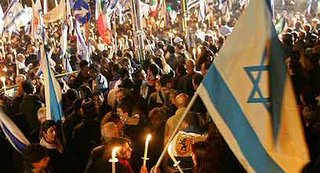
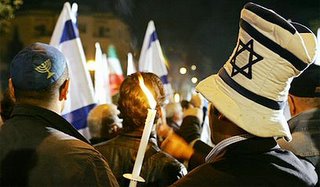
Italians rally for Israel
A very satisfying European response to the Iranian President's words - Italians rally for Israel, with some very nice photos from the rally. 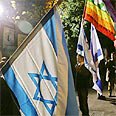
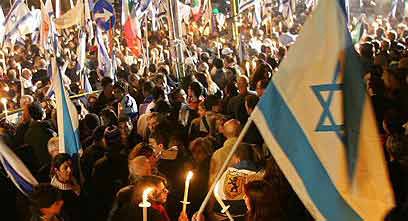
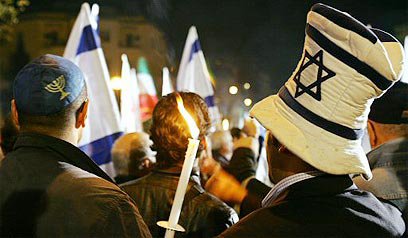
Monday, October 31, 2005
Sunday, October 30, 2005
Iran's Useful Reminder
Jim Hoagland at the Washington Post points out how President Ahmadinejad's anti-Israel statements serve as a Useful Reminder of the true nature of the Iranian regime and indeed of what the U.S. is fighting in the Middle East. He says:
For Hoagland, the new thing is that the Europeans have denounced the statements of Ahmadinejad:
He then turns to an example of hope in the Middle East - Iraqi Kurdistan.
We shouldn't forget that we've actually accomplished something good in Iraq - allowing the Kurds to live freely, rather than at the mercy of Saddam Hussein.
Most Valuable Politician of the year? How about President Mahmoud Ahmadinejad of Iran, who has surged ahead for the 2005 MVP award in the few months he has been in office? He reminds a distracted world at crucial moments of the true nature of Iran's regime, of the abiding source of conflict in the Middle East and of the deeper meaning of global terrorism.
Racial and religious hatreds are at the core of these phenomena - and at the heart of Ahmadinejad's pledges to see Israel "wiped off the map" and to ensure that Arabs who recognize the Jewish state "burn in the fire of the Islamic nation's fury." His statements were reported in laudatory terms by Iranian state-run television Wednesday.
For Hoagland, the new thing is that the Europeans have denounced the statements of Ahmadinejad:
Even though the Persian chauvinists who took power in Tehran in 1979 have been more discreet in public in recent years, it is not news that they hate both Jews and Arabs - or that the sentiment is returned. If novelty there was, it lay in statements of condemnation that European governments issued as the inflammatory remarks spread around the globe.
Britain, France and Germany raced to distance themselves from Ahmadinejad's double-barreled anti-Semitic blast. They have been negotiating with his regime in hopes of rehabilitating it. A spiteful and belligerent speech the Iranian leader gave at the United Nations in mid-September had already signaled the enormousness of their task. But they persisted. Now even Russian Foreign Minister Sergei Lavrov, perhaps the coldest and most uncaring fish in international diplomacy, feels compelled to mutter that the Iranian firebrand's statements were "unacceptable."
He then turns to an example of hope in the Middle East - Iraqi Kurdistan.
The fates of Nazi Germany and Vichy France are not the only lessons available to Iranians - or for that matter to Israelis or Americans - of the bitter fruits of preaching and practicing racial hatred. In neighboring Iraq, a regime that committed genocide against the Kurdish tribesmen of the north and persecuted Shiite Arabs in the south lies in ruins and seems incapable of rising again.
Because Saddam Hussein would not leave them in the peace and isolation of their mountain redoubt, Iraq's Kurds went to war against Baghdad three decades ago. They deliberately set in motion the chain of events that were to bring an American invasion force to Baghdad to overthrow the dictator in 2003. While he could not foresee exactly how it would happen, the late Kurdish leader Mullah Mustafa Barzani told me in 1972 that it would. I was skeptical; he was right.
No political outcome can balance the scales of personal grief and loss brought by the loss of 2,000 and more American service personnel in Iraq since the invasion began. Human lives cannot be measured and counted as instruments or integers of policy or politics.
So the fact that Kurds live in freedom today from racial pogroms directed at them from Baghdad -- in large part because of U.S. protection and sacrifice -- can assuage no mother's grief or friend's anger over U.S. casualties. But neither can the positive change that American actions have brought simply be dismissed or ignored.
Barzani's son, Massoud, visited the White House last week to thank the American nation, through President Bush, for those sacrifices and to reiterate the Kurds' commitment to staying in a "federal" Iraq that institutionalizes their autonomy -- and survival. Federalism for the Kurds is not some legalistic ploy to maximize their share of oil reserves, or a thumb to stick in Arab eyes in revenge. It is a chance to live and to let live.
We shouldn't forget that we've actually accomplished something good in Iraq - allowing the Kurds to live freely, rather than at the mercy of Saddam Hussein.
Saturday, October 29, 2005
More on Iran
This editorial, Contrived Fury, in the Arab News (published in Saudi Arabia - referral from The Religious Policeman) is an interesting comment on the Iranian President's call to "wipe Israel off the map."
The editorial points out that "Four years ago, former President Hashemi Rafsanjani, regarded by the West as a moderate, called for the nuclear annihilation of Israel. The West did not blink an eye. Ever since the 1979 revolution, Iran has been consistently and vehemently anti-Israel. The rest of the world has known it and lived with it. It lived with the knowledge because it also knew that Iran was not in a position to wipe Israel off the map and that the words were mere rhetoric from those who wanted to give their people something other than their failures to think about. The rest of the world too has been happy to live with the knowledge that most Muslims and Arabs would prefer that Israel did not exist. But it does exist. It is a question of accepting reality."
As this editorial states, it is not as if the current Iranian President invented the Iranian threats against Israel. And it is interesting the evidence the editorial brings about Rafsanjani, who is the head of the "Expediency Council" in Iran. In a May 25, 2005 article about the upcoming Iranian elections (in which Ahmadinejad was elected), Neil Macfarquhar of the New York Times says, "Mr. Rafsanjani is a staunch supporter of Iran's developing its nuclear capacity for electric power, medical applications and other uses, but says he opposes nuclear weapons. That contrasts with a sermon at a Friday Prayer in 2001, however, in which he suggested that just one nuclear bomb could solve the problem of Israel's threatening the region with its own nuclear arsenal."
This New York Times article describes how western leaders seem to regard Rafsanjani -
Now, since Rafsanjani essentially said the same thing as Ahmadinejad, then why should we be getting particularly upset at what Ahmadinejad just said - it doesn't represent a change in what the Iranian government would like to do. Perhaps the problem is simply, as the Arab News editorial says, that negotiations with the Iranian government over their nuclear weapons development have reached a critical point, and this statement points out once again how radical and dangerous the Iranian regime is.
A few years ago, in the late 1990's, when I had a postdoctoral fellowship at the Society of Fellows at Columbia University, Salman Rushdie came to speak. Rushdie still had to travel secretly and was protected by guards everywhere he went. We were invited to hear him speak by special letters and had to put our names on a list in order to be allowed into the hall where he was speaking. We also were not supposed to tell anyone that we were going to hear him speak, since his visit to New York was supposed to be a secret. When entering the hall, we had to show identification and our bags were searched. His talk was actually a conversation with Edward Said, then professor at Columbia. I also heard him the next day, when he came to the Society of Fellows to speak to graduate students. I knew that he was there because when I tried to enter the building, several NYPD officers were there as the security for Rushdie, and I had to prove that I had a legitimate reason to enter the building.
One thing I remember Rushdie saying - that the Iranian regime tried to present itself as reasonable to people in the West, that on the surface there were people in the regime who tried to present Iran as a regime like any other, but that we should not believe them - the regime was still as radical as under Ayatollah Khomeini. This is the same regime that (probably) ordered the bombings of the Israeli embassy and the Jewish community organization building in Argentina. If Iran is today restrained from trying to act out its threats to Israel, that does not mean that given the opportunity, the regime would not try to destroy Israel.
The editorial points out that "Four years ago, former President Hashemi Rafsanjani, regarded by the West as a moderate, called for the nuclear annihilation of Israel. The West did not blink an eye. Ever since the 1979 revolution, Iran has been consistently and vehemently anti-Israel. The rest of the world has known it and lived with it. It lived with the knowledge because it also knew that Iran was not in a position to wipe Israel off the map and that the words were mere rhetoric from those who wanted to give their people something other than their failures to think about. The rest of the world too has been happy to live with the knowledge that most Muslims and Arabs would prefer that Israel did not exist. But it does exist. It is a question of accepting reality."
As this editorial states, it is not as if the current Iranian President invented the Iranian threats against Israel. And it is interesting the evidence the editorial brings about Rafsanjani, who is the head of the "Expediency Council" in Iran. In a May 25, 2005 article about the upcoming Iranian elections (in which Ahmadinejad was elected), Neil Macfarquhar of the New York Times says, "Mr. Rafsanjani is a staunch supporter of Iran's developing its nuclear capacity for electric power, medical applications and other uses, but says he opposes nuclear weapons. That contrasts with a sermon at a Friday Prayer in 2001, however, in which he suggested that just one nuclear bomb could solve the problem of Israel's threatening the region with its own nuclear arsenal."
This New York Times article describes how western leaders seem to regard Rafsanjani -
Mr. Ahmadinejad's principal rival for power, Ali Akbar Hashemi Rafsanjani, a former Iranian president who was defeated by Mr. Ahmadinejad in the election, continues to hold considerable power as leader of the nation's Expediency Council, which was created in 1988 to help resolve contentious legislative issues. The Europeans have been negotiating with envoys loyal to Mr. Rafsanjani for the last two years and hope that they or others like them will re-emerge in the future.
Indeed in the last few weeks, Iran's ruling clerics, who still hold most of the power, have moved to strip the presidency of some of its authority over international diplomacy and hand it over to the Expediency Council under Mr. Rafsanjani. If there is any hope in the West for a diplomatic solution, it thus rests with this turn of events.
Now, since Rafsanjani essentially said the same thing as Ahmadinejad, then why should we be getting particularly upset at what Ahmadinejad just said - it doesn't represent a change in what the Iranian government would like to do. Perhaps the problem is simply, as the Arab News editorial says, that negotiations with the Iranian government over their nuclear weapons development have reached a critical point, and this statement points out once again how radical and dangerous the Iranian regime is.
A few years ago, in the late 1990's, when I had a postdoctoral fellowship at the Society of Fellows at Columbia University, Salman Rushdie came to speak. Rushdie still had to travel secretly and was protected by guards everywhere he went. We were invited to hear him speak by special letters and had to put our names on a list in order to be allowed into the hall where he was speaking. We also were not supposed to tell anyone that we were going to hear him speak, since his visit to New York was supposed to be a secret. When entering the hall, we had to show identification and our bags were searched. His talk was actually a conversation with Edward Said, then professor at Columbia. I also heard him the next day, when he came to the Society of Fellows to speak to graduate students. I knew that he was there because when I tried to enter the building, several NYPD officers were there as the security for Rushdie, and I had to prove that I had a legitimate reason to enter the building.
One thing I remember Rushdie saying - that the Iranian regime tried to present itself as reasonable to people in the West, that on the surface there were people in the regime who tried to present Iran as a regime like any other, but that we should not believe them - the regime was still as radical as under Ayatollah Khomeini. This is the same regime that (probably) ordered the bombings of the Israeli embassy and the Jewish community organization building in Argentina. If Iran is today restrained from trying to act out its threats to Israel, that does not mean that given the opportunity, the regime would not try to destroy Israel.
Thursday, October 27, 2005
Dateline Spandau
Imagine how Human Rights Watch, and other pundits, might have reacted to a trial of Hitler, ca. 1946 - Dateline Spandau, October 1946.
An excerpt from this exercise in alternative history: “Human rights groups have expressed concerns. A Human Rights Watch report says the Berlin trial ‘runs the risk of violating international standards for fair trials’. Amnesty International has sent three delegates to Berlin to ensure that Adolf Hitler receives a fair trial, and to oppose the death penalty if he is found guilty.”
An excerpt from this exercise in alternative history: “Human rights groups have expressed concerns. A Human Rights Watch report says the Berlin trial ‘runs the risk of violating international standards for fair trials’. Amnesty International has sent three delegates to Berlin to ensure that Adolf Hitler receives a fair trial, and to oppose the death penalty if he is found guilty.”
Wednesday, October 26, 2005
Fomenting hatred against the Jewish people
And if my previous posts today have not sufficiently depressed you about the spread of anti-semitism today - take a look at this posting from Norman Geras, about anti-semitic videos shown in Iranian and Jordanian television, and also anti-semitic brochures distributed at the Frankfurt Book Fair (happening right now). They included the Protocols and an abridgement of the "International Jew" by Henry Ford. See this article on the Frankfurt Book Fair: The "Protocols of the Elders of Zion" at the Frankfurt Book Fair. I had been under the impression that it was illegal to disseminate such literature in Germany, so I'm kind of surprised that the police did not seize these books.
Suicide bombing in Israel
Earlier today, an Islamic Jihad terrorist killed 5 Israelis in a suicide bombing in Hadera. Three of the victims have already been identified: Michael Koifman, Sabicha Nissim and Pirchiya Machluf. 30 people were wounded in the attack.
Mirty's Place
A moving post at Mirty's Place on the difficulties of being a Jew. She says:
I joked about the statement of the President of Iran in the previous post, but really, it's quite frightening to hear. I have good friends, whom I love dearly, living in Israel, and many relatives - and this man wants to wipe them all out! He's not seeking justice for the Palestinians - he's seeking mass murder.
It is a sobering return to reality after the splendid silliness of Simchat Torah services last night and today. I was one of the leyners for Bereshit (5th, 6th, and 7th days), and inbetween each day people in the congregation sang songs and acted out each day's creations. At the end, for the maftir reading (which outlines the sacrifices to be brought on the day, were the Temple still standing), we set up a grill & little stuffed rams were placed on it, next to some Triscuits (representing the grain offering). The two people who received Hatan Torah and Hatan Bereshit smiled with pleasure at the honor.
The other event I always mark on Simchat Torah is my mother's yahrzeit. She died on October 21 / Tishrei 23 in 1981 - 24 years ago. I was only 25 at the time, and it was devastating - and changed my life.
Other things come back too. I remember now why it is hard to be a Jew. Not because of the many customs and laws, but because of the pain. It’s hard to read about young Israelis gunned down alongside a road outside Jerusalem, to see the photos of their beautiful, shining faces. It’s hard to face the hatred that inflates our enemies. The news from Israel is so often bad. Beyond bad; heartbreaking. James Joyce wrote: “history is a nightmare from which I am trying to awaken.” But we know there is no escape. Our history is indeed a nightmare, a revelation of the darkest pits of human evil. It’s hard to carry that weight. It’s hard to watch my husband clean his plate at every meal, and wonder if he does that because his father was starved in Auschwitz. That is a lot of pain to carry. It is hard to be a Jew. It’s hard to care and feel so much.
I joked about the statement of the President of Iran in the previous post, but really, it's quite frightening to hear. I have good friends, whom I love dearly, living in Israel, and many relatives - and this man wants to wipe them all out! He's not seeking justice for the Palestinians - he's seeking mass murder.
It is a sobering return to reality after the splendid silliness of Simchat Torah services last night and today. I was one of the leyners for Bereshit (5th, 6th, and 7th days), and inbetween each day people in the congregation sang songs and acted out each day's creations. At the end, for the maftir reading (which outlines the sacrifices to be brought on the day, were the Temple still standing), we set up a grill & little stuffed rams were placed on it, next to some Triscuits (representing the grain offering). The two people who received Hatan Torah and Hatan Bereshit smiled with pleasure at the honor.
The other event I always mark on Simchat Torah is my mother's yahrzeit. She died on October 21 / Tishrei 23 in 1981 - 24 years ago. I was only 25 at the time, and it was devastating - and changed my life.
Our friends, the Iranians
As a post-holiday welcome to reality, Iran's President Says Israel Must Be 'Wiped Off the Map' - New York Times. He spoke at a "to an audience of about 4,000 student at a program called The World without Zionism, in preparation for an annual anti-Israel demonstration held on the last Friday of the holy month of Ramadan."
He continued by saying:
One wonders what is the identity of the "world oppressor" that he mentions....
He continued by saying:
"The establishment of Zionist regime was a move by the world oppressor against the Islamic world," Mr. Ahmadinejad said, the news agency reported. "The skirmishes in the occupied land are part of the war of destiny. The outcome of hundreds of years of war will be defined in Palestinian land."
One wonders what is the identity of the "world oppressor" that he mentions....
Sunday, October 23, 2005
Justice in Baghdad
Once again, Anne Applebaum writes an important op-ed piece, this time on Justice in Baghdad, on the Iraqi trial of Saddam Hussein. I must say, I've been astonished and disgusted that human rights groups like Human Rights Watch have seemed to be more concerned with Saddam's rights as a defendant than they are in the necessity to hold these trials and expose what he did to the people of Iraq. They seem more worried about the possibility that Saddam might be executed at the end of these trials than they are in bringing out the truth of the atrocities he committed.
Wednesday, October 19, 2005
Africa May Face Risk for Bird Flu
As I feared, Africa May Face Risk for Bird Flu.
"One of our major concerns is now the potential spread of avian influenza through migratory birds to North and Eastern Africa," said Dr. Joseph Domenech, the chief veterinary officer at the United Nations Food and Agriculture Organization, which monitors the spread of the disease in animals.
If the disease touches down there, it could well become widespread in the environment and on farms before it is even detected, he said.
Also, because in poorer African nations people live in close proximity with animals, such a situation would provide a dangerous crucible for the mixing or the bird and human viruses, vastly increasing the risk that the avian virus could gain the ability to readily spread among humans.
"The close proximity between people and animals and insufficient surveillance and disease control capability in eastern African countries create an ideal breeding ground for the virus," Dr. Domenech said.
Friday, October 14, 2005
Asian Avian Flu Confirmed as Killer of Birds in Turkey
This article on the spread of avian flu to birds in Turkey mentions at the end the possible consequences if it spread to Africa: "Dr. Jutzi also said the disease would be much more difficult to control if it reached Africa - as it was in Asia - because poorer countries often lacked the disease surveillance capacity and health systems to orchestrate a swift response." The horrifying possibility this suggestion opens up is that if the bird flu spreads to Africa, and mutates so that it can be spread between humans (not just from bird to human), that it would first strike in African countries already reeling from civil war and genocide (e.g., Sudan), poor crops (e.g., Niger), abysmally poor governance (e.g., Zimbabwe), malaria, and AIDS (all over sub-Saharan Africa).
Monday, October 10, 2005
Peace is not the answer
An inspiring op-ed piece by William Shawcross on the limited vision of the anti-war movement and the necessity to stay in Iraq.
Read the whole thing.
You did not see in those demonstrations, after all, many banners reading, "Support Iraq's New Constitution," "No to Jihad" or "Stop Suicide Bombers." The crimes committed daily against the Iraqi people by other Arabs who wish to re-enslave them seem to be of little interest to Michael Moore, Jane Fonda and their followers. Rage against the daily assaults on children, women, anyone, by Islamo-fascists and ordinary national fascists is not fashionable. Only alleged American crimes are cool to decry.
It's hard to think of a more graphic illustration of the horror the U.S.-led coalition is fighting in Iraq than the mass murder on Sept. 26, in which terrorists disguised as policemen (a New York Times headline called these butchers "fighters") burst into a primary school in Iskandaria, south of Baghdad, seized five teachers (all Shiites) and shot them dead. Children stood weeping through this atrocity.
Why do crimes like this make so little impression on those Americans and Europeans who want the coalition to abandon Iraq? The demonstrators think of themselves as moral, but it is hard to think of any policy more amoral than abandoning Iraq to such an enemy.
Read the whole thing.
Sunday, October 09, 2005
Sokwanele - Zvakwana - Enough is Enough
Really, is there no end to the suffering of the people of Africa under horrendous rulers? In this case, in Zimbabwe, not in Sudan. A reporter reveals the ongoing starvation in rural areas of Zimbabwe as a result of Robert Mugabe's insane policies, which have led to runaway inflation, devastating lack of fuel, and a situation in which Zimbabwe needs to import food (it used to be a food exporter). Mugabe kicked out NGO's that were feeding people, and now they have nothing left to eat. He's thrown all sorts of street vendors and poor people out of the poor neighborhoods of the cities - hundreds of thousands of people who now have nothing to live on. Why aren't we crying to the skies about this horrible situation too!
On a slightly more hopeful note, Nicholas Kristof has a fine article in today's New York Times about citizen activism on the genocide in Darfur. (I reprint the entire article here - it's only available to NY Times subscribers otherwise).
At Ithaca College, students have organized a local chapter of STAND and sponsored their first vigil last week, on October 6, which was a day to fast for Darfur. I went and said a few words. It was very moving to see students actually caring and organizing about Darfur. They are planning more activities, including a showing of Hotel Rwanda.
On a slightly more hopeful note, Nicholas Kristof has a fine article in today's New York Times about citizen activism on the genocide in Darfur. (I reprint the entire article here - it's only available to NY Times subscribers otherwise).
A year ago, a group of Swarthmore students decided to take on an unusual extracurricular activity: stopping genocide. Mark Hanis, one of the students, is Jewish and all four of his grandparents survived the Holocaust. He was troubled by the way generations of Americans acquiesced in one genocide after another - only to apologize afterward and pledge "Never Again." So Mr. Hanis and fellow students started to raise money to help provide security to stop the slaughter in Darfur. In particular, they wanted to help pay for African Union peacekeepers. Their Genocide Intervention Fund has now raised $250,000 and is about to hand over the first installment to the leaders of the African Union. The money may be used to pay for female African police officers to protect Darfur women from being raped. The Genocide Intervention Fund now has an all-star cast, including the backing of former White House officials, generals, and celebrities like Mia Farrow and Don Cheadle. Its spokeswoman, a Rwandan genocide survivor who is now a Swarthmore sophomore, introduced Bill Clinton at a student conference. It has opened a Washington office and is lobbying for the bipartisan Darfur Peace and Accountability Act, which calls for sanctions on Sudan and a no-fly zone. "We do lobby days, where we arrange for people to come to Washington to meet their Congressional offices and say, 'I've put $20 down to protect the people of Darfur. What are you doing?' " said Mr. Hanis, who graduated recently.
So far more than 100 colleges have raised money for the fund (www.genocideinterventionfund), and universities have become the center of the movement to stop the slaughter. A group started at Georgetown, Stand (Students Taking Action Now: Darfur), has chapters nationwide and across Canada, and Harvard led a divestment effort by having its endowment sell stock in companies that support the Sudanese government. In the long term, the organizers hope to encourage more education about genocide in American schools - California and a few other states have passed laws that public schools must include education about genocide - and to bolster an early warning system so that the world will respond to atrocities more promptly. "We're getting smarter at this," Mr. Hanis said. "We're building a permanent political constituency against genocide." He paused and added soberly: "Of course, there are lives lost every day."
So while President Bush is proving wimpish on genocide, the response of many ordinary Americans like Mr. Hanis has been inspiring. Aside from students, the leaders in the effort include Jewish and Armenian groups (the word genocide has special resonance for both) and religious groups. In Dallas, Temple Emanu-El started Dolls for Darfur, which has made thousands of tiny paper dolls representing the victims of Darfur. It has sent them to senators and is preparing "advocacy kits" to help people lobby for a sterner American response to the genocide (see Dolls for Darfur).
Then there are the big-hearted folks at Ginghamsburg Church, a large Methodist church in Tipp City, Ohio. After the pastor, Mike Slaughter, read about atrocities in Darfur, he decided to ask the congregation to spend only half as much on Christmas presents last year as they planned, and to donate the rest to victims in Darfur. The result, along with other fund-raising efforts, was $327,000 in donations; the congregation is planning the same campaign this Christmas. The money is being used to keep children alive and safe in South Darfur. "We recognize that this is only a pittance in the face of the entire crisis in Darfur," says Karen Smith, director of operations for the church. "However, if we can successfully engage other churches across the U.S. in this call so that they issue the same challenge to their constituents, the impact could truly be God-sized."
During the Holocaust, when Franklin Roosevelt was as uninterested in genocide as George W. Bush is today, Arthur Koestler referred to those who demanded action as "the screamers." Today, Mr. Hanis, Ms. Smith and others like them are "the screamers," and if it weren't for them the death toll in Darfur would be even higher. Countless thousands of survivors sitting in refugee camps owe their lives to screams coming from places like Swarthmore or Ginghamsburg.So out of the miasma of horror that is Darfur, something uplifting is taking place. Ordinary Americans are finding creative ways to respond to the slaughter, so that they personally inject meaning into those traditionally hollow words: Never Again.
At Ithaca College, students have organized a local chapter of STAND and sponsored their first vigil last week, on October 6, which was a day to fast for Darfur. I went and said a few words. It was very moving to see students actually caring and organizing about Darfur. They are planning more activities, including a showing of Hotel Rwanda.
Sunday, September 11, 2005
Photographer's Journal: A Wounded City
To see photographs from September 11, 2001, see this special site from the New York Times Photographer's Journal: A Wounded City.

September 11, 2005
Today, as everyone knows, is the fourth anniversary of the terrorist attacks on September 11, 2001. It's another beautiful, cloudless day in Ithaca - a blue sky day, just like September 11, 2001. This morning I went to the Farmer's Market with a friend and wandered around picking up my vegetables, drinking strong coffee, tasting local wines, and encountering friends doing the same thing. I don't know if I'll do anything to remember the day. Tonight, on campus, the student Republican club is sponsoring a candlelight vigil (why only the Republicans, I don't know - I don't think of remembering September 11 as a necessarily Republican action).
At this time of day on September 11, 2001, I was on campus, probably in my office, wondering what the hell I should be doing. I had a class scheduled for later that day and didn't know if we should meet (we didn't, as it happened). I tried to talk to people. I saw students calling their families on their cellphones. I went into the TV lounge and watched more of the coverage. I was in shock, along with everyone else I knew. I worried about friends of mine in New York City, one of whom I thought (incorrectly) worked at the World Trade Center. It was impossible to reach anyone by phone in New York City - in fact, I couldn't even get an open phone line to my family in the Boston area. You know, you all remember that day.
For some of the stories from that day, see this site from the September 11 Digital Archive. It's a Google map of lower Manhattan - click on the blue blobs and you get photographs, or on the red ones to get personal stories from the day.
At this time of day on September 11, 2001, I was on campus, probably in my office, wondering what the hell I should be doing. I had a class scheduled for later that day and didn't know if we should meet (we didn't, as it happened). I tried to talk to people. I saw students calling their families on their cellphones. I went into the TV lounge and watched more of the coverage. I was in shock, along with everyone else I knew. I worried about friends of mine in New York City, one of whom I thought (incorrectly) worked at the World Trade Center. It was impossible to reach anyone by phone in New York City - in fact, I couldn't even get an open phone line to my family in the Boston area. You know, you all remember that day.
For some of the stories from that day, see this site from the September 11 Digital Archive. It's a Google map of lower Manhattan - click on the blue blobs and you get photographs, or on the red ones to get personal stories from the day.
Thursday, September 08, 2005
A debate of biblical proportions
New excavating in Jerusalem has reopened a debate of biblical proportions - between those archaeologists who argue that the Jerusalem of David and Solomon was a substantial city with large public buildings, and those who maintain that Jerusalem only became an imposing city centuries after the time of David and Solomon.
One interesting find, discovered by Dr. Eilat Mazar, was a "a bulla, a round clay seal about one centimeter in diameter in which its owner's name was inscribed." It was inscribed "in a Hebrew script characteristic of the late First Temple period," and "contained the name of Yehokal ben Shlamyahu ben Shavi, who is mentioned twice in the Book of Jeremiah."
"When Mazar investigated further to see who the owner of the seal was, she let out a cry of surprise: Yehokal ben Shlamyahu was a senior minister in the government of Zedekiah. He is mentioned in Jeremiah 37:3 as one of two emissaries dispatched by King Zedekiah to Jeremiah, asking him to pray for the people during the siege of Nebuchadnezzar, King of Babylon. Chapter 38 tells that Yehokal was one of four ministers who asked the king to kill Jeremiah, alleging that the prophet was sowing demoralization among the besieged people."

Is this cool or what?
One interesting find, discovered by Dr. Eilat Mazar, was a "a bulla, a round clay seal about one centimeter in diameter in which its owner's name was inscribed." It was inscribed "in a Hebrew script characteristic of the late First Temple period," and "contained the name of Yehokal ben Shlamyahu ben Shavi, who is mentioned twice in the Book of Jeremiah."
"When Mazar investigated further to see who the owner of the seal was, she let out a cry of surprise: Yehokal ben Shlamyahu was a senior minister in the government of Zedekiah. He is mentioned in Jeremiah 37:3 as one of two emissaries dispatched by King Zedekiah to Jeremiah, asking him to pray for the people during the siege of Nebuchadnezzar, King of Babylon. Chapter 38 tells that Yehokal was one of four ministers who asked the king to kill Jeremiah, alleging that the prophet was sowing demoralization among the besieged people."

Is this cool or what?
Monday, September 05, 2005
HungryBlues
For extensive coverage on the racial implications of the hurricane in New Orleans, see my friend Ben's blog, Hungry Blues. Listening to Amy Goodman's "Democracy Now" show this morning was also eye-opening.
Sunday, September 04, 2005
A Nation's Castaways
The news about the racial divisions revealed in New Orleans by the hurricane has been noted by many news articles this weekend. In the Washington Post, an article reads:
The history of marginalizing black folk in America, especially poor ones, runs so deep that it occurs like second nature. It is one reason, say several prominent black intellectuals, that the response to the devastation of Katrina was so slow.The article also notes the racialized way that the photographs and news footage coming from New Orleans have been interpreted:
Racism runs "so deep that the folks who are slow to respond can't see it," says Russell Adams, professor of Afro-American studies at Howard University. "That's the unperceived character of racial behavior, of what I would call hidden racism where you don't know that this situation has a racial character to it, just like fish have trouble defining water."
This feeling of being disregarded is pervasive in the African American community, where old wounds still sting. Witness a "Saturday Night Live" skit from 1998, where Samuel L. Jackson and Tracy Morgan indulge in a bit of hyperbole, playing African Americans in the fifth class steerage of the Titanic. Everyone was rescued before them -- even the furniture.For another way of thinking about race, see these comments:
While that may have been comedy, its message is conveyed in all kinds of real-life ways. Deborah Willis, photographer and professor of the arts at New York University, laments some of the images coming out of New Orleans.
The frequent replay of what has become an iconic looting photo -- the guy with the flying braids and falling pants -- "desensitizes the viewer of finding compassion for what happened to the thousands of people who have died or who have suffered," she says.
It's an us-vs.-them kind of image, she says, and "a racialized image because of the way it's been used and reused over again."
Noel Ignatiev, author of "How the Irish Became White" and editor of Race Traitor, a journal dedicated to the "New Abolitionism," suggests that the nation is poised at a pivotal point. He sees an opportunity for a realignment of thinking.
"White is not a matter of color. White is a matter of a sense of entitlement, a sense they are or ought to be entitled to specially protected place in society," he says. "But there are plenty of white folks on the bottom rung of society, people for whom whiteness isn't doing much at all."
"Some may be awakening to the notion there's no use clinging to an identity that's doing them no good. If white folks start thinking of themselves as poor and dispossessed instead of privileged, it will change the way they act. We will see the beginnings of class conflict."
Friday, September 02, 2005
"To me, it just seems like black people are marked"
See a Washington Post article on the disproportionate number of black people hit by this disaster:
BATON ROUGE, La., Sept. 1 - It seemed a desperate echo of a bygone era, a mass of desperate-looking black folk on the run in the Deep South. Some without shoes. It was high noon Thursday at a rest stop on the edge of Baton Rouge when several buses pulled in, fresh from the calamity of Hurricane Katrina in New Orleans. Hundreds piled out, dragging themselves as if floating through some kind of thick liquid. They were exhausted, some crying.
"It was like going to hell and back," said Bernadette Washington, 38, a black homemaker from Orleans Parish who had slept under a bridge the night before with her five children and her husband. She sighed the familiar refrain, stinging as an old-time blues note: "All I have is the clothes on my back. And I been sleeping in them for three days."
While hundreds of thousands of people have been dislocated by Hurricane Katrina, the images that have filled the television screens have been mainly of black Americans - grieving, suffering, in some cases looting and desperately trying to leave New Orleans. Along with the intimate tales of family drama and survival being played out Thursday, there was no escaping that race had become a subtext to the unfolding drama of the hurricane's aftermath.
"To me," said Bernadette Washington, "it just seems like black people are marked. We have so many troubles and problems."
"After this," her husband, Brian Thomas, said, "I want to move my family to California."
Thursday, September 01, 2005
A social meltdown
Andrew Sullivan expresses eloquently how I feel: "This has morphed from a natural disaster into a social meltdown. The Lousiana governor seems overwhelmed (Barbour seems much more effective); New Orlean's civic authorities seem non-existent (and bear responsibility for the insufficient preparation for this potential and widely predicted nightmare); and the president's response has been decidedly weak. His call to restrain from using gas was, well, Carteresque. It seems to me inconceivable that we cannot impose basic law and order in a major American city five days after a hurricane has hit. This is a very basic governmental responsibility and all I can say is that I see no evidence of competence or effectiveness so far. FEMA had no solid evacuation plan? The feds had no plans to maintain order in such a situation? The explosion of complete lawlessness is beginning to make Haiti look like a pleasant place to live. This is America? Where order is so distant that snipers can prevent the evacuation of a hospital? The fundamental reason for my inability to support a second Bush term was his demonstrated incompetence in performing the basic functions of government. It seems to me that the people of New Orleans are now as much a victim of this as the people of Iraq. I guess we can merely be thankful that Rumsfeld hasn't yet appeared to say 'Stuff happens.' Yes, it does. When your government seems unable to do the most basic things required of it."
Disaster in New Orleans
I'm starting to have the feeling that the country I grew up in is no more. How can it happen that a major city can break down so quickly while the rest of us watch on television? Why isn't the federal government doing more - doing everything it can - to save people in New Orleans from hunger, thirst, heat, lack of sanitation, lack of access to doctors and medication - you name it? How can it be that people are dying in the streets and no one is even noticing the corpses? Why didn't the local and state governments bring in buses before the hurricane hit to evacuate the people too poor to get out on their own?
Is it really because our government has sent so many National Guard troops to Iraq that we have none left to deal with disasters here at home? So much for our "wartime" President, who can do nothing more than fly over Louisiana in Air Force One, watching from above. Is it because most of the people left in New Orleans are poor and black?
And the rest of us, we sit at our televisions and watch it as if it were a spectacle akin to a reality show.
Some words from local officials in New Orleans:
On the situation in the Superdome:
On FEMA:
A local resident outside the Superdome:
On where the refugees are being sent:
This article from the New York Times talks about how the government did not forsee the failure of the levees, and did not prepare for having to evacuate and house 100,000 people in the city who were too poor, old, or sick to leave on their own. They thought that even if Katrina had been a Category 5 storm, the levees and flood walls might be overtopped - not that they might be breached.
While they may have done that, they didn't try to evacuate them outside the city.
I know that it's impossible to plan for everything, and that the magnitude of the disaster has overwhelmed everyone - but can't we help those people who are suffering?
Is it really because our government has sent so many National Guard troops to Iraq that we have none left to deal with disasters here at home? So much for our "wartime" President, who can do nothing more than fly over Louisiana in Air Force One, watching from above. Is it because most of the people left in New Orleans are poor and black?
And the rest of us, we sit at our televisions and watch it as if it were a spectacle akin to a reality show.
Some words from local officials in New Orleans:
On the situation in the Superdome:
"Some people there have not eaten or drunk water for three or four days, which is inexcusable," acknowledged Joseph W. Matthews, the director of the city's Office of Emergency Preparedness. "We need additional troops, food, water," Mr. Matthews begged, "and we need personnel, law enforcement. This has turned into a situation where the city is being run by thugs."
On FEMA:
Col. Terry Ebbert, director of homeland security for New Orleans ... was particularly pungent in his criticism. Asserting that the whole recovery operation had been "carried on the backs of the little guys for four goddamn days," he said that "the rest of the goddamn nation can't get us any resources for security."
"We are like little birds with our mouths open, and you don't have to be very smart to know where to drop the worm," Colonel Ebbert said. "It's criminal within the confines of the United States that within one hour of the hurricane they weren't force-feeding us. It's like FEMA has never been to a hurricane." FEMA is the Federal Emergency Management Agency.
A local resident outside the Superdome:
"We're just a bunch of rats," said Earle Young, 31, a cook who stood waiting in a throng of perhaps 10,000 outside the Superdome, waiting in the blazing sun for buses to take them away from the city. "That's how they've been treating us."
On where the refugees are being sent:
The effects of the disaster spilled out over the country. In Houston, the city began to grapple with the logistics of taking tens of thousands of refugees into the Astrodome, and San Antonio and Dallas each braced for the arrival of 25,000 more. Baton Rouge overnight replaced New Orleans as the most populous city in Louisiana and was bursting at the seams.
On the receiving end in Houston, though, the Astrodome looked at times like a squatters' camp in a war-torn country. The refugees from Louisiana, many dirty and hungry, wandered about aimlessly, checking bulletin boards for information about their relatives, queuing up for supplies and pay phones, mobbing Red Cross volunteers to obtain free T-shirts. Many found some conditions similar to those that they left behind at the Superdome, like clogged toilets and foul restrooms.
But in Houston, there were hot showers, crates of Bibles and stacks of pizzas, while in New Orleans, many refugees scrounged for diapers, water and basic survival.
This article from the New York Times talks about how the government did not forsee the failure of the levees, and did not prepare for having to evacuate and house 100,000 people in the city who were too poor, old, or sick to leave on their own. They thought that even if Katrina had been a Category 5 storm, the levees and flood walls might be overtopped - not that they might be breached.
Rodney Braxton, the chief lobbyist for New Orleans, said that many of the city's poorest residents "had nowhere to go outside the region and no way to get there. And there wasn't enough police power to go to each house to say, 'You have to go, come with me.' " In a city with so many residents living in poverty, the hurricane came at the worst possible time: the end of the month, when those depending on public assistance are waiting for their next checks to be mailed on the first of the month. Without the checks, many residents didn't have money for gas, bus fare or lodging. City officials said they provided free transportation from pick-up points publicized on television, radio and by people shouting through megaphones on the streets. In addition to the Superdome, officials opened schools and the convention center as shelters.
While they may have done that, they didn't try to evacuate them outside the city.
The chaotic disaster response came despite repeated efforts over many years to plan a coordinated defense if the worst should occur. As recently as July 2004, federal, state and local officials cooperated on the Hurricane Pam drill, which predicted 10 to 15 feet of water in parts of the city and the evacuation of one million people. Martha Madden, who was the Louisiana secretary of environmental quality from 1987-1988, said that the potential for disaster was always obvious and that "FEMA has known this for 20 years." "Hundreds and hundreds of thousands of dollars were spent, in studies, training and contingency plans, scenarios, all of that," said Ms. Madden, now a consultant in strategic planning. The Army Corps, she said, should have had arrangements in place with contractors who had emergency supplies at hand, like sandbags or concrete barriers, the way that environmental planners have contracts in place to handle oil spills and similar events.
I know that it's impossible to plan for everything, and that the magnitude of the disaster has overwhelmed everyone - but can't we help those people who are suffering?
Disaster relief funds for New Orleans
Miriam at Bloghead provides useful information on Jewish agencies where money can be sent to help people in New Orleans and the Gulf coast. As she says, "The pictures and stories coming out of New Orleans tonight are simply beyond belief. An entire city destroyed! Who can comprehend. Even the most powerful nation in the world can be impotent before nature."
More on Pulsa Denura
The Israeli Attorney-General, Menahem Mazuz has decided not to charge the Jewish extremists who enacted the Pulsa Denura against Prime Minister Sharon this summer.
Attorney-General Menahem Mazuz has decided not to press charges against a group of Jewish extremists who carried out an ancient curse ceremony meant to place a death wish on Prime Minister Ariel Sharon, since the appeal was to God and not to mankind, the Justice Ministry said Tuesday.
The decision by Israel's top law enforcement official was made after determining that the ceremony was an appeal for heavenly action against the prime minister, and as such could not be viewed in the legal sense as incitement to violence, according to a letter that Deputy State Attorney Shai Nitzan sent to MK Ran Cohen (Yahad).
Tuesday, August 30, 2005
Hurricane Katrina
I am reminded of the tsunami in Indonesia and Sri Lanka in December when looking at the photographs and video of New Orleans today. Right now I'm watching the live streaming video from one of the local New Orleans television stations, WWL-TV (if you wish to find it, go to WWLTV). An AP story on Yahoo said, "From the air, neighborhood after neighborhood looked like nothing but islands of rooftops surrounded by swirling, tea-colored water." This is just an appalling disaster - the levees have broken through and water is pouring into New Orleans from Lake Pontchartrain. Apparently water is rising in the Superdome, where tens of thousands of people have taken refuge. On WWL they're now broadcasting a helicopter tour of the area (probably from earlier today, because it's in daylight), and are commenting on how high the water has gone - up the eaves on two-story houses (as I'm sure you've seen yourselves on television).
For those who wish to help with the relief efforts, contributions can be sent to the American Red Cross.
For those who wish to help with the relief efforts, contributions can be sent to the American Red Cross.
Saturday, August 27, 2005
I had not thought Death Eaters had undone so many.
For a beautiful poetic parody of T.S. Eliot's "The Wasteland" and of J.K. Rowling's latest book, "Harry Potter and the Half-Blood Prince," see this wonderful entry by ladysysiphus - Harry Potter and the Half-Blood Poet.
Friday, August 26, 2005
Dispiriting Israeli moves after the disengagement from Gaza
The Israeli government has engaged in several actions concurrent with or just after the disengagement from Gaza that make me feel very depressed about the future of any possible peace with the Palestinians. Among other things, it has decided to build the separation wall around Ma'aleh Adumim, a Jewish suburb of Jerusalem in the West Bank, so that it will be connected to the Jerusalem municipality. This means that Palestinians will suffer further from the inability to travel, to work, to go to school, to visit family, to engage in business, etc. It also means that the Arab neighborhoods of East Jerusalem will be completely surrounded by Jewish neighborhoods, thus making it impossible for Jerusalem to serve as the capital of two states, Israel and Palestine. Another move that I just received news about involves the plan to build a new Jewish settlement inside the Muslim Quarter of the Old City of Jerusalem, near Herod's Gate.
This news comes via ICAHD: Israeli Committee Against House Demolitions, which among other organizations is denouncing this decision and trying to reverse it. For more information about this decision and suggestions for letters to write against it, see the following information (I have abridged the statement).
As a Zionist, I oppose unilateral actions like these, because they will increasingly make it impossible even to hope for the future of an Israeli Jewish state. The long-term result of Israeli governmental actions like this will be to make the idea of "two states for two peoples" impossible, and will force Israelis to contemplate the existence of a unitary state in Palestine which will, in a few decades, have an Arab majority. I also oppose actions like these because they indicate that the Israeli governmental is gratuitously ignoring the suffering it is imposing upon Palestinians - which is hardly a Jewish value!
Update
An editorial in today's Haaretz, A poorly timed provocation, also criticizes the moves by the Israeli government to build the separation wall around Ma'aleh Adumim, with these words, "It is hard not to view the decisions about the fence and the new construction near Ma'aleh Adumim as a poorly timed provocation. They damage the efforts to rebuild trust with the Palestinian Authority and to strengthen its leader, Mahmoud Abbas, as a partner for future negotiations. They lend credence to the Palestinian claim that the withdrawal from Gaza was merely an Israeli trick designed to obtain international support and to divert attention from its tightening occupation of the West Bank and East Jerusalem. They erode the contribution that the successful disengagement made to reviving the diplomatic process and show that Sharon has returned to his evil ways in the settlements."
This news comes via ICAHD: Israeli Committee Against House Demolitions, which among other organizations is denouncing this decision and trying to reverse it. For more information about this decision and suggestions for letters to write against it, see the following information (I have abridged the statement).
Recently the Sub-committee of the Local Committee for Planning and Construction in Jerusalem has confirmed a plan to erect a Jewish neighbourhood in the Muslim Quarter of the Old City of Jerusalem. According to the plan, 30 housing units and a synagogue will be built to accommodate some 150 people. Professionals (BIMKOM - Planners for Planning Rights) warn of the implications of this plan:
The proposed plan violates the basic planning principles of all construction in the Old City:
1. Principles of preservation....
2. The Old City is the most densely inhabited place not only in Jerusalem but also in Israel....
3. In addition to the density, changing the open space, which is among the extremely few open spaces in the Old City, into a housing area will seriously harm the welfare of the people living there.
Besides the above planning drawbacks and the environmental implications, we recognize the political danger inherent in the plan. Building housing units for Jews in the Muslim Quarter has far-reaching implications over the delicate social fabric of the city. The Palestinians in East Jerusalem live in socio-economic distress, therefore a permanent presence of Jews in such a vicinity, in improved living conditions, would lead to provocation and a serious political and social crisis. Moreover, the proposed plan is also a continuation of a consistent Israeli policy whose purpose is a violation of the balance between Palestinians and Israelis in Jerusalem, creating by this policy a Jewish majority in East Jerusalem...
ACTION: WHAT YOU CAN DO:
One way to help change policy is to contact government representatives....
--Phone, fax, or email your representatives directly. If you are a U.S. resident or citizen, find your representative's contact information at www.senate.gov and www.house.gov. If you have the ability, one fax is generally worth about ten emails.
--To help us gauge the response, please send a cc of your messages to lucia@icahd.org.
--Please also contact Israeli policy makers:
Min. Interior Ophir Pines, fax: 03-763 2638/ 02-566-6376 or email pinespaz@knesset.gov.il..
Minister for Building & Infrastructure, Isaac Herzog, fax: 02-584-7033 and 02-582-4111
Director of Jerusalem District Planning, Ruth Yosef: fax: 02-624-1986 or phone: 02-629-0216
Jerusalem Mayor, Uri Lupoliansky, Fax: 02-629-6014
Rabbi Yehoshua Pollak, Chairman, Municipal Local Committee of Building & Planning: fax: 02-629-6178
Emails to Meir Margalit at meir@icahd.org will be hand delivered to the Municipality
SAMPLE LETTER:
Dear…….,
I was shocked to hear that the Sub-committee of the Local Committee for Planning and Construction in Jerusalem has confirmed a plan to erect a Jewish neighbourhood in the Muslim Quarter of the Old City of Jerusalem.According to the plan, 30 housing units and a synagogue will be built to accommodate some 150 people.
Besides the fact that building this settlement is illegal under international law, professionals (BIMKOM - Planners for Planning Rights) warn of the negative impact of the plan on the Old City.
The building of this settlement in the Muslim Quarter also has negative political implications for the delicate social fabric of the city between Palestinians and Jews.
I urge you to do everything in your ability to stop the building of this settlement.
Regards,
[Sign]
As a Zionist, I oppose unilateral actions like these, because they will increasingly make it impossible even to hope for the future of an Israeli Jewish state. The long-term result of Israeli governmental actions like this will be to make the idea of "two states for two peoples" impossible, and will force Israelis to contemplate the existence of a unitary state in Palestine which will, in a few decades, have an Arab majority. I also oppose actions like these because they indicate that the Israeli governmental is gratuitously ignoring the suffering it is imposing upon Palestinians - which is hardly a Jewish value!
Update
An editorial in today's Haaretz, A poorly timed provocation, also criticizes the moves by the Israeli government to build the separation wall around Ma'aleh Adumim, with these words, "It is hard not to view the decisions about the fence and the new construction near Ma'aleh Adumim as a poorly timed provocation. They damage the efforts to rebuild trust with the Palestinian Authority and to strengthen its leader, Mahmoud Abbas, as a partner for future negotiations. They lend credence to the Palestinian claim that the withdrawal from Gaza was merely an Israeli trick designed to obtain international support and to divert attention from its tightening occupation of the West Bank and East Jerusalem. They erode the contribution that the successful disengagement made to reviving the diplomatic process and show that Sharon has returned to his evil ways in the settlements."
Monday, August 22, 2005
Sun Sun Sun here we come!
I'm sitting here in my study in Ithaca, planning this semester's courses and listening to "Here Comes the Sun" by the Beatles on Israel's Reshet Bet on my computer.... It is, after all, a little after 5:00 a.m. in Israel right now. Gotta love the internet.
Settlers set IDF troop transport ablaze in West Bank
It's sounding like the pullout from the four West Bank settlements is going to be toughter to execute than in Gaza. A recent incident, Settlers set IDF troop transport ablaze in West Bank, provides further evidence. 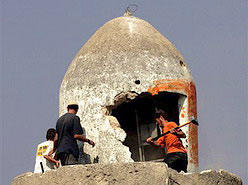 This picture, from the AP, of "settlers attempting to destroy the minaret of an old mosque located inside Sa-Nur on Monday," shows further their lack of respect for their Palestinian neighbors. (One also has to wonder why Sa-Nur was built on that particular location). Other actions by settlers against Palestinians included:
On another point, Amira Hass in Haaretz points out the human cost to Palestinians living near Netzarim, in the Gaza Strip, the last Gaza settlement to be evacuated. When it was evacuated, there were 80 veteran families and 20 families of newcomers living there. She says, "Netzarim is 114 people killed, including 17 children; 1,915 dunams of destroyed vineyards and fields; and 105 houses that were demolished and another 35 partially torn down." In another article I read today, 17 Israeli soldiers were killed over the years defending Netzarim from Palestinian attacks of various kinds. And were all these deaths worth it? I don't think so.
 This picture, from the AP, of "settlers attempting to destroy the minaret of an old mosque located inside Sa-Nur on Monday," shows further their lack of respect for their Palestinian neighbors. (One also has to wonder why Sa-Nur was built on that particular location). Other actions by settlers against Palestinians included:
On the eve of the evacuation of the northern West Bank settlements of Sa-Nur and Homesh, settlers before dawn on Monday vandalized property in at least eight Palestinian villages in the region, Palestinian witnesses said. In some instances, settlers reportedly marched through the villages with the aim of infiltrating Sa-Nur and Homesh, areas that have been sealed by security forces in the lead up to the evacuation. In other instances, the settlers reportedly entered the Palestinian villages with the sole aim of vandalizing property. Palestinian sources confirmed property was damaged but said there were no casualties.
In a separate incident, two Palestinians were lightly wounded late Monday evening when settlers threw stones at them near the Eli settlement located east of Ariel in the West Bank. Palestinians in Fendaqumiyah, located adjacent to Homesh, said armed settlers rode through the village before dawn Sunday on all-terrain vehicles, firing their weapons in the air. Sources said settlers also entered the villages of Kuchin and Madmah, located south of Nablus. Settlers in those villages threw stones and bottles at house windows and at cars.
Additional incidents were reported in Bazariyah, Burqa and Sabastiyah, located next to Karnei Shomron. Overnight Sunday, settlers reportedly took over a Palestinian family home in the village of Burqa and kicked the residents out for an hour as they destroyed furniture and smashed windows. Settlers also reportedly threw stones at residents in the village of Jit, located next to Kedumim. There were no casualties. The overnight incidents join other recent violent attacks on Palestinians, including the terror killing of four Palestinians laborers by a settler in the Shilo industrial area.
On another point, Amira Hass in Haaretz points out the human cost to Palestinians living near Netzarim, in the Gaza Strip, the last Gaza settlement to be evacuated. When it was evacuated, there were 80 veteran families and 20 families of newcomers living there. She says, "Netzarim is 114 people killed, including 17 children; 1,915 dunams of destroyed vineyards and fields; and 105 houses that were demolished and another 35 partially torn down." In another article I read today, 17 Israeli soldiers were killed over the years defending Netzarim from Palestinian attacks of various kinds. And were all these deaths worth it? I don't think so.
Thursday, August 18, 2005
Soldiers vs. Settlers in Gaza
I was just looking at some of the photographs from Kfar Darom about the fighting between IDF soldiers and settlers on the roof of the synagogue - a horrible scene. This photograph is from the New York Times, with the following caption: "Israeli settlers fighting with Israeli riot police from the roof of the synagogue of Kfar Darom." It was taken by Pavel Wolberg/European Pressphoto Agency.
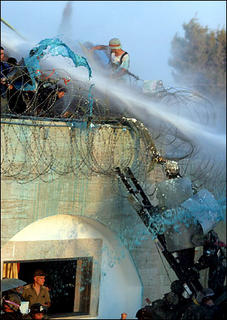
Update (from Haaetz) - What we saw here crossed all boundaries

Update (from Haaetz) - What we saw here crossed all boundaries
Israeli security forces seized control of the roof of Kfar Darom's synagogue Thursday evening, as they moved to oust die-hard protesters, hours after troops stormed the inside of the building to remove illegal infiltrators. Some 44 people were injured in the operation - 27 police officers, 14 protesters and 3 soldiers. The police officers were taken for tests at Soroka Medical Center in Be'er Sheva, after acid was thrown at then during the evacuation. One of the policemen sustained moderate to serious injuries when he slipped on oil thrown by protesters to deter security forces, and fell from the second story of the synagogue. Major General Dan Harel said several troops were wounded by acid and were sent to hospital. "What we saw here crossed all boundaries," he said. "Everybody who was now on the roof will be arrested and put in prison."
Cuban crackdown brings arrests of 50 dissidents
Here we go again - Cuban crackdown brings arrests of 50 dissidents, and yet people on the left still defend it. Chris McConkey (of "Pastors for Peace") said in 2004, "'To think that there aren't organic changes occurring in Cuba is insane,' says McConkey. 'Democratic ideas are developing there at the community and local level.'" Unfortunately, those democratic ideas are being systematically suppressed by the Cuban government.
Wednesday, August 17, 2005
On the terrorist attack
Some Jewish blogs on the recent terrorist attack:
Rahel (in Jerusalem) at Elms in the Yard condemned today's terrorist attack by an Israeli with these words:
Jack's Shack said: "This type of behavior is inexcusable and does nothing but damage. It is terrorism, it is murder and it is shameful."
Life-of-Rubin says: "The only thing being accomplished by people who think the only channel for protest is murder is convincing the world that we are just as bad as they are. We don't commit senseless acts of terror, and that's what this is. I can't speak out against this enough."
Rahel (in Jerusalem) at Elms in the Yard condemned today's terrorist attack by an Israeli with these words:
According to Weisgan’s friends, he was “depressed” over the disengagement. Well, what do you know—so is most of the country. No matter which side of the issue you’re on, what is happening in Israel right now is absolutely heartbreaking. But we don’t deal with sadness, depression and heartbreak by going out and committing murder. Anyone who practices such a hideous form of “therapy” is no better than the terrorists who, in order to sate their lust for blood and power, strap on explosive belts and blow themselves up amid crowds of innocent people.
The best Weisgan can now expect is a trial followed by a long prison term, possibly for life. But at least he will live, which is more than can be said of the four people whose lives he cut short today in cold blood.
Jack's Shack said: "This type of behavior is inexcusable and does nothing but damage. It is terrorism, it is murder and it is shameful."
Life-of-Rubin says: "The only thing being accomplished by people who think the only channel for protest is murder is convincing the world that we are just as bad as they are. We don't commit senseless acts of terror, and that's what this is. I can't speak out against this enough."
Another Israeli terrorist attack
The scenes from the disengagement are horrible to watch and hear. I was especially appalled to hear on the radio this morning that a woman had attempted to burn herself to death as a protest. And then today, another Israeli attacks Palestinians:
Israeli Prime Minister Sharon condemned the attack:
An Israeli Jew killed three people and wounded three others Wednesday afternoon when he opened fire on a group of Palestinians in the industrial area of the West Bank settlement of Shiloh.
Asher Weisgan, a 38-year-old driver from Shvut Rahel in the West Bank, transported Palestinian workers to and from the industrial area daily. Wednesday afternoon, he picked up the workers to take them home, and stopped on the way out to ask a security guard for a cup of water.
He then stole the guard's weapon, shot the two Palestinian workers in his car at the time, and then ran into the industrial area, killing another worker on the way and wounding two others.
Israeli Prime Minister Sharon condemned the attack:
Prime Minister Ariel Sharon on Wednesday condemned a shooting attack by an Israeli Jew in the West Bank, in which three Palestinians were killed, saying that he regarded the attack "very gravely."
"I view this act of Jewish terror, which was aimed at innocent Palestinians with the twisted thinking that it would stop the disengagement plan, very gravely," Prime Minister Ariel Sharon said in a statement released by his office.
Tuesday, August 16, 2005
Street Hebrew
Once more, a reprise of the essential Hebrew slang you never learned in ulpan, from "The Underground Academy for the Hebrew Language": Street Tongue - The Hebrew they never taught you.
My favorites: לנקר (l'na-ker) - to nod off, literally, with head striking nearest lower surface.
BAS'A - באסה. Bummer, or that which has caused said bummer.
COM'BEE'NAH - קומבינה. Somewhat sleazy deal, which often has the effect of screwing one or more of its partners, to the advantage of the COMBINATOR, see below. I first heard this one in the late 90s - I think it comes from Russian.
And finally -
ACHOOL S'RATIM - אכול סרטים. [Literally, "Eaten up by Movies"]
Adjective describing person consumed by anxieties, or one who imagines nightmare scenarios.
My favorites: לנקר (l'na-ker) - to nod off, literally, with head striking nearest lower surface.
BAS'A - באסה. Bummer, or that which has caused said bummer.
COM'BEE'NAH - קומבינה. Somewhat sleazy deal, which often has the effect of screwing one or more of its partners, to the advantage of the COMBINATOR, see below. I first heard this one in the late 90s - I think it comes from Russian.
And finally -
ACHOOL S'RATIM - אכול סרטים. [Literally, "Eaten up by Movies"]
Adjective describing person consumed by anxieties, or one who imagines nightmare scenarios.
Sunday, August 14, 2005
The Other Uprooting
Danny Rubinstein in Haaretz reminds us today of the other uprooting. While many Jews today are mourning the evacuation from Gaza, we should remember that:
I reread Eicha (Lamentations) this morning (after hearing it in synagogue last night). One of the clear emphases of the book is that the destruction of Jerusalem and the exile from Judah were not blamed on others - the author or authors of Lamentations place the blame on the people of Israel, figured as the woman Jerusalem.
"Jerusalem has greatly sinned,
Therefore she is become a mockery.
All who admired her despise her,
For they have seen her disgraced;
And she can only sigh
And shrink back."
- Lam. 1:8
God is the author of her sufferings:
"May it never befall you,
All who pass along the road -
Look about and see:
Is there any agony like mine,
Which was dealt out to me
When the Lord afflicted me
On His day of wrath?
From above He sent a fire
Down into my bones.
He spread a net for my feet,
He hurled me backward;
He has left me forlorn,
In constant misery."
- Lam. 1:12-13
"The Lord is in the right,
For I have disobeyed HIm.
Hear, all you peoples,
And behold my agony:
My maidens and my youths
Have gone into captivity!"
- Lam. 1:18
The authors of these beautiful poems of lamentation blamed no one but themselves for their sufferings, but they still hope for reconciliation with God, as the lovely next to last verse of the book says:
"Take us back, O Lord, to Yourself,
And let us come back;
Renew our days as of old!"
- Lam. 5:21
When we finish these words at the end of the reading of Eicha, they always remind me of the great message of the Yamim Noraim (the Days of Awe - Rosh Hashanah, Yom Kippur, and the days between): teshuvah, turning back to God, repairing our relationships with God and with other people, is always possible, and when we turn back to God, God will turn back to us, as Maimonides says in the Mishneh Torah.
DovBear and the Renegade Rebbetzin have recently both written movingly about the disengagement, teshuvah, and the meaning of exile. DovBear says:
And the RenReb says this:
During the course of the bloody conflicts of recent years, approximately 30,000 inhabitants of the Gaza Strip have been uprooted from their homes. Entire Palestinian neighborhoods along the Philadelphi route in Rafah, at the edges of the Khan Yunis refugee camp, along the route to Netzarim and in the north on the edges of Beit Hanun have been turned into heaps of ruins by the Israel Defense Forces. The reason was an Israeli security need.
Thousands of Palestinian refugees, with only a few days' warning, and in some cases only a few hours, have had to evacuate their homes, which were demolished, and their fields and orchards, which have been razed. In at least two cases that were publicized, an Israeli bulldozer demolished a house with its tenants inside, two old people to whom no one had paid any attention, and they were buried under the ruins.
I reread Eicha (Lamentations) this morning (after hearing it in synagogue last night). One of the clear emphases of the book is that the destruction of Jerusalem and the exile from Judah were not blamed on others - the author or authors of Lamentations place the blame on the people of Israel, figured as the woman Jerusalem.
"Jerusalem has greatly sinned,
Therefore she is become a mockery.
All who admired her despise her,
For they have seen her disgraced;
And she can only sigh
And shrink back."
- Lam. 1:8
God is the author of her sufferings:
"May it never befall you,
All who pass along the road -
Look about and see:
Is there any agony like mine,
Which was dealt out to me
When the Lord afflicted me
On His day of wrath?
From above He sent a fire
Down into my bones.
He spread a net for my feet,
He hurled me backward;
He has left me forlorn,
In constant misery."
- Lam. 1:12-13
"The Lord is in the right,
For I have disobeyed HIm.
Hear, all you peoples,
And behold my agony:
My maidens and my youths
Have gone into captivity!"
- Lam. 1:18
The authors of these beautiful poems of lamentation blamed no one but themselves for their sufferings, but they still hope for reconciliation with God, as the lovely next to last verse of the book says:
"Take us back, O Lord, to Yourself,
And let us come back;
Renew our days as of old!"
- Lam. 5:21
When we finish these words at the end of the reading of Eicha, they always remind me of the great message of the Yamim Noraim (the Days of Awe - Rosh Hashanah, Yom Kippur, and the days between): teshuvah, turning back to God, repairing our relationships with God and with other people, is always possible, and when we turn back to God, God will turn back to us, as Maimonides says in the Mishneh Torah.
Repentance brings close those who are far away. Yesterday this one was hated before the Omnipresent - filthy, far away, an abomination. Today he is beloved and lovely, close and intimate. And thus you find that with the words that the Holy One sends away the sinners, He brings close those who repent, whether individuals or many people. As it is said, "In the place that it is said to them, 'you are not My people,' it is said to them, 'children of the living God.'"...
Yesterday this one was separated from the Lord, the God of Israel, as it is said, "Your sins separate you from your God." He cries out and is not answered... And today he cleaves to the Shekhinah, as it is said, "And you who cling to the Lord your God are alive here today." He cries out and is immediately answered.
- Maimonides, Mishneh Torah, Book of Knowledge, Laws of Repentance 7:6-7 (my translation).
DovBear and the Renegade Rebbetzin have recently both written movingly about the disengagement, teshuvah, and the meaning of exile. DovBear says:
In my eyes, the Gaza withdrawl is an act of Teshuva. The nation and the people are repenting for abiding 30 years of Jim Crow conditions in Yesha; and it is my abiding hope that a "treasure of gold" waits for the nation and the people who complete this process.
And the RenReb says this:
So I've given up. I'm going to let myself cry over the disengagement, that is, assuming I'm able to cry instead of just sit there all frozen. Because it's all about the same thing, isn't it. It's all about the exile, and about how God doesn't speak to us anymore, and how we have to try our best to carry out His will as well as we can interpret it, and about how unimaginably difficult, divisive, and painful that process can be.
Hashiveinu Hashem eilecha v'nashuva, chadesh yamenu k'kedem. (Lam. 5:21, translation above)
The Religious Policeman
I just made a pleasant discovery: The Religious Policeman has returned from to blogging after a year of inactivity. Who is he? "The diary of a Saudi man, currently living in the United Kingdom, where the Religious Police no longer trouble him for the moment." He started the blog while he was still living in Saudi Arabia, writing caustically about the injustices of Saudi life, especially towards women.
Thursday, August 11, 2005
Semitism.net
Well, I've just had the unusual experience of having this blog be be counted among the "more conservative Jewish blogs" in a discussion on Semitism.net about the Jewish terrorist attack on Arabs in Shefaram last week. Andrew Schamess writes a very interesting post, giving a somewhat more leftwing position than I would, but still not out of my range, about the terrorist attack, religious fundamentalism, and Zionism. I agree with him that "Islam is not the only religion to generate a radical fundamentalist philosophy that can be used to justify terrorism. Kahanism is an outgrowth of religious Zionism just as militant Islam is an outgrowth of Islamic fundamentalism."
I also agree, but less comfortably, with his statement that:
He is right that the settler movement has been able to use the power of the state to gain their ends, and that this has often (and perhaps normally) resulted in violence against Palestinians - whether direct violence by soldiers, or the more indirect violence of having their land expropriated for settlements, olive groves uprooted, people being forbidden access to their own farmland, etc.
What I find uncomfortable is that even though there has never been a religious Zionist majority in the Kenesset, they have been able to have their way for so many years with largely secular governments, because secular and religious non-Zionist parties have gone along with their messianic version of Zionism in order to make viable governmental coalitions.
I also agree, but less comfortably, with his statement that:
Religious Zionism has generated less violence than the Islamic movements because, until recently, Israel's actions were more or less in synch with its philosophy. There was little reason for Jewish extremists to engage in terrorism because they had the apparatus of the state at their disposal. As long as the settlements were expanding and the Palestinians being driven gradually out of Eretz Israel, there was no reason for violent opposition.
He is right that the settler movement has been able to use the power of the state to gain their ends, and that this has often (and perhaps normally) resulted in violence against Palestinians - whether direct violence by soldiers, or the more indirect violence of having their land expropriated for settlements, olive groves uprooted, people being forbidden access to their own farmland, etc.
What I find uncomfortable is that even though there has never been a religious Zionist majority in the Kenesset, they have been able to have their way for so many years with largely secular governments, because secular and religious non-Zionist parties have gone along with their messianic version of Zionism in order to make viable governmental coalitions.
Gaza disengagement
There are some interesting discussions/debates going on in the Jewish blogs about the Gaza disengagement, which is about to happen after Tisha B'Av. Dov Bear argues that "In my eyes, the Gaza withdrawl is an act of Teshuva. The nation and the people are repenting for abiding 30 years of Jim Crow conditions in Yesha; and it is my abiding hope that a "treasure of gold" waits for the nation and the people who complete this process." Over at Bloghead Miriam argues that "it's the demography, stupid." She quotes from a recent demographic study reported in Haaretz:
Chayyei Sarah, in Jerusalem, blogs about her several feelings and opinions about the disengagement, and scolds those commenters who try to use her blog as a soapbox for their own opinions. Orthomom, back here in the States, posts about her ambivalence about the disengagement from Gaza.
One thing I have found useful in reading blogs from people I disagree with on the disengagement is that it has made me more sympathetic to the Jewish settlers who are being uprooted. It is easier for me to see how they feel and how wrenching and difficult it must be for them. I do believe that it is the right thing for Israel to evacuate all the settlers from Gaza, but it is at a tremendous human cost. The people who moved to Gaza were doing it with the approval of the Israeli government - it was not simply an idiosyncratic action of their own - so the government bears a great deal of the responsibility for their suffering now that they are being uprooted.
[F]or the first time, the proportion of Jews living in territories under the country's control has dropped below 50 percent, standing slightly more than 49 percent .The results are based on figures supplied by Israel and the Palestinian Authority's official statistics bureaus. According to the figures, following the upcoming disengagement, the proportion of Jews in territories under Israeli control will jump to 56.8 percent. As a result of this development, demographic expert Prof. Sergio Della Pergola of the Hebrew University said the country is ensured of a Jewish majority within its territories for the next 20 years.
Chayyei Sarah, in Jerusalem, blogs about her several feelings and opinions about the disengagement, and scolds those commenters who try to use her blog as a soapbox for their own opinions. Orthomom, back here in the States, posts about her ambivalence about the disengagement from Gaza.
One thing I have found useful in reading blogs from people I disagree with on the disengagement is that it has made me more sympathetic to the Jewish settlers who are being uprooted. It is easier for me to see how they feel and how wrenching and difficult it must be for them. I do believe that it is the right thing for Israel to evacuate all the settlers from Gaza, but it is at a tremendous human cost. The people who moved to Gaza were doing it with the approval of the Israeli government - it was not simply an idiosyncratic action of their own - so the government bears a great deal of the responsibility for their suffering now that they are being uprooted.
Saturday, August 06, 2005
Jewish Terrorism
In response to several commenters on Orthomom's denunciation of the Shfaram killings, who attempted to make light of this attack, I wrote this comment:
Jews, unfortunately like other human beings in this respect, are fully capable of committing terrorist attacks. And just to be clear on how I define terrorist attacks - deliberate attacks on innocent civilians, with the aim of causing death and mayhem, and with the intention of terrifying and intimidating.
Well, some people are doing their best to avoid the fact that a Jew killed other human beings in cold blood. I remember when Yitzhak Rabin was assassinated - I was in Israel, on a sherut (shared taxi) going to the airport (at the end of a week-long visit). We heard it on the radio, and one of my fellow Jewish passengers said that it couldn't possibly be a Jew who had done this.
And don't blame Ariel Sharon for this attack. Blame the extremists in the settler movement who have been engaging in the most over-the-top rhetoric possible for inciting someone like this. The people who compare the disengagement from Gaza to the deportations to the death camps create the atmosphere that makes people like this snap. If the disengagement is like sending people to the camps, then anything is justified to stop it. And let us also not forget that the perpetrator was a member of Kach, a banned organization in Israel that has advocated racism against Arabs for many years.
I remember one day in Jerusalem stumbling upon a Kach demonstration in the center of the city. I stood on the outskirts of the (thuggish) crowd to listen to Meir Kahane speak (this was in 1988, I think). He was speaking in the most disgusting way possible about Arabs and how there should be laws forbidding sexual relations between Jews and Arabs - shades of the Nuremberg laws. I left shaking with anger. Let's not pretend that we don't have racists among us.
And let us not forget the plots of the Jewish underground in the early 1980s to blow up the Temple Mount.
Jews, unfortunately like other human beings in this respect, are fully capable of committing terrorist attacks. And just to be clear on how I define terrorist attacks - deliberate attacks on innocent civilians, with the aim of causing death and mayhem, and with the intention of terrifying and intimidating.
Thursday, August 04, 2005
IDF, police fear riots in wake of Shfaram shooting
And now this - Deserter from IDF kills four Arabs on a bus in Shfaram, in northern Israel. "A Jewish Israeli man in an Israel Defense Forces uniform opened fire on passengers on a bus in a Druze neighborhood of the Israeli Arab town of Shfaram Thursday afternoon, killing four people and wounding 12. The gunman was killed by a mob that boarded the bus after the shooting."
Israel Prime Minister Sharon denounced the deed with these words: "a sinful act by a bloodthirsty terrorist." The murderer lived in the settlement of Tapuah in the West Bank - a settlement "dominated by followers of U.S.-born Rabbi Meir Kahane, who believed in expelling Arabs from Israel and the West Bank."
Israel Prime Minister Sharon denounced the deed with these words: "a sinful act by a bloodthirsty terrorist." The murderer lived in the settlement of Tapuah in the West Bank - a settlement "dominated by followers of U.S.-born Rabbi Meir Kahane, who believed in expelling Arabs from Israel and the West Bank."
Jews in Prague
Looking through my photos of Prague, the architectural difference between the churches and the synagogues strikes me. The churches are all bigger than the synagogues - especially than the Staronova (the Old-New Synagogue, the oldest in Prague, from the 13th century), the level of which is below-ground. The churches are in open public squares, obvious to everyone, with lots of fancy decoration and statues on them. The synagogues are not nearly so decorated outside, except for the Spanish synagogue and the Jerusalem synagogue (which is fabulous outside, but I didn't see the inside). When I went into the Staronova the guidebook said that in the Middle Ages the synagogues had to be built lower than the churches as a sign of the Jews' inferior status to Christians. It is really a striking architectural statement of the inferiority of Jews to Christians.


The Staronova synagogue is on top, and below it is St. Vitus Cathedral in the Prague Castle.
It is intimidating to realize in my guts that I come from a group of people who were despised and denigrated for hundreds, if not thousands of years, in the places that they called home. They were systematically discriminated against, restricted in their livelihoods, even in whether their children could marry (under the Hapsburgs, before Emancipation), prevented from living anywhere but in ghettos, their religion was denigrated, they were forced to wear special clothing to single them out for ridicule.... the list goes on and on. Knowing this intellectually is one thing, seeing it even in the architecture is another.
And it's not as if it's over. Strangely enough, tourists can go in and out of the synagogues as they wish, after having paid the entrance fees, but people who want to pray in the synagogue on Shabbat have to be inspected by guards before being allowed to enter. If one is identified as a Jew in a Jewish place there is clearly a danger of terrorism (this is not true only in the Czech Republic, for that matter - I've had this same experience going to synagogue services in Israel, for example, and when I visited Vienna a couple of years ago and went into the sole remaining synagogue, I had to show my passport and inspected by the guard). When I went on Friday night there were two guards searching bags and wanding people for weapons or explosives. And then when we entered the synagogue for the service, it was so obvious that the building had been made for a much larger congregation (this was in the Spanish synagogue, built in the late 1800s), and that we were a rather meager remnant, mostly made up of visiting tourists. The service was held in Hebrew and English, with occasional Czech translation.


The Staronova synagogue is on top, and below it is St. Vitus Cathedral in the Prague Castle.
It is intimidating to realize in my guts that I come from a group of people who were despised and denigrated for hundreds, if not thousands of years, in the places that they called home. They were systematically discriminated against, restricted in their livelihoods, even in whether their children could marry (under the Hapsburgs, before Emancipation), prevented from living anywhere but in ghettos, their religion was denigrated, they were forced to wear special clothing to single them out for ridicule.... the list goes on and on. Knowing this intellectually is one thing, seeing it even in the architecture is another.
And it's not as if it's over. Strangely enough, tourists can go in and out of the synagogues as they wish, after having paid the entrance fees, but people who want to pray in the synagogue on Shabbat have to be inspected by guards before being allowed to enter. If one is identified as a Jew in a Jewish place there is clearly a danger of terrorism (this is not true only in the Czech Republic, for that matter - I've had this same experience going to synagogue services in Israel, for example, and when I visited Vienna a couple of years ago and went into the sole remaining synagogue, I had to show my passport and inspected by the guard). When I went on Friday night there were two guards searching bags and wanding people for weapons or explosives. And then when we entered the synagogue for the service, it was so obvious that the building had been made for a much larger congregation (this was in the Spanish synagogue, built in the late 1800s), and that we were a rather meager remnant, mostly made up of visiting tourists. The service was held in Hebrew and English, with occasional Czech translation.
Subscribe to:
Posts (Atom)