Friday, August 04, 2006

Hizbollah's intentionality - and Israel's

For first time, Hizbullah targets Hadera area. This is the furthest south missiles have fallen in Israel or Palestine (previous missiles had fallen very close to Jenin in the West Bank, but Hadera is south and west of Jenin).

Haaretz reports: "Hezbollah on Friday struck deeper inside Israel than ever before, firing missiles which struck open fields near the town of Hadera, 75 kilometers (50 miles) south of the Lebanese border, police said. No injuries were reported."

I just read also, in the New York Times, that Israel extends strikes north of Beirut, hitting village: "At least 20 people were killed today in an Israeli rocket attack on a village near the Syrian border, according to Lebanese officials, who said most of the dead appeared to be farmers."
The attack came as Israel made a round of airstrikes whose effect was to tighten the blockade it has imposed on Lebanon since the conflict began more than three weeks ago.

Warplanes bombed four bridges north of Beirut, in the first strikes in the heartland of the country’s Christian populace, cutting off one of the main routes for the trickle of aid entering the country. At least five civilians were reported killed in the bridge attacks, and six others died in attacks elsewhere in and around the capital, news services said.

The Israeli military said that targets in Beirut included a Hezbollah bunker hidden under a soccer stadium, and that 30 targets were hit in southern Lebanon.


This photograph from the New York Times article, by Hussein Malla of the Associated Press, shows "Red Cross rescue workers carr[ying] the body of a man who was killed in an Israeli airstrike targeting a bridge that linked Beirut to northern Lebanon."

According to this story, then, Israeli airstrikes killed at least 31 people in Lebanon today. From reading these stories, it's not clear that all of them are civilians, or that the final number will actually be 31 dead, but let's take it as assumed that Israel is responsible for the violent deaths of quite a few civilians today in Lebanon, in addition to destroying bridges and other buildings. It's also not clear how careful the Israelis were in trying to avoid civilian deaths - did they know that the people they were about to kill were farm laborers, as Lebanese officials report? This is the continuation of the New York Times report:
The farming village where the rocket attack took place, El Qaa, lies at the northern tip of the Bekaa Valley in the country’s east. It is close to one of the country’s last accessible border crossings, and is about 10 miles from the town of Al Hermel, a Hezbollah stronghold.

Lebanese officials told news services that the dead were farm laborers who were loading fruits and vegetables on trucks at the time of the attack. Ali Yaghi, a civil defense official, told The Associated Press that at least 23 people were killed and that more might be buried under the rubble. He said 11 workers were wounded, and a foreman on the farm said they were taken to Syria because Israeli airstrikes had blocked roads to local hospitals.
Perhaps the Israeli attack was intended to hit the border crossing and by mistake hit the village. Were the Israelis careful to make sure of their target? I don't think there's any way of knowing right now, and it's not much consolation to the families of the dead and wounded that Israel may not have intended to kill these particular people.

I'm asking these questions for a couple of reasons: one is to consider the questions of intention and carefulness. Is the IDF in fact being as careful as it claims it is? Does it in fact intend to avoid hitting civilians? (This is to exclude the question of whether it is possible for the IDF to be careful enough to avoid hitting civilians). Do the IDF commanders care about these questions? To answer them, one could look at statements by IDF spokesmen and commanders, and could also analyze (probably after the war is over) whether their actions fit their words.

At this point, I don't have the time to search for IDF statements, but Human Rights Watch has issued a report that says, "Statements from Israeli government officials and military leaders suggest that, at the very least, the IDF has blurred the distinction between civilians and combatants, arguing that only people associated with Hezbollah remain in southern Lebanon, so all are legitimate targets of attack. Under international law, however, only civilians directly participating in hostilities lose their immunity from attack. Many civilians have been unable to flee because they are sick, wounded, do not have the means to leave or are providing essential civil services."

Human Rights Watch presents evidence that Israeli leaders have blurred the distinction between Hizbollah combatants and civilians:
On July 17, for example, after IDF strikes on Beirut, the commander of the Israeli Air Force, Eliezer Shkedi, said, “in the center of Beirut there is an area which only terrorists enter into.” (Source: Amir Buchbut and Itamar Inbari, “IDF: Hezbollah Did Not Intercept an Israeli Aircraft,” available in Hebrew, as of July 28, 2006) The next day, the IDF deputy chief of staff, Moshe Kaplinski, when talking about the IDF’s destruction of Beirut’s Dahia neighborhood, said, “the hits were devastating, and this area, which was a Hezbollah symbol, became deserted rubble" (source: Hanan Greenberg, “Three Reserve Battalions Called Up," available in Hebrew as of July 28, 2006).

On July 27, Israeli Justice Minister Haim Ramon said that the Israeli air force should flatten villages before ground troops move in to prevent casualties among Israeli soldiers fighting Hezbollah. Israel had given civilians ample time to leave southern Lebanon, he claimed, and therefore anyone remaining should be considered a supporter of Hezbollah. “All those now in south Lebanon are terrorists who are related in some way to Hezbollah,” he said (source: BBC News Online, “Israel says world backs offensive” July 27, 2006).
These are incriminating statements - I remember reading Haim
Ramon's statement at the time, and being shocked by it.

I'm not going to enter into the question right now of whether Israel in fact is acting as HRW has charged, or whether it should change its tactics, but rather into the question of intention and how one's feelings can alter one's intentions, perhaps even unconsciously. I know that yesterday, when I heard about the eight Israeli civilians killed by Hizbollah rockets, I felt sad and angry, and really didn't care how many Lebanese, innocent or not, the Israeli army killed. When my feelings cooled down a bit, I began to care again, but to be honest, my feelings are really with Israelis and not with Lebanese.

My mind - my reason - tells me that I should consider carefully the charges made by Human Rights Watch, and not dismiss them out of hand. My sense of fairness and justice tells me that every person is made in the image of God, and that I should care for the lives of every human being, regardless of religion or nationality. But in this situation, it is very hard for me to follow my reason or my sense of justice, because my feelings - of fear and anger - overwhelm reason or justice. Perhaps this is what happened to Haim Ramon, who is after all the Justice Minister in the Israeli government - although since I can't read his mind, I really don't know.

If my feelings were not involved in this war, it is possible that it would be much easier for me to adhere to reason and my sense of justice. But it is very hard, given my emotional involvement, to view events coolly and dispassionately, and to give equal weight to the statements and actions of Israelis and Lebanese. I think I understand now what it means to be caught up in the "fog of war." The fog of war comprises both the moral confusion wrought by war as well as uncertainty about what is actually happening.

And who is it that gives missiles to Hizbollah?

Iran admits what everyone has known - they have supplied long-range Zelzal-2 missiles to Hizbollah (not to speak of other types of missiles as well!).
Mohtashami Pur, a one-time ambassador to Lebanon who currently holds the title of secretary-general of the "Intifada conference," told an Iranian newspaper that Iran transferred the missiles to the Shi'ite militia, adding that the organization has his country's blessing to use the weapons in defense of Lebanon. Pur's statements are thought to be unusual given that Tehran has thus far been reluctant to comment on the extent of its aid which it has extended to Hezbollah.

... [Israeli] Military Intelligence estimates that Nasrallah would like to end the war with a dramatic move, such as the firing of missiles against Tel Aviv.

The range of the Iranian-made Zelzal missiles is estimated to be 210 kilometers, enabling Hezbollah to target the northern suburbs of Tel Aviv and its environs. Last week, the IAF deployed Patriot anti-aircraft missiles near Netanya as part of the overall effort to foil a possible Zelzal attack.
And today, three killed, one critically injured in Katyusha attacks. A woman was killed in the Druze village of Maghar in the Lower Galilee, near Tiberias, and two people were killed in a restaurant in the Druze village of Majdal Krum.
Close to 200 Katyusha rockets struck towns all across the north Friday, the worst blow being the approximately 60 rockets which hit Kiryat Shmona. In the coastal town of Nahariya, 32 rockets were reported to have landed, 14 rockets slammed into Ma'alot, Safed absorbed six rockets, the Tiberias region was hit by close to 10 rockets, and three rockets were reported to have struck the Carmiel region.

A torrent of rockets were fired in the direction of the Golan Heights on Friday, some of which landed in Quneitra, a town on the Syrian side of the border.

IDF Brigadier-General Shuki Shachor of the Northern Command told reporters Friday that the Katyusha strike on Syrian Quneitra is a cynical attempt by Hezbollah to drag Damascus into the conflict.

Thursday, August 03, 2006

The Handiwork of Hizbollah

Today, 12 Israelis Die. Of the eight Israeli civilians killed today, three were young Israeli Arab men from the town of Tarshiha and five were from Acre.


This Reuters photo (Yonathan Weitzman; published in the August 4, 2006 New York Times) shows "A woman and two children at the scene of an attack in Acre, Israel."


A Katyusha found in Kiryat Shmona after a bombing today.


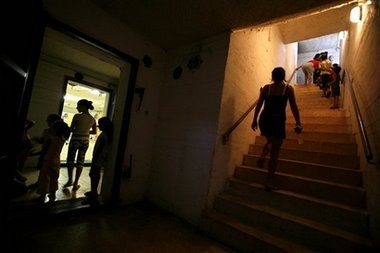
These two photographs, from the AP, show Israelis in a bomb shelter in Kiryat Shmona during a Hizbollah bombardment.


A Lebanese boy injured in an Israeli airstrike on Tyre - he is being airlifted to Cyprus, from which he'll be taken to France for treatment.

If it had not been for the Hizbollah attack on Israel, then there would have been no Israeli airstrikes on Lebanon. If Hizbollah had, like all the other militias in Lebanon, disarmed, there would have been no reason for Israel to attack in Lebanon. If Hizbollah had not amassed an arsenal of 13,000 missiles, there would be no conflict between it and Israel.

Nonetheless, Israel should be, if possible, taking much more care to avoid civilian deaths. Simply dropping leaflets telling people to leave is not sufficient, especially if those people are then bombed on the roads on their way out of the danger zone. I am also afraid of what Israel may do if Hizbollah does, in fact, bomb Tel Aviv - I do not think it should bomb all of Lebanon's infrastructure, as it has threatened, since that would be punishing many more innocent people for the sins of the guilty.

Rocket Barrage in Israel Kills 6 People

The latest attacks by Hizbollah in Israel - Rocket Barrage in Israel Kills 6 People.
JERUSALEM (AP) -- Hezbollah rocket attacks killed six people in northern Israel Thursday and injured many others, Israeli police said. Meanwhile, Hezbollah's chief spokesman said that his group will not agree to a cease-fire until all Israeli troops leave Lebanon.

The six rocket fatalities were the most in a single day since eight people were killed July 16 when a rocket struck a train maintenance depot in Haifa. At least 100 rockets hit northern Israel within several minutes, killing at least two people in Acre and three in Maalot. In Acre, some people came out of their shelters after an initial rocket barrage to see where the missiles fell. A new round of rockets struck the town, killing two people who were standing on their balcony, Mayor Shimon Lankry told Israel's Channel 2 Television. Five other people were injured, one critically and four seriously, he said. At least three people were killed in Maalot when rockets hit an open area, Mayor Shlomo Buhbut told Channel 10 television. Two were killed immediately and a third died on the way to the hospital, he said. ''It is a black day for our community,'' he said. It was not immediately clear where the sixth fatality occurred.

Hezbollah spokesman Hussein Rahal made his demands about the cease-fire during a live interview with Al-Jazeera television. ''Declaring a cease-fire is not the concern of the people of Lebanon as long as there is one Israeli soldier on Lebanese soil -- even one meter (into Lebanon),'' he said. ''We will not accept any (Israeli) soldier staying on Lebanese territory, and it is the right of every Lebanese to fight until liberation.''
Mr. Rahal should perhaps have thought about that before launching a raid into Israel and kidnapping two Israeli soldiers - if Hizbollah hadn't done that, there wouldn't be any Israeli soldiers on Lebanese soil. Statements like this also really put the lie to those who see Israel as the sole cause of this war, who see Israel as solely intransigent, who somehow see Hizbollah as a purely "resistance" organization. Right. A resistance organization whose main tactic is to try to kill, and then succeed in killing, Israeli civilians.

UPDATE - Jameel reports 8 Israelis dead in Katyusha attacks today - 5 in Akko, 3 in Ma'alot.

More on the war

For those who may doubt the destructive power of the Hizbollah rockets and Hizbollah's intention to kill civilians see this home video - missile attack on haifa - Google Video. It looks like it was posted on July 27, but that the attack took place on July 17 (at least judging from the time stamps on the video itself).

I just read an article in the Los Angeles Times about a recent poll on whether Americans support Israel in this current war. In answer to the question, "Do you think Israel's actions are justified or not justified?," 43% answered "justified, not excessively harsh," 16% said, "justified, but excessively harsh," 28% said "unjustified," and 13% "didn't know."

In answer to a question about what the American posture should be toward Israel and the Arab countries, 50% said the U.S. should continue to align with Israel, 44% said the U.S. should adopt a more neutral position, and 2% said the U.S. should side more with Arab countries.

It is interesting to see that there is a real split between Democrats, Independents, and Republicans. If we go back to the first question, 29% of Democrats think Israel's reaction is justified, but not excessively harsh, with 20% saying it's justified but excessively harsh (49% total justified response), and 36% saying it's unjustified. The Republican positions are 64% - 11% (75% justified) - 17% - so that Republicans are much more supportive, on the whole, than are Democrats. Independents fall inbetween - 37% - 15% - 33% (52% justified).

It seems to me that these poll results may forecast some trouble ahead for the Democratic Party on the subject of Israel, especially since 39% of Democrats call for the U.S. to continue to align with Israel, while 54% advocate a more neutral position.

Tuesday, August 01, 2006

Rocket hits Israeli kindergarten

Today, a Katyusha rocket hits western Galilee kindergarten. Fortunately the kindergarten was empty, but if it had been full of children? Would Arab countries and the EU be demanding an investigation? I don't wish to diminish the horror of what happened in Kana and other towns in Lebanon - but where is the vocal criticism of Hizbollah's targeting of Israeli civilians?

Jeff Weintraub

I just discovered (via a link in Normblog), a blog written by Jeff Weintraub, a "social & political theorist, political sociologist, and democratic socialist who currently teaches at the University of Pennsylvania." He is covering the current Hizbollah-Israel war pretty closely, with links to a number of good articles and opinion pieces.

Sunday, July 30, 2006

Photos that damn Hezbollah

More evidence that Hizbollah is deliberately placing its missile launchers in residential areas - Photos that damn Hezbollah.

Saturday, July 29, 2006

Lebanese Political Journal

For some fascinating analysis of the internal Lebanese situation, see Lebanese Political Journal. Lebanon Profile's postings are helpful in understanding (or trying to understand) the incredibly complex sectarian politics of Lebanon. (Reference from Oleh Girl, an Israeli blogger).

Hizbollah's hostages

Another report on a Lebanese town that Hizbollah is trying to hold hostage - a Druse town named Mari not far from the Israeli town of Metulla.
Not all villages in southern Lebanon are Shiite. Just above the abandoned SLA base at the old Majidiyya estate on the Lebanon-Israel border sits a small, quiet Druse village called Mari. You will not find Mari on any maps, but at the beginning of the current conflict Mari found itself caught between the Israeli Air Force, which apparently wanted to avoid bombing the village directly, and Hizbullah, which wanted to enter the town at all costs. You see, Mari's location would provide the militia an excellent overview of the Israeli city of Kiryat Shmona (and the settlement of Metulla, which is closer but much smaller), and finding a way to operate there would give Hizbullah increased civilian cover for their Katyusha rocket fire.

Hizbollah - hiding behind civilians

It's becoming clear that one reason so many innocent Lebanese civilians are being killed by Israeli bombs and missiles is that Hizbollah fighters are launching their missiles from the middle of Lebanese towns. There was an article in today's New York Times about this and also Jan Egeland, the UN refugee chief, said the same thing a couple of days ago. For a really disheartening, first-person account, read this posting and comments from a Lebanese blog, Free Ain Ebel.
The situation in Ain Ebel is unbearable. Thousands of civilians have fled to the village from nearby villages and more than 1000 rockets have hit the village, there is no more food neither clean water and diseases r spreading.

Now here comes the most sickening part:
Hezbollah has been firing rockets from the village since Day 1 hiding behind innocent people’s places and even CHURCHES. No one is allowed to argue with the Hezbollah gunmen who wont hesitate to shoot you and i ve heard about more than one shooting incident including young men from the village and Hezbollah.
Urgent appeals have been done through phone calls from terrified people who wouldnt give out their name fearing Hezbollah might harm or even eliminate them.

This is the true image of our brave Islamic Resistance, putting the civilians and their homes as body shields to the Israeli bombardements.

Let the message spread and let those criminals move out of the village once and for all.
Free Ain Ebel from the terrorists !
Have I mentioned recently that this war is making me so sick? It is so sad that all these innocent Lebanese are being killed, having their homes and businesses destroyed, being driven from their homes - I can't stand it. I think that Israel is justified in defending itself, and in trying to destroy Hizbollah - but this has got to stop before even more of Lebanon is destroyed.

Secretary of State Rice is apparently back in the Middle East (in Israel tonight) supposedly trying to get a UN resolution passed this week calling for a ceasefire, along with a whole list of other demands. Why couldn't this have happened two weeks ago? Why didn't she stay in the Middle East during her previous visit? Why hasn't the U.S. done its best to crack heads together and tell Israel, Syria, Lebanon, and anyone else who would listen, that it's time to stop the killing? I don't understand. It certainly looks to me that she and Bush have dragged their feet on insisting on a ceasefire in order to further their grand strategic plan for the Middle East - and said plan doesn't involve any care or concern that hundreds of innocent people have died in the last two weeks.

The War at Home

I lived in Seattle from 1979-1981. It was there that I began to take part in Jewish community life again, after losing much of my connection to Judaism in my late teenage years and early college years (reading Nietzsche didn't help - all that "death of God" stuff).

I went to a couple of seders organized by a progressive Jewish group named Kadima, which eventually became a chapter of New Jewish Agenda. Looking at their website it seems that they're now affiliated with the Reconstructionist movement; their concerns seem to be about the same as they were when I went to their events, including "a commitment to social, economic, gender, and racial justice, the eradication of anti-Semitism..., The survival of Israel as a Jewish nation based on its pursuit of democracy, pluralism, civil rights, equality, and a peaceful co-existence for all," and "Peace in the Middle East that includes the co-existence of an Israeli state and a Palestinian state."

I remember attending a several session class on the history and nature of anti-semitism; I also remember going to one of their rallies, which probably had something to do with Israel but I don't remember the issue. I think I also went to a Purim celebration that they organized - it was the first time I read the book of Esther, and I was shocked by the violence of the book. Another project of theirs now is the Middle East Peace Camp on which they collaborate with the Arab Center of Washington.

In Seattle I also joined a newly born synagogue (Tikvah Chadashah) and became its first female co-president. I remember going to services also at a Reform Synagogue named Beth Am, and being moved by the prayers. I was searching for meaning - my mother had been diagnosed with lung cancer in the summer of 1980, and I felt adrift. I started to believe in God again - just spontaneously, no sudden revelation - it made more sense than being an atheist or agnostic or wherever I had been wandering before.

I left Seattle in the summer of 1981, when it became clear that my mother's cancer was returning after radiation treatment, and it seemed likely that she did not have much longer to live. For a year or so after I left, I kept my subscription to the local Jewish newspaper, published by the Seattle Jewish Federation, to keep up on what was happening in Seattle. I only returned to visit a couple of times after that - I think the last time was in 1984. But I still have very fond memories of Seattle.

So it was a great shock when I heard on the news this morning that a Muslim American man had entered the offices of the Seattle Federation yesterday and started shooting randomly, killing one woman and injuring five more, including a pregnant woman. Pam Waechter was the woman who was killed, and the five other staff members were Cheryl Stumbo, Dayna Klein, Carol Goldman, Layla Bush and Christina Rexroad. Mrs. Waechter was a leader in the local Jewish community, most recently serving as director of the annual fundraising campaign for the Seattle Federation.

The man identified as the killer, Naveed Haq, grew up in Richland, and his father was one of the founders of Richland's Islamic Center. Haq apparently has a history of mental illness.

The attack came only a day after "the FBI had warned Jewish organizations nationwide to be on alert after Hezbollah leaders in Lebanon and al-Qaida's second in command urged that the war raging in the Middle East be carried to the U.S. However, the law-enforcement source, who spoke on condition of anonymity, said there is no evidence that Haq was involved with any group. 'He said he hates Israel,' said the source, who is part of the Seattle Joint Terrorism Task Force, which was called in to help investigate the shootings. David Gomez, the assistant special agent-in-charge of the Seattle FBI office, said there is 'nothing to indicate he is part of a larger organization....We believe he is a lone individual with antagonism toward this organization,' said Gomez." I certainly hope that the FBI is correct.

Reaction by one of the Seattle Post-Intelligencer columnists
"For every argument there is a gripe, a countergripe and a gripe to the countergripe. But pulling a semiautomatic trigger before the evening rush hour is not the answer. Violence never is. Whatever thread of intelligence might have been inside the shooter's mind has become forever lost in a tragic act of exceptional rage directed at Jews. If he had entered the building with an open mind -- instead of declaring open season -- he could have learned something.

The Jewish Federation has opened its doors to many, including me, so that we can better understand Israel's plight. I've sat in the very offices that Friday became a crime scene and listened to community leaders talk about foreign policy, a sincere hope for peace abroad and the challenges faced by Seattle's small but vibrant Jewish community. The gunman would have come to understand how central Israel is to Jewish life. He would have gained an appreciation for the diversity of Jewish opinion, inside the organization, across the city and the globe.

Instead, he arrived with closed heart and mind. One person is dead. Five people are injured. It is sad and infuriating and frightening to think that conflict in the Middle East can ruin peace of mind here at home. It doesn't matter if the target of a hate crime is a mosque, a synagogue or a community center. An attack on any such institution is an attack on anyone who believes in the freedoms of this country and importance of community. On a sunny Friday afternoon in Seattle, a man filled with hate attacked every one of us.

Wednesday, July 19, 2006

Nazareth: 2 children killed in rocket barrage

Two brothers, three and nine years old, were killed Wednesday afternoon when a Katyusha barrage hit the town of Nazareth. The rockets pummeled the town, hitting various neighborhoods. The two children were killed when their house sustained a direct rocket hit. Reports of a third fatality were being verified.

The two casualties Wednesday raised the civilian death toll since the beginning of the fighting to 15. Magen David Adom reported that 76 people were injured in rocket attacks on the Valley area, including 26 who suffered from shock....

Prime Minister Ehud Olmert called Nazareth Mayor Ramez Jiraisi to express his condolences over the killing of the townspeople and to offer aid. Jiraisi told Ynet he heard the reports while driving.

During the morning hours, the Home Front Command recommended alertness and caution. "Today we held children's camps inside buildings. This is a very crowded neighborhood. I have no idea what the identities of those killed are," Jaraisi said.
These were two Israeli Arab children who were killed. Katyushas don't distinguish between Jews and Arabs.

Two Israeli soldiers were also killed in fighting with Hizbollah terrorists just north of the border near Kibbutz Avivim. I mourn for the soldiers, but at least they had a chance; they were armed and theatened other armed men. The two children were doing nothing except playing.

Just as Lebanese children are dying, since Israeli bombs don't distinguish between Hizbollah terrorists and children. When Hizbollah decides to stop firing rockets on Israel, and stops threatening Israeli communities in the north, then the dying will stop in both Israel and Lebanon.

Ithaca and "peace"

What is "peace"?
************************************************************
ITHACA WAR AND PEACE REPORT
************************************************************
Are you upset about the escalation of violence in Gaza, Lebanon and Israel, the civilians being killed every day, and the infrastructure being destroyed in Gaza and Lebanon?

Tuesday July 18, the Ithaca Journal reported "By nightfall Monday, 209 Lebanese had been reported killed in the six days of fighting. At least 24 Israelis have been killed."

Today, Wednesday July 19, gather on the Commons between 10:00 am and 6:00 pm to share your views and hear perspectives that haven't been reported in mainstream media. 10:00 am-4:00 pm, Occupation Witness, a new local group, will have a photo display and pass out literature. They are also distributing a petition that calls on members of Congress to stop all U.S. military aid to the Israeli government until the Israeli military pulls out of Gaza and Lebanon.

From 4:00-6:00 pm, a gathering on the Commons will include music, some information about current activities, including a very recent statement by the Democratic candidate for the Senate, Jonathon Tasini, and an opportunity to share your own views.
I don't know what the group "Occupation Witness" is - I've never heard of them before - but they seem to have an entirely one-sided perspective on the current war. Haven't they figured out that Israel started attacking Hizbollah in Lebanon because Hizbollah attacked Israel with no provocation whatsoever? I am also upset at the Lebanese civilians who have been killed and the infrastructure that has been destroyed, and wonder if Israel could have acted in a way to limit deaths and destruction - but what about the fact that a million Israelis are currently sitting in bomb shelters? What about the fact that Israelis continue to die at the hands of Hizbollah? There's no mention in this piece that Hizbollah has any responsibility to stop bombing Israel.

I've been reading enviously about other communities where people are organizing solidarity rallies to support Israel. We definitely need one here too.

Monday, July 17, 2006

Jerusalem

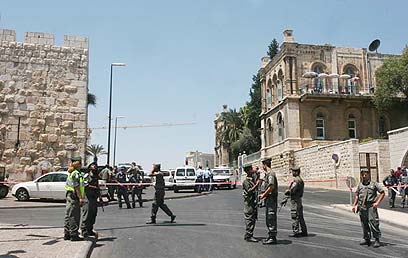
In a location I recently visited in Jerusalem, police foil a terror attack.
A great disaster was avoided Monday in Jerusalem, when an explosive device was found in the bag of a 25-year-old Palestinian at the city's Tzahal Square. Police officers operating a metal detector noticed a Palestinian walking toward them, carrying a bag. They demanded that he undergo a security check, and then he told them he was carrying an explosive device.

The police arrested the man, handcuffed him and took him into interrogation by interrogation by security forces at the Jerusalem Police's minorities department.

In his interrogation, the man said that he planned to carry out a terror attack, and according to estimations the target was the center of the capital. It is still unclear whether he planned to detonate himself with the device or leave it in the area and flee.

Following the incident, the police closed the entire area and dispatched a helicopter to the air in an attempt to locate the terrorist's accomplices. Sappers were dispatched to the area to examine the device.

The security establishment currently holds dozens of warnings on plans to carry out terror attacks in the home front, in an attempt to expand the fighting arena and hurt more civilians.

Tzahal Square

Tzahal Square is quite close to the Old City. This photo from Ynet shows the location of the capture of the terrorist. On the day I decided to visit the Old City, I walked through Tzahal Square on my way into the city.

Women praying at the Kotel

I had been somewhat nervous to visit the Old City once things got hot in Gaza, about two weeks after I arrived in Israel, but my visit was uneventful. I went to the Kotel and wandered through the Muslim Quarter, where I bought some scarves as gifts for friends, as well as a dress for myself. It was a totally uneventful, pleasant trip.

Friday, July 14, 2006

Chirac

As usual, French President Jacques Chirac takes his usual evenhanded line - Israel 'wants to destroy Lebanon'. He also claims to speak on behalf of "all Europeans" - "the current reactions are totally disproportionate." I wonder how Mr. Chirac would react if French territory was being shelled from a neighboring state and French citizens being killed and injured by rocket fire? I doubt he would be so sanguine about the lives of his own country's citizens.

A lighter note

In the middle of the rotten news from Israel and Lebanon: more Katyushas landing in northern Israel - a residential building hit in Safed, another one in Nahariyah (several people seriously injured); continued Israeli bombing in Lebanon, including again on the Beirut airport and on a base of the Palestinian terror group PFLP-CG which is only 2 km from Syria; thousands of Lebanese fleeing the south because of the Israeli attacks; at least 60 Lebanese killed thus far - a lighter note.

A couple of days ago, a multicolored van pulled up across the street, and several shaggy guys filed out. On one side of the van was painted the title The Jugtown Pirates. They greeted my neighbors with hugs, and then later on in the evening I heard the sound of (acoustic) guitars playing from the house across the street. Yesterday the van was gone all evening, only coming in around midnight. They appear to have just left for another gig. I just snapped a photo of them from my window:


From their website, it appears that they're a jugtown band in Vermont.

Thursday, July 13, 2006

Reminders of normality in Jerusalem


When I left Jerusalem on very early Monday morning, there was a full moon - I captured a photo of it over one of the buildings in my apartment complex.


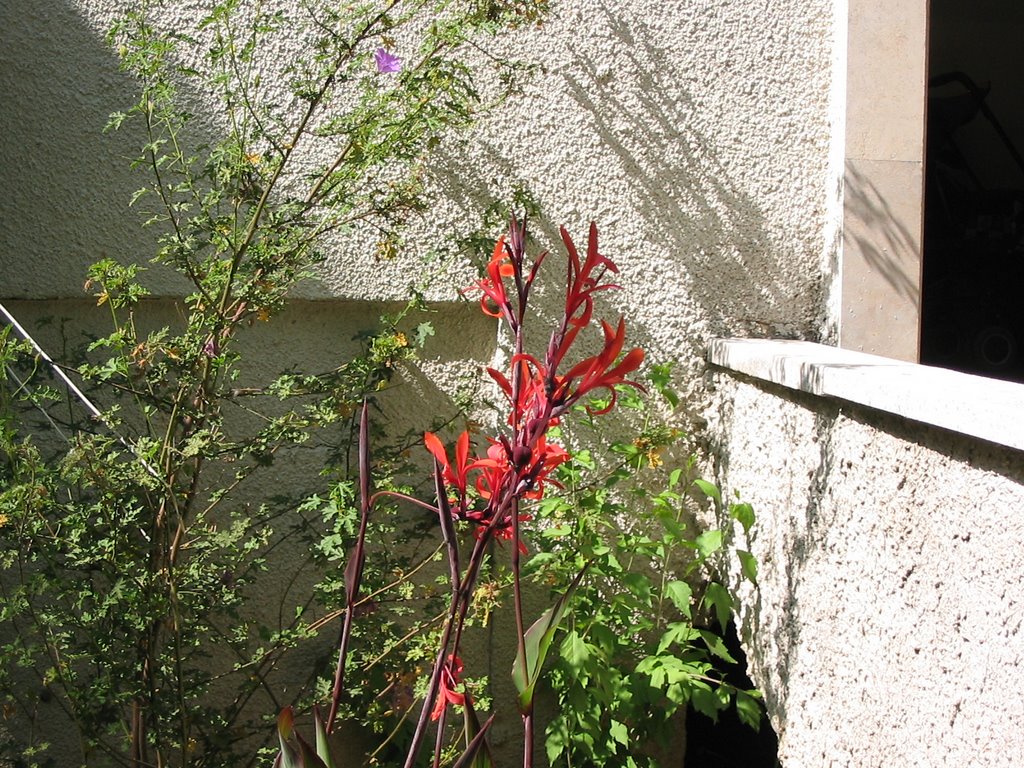
And here's a photo of one of the beautiful flowers in the garden - I don't know what it's called, but they certainly don't grow in nature here in Ithaca!

Blogger updates on Israel

For updates on what's happening in Israel, see Jameel at The Muqata (this is obviously a pseudonym!). He's been keeping pretty good track of events of the last two days.

See also Lisa Goldman in her latest post: "If there is one thing we can always count on in the Middle East, it is this: Just when there are signs of positive developments toward peace, just when we start to hear the voices of sanity, the extremists - the madmen with the crazed eyes who are convinced they have a direct phone line to God (and that God likes to see people kill each other) - spring into action and take us backward. That is what has been happening over the last two weeks, starting with the Hamas incursion from Gaza into Kerem Shalom and culminating yesterday morning with a Hezbollah "operation" inside Israel's northern border."

Chayyei Sarah writes: "It was only tonight that I realized that we'd crossed the line from 'tensions' and 'crisis' to 'war.' I hadn't wanted to believe it before then. It's a strange thing. Nothing in my neighborhood in Jerusalem is different. If I didn't read the news, I wouldn't know anything is happening. Today, to get out a little, I went to the new park behind my house, where dog owners have a daily 'dog park' from 6-7 pm, and no one brought up Lebanon at all. We just talked about the dogs, and watched a family playing baseball on the grass."

The park she's writing about is just across the street from where I was just staying in Jerusalem. A friend of mine has a cute pooch named Charlie, and every evening between 6 and 7 she goes to the dog park to let the dog run around and schmooze with friends.

I talked to another friend of mine in Jerusalem earlier today (it was around 10:30 p.m. her time), and asked her if anything felt different. She said that it was quieter than normal - no one was playing basketball in the park across the street, and that the streets were fairly empty.

Everything *is* exploding

I'm finding it truly bizarre that two days after I leave Israel, where it was not exactly peaceful but on the other hand there was not a full-scale war being waged - Hizbollah just killed 8 Israeli soldiers, kidnapped two others, and rained down over 100 missiles on northern Israel, including a longer-range one that hit Haifa this evening. I had no idea that the northern border was so volatile. But I should have, since I read Michael J. Totten's two prescient articles on the dangers of Hizbollah and Iran, which he published on his blog in late April/early May.

In the end of April, Totten wrote "Everything Could Explode at Any Moment" and "On the Rim of a Volcano." I remember reading the two articles and finding them incredible, since I hadn't read anything else that pointed out how dangerous the border was. During Totten's trip to Israel, he traveled with blogger Lisa Goldman on a visit to the northern border. Before they went, he said to her, "Something is wrong on the border. Something bad is going to happen.” And he was right. When they went up, they had a conversation with an IDF spokesman, Zvika Golan. Golan told them they weren't safe, because "Hezbollah is planning an operation." An IDF lieutenant said to them, "Any minute now something huge could break out....I am afraid to go home and leave my soldiers. When Hezbollah decides to do something, they do it. And they’re pretty good at it.” When Totten asked him what that could be, he said - "Kidnapping. Sniper."

The lieutenant also said to them: “I say this to my guys every morning: Everything could explode at any moment. Just after I said it this morning a bus load of pensioners showed up on a field trip. An old woman brought us some food. It’s crazy. They shouldn’t be here. You shouldn’t be here.”

Totten then pointed to an article published in the Daily Telegraph on April 4, 2006. This article spells out how Iran has entered directly into southern Lebanon.
Iran has set up a sophisticated intelligence gathering operation in southern Lebanon to identify targets in northern Israel in the event of a military confrontation over its controversial nuclear programme. Senior Israeli military commanders say Iran has spent tens of millions of pounds helping its close ally, Hizbollah, the Shia Muslim militant group that controls southern Lebanon, to set up a network of control towers and monitoring stations along the entire length of Israel's border with south Lebanon. Some of the new control towers, which are made of reinforced concrete and fitted with bullet-proof reflective glass, are less than 100 yards from Israeli army positions and are clearly visible for long stretches along Israel's border. "This is now Iran's front line with Israel," a senior Israeli military commander said. "The Iranians are using Hizbollah to spy on us so that they can collect information for future attacks. And there is very little we can do about it."

Israeli military officers report that teams of Iran's Revolutionary Guards travel regularly to southern Lebanon to help train local Hizbollah fighters in terrorist tactics. Tensions between Iran and Israel have intensified dramatically since the election last summer of President Mahmoud Ahmadinejad as Iran's new leader. Israel has repeatedly threatened to take military action to prevent Iran from acquiring nuclear weapons, and the new Iranian government has responded by calling for Israel's destruction. Senior Israeli military officers believe Iran is deliberately exploiting the power vacuum caused by Syria's withdrawal to intensify pressure on Israel's northern border.

Although the Lebanese government technically controls the border area, its military is not considered strong enough to control Hizbollah, which takes its orders directly from Teheran. "Iran is playing a very dangerous game of cat and mouse on our northern border and it could easily spiral out of control at any moment," said the officer.

In recent weeks Hizbollah sent unmanned aircraft on reconnaissance missions over the border to photograph sensitive Israeli military installations. The spy planes returned to base before being detected by air defence systems. In addition to providing intelligence-gathering and communications equipment, Iran has also equipped Hizbollah with improved weapons and ammunition to launch attacks against Israel, including heavy mortars and rockets with a range of up to 30 miles.
I suspect it is one of these Iran-provided missiles that hit Haifa tonight. Ynet quotes the Hizbollah television station as saying that they fired a Raad 1 missile at Israel: "That's the missile used by Hizbullah to respond to Israeli attack and to hit military strongholds of the Zionist enemy. The rocket is of 333 mm in diameter and has a warhead of 100 kilograms. Our fighters used it today when they attacked the military base in Har Meron which was severely damaged and set on fire." There was an attack on Mt. Meron (in northern Israel, near Safed) in May.

So now it seems that Iran is getting the confrontation it wants. What's going to happen next? Will everything continue to spiral out of control? Will Iran actually get involved in the fighting? Ahmehdinejad just said: “'If the Zionist regime commits another stupid move and attacks Syria, this will be considered like attacking the whole Islamic world and this regime will receive a very fierce response,' Ahmadinejad was quoted as saying in a telephone conversation with Syrian President Bashar Assad. The president made the comments after Israel struck Beirut airport and military airbases and blockaded Lebanese ports in reprisals that have killed 55 civilians in Lebanon since Hizbullah guerrillas captured two Israeli soldiers a day earlier. 'He (Ahmadinejad) also said it was a must for the Organization of the Islamic Conference to become more active regarding the new crisis created by the Zionist regime,' State television reported."

Sunday, July 09, 2006

A walk in Jerusalem

Yesterday I took some photos of a path I very frequently walk - along Emek Refaim St. towards the apartment where I'm staying. Some images from that walk:


This shows a frequent graffito around here - בשר = רצח, "meat=murder," presumably referring to the eating of meat. Another local graffito, for which I unfortunately don't have a photo: צמחונות מצילה חיים - "vegetarianism saves life."


This is a local shop that sells prepared goodies, including stuffed grape leaves, various cheeses, smoked fish, etc.


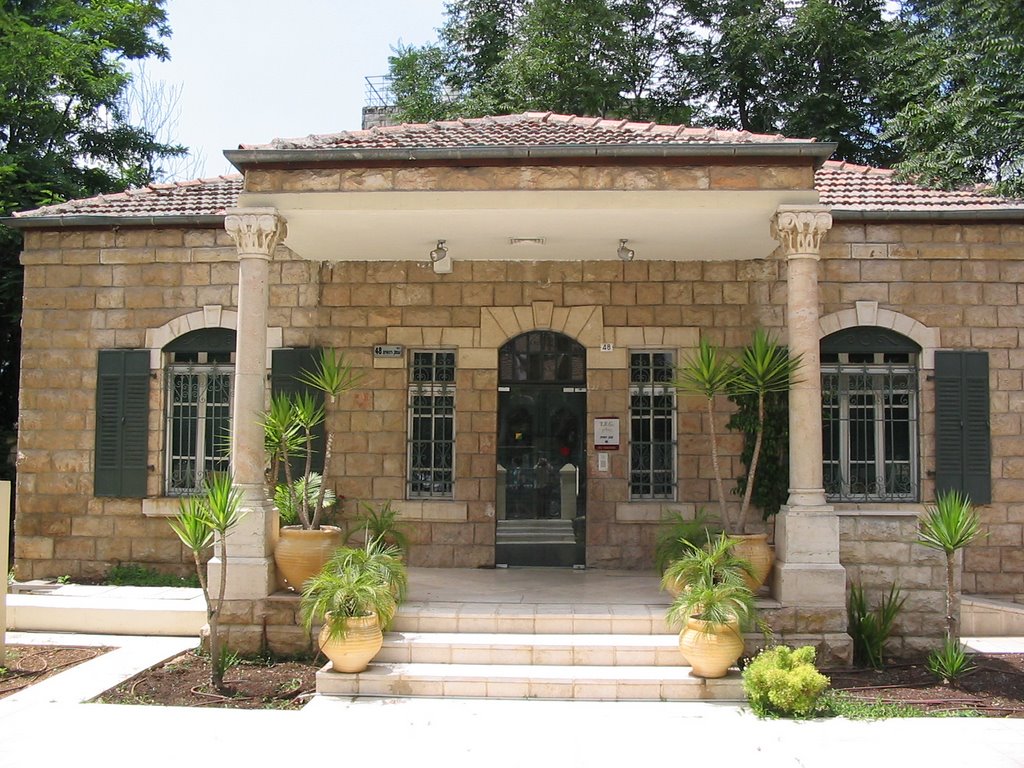
48 Emek Refaim St., a Realtor.


A plant store, also selling lots of flowers - see below.


Flowers for Shabbat.


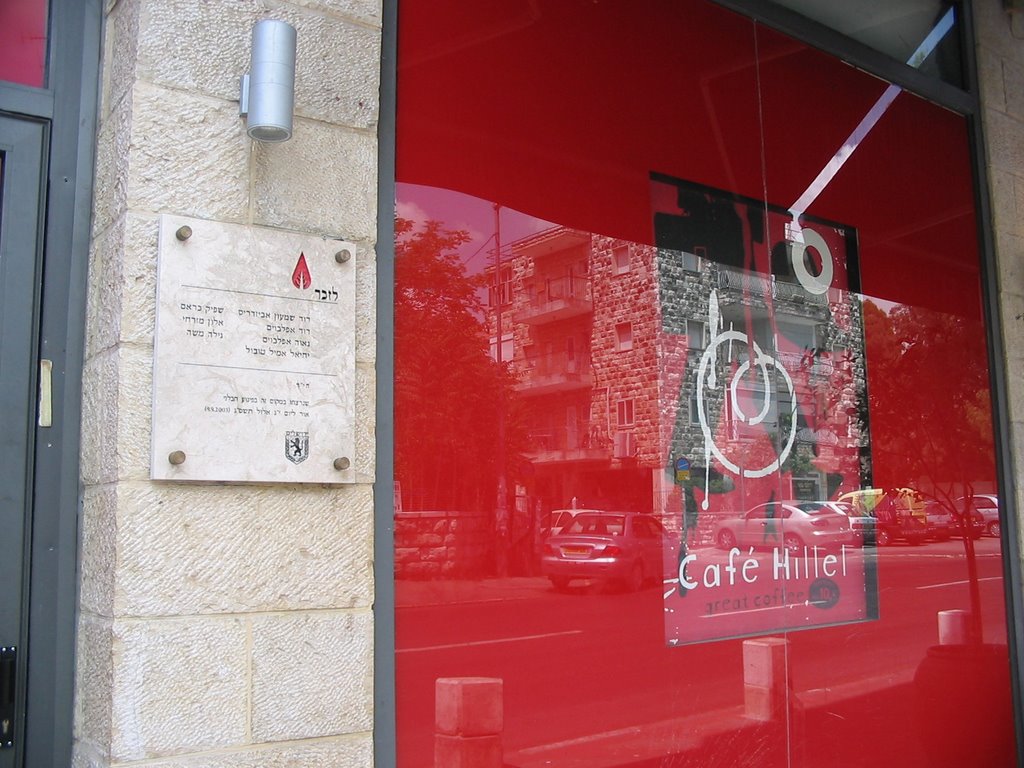
Cafe Hillel - a plaque marking the suicide terrorist attack in which 7 people were killed.


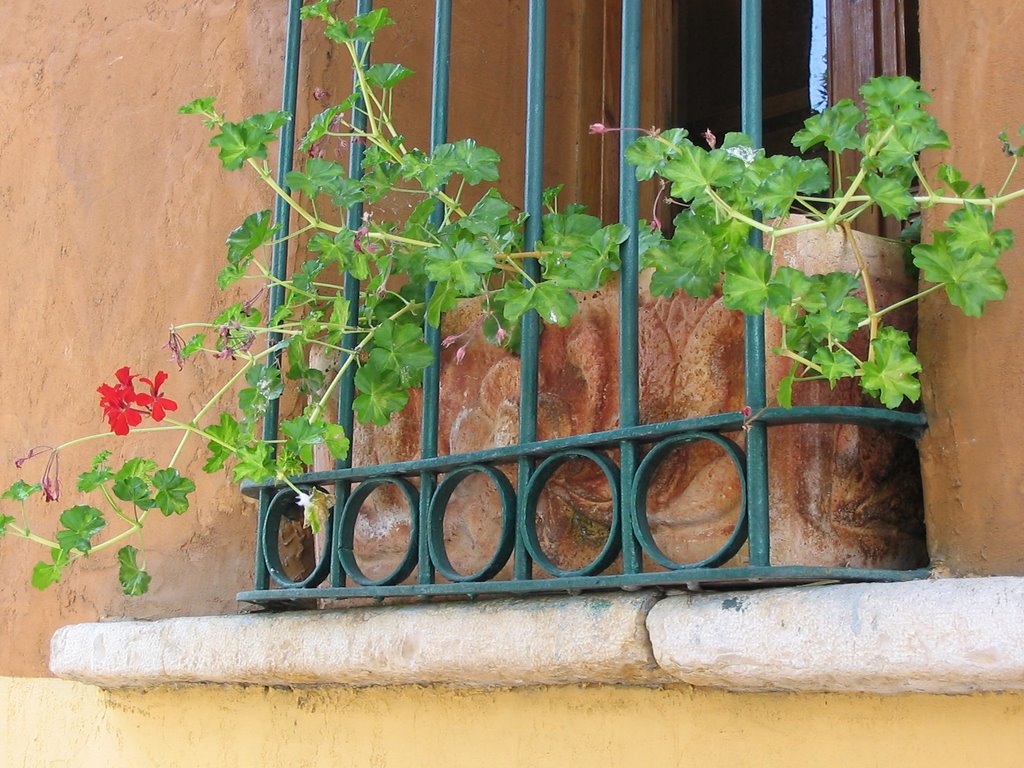
Flowers in the window of Pizza Meter, an Israeli pizza chain.


A bicycle, chained to the fence that prevents people from parking their cars on the sidewalk (I am not making that up, it's a frequent plague in Jerusalem that forces pedestrians to walk on the street).


The gate of a house on Yehoshua bin Nun St.

In Israel

I've been in Israel since June 8, but obviously have not been posting to the blog, undecided whether in fact I wanted to continue writing a blog. But since I'm about to leave Israel to return to the U.S., and I don't really feel like leaving Israel, I thought I'd at least post some thoughts about my trip.

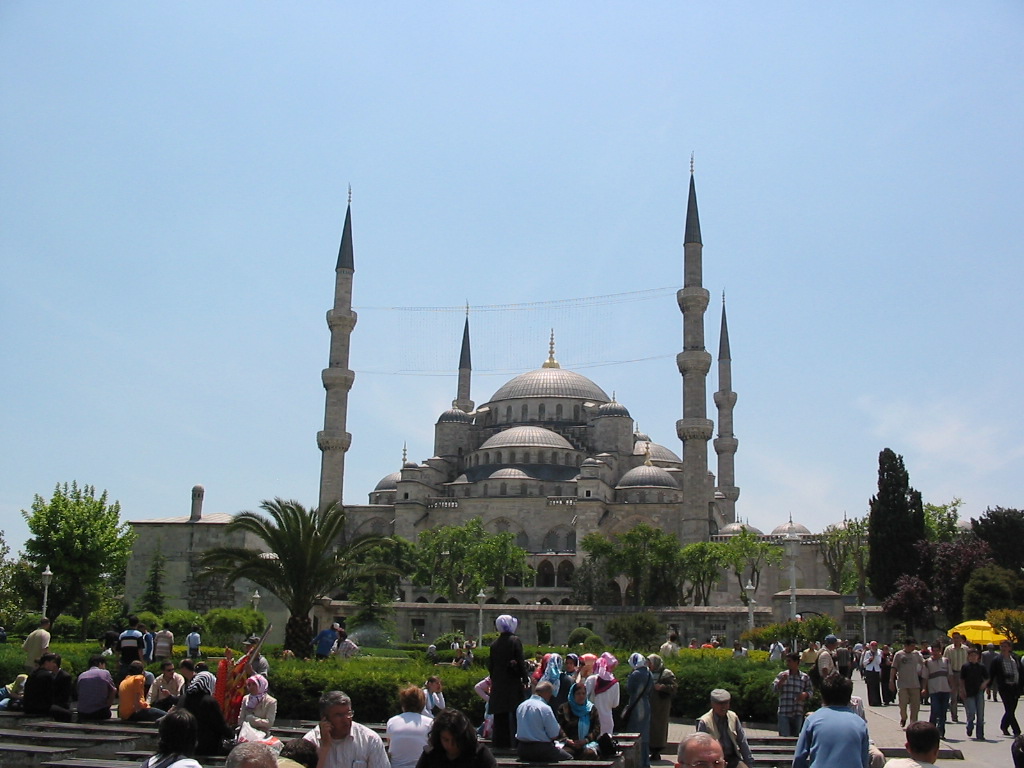
Going to Istanbul was being on vacation - a learning vacation, but a vacation nonetheless. I got to see some fabulous places I had never been to before (including the Blue Mosque, pictured here inside and out), I learned quite a bit about Ottoman history, I was fortunate to be able to get a glimpse of some of the dilemmas of modern Turkey - but this was a vacation in a foreign country.

Coming to Israel, however, felt like I was coming home, in a sense, even though I am an American citizen, not an Israeli. I've lived a total of four years in Israel, and have visited many times in addition to that. My first trip to Israel was in 1983, on a trip organized by New Jewish Agenda. I returned in 1987 for two years to study at the Hebrew University as part of my graduate studies in religion. I came back again in the 1992-93 academic year to do dissertation research. And then in 1998-99 I received another grant to do research at the Hebrew University. But that sounds like my only attachment to Israel is intellectual or academic.

It's much stronger than that, however. In 1990, I had been planning to visit Israel for part of the spring semester of 1991. But then, of course, Iraq invaded Kuwait on August 2, 1990, and it slowly became clear through the autumn that the U.S., in coalition with many other nations, would attack the Iraqis in Kuwait and force them back. Thus, I did not visit Israel in January of 1991, even though I wanted to. Throughout the Gulf War, I was constantly watching CNN, calling friends in Israel to make sure they were all right (racking up quite a phone bill in those days before real competition for international calling!), and wondering if I should go visit, nonetheless. I finally decided to go - to stay for six weeks, from Purim to Pesach. I flew to Israel on Purim, 1991 - which, as it happens, was the day the ceasefire was declared. When I landed at the airport, they were still giving people gas masks, but fortunately there was no need for them. I took the shared taxi to Jerusalem, and went to the reading of the book of Esther. People were wearing costumes that related to the Gulf War - one person had torn down the plastic sheeting from his windows and wrapped it all around himself, and stuck photos of Yasser Arafat (remember him? He supported Saddam Hussein) and Saddam Hussein on himself. What was he coming as? As the Gulf War!

Since then I've visited many more times, inbetween my year-long stays. I was here for a visit in the summer of 2001 - after the second intifada had broken out. It was unnerving to hear the gunfire on Gilo and the Israeli tank fire in reply. Since then, I visited several times in the winter, during the break between semesters, but this is the first time since then that I've come in the summer, and it's been quite lovely. I've been going to the National Library at the Givat Ram campus of the Hebrew University and doing research, which has gone very well - I've sent off one article and another one is close to being finished. I've seen lots of friends and even had dinner with some third cousins - of whose existence I didn't even know until my brother, the family genealogist, found them in his researches.

Some people might find that surprising, given the current political/military events - the attack on the Israeli military post near Gaza, in which two soldiers were killed and a third - Gilad Shalit - was abducted by the Hamas military wing; the murder of Eliyahu Asheri, a resident of Ithamar on the West Bank, killed right after his kidnapping; of the continuing rocket fire on Sederot and now on Ashkelon, from Gaza; and the Israeli military response, entering Gaza for the first time since the disengagement last summer. It's all certainly on my mind, but it's not the only part of my experience. I feel ambivalent about what Israel is doing. On the one hand, how can any government refuse to act when its cities are being attacked by random rocket fire that is aimed at civilians? On the other hand, why punish all the residents of Gaza by destroying the electrical station (insured by an American company), and depriving hundreds of thousands of people of electricity in the middle of the punishing heat of summer? Why warn the civilian residents of Beit Hanun (the region in Gaza from which Hamas and the other terror groups have been launching rockets at Sederot and Ashkelon) that they should leave when Israeli tanks and troops enter to chase those launching the rockets? Are they to blame? No.

But I think the Israeli government is really in a hard place - I can't say what I think they should do. How can they really negotiate with the Hamas government, as some are demanding, when even they don't seem to have any control over the Hamas military wing? And should they negotiate with kidnappers at all - won't it just encourage more kidnappings? But then, when I hear the remarks of Noam Shalit, the father of Gilad, pleading with the government to negotiate for the safe return of his son - how can Israel close off the avenue of negotiation completely?

I find myself really torn here - I listen to left-wing friends, and I agree with them that the Israeli government is being entirely unjust with the Palestinians, and that the separation fence/wall is an injustice and a disaster to innocent Palestinian civilians. But then, I listen to other friends, more centrist in their politics, who say that the wall is protecting innocent Israeli civilians from suicide bombings. Back in the U.S., I have other friends who are so certain that whatever Israeli does is absolutely wrong, and others who think that whatever Israel does is absolutely correct. From here, things seem so complicated - my own moral sense pulls me back and forth, I'm not sure how to judge.

But as I just wrote above, most of the time I've simply enjoyed myself here. In Jerusalem, it's generally pretty hot during the day, but then it cools off at night. Cool breezes start to blow in the late afternoon, and then as the sun sets it becomes comfortable. Tonight it's a lovely temperative, and I'm listening to the automatic sprinklers watering the garden of the apartment complex where I'm staying. When I go out on the mirpeset (porch) there is the scent of sweet flowers wafting upward. The photo on the left is a view from my garden.

Tuesday, May 30, 2006

Visiting Turkey

I'm off on another trip, this time to Istanbul, Turkey. I'm with a group studying Ottoman history, but we're really looking at sites from all periods of history in Istanbul. Our first day we went to the Haghia Sophia - the former great church of Byzantine times, which was transformed into a mosque with the Ottoman conquest in 1453. Across a beautiful garden with flowers and fountains is the Blue Mosque, built in the time of Sultan Ahmet I - an amazing, beautiful, serene building inside and out. We entered after the early afternoon prayer time was over and saw the soaring domes inside, with blue tiles (hence the name of the mosque) - many tourists but also people praying. I felt that I had entered a different atmosphere from that of contemporary tourist Istanbul, full of people from all over the world gawking at the sites. There is something about Islamic architecture that is truly impressive.

Yesterday we went to the Topkapi Palace, which was the palace of the Ottoman sultans for hundreds of years. Calling it opulent hardly does justice to the place - many buildings, spectacular blue and white tiles in the harem, treasures of the world amassed by the Ottomans and displayed in the Treasury. There are also holy Muslim relics, including the cloak of the Prophet and his sword, an impression of his footprint, hairs from his beard in reliquary boxes. In the room with the relics a man sat reciting from the Qur'an, since it is a Muslim pilgrimage site. It felt strange to be entering such a place as a tourist - but this is a feature of many holy places, which serve both as places of pilgrimage for the faithful and as sites for tourists to visit and touch the strange and exotic. (In Jerusalem, the Church of the Holy Sepulchre, the Western Wall, and the Temple Mount serve both functions).

Wednesday, May 24, 2006

New (to me) blogs to read

While wandering around the blogosphere, I've found some interesting blogs recently, including Emes Ve-Emunah, written by Harry Maryles and discussing many important and interesting Jewish issues from an Orthodox perspective. One I found particularly interesting was on "Gedolim and the Holocaust."

Another is Orthonomics by SephardiLady, who has some wise things to say about the necessary guidelines for Jewish schools to fight against sexual abuse of children.

Another, that I've read before, is Da'as Hedyot, who also has a very thoughtful posting on the recent sexual abuse scandal in the Orthodox world.

What is most interesting to me about all these blogs is the light they shine on a world that I am not part of - Orthodoxy and especially Ultra-Orthodox Judaism. Da'as Hedyot is fascinating in writing about the process by which he left the Orthodox world. There are other blogs (like Hasidic Rebel that describe the lives of people who still live an outwardly Orthodox or Hasidic life but who inwardly have traveled far away from it. I would not even know that people like him existed without the world of blogs. Sometimes it seems almost voyeuristic to read people's blogs - they are so revealing of themselves and their world, and I wonder if they imagine that people like myself are reading them (actually, I know that they do, because people like me post comments on their blogs).

Tuesday, May 23, 2006

Taheri-ng It Up

But is there actually a figure in Iran's government named Mostafa Pourhardani, as Jim Henley of Unqualified Offerings asks?

A quick dash around the blogosphere via Technorati presents several versions of sharp skepticism about Taheri's reaffirmation of his story, from the right to the left.

Amir Taheri responds to his critics

An interesting response from Taheri, but without enough details to satisfy me.
Regarding the dress code story it seems that my column was used as the basis for a number of reports that somehow jumped the gun.

As far as my article is concerned I stand by it.

The law has been passed by the Islamic Majlis and will now be submitted to the Council of Guardians. A committee has been appointed to work out the modalities of implementation.

Many ideas are being discussed with regard to implementation, including special markers, known as zonnars, for followers of Judaism, Christianity and Zoroastrianism, the only faiths other than Islam that are recognized as such. The zonnar was in use throughout the Muslim world until the early 20th century and marked out the dhimmis, or protected religious minorities. (In Iran it was formally abolished in 1908).

I have been informed of the ideas under discussion thanks to my sources in Tehran, including three members of the Majlis who had tried to block the bill since it was first drafted in 2004.
I do not know which of these ideas or any will be eventually adopted. We will know once the committee appointed to discuss them presents its report, perhaps in September.

Interestingly, the Islamic Republic authorities refuse to issue an official statement categorically rejecting the concept of dhimmitude and the need for marking out religious minorities.

I raised the issue not as a news story, because news of the new law was already several days old, but as an opinion column to alert the outside world to this most disturbing development.
From reading this press release, it does not sound that he knew what other articles were going to be published by the National Post on the dress code (unless he's being disingenuous). I don't know how it is that the NP acquired his article and what his relationship is with the editors of the paper. Perhaps, as some suggest, there is a sinister relationship between them - if so, perhaps commenters to this post can enlighten us further.

The sources he mentions are NOT other Iranian emigres, but (unnamed) sources in Teheran - which was also true in the original article, where he named one, Mostafa Pourhardani, Minister of Islamic Orientation. Who are the three unnamed members of the Majlis who are his sources? Why doesn't he name them?

But in this press release he is much less categorical than in his editorial piece, where he says that the law "also envisages separate dress codes for religious minorities, Christians, Jews and Zoroastrians, who will have to adopt distinct colour schemes to make them identifiable in public." He says further, "Religious minorities would have their own colour schemes. They will also have to wear special insignia, known as zonnar, to indicate their non-Islamic faiths. Jews would be marked out with a yellow strip of cloth sewn in front of their clothes while Christians will be assigned the colour red. Zoroastrians end up with Persian blue as the colour of their zonnar. It is not clear what will happen to followers of other religions, including Hindus, Bahais and Buddhists, not to mention plain agnostics and atheists, whose very existence is denied by the Islamic Republic." In the press release, in contrast, these are ideas under discussion - but by whom? And how likely is it that these ideas will come to fruition? Are these ideas put forth by a minority or a majority?

This is an unsatisfying statement, which raises more questions than it answers. I think it is necessary for Taheri to publish an additional article that supplies the sources for his statements and gives convincing details that counter the remarks by the Jewish representative to the Majlis and the Iranian government that categorically deny that one of the purposes of the law is to mark out religious minorities.

On the other hand, the article by Chris Wattie in the National Post (cited above) that contains the denials about the religious minorities part of the law, contains information that indicates that these provisions were under discussion at a certain point, if not now.
Sam Kermanian, of the U.S.-based Iranian-American Jewish Federation, said in an interview from Los Angeles that he had contacted members of the Jewish community in Iran - including the lone Jewish member of the Iranian parliament.

They denied any such measure was in place.

Mr. Kermanian said the subject of "what to do with religious minorities" came up during debates leading up to the passing of the dress code law. "It is possible that some ideas might have been thrown around," he said. "But to the best of my knowledge the final version of the law does not demand any identifying marks by the religious minority groups."

Ali Reza Nourizadeh, an Iranian commentator on political affairs in London, suggested that the requirements for badges or insignia for religious minorities was part of a "secondary motion" introduced in parliament, addressing the changes specific to the attire of people of various religious backgrounds. Mr. Nourizadeh said that motion was very minor and was far from being passed into law. That account could not be confirmed.

Meir Javdanfar, an Israeli expert on Iran and the Middle East who was born and raised in Tehran, said yesterday that he was unable to find any evidence that such a law had been passed. "None of my sources in Iran have heard of this," he said. "I don't know where this comes from." Mr. Javdanfar said that not all clauses of the law had been passed through the parliament and said the requirement that Jews, Christians and Zoroastrians wear special insignia might be part of an older version of the Islamic dress law, which was first written two years ago. "In any case, there is no way that they could have forced Iranian Jews to wear this," he added. "The Iranian people would never stand for it."

However, Mr. Kermanian added that Jews in Iran still face widespread, systematic discrimination. "For example, if they sell food they have to identify themselves and their shops as non-Muslim," he said.
Perhaps Taheri's Iranian informants are themselves not up to date on what the debates are and the meaning of the law; perhaps they spun it to him in this direction; perhaps Taheri himself is the author of the spin. I think the only way we'll know is with further detailed reporting.

Monday, May 22, 2006

Holocaust Museum blog

The U.S. Holocaust Memorial Museum has started a blog about Darfur and other crimes against humanity. Their Committee on Conscience also has a weekly podcast that one can subscribe to from this website.

Saudi textbooks - preaching hatred

Nina Shea reports on Saudi textbooks that the Saudi government describes as having been cleansed of intolerance towards Christians and Jews.

An eighth grade lesson: "As cited in Ibn Abbas: The apes are Jews, the people of the Sabbath; while the swine are the Christians, the infidels of the communion of Jesus."

A tenth-grade textbook perpetuates the lies of the "Protocols of the Elders of Zion":
A 10th-grade Saudi textbook on the hadith and Islamic culture for boys contains a lesson on the "Zionist movement." A key part of the lesson teaches students about the Protocols of the Elders of Zion, an anti-Semitic forgery that purported to expose a scheme for Jewish global domination and has been widely circulated since the early 20th century. Despite repeated debunking and a notorious role in inciting Nazi violence, the protocols are still taught to the 10th graders as an authentic document revealing what Jews genuinely believe. The lesson goes on to blame many of the world's wars and discord on the Jews.

Sunday, May 21, 2006

Iranian badge story false

Jewschool quotes a number of newspaper articles from the Canadian press which demonstrate that the story about Iranian badges is based on false information. Mobius says, "What seems apparent from this, at least to me, is that powerful forces are attempting to build international support for an invasion of Iran by equating its actions with that of Nazi Germany’s loudly in the press." He may be right about the National Post in Canada - their front page certainly made that point, with the headline of "Iran Eyes Badges for Jews" and under it a photograph of two Jews in Germany wearing the yellow star. But again, as I've stated in my comments to my previous post, this was not the only point that Taheri was making in his article - he wrote about how this law might affect Jews, Christians, and Zoroastrians in Iran, rather than singling out Jews.

In any case, regardless of what Iran may or may not be doing, I certainly do not support a U.S. war against Iran, which I think would be disastrous for the U.S., Iran, and Israel.

Update: The Jerusalem Post has also published an article denying the truth of the story, and describing what impact this new law, which deals with recommended "Islamic dress", might have on Iranian women.

See also this posting by Andrew Sullivan: "I've now read enough to feel confident in saying that the Canada National Post story about Jews in Iran being forced to wear yellow badges is almost certainly bunk. The Jewish delegate in Iran's pseudo-parliament denies it....Was this active disinformation? If so, who was behind it? And for what purpose? That seems to me to be the next salient question."

Further Update: Haaretz has an interesting article on the retraction of the story about the Iranian badges: "Yesterday, after it emerged that the report had been false, the affair of 'the yellow patch that wasn't' left us with one lesson: The world is ready to believe anything when it comes to a country ruled by Mahmoud Ahmadinejad.... '[The Iranian president] has aroused a tense mood of hostility toward himself and toward Iran," Iran expert Javedanfar said. "The Western world's readiness to accept without question this false accusation is an attempt to settle accounts with Ahmadinejad. It is as if the Western world was saying to him: Just as you are willing to be inaccurate when it comes to historical facts about the Holocaust, so we can pay you back in kind,' Javedanfar continued."

Soferet

Soferet has some wise words on the dangers of charismatic leadership:
Rabbis, gurus, priests, politicians, you name it. Charisma is a heady tool that should be used with caution. Remember with humility that we are all vessels of Torah, & it is the Torah we share that is so attractive. It speaks to people's souls. So it is shocking & sad that any liberties would be taken with another's soul.

"Rebbe-izing" people so that they give their power away is harmful. Rabbinic privilege does not extend to people's bodies. Assaulting your students, your employees, or anyone vulnerable to you is unethical.

Sacred physical intimacy can be achieved, IY"H, by equally empowered, lovingly covenanted partners.

Rabbinic abuse

This horrifying story about Mordechai Gafni, recently fired spiritual leader of "Bayit Chadash" in Israel, gives more details about his abuse of teenage girls in the United States, quite a while before he went to Israel and changed his name from Marc Winiarz. A series of postings on Jewschool, starting with Gafni Strikes Again on May 12 outlines the charges against him. The case has also been covered in the Forward and in Haaretz.

More information from a Ynet article:
Since the 1980s' Gafni – also known as Marc (Mordechai) Winyarz – has been accused of molesting teenage students as a young rabbi with the now-defunct Jewish Public School Youth organization, and of plagiarizing influential rabbis such as late Yeshiva University rector Rabbi Joseph Dov Soleveitchik and Shlomo Carlebach. One former colleague who experienced Winyarz's sexual advances first-hand says he had a magnetic charm, but was entirely unpredictable and manipulative. "He simply couldn't control himself," she says.

As a rabbi in Boca Raton, Florida in the late 1980s, Gafni was censured by the South County Rabbinical Association for ''denigrating'' other congregations, for "undermining" the work of the local kosher food authority and for raiding other synagogues for members. The censure was eventually revoked. And Rabbi Shlomo Riskin says Gafni's was the only ordination he has ever revoked. Riskin is the chief rabbi of Efrat and one of Modern Orthodoxy's leading spokesmen....

In a 2004 interview with New York Jewish Week editor Gary Rosenblatt, Gafni admitted committing statutory rape as a young rabbi, but dismissed the allegations because he was a "stupid kid and we were in love.... She was 14 going on 35, and I never forced her," said the rabbi. But unconfirmed reports attributed to that victim paint a rather less flattering picture of their "affair":

"(There he was) in my room, standing over me at my bedside in only his underwear. I had not even heard him come in the door. He lay down next to me and began touching me again, like he had previously. I said, 'Mordechai, no, this is wrong.' It was as if he didn't even hear me. I just shut down and let him do what he was going to do. He continued fondling me, took off all of my clothes and his. He positioned himself on top of me ready for intercourse.

"'When did you get your last period?' he asked. What a weird question. I wasn't sure of the answer. I just made something up. 'That's no good.' He replied. 'You know I could get you pregnant.' He seemed disappointed as he lay beside me. Mordechai took my hand and forced me to help him climax. I had never done anything like that before. I had never even seen a man naked. He ejaculated all over me. I felt horrible. When he was finished he stood abruptly.

"Get cleaned up and come upstairs," he ordered and left the room. But by the time this interview was published, the New York State statute of limitations had expired, and Gafni was never prosecuted.
I haven't commented on this case before because I've never met Gafni, attended Bayit Chadash, and have only a slight connection to Jewish Renewal. But this is a truly disturbing story, one unfortunately with many echoes in other parts of the Jewish and Christian worlds.

Saturday, May 20, 2006

A colour code for Iran's 'infidels'

I've finally had a look at Amir Taheri's article in the National Post - A colour code for Iran's 'infidels' - and it doesn't mention Iranian exiles as his source for the article. He also quotes from various Iranian officials, and seems to have very detailed information. I am wondering what the truth is - is the Iranian government denying this story because it casts such a negative light on the country, or is it doing so simply because the story isn't true? An Israeli expert on Iran also denies the truth of this report. I hope we'll learn in the next few days what the truth is.

Experts say report of badges for Jews in Iran is untrue

An updated report from the National Post (Canada) - Experts say report of badges for Jews in Iran is untrue.

Arash Abadpour, of the Kamangir blog, provides a translation of the main points of the law, which do not mention anything about non-Muslims.

On the possible Iranian law

Doubts are being cast on the story from Iran about requiring distinguishing clothing for Jews, Christians, and Zoroastrians.

It is interesting to me that those who comment on this possible law always draw the comparison to the Nazis, who required Jews to wear the yellow star. The supposed Iranian law, at least as stated in the articles I have read, requires it rather for adherents of the three religions that have "protected" (dhimmi) status under Muslim religious law, who live according to the so-called Pact of Umar, which dates to the 9th century C.E. The Pact requires members of the dhimmi peoples to acknowledge the superiority of Islam and act in a humble manner towards Muslims. For example, according to the version I've just linked to, Christians were not supposed to build new churches. Christians were not to "imitate them [Muslims] in [their] dress, either in the cap, turban, sandals, or parting of the hair." In exchange for agreeing to these terms, Jews, Christians, and Zoroastrians were permitted to practice their religions and within certain specified conditions, to live freely under Muslim rule. They also had to pay the jizya, a special poll-tax that guaranteed them safety under Muslim rule. Other limitations were that dhimmis were not supposed to hold government office with control over Muslims, but in the Middle Ages this provision (as well as others) were often ignored.

Other Iranian laws that are in force seem to be inspired by the rules of the dhimma. The last paragraph in the New York Sun article says:
Iran's constitution already carves out special status for non-Muslims. For example, it prohibits non-Muslims from obtaining senior posts in either the army or government. A national ordinance made into law in 2000 and 2001 requires all non-Muslim butchers, grocers, and purveyors of food to post a form in the window of their place of business warning Muslims they do not share their faith. At the time the code was defended in order to enforce Islamic dietary law. Muslims in Iran officially enjoy preference over non-Muslims in terms of admission to universities and colleges.
Professor Laurence Loeb's book, Outcaste: Jewish Life in Southern Iran (New York: Gordon and Breach, 1977), describes the strict dhimmi rules that Jews in Iran, based on notions of the impurity of non-Muslims, lived under until the 1920s:
Professor Laurence Loeb’s seminal analysis of dhimmi Jews under Muslim suzerainty in Iran documents the social impact of Shi’ite najas [impurity] regulations, beginning with the implementation of a “badge of shame [as] an identifying symbol which marked someone as a najas Jew and thus to be avoided. From the reign of Abbas I [1587-1629] until the 1920s, all Jews were required to display the badge.”
See also this article on the history of the impurity regulations in Iran as applied to Jews and Christians. (I am hesitant to link to these two articles, which were published in Front Page Mag, but I have read Loeb's book and his conclusions are as described in these articles).

While the supposed law is vile, it may be a real historical mistake to point to Nazi influence - there is plenty of historical precedent in Iran prior to the rise of Nazism for this kind of invidious singling out of non-Muslims for prejudice and discrimination.

Another denial that the proposed law would refer to Jews, Christians, or Zoroastrians comes from the AP:
Iran's conservative-dominated parliament is debating a draft law that would discourage women from wearing Western clothing, increase taxes on imported clothes and fund an advertising campaign to encourage citizens to wear Islamic-style garments....

In Tehran, legislator Emad Afroogh, who sponsored the bill and chairs the parliament's cultural committee, told The Associated Press on Friday there was no truth to the Canadian newspaper report. ''It's a sheer lie. The rumors about this are worthless,'' he said.

Afroogh said the bill seeks only to make women dress more conservatively and avoid Western fashions. ''The bill is not related to minorities. It is only about clothing,'' he said. ''Please tell them (in the West) to check the details of the bill. There is no mention of religious minorities and their clothing in the bill,'' he said.

Iranian Jewish lawmaker Morris Motamed told the AP: ''Such a plan has never been proposed or discussed in parliament. Such news, which appeared abroad, is an insult to religious minorities here.''

At Iran's mission to the United Nations, a diplomat, speaking anonymously because he was not allowed to make official statements, called the report ''completely false... We reject that. It is not true. The minorities in Iran are completely free and are represented in the Iranian parliament,'' the diplomat said.

According to the bill, a joint committee of the parliament and Cabinet ministers will decide on the tax increase on imported clothes and other details. ''Promotion of Western and spontaneous styles has become a cultural problem in major cities. It needs national attention,'' Mahmoud Hosseini, spokesman of the cultural committee in the Majlis, or parliament, has said in comments broadcast live on state radio.

Friday, May 19, 2006

Revival of the "Badge of Shame"?

The Iranian parliament has recently passed a bill requiring non-Muslims in Iran - Jews, Christians, and Zoroastrians - to wear distinguishing marks on their clothing to single them out from Muslims.

Haaretz picked up the story but with some skepticism - "According to Meir Jawadnafar, an Israeli expert on the Iranian government, Tehran has not yet determined the nature of Muslim dress that will be required in the country. Therefore, he says, the claim that it was decided that Iran's Jews would be forced to wear yellow badges on their clothing is baseless. He said the Iranian government has no intention of forcing ethnic groups to wear specific colors." Also, "Some Israeli commentators suggested the story still needed to be fully verified, pointing to the fact that the source of the story was Iranian exiles strongly opposed to the regime ruling their country."

Bad News from Darfur

The peace accord between Sudan and one of the rebel groups seems to have had little effect - Darfur Effort Said to Face Collapse
Jan Egeland, the chief United Nations aid coordinator, told the Security Council today that conditions in Darfur had deteriorated so drastically that the international assistance effort there faced collapse in weeks.
Lydia Polgreen of the NY Times also reports that Violent Rebel Rift Adds Layer to Darfur's Misery
Two of the main rebel factions fighting the Sudanese government and its allied militias have turned on each other, spurred by ethnic tensions and what appears to be a relentless grab for more territory. Now the rebels have unleashed a tide of violence against the very civilians they once joined forces to protect.

"Right now, we don't have any security problem with the government forces or with the janjaweed," said Lt. Col. Wisdom Bleboo, the commander of 140 African Union troops based in nearby Tawila, referring to the Arab militias that have terrorized the people of Darfur in recent years. "It is only the fighting between the rebel factions that is causing us trouble."

The tactics of the rebels have grown so similar to those of their enemies that an attack on this dusty village on April 19 bore all the marks of the brutal assault that first forced its people to flee their homes three years ago. Soldiers in uniform, backed by men toting machine guns on camels, flooded the village, burning huts, shooting, looting and raping.

Only this time, the soldiers were not government troops, as they had been before. Nor were the men on camels and horseback the fearsome janjaweed, who often destroy villages alongside government forces in a campaign of state-supported murder and rape that the Bush administration has called genocide.

Instead, last month's attack came from a faction of the Sudan Liberation Army, the same rebel movement that says it wants to liberate the non-Arab people of Darfur from the yoke of Arab domination. Alongside the rebels were armed nomadic herdsmen from the Zaghawa, a non-Arab tribe that is supposedly fighting for the people of Darfur against the government.

Monday, May 15, 2006

A Cruel Joke is Played on Darfur

In this article published by Eric Reeves, he writes that A Cruel Joke is Played on Darfur. This is what a NATO force on the ground could do to stop the genocide:
A robust brigade of NATO-quality troops, ideally (if improbably) operating with a UN mandate, serving as the core of a larger force of approximately 20,000 troops, could immediately change the security dynamic on the ground in ways critical for the almost 4 million human beings now defined by the UN as "conflict-affected" and in need of humanitarian assistance.

Such a force could produce an immediate and complete stand-down of Khartoum’s regular forces, including helicopter gunships. The Janjaweed could be put on notice that they would be destroyed if they assembled in groups larger than a couple of dozen (this would have the effect of "disarming" these brutal militias, since they function as a quasi-military force only when the aggregate in the hundreds or thousands). Camps for displaced persons could be protected from marauding remnants of the Janjaweed and other violent elements. Vital humanitarian corridors and operations could be protected. And there would be sufficient manpower available to start the process of providing security for people as they return to their lands. Crucially, staunching the flow of genocidal violence into an increasingly unstable eastern Chad could also begin.

Yes, there are risks and significant costs to such an operation; it will be neither short nor easy. But the alternative is to survey the current death toll, in excess of 450,000 from all causes, and declare that we are prepared to accept hundreds of thousands of additional deaths in the coming months as we enter the most deadly hunger gap to date (the period between spring planting and fall harvest). Food stocks are critically low, humanitarians continue to evacuate, more than 700,000 people are beyond the reach of all aid efforts in the greater humanitarian theater of Darfur and eastern Chad. This is Rwanda in slow-motion, and the Abuja accord between one faction of the Sudan Liberation Army and Khartoum’s genocidaires provides no guarantees or guarantors that might halt Darfur’s ghastly spectacle.
However, as this article from Sudan Tribune reports, the U.S. bid even to form a U.N. force in Darfur has run into objections from China, Russia, and several African nations:
The U.S. has run into strong resistance in its bid for a Security Council resolution that would give the U.N. immediate control over peacekeepers in Darfur, diplomats said Friday. Objections from China, Russia and several African nations have forced the U.S. to strip out much of the most powerful language of the draft, possibly delaying the deployment of U.N. peacekeepers in the troubled Sudanese region. The retreat is a blow to U.S. President George W. Bush, who had announced Monday that he would seek the new resolution and asked Secretary of State Condoleezza Rice to press for it during a U.N. visit Tuesday.

It was part of several new initiatives from Bush to bring an end to the suffering in Darfur, where violence has killed nearly 200,000 people since 2003. Late last week, Darfur’s government and rebels signed a peace deal at last.

A new draft of the U.S. resolution circulated late Thursday makes several key concessions. For example, it asks only that a U.N. assessment team inspect the A.U. force "with a view to a follow-on United Nations operation in Darfur."

The draft also asks all parties to the Darfur deal, the U.N. and other organizations "to accelerate transition to a United Nations operation."

Sudan’s government has previously refused to allow the assessment team into the country, though officials have suggested the peace deal could ease its concerns.

"The expectation continues that we will have a joint planning team on the ground in Darfur as soon as possible," U.N. spokesman Stephane Dujarric said. "We would expect the government of Sudan to cooperate fully and let this team do its work."

The African Union forces, which number about 7,200, are now low on funds and have largely been ineffective in stopping atrocities and re-establishing security.

According to the U.N. plan, the force would be bolstered and folded into the command of a U.N. peacekeeping force monitoring a separate peace deal between Sudan’s largely Muslim north and the Christian and animist south.

U.S. Ambassador John Bolton said Friday he did not think the new draft was "substantially weaker," though he acknowledged several changes had been required.

"I think some things were removed in an effort to reach a broader consensus within the council about what the text would be," Bolton said. "I think we’re very close to bringing it before the council. I hope it will be unanimous but again, we’re prepared to go whether it’s unanimous or not."

But several diplomats said objections remained. They portrayed the latest draft more as a U.S. effort to show progress on Darfur than as a text that will move any closer to a U.N.-led mission there. The diplomats spoke on condition of anonymity because they were not authorized to discuss the draft publicly.

China and Russia, two veto-wielding members of the council, oppose that even the new draft is written under Chapter VII of the U.N. Charter, which could make it legally binding and enforceable by sanctions.

The African Union has asked that the council delay voting on the draft until after Monday, when its Peace and Security Council meets to endorse the Darfur peace deal and discuss the possibility of giving the U.N. authority over the A.U. force.

Truce Is Talk, Agony Is Real in Darfur War

Lydia Polgreen of the New York Times has published a series of articles since the peace agreement signed between the largest of the Darfur rebel groups and the Sudanese government - all unfortunately pointing to the same thing, that the Truce Is Talk, Agony Is Real in Darfur War.
It took three months for Fatouma Moussa to collect enough firewood to justify a trip to sell it in the market town of Shangil Tobayi, half a day's drive by truck from here. It took just a few moments on Thursday for janjaweed militiamen, making a mockery of the new cease-fire, to steal the $40 she had earned on the trip and rape her.

Speaking barely in a whisper, Ms. Moussa, who is 18, gave a spare account of her ordeal.

"We found janjaweed at Amer Jadid," she said, naming a village just a few miles north of her own. "One woman was killed. I was raped."

Officially, the cease-fire in the Darfur region went into effect last Monday.

That was three days after the government and the largest rebel group signed a broad peace agreement, creating hope for an end to the brutal assaults that have left more than 200,000 dead and have driven two million from their homes, a campaign of government-sponsored terror against non-Arab tribes in Darfur that the Bush administration has called genocide.
There seemed to be a glimmer of hope with the agreement, but now it seems as if it is going in the same direction as the truce signed in 2004 - nowhere. And the genocide continues. I believe that the only thing that will really change what is happening there is persistent, strong U.S. pressure on the Sudanese government - not just to get the various parties to sign an agreement, but to send a strong U.N. force to Darfur with the power and authority to disarm the Janjaweed and the rebel militias. But that would require the 5 permanent members of the U.N. security council all agreeing - and I don't see much hope of that with China on the security council, with its interest in Sudanese oil.

Sunday, May 14, 2006

Welcome to Avaslan

While looking at some of the referrers to my blog, I came across the Welcome to Avaslan site. It was set up by Brian Friedman, who also has family origins in Liepaja/Libau, Latvia. He writes:
Thank you for visiting Avaslan. This website is named after the ancestral farm of my Zlotover ancestors, which was situated on the banks of the Venta river in Northern Lithuania.

The four grandparental branches of my family tree all originated from the same corner of the Pale of Settlement. The family all left Heim in the late 1880s with most emigrating to England or Ireland. These days family members are spread throughout the world - from China to Australia, US, Israel and everywhere inbetween.

My genealogy research has been predominately focused in the triangle bordered by Vilnius in Lithuania and Riga and Liepaja in Latvia. In earlier times, this was largely known as the Duchy of Courland.

During my researches, I have traipsed through tumbled down cemeteries, waded in remote streams in search of ruined watermills and attended emotional memorial services in the killing fields of Skede. I have also met local dignitaries and on one occasion even had drinks with the British ambassador to Latvia on board a Royal Navy warship in Liepaja.
Brian writes about his attending the dedication of the memorial to the Jews murdered on the beaches of Skede, and provides photos of Libau as it used to be and of present-day Liepaja. I wish I could e-mail him to thank him for the website, but there's no link provided, so this posting will have to express my thanks.

Seeing his site made me wonder about other websites put up by descendants of Libau Jews (other than Jews in Liepaja/Latvia 1941-45, put up by Edward Anders and Juris Dubrovskis, which is a database of victims and survivors of WWII. If I come across any more I will note them here.

Thursday, May 04, 2006

Darfur Proposal Meets Demands

There is a glimmer of hope that a compromise has been reached between the Darfur rebels and the Sudanese government: Darfur Proposal Meets Demands.
Jaffer Monro, spokesman for the largest rebel group, the Sudan Liberatian Movement, told The Associated Press that the U.S.-drafted revisions to an earlier draft made an agreement possible.

''We are going to study them, but the improvements give us the sign that we can agree, that we do not need to renegotiate and that there will be no further delay for the final agreement,'' he said.
If this is true, perhaps this is a real start to a beginning of peace - but we will have to see.

Darfur rally

I went to the rally for Darfur on Sunday, April 30, in Washington, D.C. I arrived in D.C. on Friday afternoon, and went with a friend to a Darfur-oriented Friday night service at the Religious Action Center of Reform Judaism, organized by a couple of local DC havurot (prayer groups). A couple of people spoke after services about Darfur, one of them a woman who had just come back from six months of working in Darfur against gender-based violence. It was wonderful to see a room full of people concerned about Darfur. I've spent a lot of time in the last couple of years feeling that I was one of only a few who really cared about Darfur - there has been very little organizing on this issue in Ithaca - so it was great to see that there actually is a movement of people who believe that it is important to stop a genocide going on right in front of our eyes, rather than mourning it later on, as we did with Rwanda.

On Sunday we joined a larger group of people from DC havurah circles going to the rally, meeting first at Ebenezer's, a cafe close to Union Station, from which we walked to the rally. On our way, we passed a large Unitarian pre-rally get-together. Some of the people with us were from a recently-organized group, Jewish Seminarians for Justice - consisting of people going to rabbinical schools ranging from Hebrew Union College (Reform) to Yeshiva University (Orthodox). We arrived at the rally shortly before it "officially" began. It was really a thrill to see such a large crowd - it eventually grew to between 50,000 and 75,000 people.

At least in the corner of the rally where I was, there were many different Jewish groups represented - various synagogues, the Reform movement, youth groups including Young Judea, students from Yeshiva University, etc. From what I've read, the rally was actually more diverse than that, as the Washington Post article reported: "They wore skullcaps, turbans, headscarves, yarmulkes, baseball hats and bandanas. There were pastors, rabbis, imams, youths from churches and youths from synagogues. They cried out phrases in Arabic and held signs in Hebrew. But on this day, they said, they didn't come out as Jews or Muslims, Christians or Sikhs, Republicans or Democrats." Although the Post reporter seemed to think that Jews were among the largest contingent of demonstrators: "But yesterday's rally brought together people from dozens of backgrounds and affiliations, many of whom strongly disagree politically and ideologically on many issues. Judging from T-shirts and banners identifying the various groups, Jews appeared to be among the largest contingent of demonstrators."

There were many many speakers. Some of the highlights: Elie Wiesel, who spoke first; Paul Rusesabagina, whose story was told in "Hotel Rwanda," Richard Land, of the National Association of Evangelicals; also a woman from Darfur who now lives in the U.S. Most speakers did not propose specific policies, but asked for awareness and for pressure on the U.S. government to do what it could. (There has been some criticism of this in the blogosphere, but I think that in a rally with such a broad coalition it would have been impossible for the speakers all to call for one particular policy). Some speakers asked for a NATO force in Darfur, I think even a couple called for a U.S. force.

We stayed at the rally until about 5:00 (it was supposed to end at 4:30... but still seemed to be going strong as we walked away).

I am very glad that I went - I now have the feeling that there is an actual, grassroots movement to try to save the people of Darfur, and perhaps we will have an effect on their fate. On Monday morning I went on a lobbying day organized by the Religious Action Center, something I've never done before. We were going in state delegations to lobby our senators on such issues as including more money in the emergency supplemental bill now before Congress for peacekeepers and to support the AU force. I went with the New York group and we spoke with legislative aides to Senators Clinton and Schumer. Clinton seemed to be much more active on this issue than Schumer. I think it's a good thing we went, it's always good to let our senators and congressmen know we care about issues like this, not just about how the price of gas is too high.

One of the things I took away from the rally and the lobbying was an appreciation of how involved the U.S. government really has been in trying to deal with Darfur. The U.S. is the single largest donor to the UN World Food Program's food relief in Darfur. The U.S. has been very involved in the negotiations going on in Abuja between the Sudanese government and the rebels. David Saperstein of the RAC said something very interesting about the rebels, by the way - that we should not regard them as inherently better than the Sudanese government, it's not like they are the "good guys" either. We were not rallying to support either side, but to support the people of Darfur who are being murdered, raped, and driven from their homes - principally, of course, by the government of Sudan, its military, and the Janjaweed. On Monday the assistant secretary of state Zoellick flew out to Abuja to try to rescue the talks - I hope that he and others will succeed in bringing the warring parties to some kind of agreement. President Bush also called the President of Sudan yesterday to urge him to compromise. This diplomatic effort is much more important than I had previously realised. I hope that the rallies that occurred on Sunday across the country will continue to provide an additional impetus for our government to be active in trying to stop the fighting and save the people of Darfur.

Wednesday, May 03, 2006

President's meeting with Darfur advocates

On Friday, April 28, President Bush met with Darfur advocates in the White House for an hour and twenty minutes. Among other things, he said, "And for those of you who are going out to march for justice, you represent the best of our country. We believe every life is precious, every human being is important." Among those he met with was David Saperstein, head of the Religious Action Center of the Reform Jewish movement. I was very moved to hear this on Monday morning, from Saperstein, in a meeting in Washington preparatory to lobbying the Senate on behalf of various bills dealing with Darfur. I went to the Darfur rally on Sunday and stayed in Washington on Monday for the lobbying.