Al Jazeera has a balanced video report on the rioting today.
Friday, February 24, 2012


Riots on the Temple Mount today
Today, after Friday prayers, there were clashes on the Temple Mount between Muslims and the Israeli police - this is after a couple of weeks of clashes, which were first provoked when posters calling for Jews to go up to the Mount and take it over were posted.
The poster, below, claims to be connected to Moshe Feiglin, a right-wing leader of the Likud Party, although Feiglin has denied that he had the poster made. It appeared on a website called "Our Temple Mount" (הר הבית שלנו), and is available at http://lamikdash.blogspot.com/2012/02/blog-post_08.html.
 This is a translation of the poster:
The Likud
Members of the Central Committee
together with thousands of supporters
under the leadership of R. Moshe Feiglin
Chairman of “Likud Leadership”
are invited to ascend to the Temple Mount to praise and thank the creator of the world, to announce that leadership is alive, and its complete control over the Temple Mount is at its beginning.
Purification of the place from the enemies of Israel, stealers of the land, and building of the Temple on the ruins of the mosques.
Not to fear at all!
We meet on Sunday, 19 Shevat, on the steps of the Rambam Gate, at 8 a.m.
-----------------------------------------------------------------------------------------------------------------------
Ynet appears to have the fullest report on what happened this afternoon:
The poster, below, claims to be connected to Moshe Feiglin, a right-wing leader of the Likud Party, although Feiglin has denied that he had the poster made. It appeared on a website called "Our Temple Mount" (הר הבית שלנו), and is available at http://lamikdash.blogspot.com/2012/02/blog-post_08.html.

The Likud
Members of the Central Committee
together with thousands of supporters
under the leadership of R. Moshe Feiglin
Chairman of “Likud Leadership”
are invited to ascend to the Temple Mount to praise and thank the creator of the world, to announce that leadership is alive, and its complete control over the Temple Mount is at its beginning.
Purification of the place from the enemies of Israel, stealers of the land, and building of the Temple on the ruins of the mosques.
Not to fear at all!
We meet on Sunday, 19 Shevat, on the steps of the Rambam Gate, at 8 a.m.
-----------------------------------------------------------------------------------------------------------------------
Ynet appears to have the fullest report on what happened this afternoon:
Officers hurt in Temple Mount riots; 4 arrested
Hundreds of Muslim worshippers hurl stones at police, Border Guard forces who in turn raid compound. Eleven officers lightly injured
Yair Altman 02.24.12, 15:29 / Israel News, Ynet
Friday prayers at Jerusalem's Temple Mount turned into a scene of violent riots as protesters hurled stones at security forces who in turn broke into the al-Aqsa Mosque compound. Police dispersed the protesters using shock grenades. Eleven officers were lightly wounded by stones and treated at the scene. Four rioters were arrested. Left-wing activists said that about 15 Palestinians were lightly hurt by the crowd-control measures used by security forces.
Hundreds of Muslim worshippers at the Mughrabi Gate hurled stones at police and Border Guard forces who raided the compound to evacuate them. Dozens initially refused to leave the mosque but later cleared out on their own accord. Police say further arrests are expected.
Following the Temple Mounts riot, similar unrest was recorded in the east Jerusalem neighborhood of Silwan, Isawiya and Ras al-Amoud, as well as near the Qalandiya checkpoint. Security forces in each of the locations suffered stoning and the hurling of Molotov cocktails. The forces responded using crowd-control measures.
The riots have caused a stir in the Arab world. Al-Jazeera carried a live broadcast from the Temple Mount. Sheikh Muhammad Hussein Hussein of the al-Aqsa mosque said: "We demand that no settlers, radicals or soldiers enter the mosque to avoid friction." He claimed that the Israeli government is responsible for the situation and will "bear the consequences."
Officers dispersing rioters (Photo: Ohad Zwigenberg)
Meanwhile, some 400 Palestinians and Israelis took part in a Hebron rally marking the 18th anniversary for the Cave of Patriarchs massacre. Some of the protesters waved Syrian flags in support of the Syrian people. The 1994 shooting saw a lone gunman, far-right Kach movement member Baruch Goldstein, open fire on Muslims praying inside the Ibrahim Mosque. Twenty-nine worshippers were killed and 125 were wounded.
Jerusalem District chief Nisso Shaham told reporters that the riots broke out after a right-wing activist posted online ads calling to "cleanse the Arabs from the al-Aqsa Mosque." He said Friday's events were the climax of riots in the past two weeks.

Wounded officer cleared from area (Photo: Ohad Zwigenberg)

Shaham was referring to an ad announcing a future Temple Mount visit by Moshe Feiglin and his supports. Fearing riots police closed the area to Jewish visitors.
On Thursday, Jerusalem Police declared a heightened state of alert at the Old City due to mounting tensions over calls by right-wing elements and members of the Temple Mount Faithful group to visit the site.
"This time it was decided not to restrict entry to the Temple Mount so as not to harm the freedom of religion," Shaham said.
Several cases of stone throwing were recorded in the Old City in the past week. The first incident saw police arrest 18 protesters suspected of rioting after hurling chairs at security forces. Several days later, an officer was injured when Arabs hurled stones at him. Police arrested three suspects.
Thursday, February 23, 2012
Iran's "peaceful" nuclear program
It's rare to find official news agencies, especially from oppressive regimes, actually telling the truth. In this article from the Fars News Agency, the wife of Mostafa Ahmadi Roshan Behdast, an Iranian scientist who was assassinated in January of this year, says that "Annihilation of Israel was 'Mostafa's Ultimate Goal.'"
"Mostafa's ultimate goal was the annihilation of Israel," Fatemeh Bolouri Kashani told FNA on Tuesday.
Bolouri Kashani also underlined that her spouse loved any resistance figure in his life who was willing to fight the Zionist regime and supported the rights of the oppressed Palestinian nation.
Iran's 32-year-old Mostafa Ahmadi Roshan Behdast, a chemistry professor and a deputy director of commerce at Natanz uranium enrichment facility, was assassinated during the morning rush-hour in the capital early January. His driver was also killed in the terrorist attack.
Monday, February 20, 2012
Old City of Jerusalem
 The other day I decided to pay a visit to the Old City because it was a warm, sunny day. I spent the earlier part of the day working on an article, and then in the middle of the afternoon took the bus to Safra Square (where the Jerusalem city hall is) and walked over to the Old City. The first photo is of Elisha Street, which goes down towards the northern part of the city from Safra Square.
My next photo is of the walkway that leads to the Old City along Jaffa Road, which was just renovated last year and now is much nicer to walk along.
 |
| From Jerusalem, February 13, 2012 |

The photo below is from outside the walls – it shows a church on Mt. Zion, which is now mostly filled with Christian churches and cemeteries.
 |
| From Jerusalem, February 13, 2012 |
I then walked over to the Jewish Quarter and continued along the Cardo. The Cardo is a street that was excavated when Israel conquered the Old City in the 1967 war. The Jewish Quarter was left in ruins after the 1948 war, and was not rebuilt by the Jordanians (who held the Old City from 1948-1967). When Israel retook the city, they decided to excavate the Jewish Quarter before beginning the rebuilding. This was a very smart decision – if they had just started to rebuild, it would have been impossible to do a really good archaeological excavation. One of the places that was uncovered was the old Roman road (the Cardo), one of the two main market streets in Jerusalem in Byzantine times (from the 4th to the 7th centuries CE). (The other is still a market street – David Street). You can see the pillars that had been on the road, which were re-erected by the archaeologists, in this photo.
 |
| From Jerusalem, February 13, 2012 |
The next photo shows Jerusalem in Byzantine times, in a copy of a mosaic map that is found in a church in Madaba, Jordan, from the sixth century CE. Someone placed the mosaic copy along the Cardo (which also has modern shops built into it). I’ve marked the map with several of the important buildings and streets of Byzantine Jerusalem.

My next stop was the main square in the Jewish Quarter, as you can see below.
 |
| From Jerusalem, February 13, 2012 |
I then went down the stairs from the Jewish Quarter to the Kotel (Western Wall). The Wall itself is part of the retaining wall of the Temple Mount – it was originally built under King Herod the Great in the first century BCE, when he created a huge platform that was much bigger than the original rocky outcropping where the Temple stood. The retaining walls were needed to keep in the fill that was under the platform. The next two photos are of buildings that are currently on the Temple Mount – the Al Aqsa mosque and the Dome of the Rock. The Dome of the Rock is a much older building, from the late 7th century BCE, not long after the Muslim conquest. An early version of the Al Aqsa mosque was probably also built in the 7th century, but it was destroyed and rebuilt a number of times. The current building goes back to the Crusaders in the 12th century.
Yesterday there were riots on the Temple Mount when Palestinians started throwing stones at tourists who were wandering around there - the Palestinians had been incited by false reports that right-wing Jewish activists intended to take over the Al Aqsa Mosque. Unfortunately, there are Jews who would like to destroy the Dome and the Al Aqsa, but they are a very small minority and the police keep a close eye on them.
 |
| From Jerusalem, February 13, 2012 |
The Temple Mount is holy to both Jews and Muslims: Jews because the Temple used to stand there (it was destroyed by the Romans in 70 CE) and Muslims for several reasons – because it’s holy to Jews, and because the location of the Dome of the Rock is identified as the place from which Muhammad ascended to heaven (while still alive) to meet the other prophets who had come before him.
 |
| From Jerusalem, February 13, 2012 |
The Dome itself was re-covered in gold leaf about a decade ago – it was financed by King Abdullah of Jordan. The tiles on the outside were made by Armenian craftsmen. It is a beautiful building inside and out – although now the Muslim authorities won’t let non-Muslims inside, unfortunately.
The holiest place where Jews can pray is at the Western Wall (the Kotel). Below is the women’s side, and after it is a close-up of two pigeons standing on ledge above the women’s heads.
 |
| From Jerusalem, February 13, 2012 |

 The next photo is of a sign at the back of the plaza in front of the Western Wall. You may or may not have heard of this, but there are groups of ultra-Orthodox Jews who are trying to create even more separation between men and women – even telling them not to walk on the same sidewalk in religious neighborhoods, or making women sit in the back of buses that go through those neighborhoods.
 | From Jerusalem, February 13, 2012 |
I left the Old City via Bus #1, which goes to one of the ultra-Orthodox neighborhoods of the city, but fortunately there was no separation of the sexes. The bus let me off close to where my visit to the Old City had started – at Safra Square. It was starting to get dark. I wandered around a bit, and then came to a charming sight in front of one of the buildings – three cats waiting for someone to come out of the building and feed them.
 |
| From Jerusalem, February 13, 2012 |
After staring for a while at the cats, I started on my way home.
Saturday, February 18, 2012
Snow doesn't fall in Jerusalem
Today was supposed to be the big day for snow in Jerusalem, but all I saw was a little bit of snow on the lawn in the morning, and when I was at Shabbat lunch, there were a few brief falls of hail. It snowed in the north and on the Hermon, however.
A picture from my lawn this morning:

This afternoon, when I got home from Shabbat lunch and the sky had started to clear.

A pretty cloud in the southern sky.

I, personally, am waiting impatiently for spring to really spring. Today I saw some snapdragons and petunias flowering. The cyclamens are also flowering (they are called raqefet in Hebrew - רקפת).
To sunnier days!
A picture from my lawn this morning:

This afternoon, when I got home from Shabbat lunch and the sky had started to clear.

A pretty cloud in the southern sky.

I, personally, am waiting impatiently for spring to really spring. Today I saw some snapdragons and petunias flowering. The cyclamens are also flowering (they are called raqefet in Hebrew - רקפת).
To sunnier days!
Friday, February 17, 2012
Weather words in Israel - sand, rain, and snow
A couple of weeks ago, the weather was described as ovech (אובך). It was cloudy (מעונן) or partly cloudy (מעונן חלקי) and there was ovech. I looked the word up in the dictionary, and the translation was "mist." But it wasn't misty outside - instead the sky was cloudy and the air was not clear. It looked like fog, but it wasn't fog. I found out that ovech refers to sand particles hanging in the air and blocking visibility - in other words, a sandstorm, but in this case a rather gentle one.

This morning I got up, opened the shutters and looked outside - and behold (הנה), it's cloudy and there is also some ovech. In the southern part of the country there is, in fact, a sandstorm.
And now the whole country is preparing for two days when it is so'er (סוער) - stormy, gashum (גשום) - rainy, and qar (קר) - cold. On Mt. Hermon, in the far north, it is mushlag (מושלג) - snowy. (The word for snow is sheleg (שלג)). Since it's been snowing on Mt. Hermon, hordes of people have rushed up to see the snow and to ski.
The news this morning warned that tonight in Jerusalem it will get to 1˚ C - just a smidge above freezing, and that we should prepare and make sure our apartments are warm enough. Tomorrow in Jerusalem it may actually snow! And people are very excited and hope it will happen. Speaking as an Ithacan, I am not looking forward to snow, since one of the reasons I decided to spend my sabbatical in Israel was to avoid the cold and snow in Ithaca.
Stay tuned for updates...

This morning I got up, opened the shutters and looked outside - and behold (הנה), it's cloudy and there is also some ovech. In the southern part of the country there is, in fact, a sandstorm.
And now the whole country is preparing for two days when it is so'er (סוער) - stormy, gashum (גשום) - rainy, and qar (קר) - cold. On Mt. Hermon, in the far north, it is mushlag (מושלג) - snowy. (The word for snow is sheleg (שלג)). Since it's been snowing on Mt. Hermon, hordes of people have rushed up to see the snow and to ski.
The news this morning warned that tonight in Jerusalem it will get to 1˚ C - just a smidge above freezing, and that we should prepare and make sure our apartments are warm enough. Tomorrow in Jerusalem it may actually snow! And people are very excited and hope it will happen. Speaking as an Ithacan, I am not looking forward to snow, since one of the reasons I decided to spend my sabbatical in Israel was to avoid the cold and snow in Ithaca.
Stay tuned for updates...
Thursday, February 16, 2012
Palestinian children killed in a deadly crash in Jerusalem
I woke up late, after uneasy dreams, turned on the radio, and discovered that a truck and bus had collided in Jerusalem, with 8 dead. The bus was carrying Palestinian children in the north of the city when a truck hit the bus head on. The bus was flipped over by the force of the collision, and went up in fire.
Wednesday, February 15, 2012
When to plan the European vacation?
I wish all the "experts" (Like Robert Haddick, the author of The Ticking Clock in Foreign Policy) who are so certain that Israel will attack Iran this year would spare a thought for the real human beings who will be injured and killed in the war that will then occur between Israel and Iran.
And on a more black humor note - it would be good if they could tell us the exact day that Israel plans to send the planes and missiles to Iran, so that we could plan our European vacation accordingly.
And on a more black humor note - it would be good if they could tell us the exact day that Israel plans to send the planes and missiles to Iran, so that we could plan our European vacation accordingly.
Sunday, February 12, 2012
Obituary for Rabbi Gunther Plaut
The Times has a nice obituary for Rabbi Plaut, highlighting the Torah commentary he authored for the Reform movement. I hadn't realized that he was a refugee from Germany - he studied law and gained his law degree in 1934, but wasn't able to practice because of the Nazi racial laws. He studied Jewish theology for a year in Berlin and then was awarded a scholarship to study at Hebrew Union College in Cincinnati. His parents also succeeded in escaping Germany in time, spending the war in Britain.
Israel's general strike called off
Israel's general strike called off as State, unions reach deal
The results:
The results:
So I can take the bus to the National Library today!Talks broke down Friday over two main issues: which subcontracted workers would be hired directly by employers; and the treasury's demand that there be no strikes for the next four years over the issue of the outsourced employees.
Of the hundreds of thousands of subcontracted workers in Israel, only about 800 are likely to be directly hired, mostly in the health-care system.
No attempt was made to deal with outsourced social workers, psychologists, teachers and others, which could mean they might strike next week, even if an agreement is signed.
Cleaners and security guards will not be hired directly in most cases, but they will receive a 20 percent hike in wages and social benefits, increasing their pay to that of their counterparts who work directly for the government.
Thursday, February 09, 2012
Tu B'Shvat flowers in my garden
| ||
| From Tu B'Shvat flowers |

| ||
| From Tu B'Shvat flowers |

| ||
| From Tu B'Shvat flowers |

| ||
| From Tu B'Shvat flowers |

| From Tu B'Shvat flowers |
 |
| The flowering almond tree behind my building. From Tu B'Shvat flowers |
| ||
| From Tu B'Shvat flowers |

| ||
| From Tu B'Shvat flowers |

Tu B'Shvat higiah טו בשבט הגיע

A few days ago I took some photos of flowers in the garden of my apartment, including a flowering almond tree. Wednesday was Tu B'Shvat (the 15th of the Hebrew month of Sh'vat, which is celebrated as the birthday of the trees when people go out and plant trees all over Israel). One of the songs that accompanies the holiday is about the flowering almond trees.

The almond tree is growing,
The bright sunshine is glowing,
The birds sing out with joyous glee,
From every roof and every tree.

Tu B’Shevat higiah, (Tu b’Shevat is coming,)
Chag la-ilanot. (The holiday of the trees.)
Tu B’Shevat higiah,
Chag la-ilanot.
Wednesday, February 08, 2012
More on today's general strike in Israel
Harry's Place has an excellent precis of the current general strike in Israel - what the goals of the strike are and the status of the negotiations. The Histadrut (the main Israeli labor union) and the private employers' association have reached an agreement that will significantly improve the pay and work conditions of contract workers. The government is still dragging its heels in negotiations with the Histadrut over contract workers for government agencies.
Monday, February 06, 2012
Let's Bomb Iran!
Oy! Kevin Drum reports on a survey that shows that almost half of Americans think that the US should be willing to use military force to prevent Iran from getting the bomb.
In this poll, 49% of likely voters say that the US should be willing to use military force to prevent Iran from getting nuclear weapons. 31% say no, and 20% aren't sure. 62% are "very concerned" or "somewhat concerned" about an Iranian terrorist attack on the US.
Apparently, the fact that we've spent the last ten years at war with Afghanistan and Iraq is not enough - now we have to go after Iran as well!
In this poll, 49% of likely voters say that the US should be willing to use military force to prevent Iran from getting nuclear weapons. 31% say no, and 20% aren't sure. 62% are "very concerned" or "somewhat concerned" about an Iranian terrorist attack on the US.
Apparently, the fact that we've spent the last ten years at war with Afghanistan and Iraq is not enough - now we have to go after Iran as well!
Israel: strikes, Palestinians, and Iranians
More Israel news.
We're not just sitting around and waiting for Bibi to decide to bomb the Iranians.
We're also waiting around to see if there will be a general strike on Wednesday. The Histadrut is negotiating with the Treasury about improving the working conditions of contract workers (for example, people who clean buildings but are not employed by the building owners, or the businesses in it, but by a cleaning contractor, or security guards who work for a contractor and not for the place they're guarding). If the strike happens on Wednesday, then all government offices will close, hospitals will run on a Shabbat schedule, administrative staff at all the universities will strike, the airport will be closed from 6:00 a.m. to noon, the ports will strike, the water authority will strike, museums will close, the banks will be closed, plus the post office, the Tel Aviv stock exchange, the national lottery - you get the idea. The buses will run on the usual schedule, however.
It would be interesting to experience a general strike in the US, the bastion of capitalism.
And what's happening with the Palestinians? The PA and Hamas have ostensibly come to a unity agreement, in which Abu Mazen will be the caretaker prime minister. Let's see - the last time they announced it, nothing happened. I don't see this as making it any more likely that Israel will negotiate with the Palestinians - but then, Bibi doesn't want to negotiate with them anyway, so this will just provide him an easy excuse.
Oh, and back to the Iranians. Niall Ferguson, who is a professor of history at Harvard, is leading the cheerleading for an Israeli attack on Iran. He writes:
He seems to think that the US would immediately jump up (upon news of an Israeli strike on Iran) and join in with its bunker busters.
What is the most disgusting part of the essay is the last sentence: "It feels like the eve of some creative destruction." How can he rejoice in what would almost certainly be the deaths of thousands of Israelis and Iranians? He's living a comfortable life in Cambridge, Massachusetts, which will not be bombed if Israel attacks Iran. He won't have to suffer the consequences. My friends here in Israel will have to dodge Iranian, Hezbollah, and Hamas rockets and missiles, on the other hand.
Oh, enough gloom and doom. Time to go watch Eretz Nehederet, the Israeli political satire TV show.
UPDATE: Religion Dispatches has a good article on Ferguson's immoral proposal, by Haroon Moghul. He talks about the possible results for Iranians (for example, if the current government collapses in the face of an attack and nothing replaces it) and for the Middle East as a whole.
We're not just sitting around and waiting for Bibi to decide to bomb the Iranians.
We're also waiting around to see if there will be a general strike on Wednesday. The Histadrut is negotiating with the Treasury about improving the working conditions of contract workers (for example, people who clean buildings but are not employed by the building owners, or the businesses in it, but by a cleaning contractor, or security guards who work for a contractor and not for the place they're guarding). If the strike happens on Wednesday, then all government offices will close, hospitals will run on a Shabbat schedule, administrative staff at all the universities will strike, the airport will be closed from 6:00 a.m. to noon, the ports will strike, the water authority will strike, museums will close, the banks will be closed, plus the post office, the Tel Aviv stock exchange, the national lottery - you get the idea. The buses will run on the usual schedule, however.
It would be interesting to experience a general strike in the US, the bastion of capitalism.
And what's happening with the Palestinians? The PA and Hamas have ostensibly come to a unity agreement, in which Abu Mazen will be the caretaker prime minister. Let's see - the last time they announced it, nothing happened. I don't see this as making it any more likely that Israel will negotiate with the Palestinians - but then, Bibi doesn't want to negotiate with them anyway, so this will just provide him an easy excuse.
Oh, and back to the Iranians. Niall Ferguson, who is a professor of history at Harvard, is leading the cheerleading for an Israeli attack on Iran. He writes:
It probably felt a bit like this in the months before the Six-Day War of 1967, when Israel launched its hugely successful preemptive strike against Egypt and its allies. Forty-five years later, the little country that is the most easterly outpost of Western civilization has Iran in its sights.Really? You mean after Egypt closed the Straits of Tiran, and built up its army in Sinai near the Israeli border, and it didn't seem like anyone else was interested in saving Israel from its enemies?
He seems to think that the US would immediately jump up (upon news of an Israeli strike on Iran) and join in with its bunker busters.
What is the most disgusting part of the essay is the last sentence: "It feels like the eve of some creative destruction." How can he rejoice in what would almost certainly be the deaths of thousands of Israelis and Iranians? He's living a comfortable life in Cambridge, Massachusetts, which will not be bombed if Israel attacks Iran. He won't have to suffer the consequences. My friends here in Israel will have to dodge Iranian, Hezbollah, and Hamas rockets and missiles, on the other hand.
Oh, enough gloom and doom. Time to go watch Eretz Nehederet, the Israeli political satire TV show.
UPDATE: Religion Dispatches has a good article on Ferguson's immoral proposal, by Haroon Moghul. He talks about the possible results for Iranians (for example, if the current government collapses in the face of an attack and nothing replaces it) and for the Middle East as a whole.
Saturday, February 04, 2012
How Israel would attack Iran
Another scary article, this time from NBC news, on the likelihood that Israel will attack Iran this year - it even goes into the details of which missiles Israel would use to attack Iranian nuclear sites.
Why is this information being passed on to journalists? Is it just part of a giant propaganda campaign to get the Iranians to take the threat of attack seriously (and thus give up the nuclear program without a fight), or is this telling the world that Israeli will, in fact, be attacking Iran this year?
Why is this information being passed on to journalists? Is it just part of a giant propaganda campaign to get the Iranians to take the threat of attack seriously (and thus give up the nuclear program without a fight), or is this telling the world that Israeli will, in fact, be attacking Iran this year?
Panetta’s reported view has been echoed in recent interviews by NBC News with current and former U.S. and Israeli officials who have access to their countries’ intelligence. Those officials, all of whom spoke to NBC News on background, estimated the odds of an Israeli attack on Iran as better than 50-50....
Officials agree the chances for an Israeli attack on Iran are at least 50-50, maybe higher. More than one former official has suggested the possibility is as high as 70 percent, but events can move that higher or lower. One said he is “worried sick” about it....
Many of those interviewed claim Israel would launch a multi-pronged attack, using its fighter bombers as well as its Jericho missile force.
Israel has both medium and intermediate range Jerichos. The medium-range Jericho I would not have the range to reach many Iranian targets but the intermediate-range Jericho II’s, capable of hitting targets 1,500 miles away, would have no problem. The Jerichos would be equipped with high explosives, not nuclear warheads. Asked if the Jericho would have the accuracy and the explosive power to take out a hardened bunker of the sort believed to be protecting Iran’s most-sensitive underground nuclear facilities, one official replied, “You would be surprised at their accuracy” and that the high explosives involved is a special mix of chemical explosives that could conceivably penetrate the Iranian fortifications.
Missile attacks would be coordinated with fighter-bomber attacks (presumably the Israelis’ extended-range F-15I Strike Eaglet) as well as drone strikes. The fighter bombers would use what one official described as “high-low, low-high” flight paths -- high first to increase fuel efficiency, then low for most of the trip to evade radar, then climbing high again as the weapons are released in what is known as a “flip toss” on the target. The Israelis would be prepared to lose aircraft if necessary, the officials said.
The Israelis are not planning to use submarine-launched cruise missile force -- “not enough of them,” one official said of the subs. (The Israelis have long had nuclear tipped sub-launched cruise missiles as part of their deterrent force.)....
As the New York Times reported Friday, the Israeli military intelligence assessment is that Iran’s military response to such an attack would be muted, in part because of its limited capability and in part because of it understands a massive attack would be met with massive response. Not everyone agrees with that assessment, noting that Iran has had years to plan out their response. The biggest fear is that Iran would unleash Hezbollah, which has between 42,000 and 48,000 missiles and rockets in southern Lebanon aimed at Israel. Even before any attack, officials in both Thailand and Azerbaijan say they have recently thwarted Hezbollah plots against Israeli facilities.
Israel understands that Hezbollah may respond on behalf of Iran following an attack and is prepared to go after Hezbollah “and not stop at the Litani River (the northern limit of most previous Israeli attacks) this time nor limit its force to a brigade or two” as one U.S. official put it. Another added that Israeli officials understand that “Israeli blood, Jewish blood will certainly be spilled” in attacks around the world in the event of an attack. And the response might not be immediate. One official noted that the Saudi Hezbollah attacks on Khobar Towers in 1996 took place months after the U.S. passed tighter sanctions against Iran.
Note: Yediot Aharonoth also has an article based upon the NBC article - Officials discuss Israel-Iran showdown.
Israel - the good, the bad, and the ugly
This article expresses the ambivalence I feel about Israel perfectly - Israel? Palestine? This is my personal take on what Marc has said.
When I come to Israel and stay here for a while, I see the good, the bad, and the inbetween about the country - and a lot more gradations than those three. It's easy here to criticize things Israel does, while at the same time, simply feel that living here, renting an apartment, taking the bus, doing research in the library (which is what I'm doing now - I have a sabbatical semester and am doing research on women's roles in early Jewish magic and mysticism) is supporting the country. I like being in Israel, and I love Jerusalem, for all of its flaws. It's a beautiful city (that is, the streets that don't have overflowing rubbish bins). I like the quiet atmosphere on Shabbat (which I am here breaking by blogging on Shabbat). And incidentally, I love the fact that the almond trees are blooming, Tu B'Shvat is coming up next week, and it's not snowing in Jerusalem. (As opposed to Ithaca, or for that matter, Mt. Hermon, where a friend of mine took her son and friend this week and they went skiing).
I don't have to declare myself a Zionist in order to support Israel, nor do I have to declare myself an anti-Zionist in order say that Netanyahu is a terrible prime minister who only has his own political ambitions in mind, or that Lieberman is the worst foreign minister Israel has ever had and that he'd fit well into Putin's party in Russia, or to condemn Israel's occupation of the West Bank. By saying these things I'm participating in the Israeli conversation (or more frequently, screaming fight).
I'm sure that there are Israelis who would say that I shouldn't participate in the conversation, even while I'm living here, because I'm not a citizen and don't have to face the responsibilities and dangers that Israeli citizens have to face. They may be right, but I take words like those also to be part of the Israeli conversation.
When I return to the United States, however, immediately I'm thrown back into the black and white world of Zionist vs. anti-Zionist, of AIPAC vs. Jewish Voice for Peace, where the opinions of J Street, which are really not particularly different from those of Kadima, the Labor Party, and Meretz (all Israeli center-left parties, although Meretz is leftier than the other two) is attacked for being either anti-Israel (from the right) or as sucking up to the Israeli government (from the left). I hate that. I wish the American Jewish community (or more accurately - communities) had the breadth of conversation about Israel that exists in Israel itself.
When I come to Israel and stay here for a while, I see the good, the bad, and the inbetween about the country - and a lot more gradations than those three. It's easy here to criticize things Israel does, while at the same time, simply feel that living here, renting an apartment, taking the bus, doing research in the library (which is what I'm doing now - I have a sabbatical semester and am doing research on women's roles in early Jewish magic and mysticism) is supporting the country. I like being in Israel, and I love Jerusalem, for all of its flaws. It's a beautiful city (that is, the streets that don't have overflowing rubbish bins). I like the quiet atmosphere on Shabbat (which I am here breaking by blogging on Shabbat). And incidentally, I love the fact that the almond trees are blooming, Tu B'Shvat is coming up next week, and it's not snowing in Jerusalem. (As opposed to Ithaca, or for that matter, Mt. Hermon, where a friend of mine took her son and friend this week and they went skiing).
I don't have to declare myself a Zionist in order to support Israel, nor do I have to declare myself an anti-Zionist in order say that Netanyahu is a terrible prime minister who only has his own political ambitions in mind, or that Lieberman is the worst foreign minister Israel has ever had and that he'd fit well into Putin's party in Russia, or to condemn Israel's occupation of the West Bank. By saying these things I'm participating in the Israeli conversation (or more frequently, screaming fight).
I'm sure that there are Israelis who would say that I shouldn't participate in the conversation, even while I'm living here, because I'm not a citizen and don't have to face the responsibilities and dangers that Israeli citizens have to face. They may be right, but I take words like those also to be part of the Israeli conversation.
When I return to the United States, however, immediately I'm thrown back into the black and white world of Zionist vs. anti-Zionist, of AIPAC vs. Jewish Voice for Peace, where the opinions of J Street, which are really not particularly different from those of Kadima, the Labor Party, and Meretz (all Israeli center-left parties, although Meretz is leftier than the other two) is attacked for being either anti-Israel (from the right) or as sucking up to the Israeli government (from the left). I hate that. I wish the American Jewish community (or more accurately - communities) had the breadth of conversation about Israel that exists in Israel itself.
Friday, February 03, 2012
What will happen in Israel if there is an attack on Iran this spring?
I tried to blog on this yesterday, but Blogger ate my post. The Forward today has an editorial, The Days After, on the question of what will happen after (if) Israel or the US attack Iran. This is a question which I think has been addressed far too little in the public debate. The discussion has mostly been about whether Iran is actually on its way to make nuclear weapons, and if so, how far along it is, and then whether a strike on Iran would actually much of an effect on their nuclear program. I haven't seen much discussion of what might be the consequences for Israel of such an attack.
David Ignatius wrote yesterday in the Washington Post that he was told by US Secretary of Defense Leon Panetta that he thinks that Israel will attack Iran in April, May, or June of this year. Panetta did not deny the report.
And yesterday, at the Herzliya Conference, various Israeli leaders, including Defense Minister Ehud Barak, talked about how the time is growing short to stop the Iranian nuclear program, especially because Iran will soon be moving critical components of the program into mountain bunkers, making them almost impossible to attack successfully. (There was a recent article in Haaretz that admitted that the US military doesn't have bombs that would successfully destroy all of the underground bunkers the Iranians are using).
(For a counter to all of the doom and gloom about a possible Israeli strike on Iran, see an article in today's Los Angeles Times - Will Israel Attack Iran? It's been asked before. The article goes back to August, 2004 - "Will Sharon Attack Iran?")
So what would happen in Israel if it attacked Iran? Chuck Freilich of the Los Angeles Times writes:
How seriously are Israeli leaders taking this? When they talk about the possibility of a war with Iran, they mention how Israel has been preparing for possible Iranian retaliation by conducting drills, improving bomb shelters, and distributing gas masks. Well, there is no bomb shelter in my apartment building - the closest one is across the street, and it's been turned into a sports club. A good friend of mine lives in this building, and she knows nothing of any efforts to turn the club back into a bomb shelter.
Last year, when I was here in the summer, there was a nationwide drill, Turning Point 5, designed among other things to test people's responses to the news of an incoming missile attack. (I wrote about it here). At the time when the sirens went off at 11:00 a.m. I was at the National Library in Jerusalem - which I might point out is a few minutes walk away from the Knesset, the Prime Minister's Office, the Bank of Israel, the Foreign Ministry, and other government ministries - thus a prime target. All of us in the reading rooms went down to the basement floor, as we had been told, and stood around. Apparently in the event of an actual attack we would have been taken into the stacks, which is where the bomb shelter for the building is. No one around me was taking the drill particularly seriously.
When I got back home in the evening I told my friend about it and asked her what she did during the drill. I believe she was home at the time, and she didn't do anything - as she said, she couldn't be bothered. And if she had wanted to do something, what should she have done? Well, go shelter in the stairwell of the building. I don't really understand how that could protect people if the building was hit by a missile.
And as for gas masks, in the case of chemical warheads? Well, a recent article in the Israeli press reported that due to a shortage, about half the Israeli population will not be receiving gas masks. They've been distributed in the last couple of years, but only 400,000 kits remain - and they will be distributed in the next couple of months. Why the Home Front Command only decided to produce 50% of the gas masks intended to protect to the population, only they know.
So are Israeli leaders really thinking about what could happen in Israel this year if the airforce strikes Iranian nuclear sites? Not what could happen in a few years if Iran decides to go ahead and create a nuclear weapon, but this year. Perhaps I'm too fixated on the short term consequences, and should worry more about Iran actually getting the bomb. But being in Israel, and facing the question of what will happen if Israel attacks Iran while I'm here, has concentrated my mind on the immediate question, not the farther off one.
If Israel does in fact attack Iran this spring, they're not going to issue a warning or a declaration of war beforehand, to let the Israeli population know that it's time to seek out the nearest bomb shelter (or to warn the Iranians) It will happen suddenly, without any warning - and presumably the counter-attack would happen pretty quickly also. There will a period of some time before effective protection against the Iranian/Hezbollah missiles will be in place, when many Israelis could die, or be injured. During the 2006 Lebanon War, it was clear that Israel was not prepared for such a large barrage of missiles from Lebanon, and there was much property damage, and hundreds of thousands people fled the north of Israel and went to stay with friends and relatives further south. There weren't enough shelters, or the shelters were filthy and lacked supplies. I understand that since then there has been a lot of work to refurbish shelters and prepare the population, but has there been enough?
And then there's the personal question - how would I react if Israel were attacked? Should I leave immediately? Or stay here with my friends? How much risk would there be for people living in Jerusalem? In the 1991 Gulf War, Jerusalem was not hit by Scud missiles from Iraq. In the 2006 Lebanon War, the Hezbollah missiles could not reach as far south as Jerusalem. Hamas or Islamic Jihad missiles from Gaza do not have a long enough range to hit Jerusalem. One presumption has been that Arab-Muslim attacks would not be aimed at Jerusalem, because of the religious importance of the city for Muslims and the presence of a large Palestinian population in the city. Does this still hold true?
David Ignatius wrote yesterday in the Washington Post that he was told by US Secretary of Defense Leon Panetta that he thinks that Israel will attack Iran in April, May, or June of this year. Panetta did not deny the report.
And yesterday, at the Herzliya Conference, various Israeli leaders, including Defense Minister Ehud Barak, talked about how the time is growing short to stop the Iranian nuclear program, especially because Iran will soon be moving critical components of the program into mountain bunkers, making them almost impossible to attack successfully. (There was a recent article in Haaretz that admitted that the US military doesn't have bombs that would successfully destroy all of the underground bunkers the Iranians are using).
(For a counter to all of the doom and gloom about a possible Israeli strike on Iran, see an article in today's Los Angeles Times - Will Israel Attack Iran? It's been asked before. The article goes back to August, 2004 - "Will Sharon Attack Iran?")
So what would happen in Israel if it attacked Iran? Chuck Freilich of the Los Angeles Times writes:
Moreover, according to Israeli estimates, Iran has hundreds of Shahab missiles capable of striking Israel. And along with Syria, Iran has provided Hezbollah with an almost unfathomable arsenal of more than 50,000 rockets, designed precisely for this scenario, which can blanket all of Israel from Lebanon.So if Israel attacked Iran, there would be extensive Iranian retaliation, in the form of missiles directly sent from Iran itself, a vast barrage of missiles from Lebanon, and a smaller one from Gaza. This could lead to many Israeli dead and injured, and a lot of property damage.
There is no reason to believe that Hezbollah will not use this arsenal. During the 2006 Lebanon war, Hezbollah fired 4,000 rockets at Israel, about one-third of its 13,000-missile arsenal at the time; if it were to employ a similar ratio today — and it could be far larger — the results would cause a level of destruction Israel has never before experienced. Hamas too has a large rocket arsenal in waiting, but "just" thousands.
How seriously are Israeli leaders taking this? When they talk about the possibility of a war with Iran, they mention how Israel has been preparing for possible Iranian retaliation by conducting drills, improving bomb shelters, and distributing gas masks. Well, there is no bomb shelter in my apartment building - the closest one is across the street, and it's been turned into a sports club. A good friend of mine lives in this building, and she knows nothing of any efforts to turn the club back into a bomb shelter.
Last year, when I was here in the summer, there was a nationwide drill, Turning Point 5, designed among other things to test people's responses to the news of an incoming missile attack. (I wrote about it here). At the time when the sirens went off at 11:00 a.m. I was at the National Library in Jerusalem - which I might point out is a few minutes walk away from the Knesset, the Prime Minister's Office, the Bank of Israel, the Foreign Ministry, and other government ministries - thus a prime target. All of us in the reading rooms went down to the basement floor, as we had been told, and stood around. Apparently in the event of an actual attack we would have been taken into the stacks, which is where the bomb shelter for the building is. No one around me was taking the drill particularly seriously.
When I got back home in the evening I told my friend about it and asked her what she did during the drill. I believe she was home at the time, and she didn't do anything - as she said, she couldn't be bothered. And if she had wanted to do something, what should she have done? Well, go shelter in the stairwell of the building. I don't really understand how that could protect people if the building was hit by a missile.
And as for gas masks, in the case of chemical warheads? Well, a recent article in the Israeli press reported that due to a shortage, about half the Israeli population will not be receiving gas masks. They've been distributed in the last couple of years, but only 400,000 kits remain - and they will be distributed in the next couple of months. Why the Home Front Command only decided to produce 50% of the gas masks intended to protect to the population, only they know.
So are Israeli leaders really thinking about what could happen in Israel this year if the airforce strikes Iranian nuclear sites? Not what could happen in a few years if Iran decides to go ahead and create a nuclear weapon, but this year. Perhaps I'm too fixated on the short term consequences, and should worry more about Iran actually getting the bomb. But being in Israel, and facing the question of what will happen if Israel attacks Iran while I'm here, has concentrated my mind on the immediate question, not the farther off one.
If Israel does in fact attack Iran this spring, they're not going to issue a warning or a declaration of war beforehand, to let the Israeli population know that it's time to seek out the nearest bomb shelter (or to warn the Iranians) It will happen suddenly, without any warning - and presumably the counter-attack would happen pretty quickly also. There will a period of some time before effective protection against the Iranian/Hezbollah missiles will be in place, when many Israelis could die, or be injured. During the 2006 Lebanon War, it was clear that Israel was not prepared for such a large barrage of missiles from Lebanon, and there was much property damage, and hundreds of thousands people fled the north of Israel and went to stay with friends and relatives further south. There weren't enough shelters, or the shelters were filthy and lacked supplies. I understand that since then there has been a lot of work to refurbish shelters and prepare the population, but has there been enough?
And then there's the personal question - how would I react if Israel were attacked? Should I leave immediately? Or stay here with my friends? How much risk would there be for people living in Jerusalem? In the 1991 Gulf War, Jerusalem was not hit by Scud missiles from Iraq. In the 2006 Lebanon War, the Hezbollah missiles could not reach as far south as Jerusalem. Hamas or Islamic Jihad missiles from Gaza do not have a long enough range to hit Jerusalem. One presumption has been that Arab-Muslim attacks would not be aimed at Jerusalem, because of the religious importance of the city for Muslims and the presence of a large Palestinian population in the city. Does this still hold true?
Sunday, January 22, 2012


Listening to Janis Ian in Israel
I'm listening right now to a beautiful concert of Janis Ian on Galei Zahal (Israel army radio). She's singing in English, and talking between songs - with her words being translated by the broadcaster. She just sang her hit, "At Seventeen," there was a lot of applause, and now she's singing the encore. One of the things she talked about earlier was going to Toronto for a science fiction conference and deciding to get married to her girlfriend there! Oh, I'd love to be at the concert!


Friday, January 20, 2012
Israeli trade with the Muslim world
Haaretz yesterday had an interesting article on Israeli companies selling (often through third parties) to countries in the Arab and Muslim world with which it has no diplomatic relations - The badly kept secret of Israel's trade throughout the Muslim world.
I discovered today that this trade goes both ways. I went shopping this morning for Shabbat at a makolet and vegetable market in Jerusalem and discovered that they were selling juice made in the United Arab Emirates: by a company named Masafi. This juice is from a product line called "Zesty Citrus."


 So much for the Arab boycott!
I discovered today that this trade goes both ways. I went shopping this morning for Shabbat at a makolet and vegetable market in Jerusalem and discovered that they were selling juice made in the United Arab Emirates: by a company named Masafi. This juice is from a product line called "Zesty Citrus."


Monday, January 16, 2012
Sima Shlosberg

This is a photograph of Sima Shlosberg, whose letters my grandfather Mark Falcon Lesses received during the 1930s into the beginning of 1940. For the text of the letters, see - http://faculty.ithaca.edu/rlesses/familyhistory/sima/.Sima sent the photograph with one of her letters to my grandfather.
Thursday, January 12, 2012
Just arrived in Israel - walking around the Old City of Jerusalem
I just arrived in Israel earlier this week for my sabbatical (I'll be here until the end of July), and I went to the Old City of Jerusalem with a friend this afternoon. See my other blog for the story - Today in the Old City of Jerusalem.
Thursday, December 29, 2011
May 16, 1948 - Jews of Arab lands endangered
I've published an article on my Israel blog, "The Land and the People," giving the text of a New York Times article published on May 16, 1948, detailing the danger that Jews of Muslim and Arab lands were in with the establishment of the state of Israel. See Jews in Grave Danger in All Moslem Lands for the complete text.
Why not say 'sci fi'?
I used to be part of science fiction fandom, in my teens and twenties, and one of the things that drove us crazy was when people referred to sci fi (pronounced sci fye) instead of SF. I think it was mostly a matter of defining boundaries - we the real science fiction fans knew the correct word to use, while the mundanes (our name for non-SF fans) didn't know what real science fiction was and called it sci fi. Calling it sci fi was a way to belittle the literature (and by extension, us).
Normblog provides a more elegant and literary reason:
Normblog provides a more elegant and literary reason:
Readers, I'm here to tell you that I've now thought of an argument in favour of myprejudicepreference. 'Sci fi' is supposed to abbreviate 'science fiction', but it is spoken as if it rhymes with 'hi fi'. What kind of sense does that make? If I say 'in the circs', I wouldn't pronounce 'circs' to rhyme with, say, 'larks', so that it came out 'sarks'. If I say 'peeps', I don't rhyme it with 'hopes' and call them 'popes'. And so on, you get the picture. Accordingly, 'sci fi' ought to be said as if the second syllable was the beginning of the word 'fiction'. But no one says it like that. It would sound silly, as if it had been interrupted by a sponge suddenly being thrust into the mouth of the speaker. From now on I'll be urging this silly pronunciation upon all who say 'sci fye', in the hope of shaming them towards the more elegant 'SF'.
Wednesday, December 28, 2011
The semester is OVER!!
I finally handed in my grades tonight - at 10:00 p.m., the deadline. What a relief! Next Wednesday I'm driving to Cambridge to see my family for a few days, and then on January 8 I'm flying to Israel for my sabbatical - I'll be there until the end of July.
Monday, December 26, 2011
Ron Paul, Anti-Semite
Eric Dondero, a former staffer for Ron Paul, has just published a statement on a right wing site - Right Wing News - trying to exonerate Paul of racism and homophobia, but concentrating on Paul's foreign policy isolationism, his opposition to the existence of Israel, and his callousness about the lives of Jews in Europe during the Holocaust. He does a really lousy job of exonerating Paul of racism and homophobia (in part by retailing a couple of stories about how Paul recoiled from physical contact - like shaking hands - with his gay male campaign supporters).
Paul's views on Israel and Jews
Israel
Update (December 27, 2011): See Jeffrey Shapiro on the Big Government site today reaffirming Paul's remark that he would not have entered WWII "to save the Jews." While this is an unpleasant thing for him to say, it seems to me that at the time a lot of people were saying this (and others were thinking it). And of course the US did not enter the war to end the Holocaust - if we had, we should have declared war against Germany in the summer of 1941 (after the German invasion of the Soviet Union) rather than after we were attacked by Japan in December. And of course, once we entered the war, it took rather a long time to persuade Roosevelt to do anything special to save European Jews (other than trying to win the war), with the establishment of the War Refugee Board in 1944. Roosevelt could have authorized US action long before then to vigorously try to save Jews in Nazi Europe, not through military action (which would have been quite difficult before D-Day), but by doing the things the WRB did - send agents to Europe to negotiate with Nazi satellite regimes, to threaten them, and to pay them off. But that is another subject.
Paul's views on Israel and Jews
Israel
Is Ron Paul an Anti-Semite? Absolutely No. As a Jew, (half on my mother’s side), I can categorically say that I never heard anything out of his mouth, in hundreds of speeches I listened too over the years, or in my personal presence that could be called, “Anti-Semite.” No slurs. No derogatory remarks.On Paul's isolationism and Jews during WWII
He is however, most certainly Anti-Israel, and Anti-Israeli in general. He wishes the Israeli state did not exist at all. He expressed this to me numerous times in our private conversations. His view is that Israel is more trouble than it is worth, specifically to the America taxpayer. He sides with the Palestinians, and supports their calls for the abolishment of the Jewish state, and the return of Israel, all of it, to the Arabs.
Again, American Jews, Ron Paul has no problem with. In fact, there were a few Jews in our congressional district, and Ron befriended them with the specific intent of winning their support for our campaign. (One synagogue in Victoria, and tiny one in Wharton headed by a well-known Jewish lawyer).
On the incident that’s being talked about in some blog media about the campaign manager directing me to a press conference of our opponent Lefty Morris in Victoria to push back on Anti-Jewish charges from the Morris campaign, yes, that did happen. The Victoria Advocate described the press conference very accurately. Yes, I was asked (not forced), to attend the conference dressed in a Jewish yarlmuke [sic], and other Jewish adornments.
There was another incident when Ron finally agreed to a meeting with Houston Jewish Young Republicans at the Freeport office. He berated them, and even shouted at one point, over their un-flinching support for Israel. So, much so, that the 6 of them walked out of the office. I was left chasing them down the hallway apologizing for my boss.
On one other matter, I’d like to express in the strongest terms possible, that the liberal media are focusing in on entirely the wrong aspects regarding controversies on Ron Paul.The conclusion I draw from these remarks is that Ron Paul represents a revival of the staunchly isolationist, anti-semitic conservative movement that existed in this country before the Second World War. He would be in good company with Charles Lindburgh and the America First Committee. No matter the number of black or Hispanic staffers he's hired, he still hold old-fashioned racist views, and he fully shares in the homophobia of the American religious right. I wonder what Andrew Sullivan, anti-Israel gay conservative, will make of these words from Dondero. I wonder what the evangelical Christian base of the Republican Party will make of Dondero's exposure of Paul's anti-Israelism and anti-semitism. This statement by Dondero deserves the widest possible publicity.
It’s his foreign policy that’s the problem; not so much some stupid and whacky things on race and gays he may have said or written in the past.
Ron Paul is most assuredly an isolationist. He denies this charge vociferously. But I can tell you straight out, I had countless arguments/discussions with him over his personal views. For example, he strenuously does not believe the United States had any business getting involved in fighting Hitler in WWII. He expressed to me countless times, that “saving the Jews,” was absolutely none of our business. When pressed, he often times brings up conspiracy theories like FDR knew about the attacks of Pearl Harbor weeks before hand, or that WWII was just “blowback,” for Woodrow Wilson’s foreign policy errors, and such.
I would challenge him, like for example, what about the instances of German U-boats attacking U.S. ships, or even landing on the coast of North Carolina or Long Island, NY. He’d finally concede that that and only that was reason enough to counter-attack against the Nazis, not any humanitarian causes like preventing the Holocaust.
Update (December 27, 2011): See Jeffrey Shapiro on the Big Government site today reaffirming Paul's remark that he would not have entered WWII "to save the Jews." While this is an unpleasant thing for him to say, it seems to me that at the time a lot of people were saying this (and others were thinking it). And of course the US did not enter the war to end the Holocaust - if we had, we should have declared war against Germany in the summer of 1941 (after the German invasion of the Soviet Union) rather than after we were attacked by Japan in December. And of course, once we entered the war, it took rather a long time to persuade Roosevelt to do anything special to save European Jews (other than trying to win the war), with the establishment of the War Refugee Board in 1944. Roosevelt could have authorized US action long before then to vigorously try to save Jews in Nazi Europe, not through military action (which would have been quite difficult before D-Day), but by doing the things the WRB did - send agents to Europe to negotiate with Nazi satellite regimes, to threaten them, and to pay them off. But that is another subject.
Thursday, December 22, 2011
Is this apartheid?
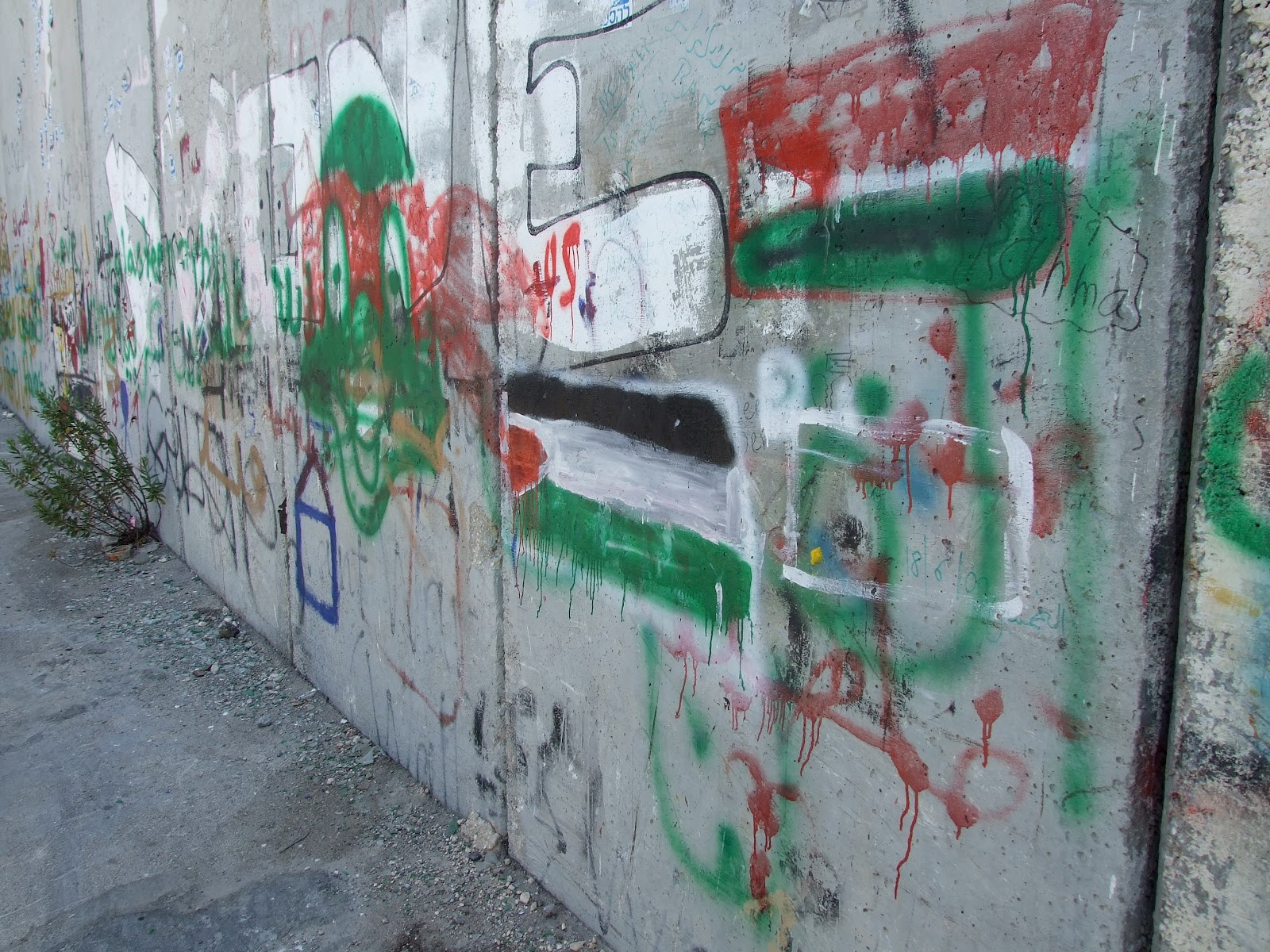 |
| Separation Wall at Abu Dis, Jerusalem |
Last week, a new border crossing was opened in East Jerusalem's Shoafat neighborhood, to little fanfare. Two days later, Jerusalem Mayor Nir Barkat asserted that Israel should relinquish Palestinian neighborhoods of the capital that are beyond the separation barrier, despite the fact that their residents carry Israeli identity cards.
Some people view these events as two pieces of the same puzzle. A third piece is the resumption of work on separate roads for Israelis and Palestinians between Jerusalem and the West Bank settlement of Ma'aleh Adumim.
 |
| Separation Wall at Abu Dis |
Photos of the Separation Wall at Abu Dis were taken when I went on a tour of East Jerusalem sponsored by Ir Amim, in the summer of 2010.
Sunday, December 18, 2011
Christopher Hitchens and the Iraq War
I've been reading all of the obituaries and encomia of Christopher Hitchens, and realizing when I started paying attention to him - after the September 11 attacks. Terry Glavin writes -
Today is also the day when the last American troops leave Iraq. I was a supporter of the Iraq War at the beginning - I believed the claim that Iraq had WMDs and was prepared to use them (being persuaded by among other things Colin Powell's presentation at the UN). Once it became clear that Iraq in fact did not have WMDs I began to have my doubts - and then more so when it also became clear that the US had no plan for what to do once we succeeded in conquering Iraq - remember the unrestrained looting and destruction after the invasion? Remember Rumsfield saying, "Stuff happens," and doing nothing? And then there came the horrible scandal of Abu Ghraib and the other prisons in Iraq where American soldiers tortured and humiliated Iraqi prisoners, and the feeble defenses of torture by the Bush administration. I am glad that we have finally withdrawn all of our soldiers. We have left behind us a devastated nation - although we are certainly not responsible for all of that devastation, since Saddam Hussein did his level best before the US invasion to destroy his own country, first by invading Iran and fighting with it for eight years, and then invading Kuwait and being defeated by the allied coalition in 1991. But even then we had a role in helping him to kill his own people - the first president Bush, after encouraging the people of Iraq to rebel against Saddam, stood idly by as Saddam's troops brutally killed thousands of Shi'ites and Kurds who began to do what he had urged them to do.
So should I have opposed the Iraq War at the beginning? In hindsight, yes, although if we had not invaded Iraq in 2003, would we still be imposing sanctions on the country which were strangling it economically and further impoverishing its people? I remember the bitter protests against the sanctions by people on the left-wing before the invasion. The sanctions were denounced as evil, as child-killing, and there were people who went to Iraq then, while Saddam was still ruling the country, to stand in solidarity with the people of Iraq. I was also dumbfounded by this response - how could western leftists act in such a way as to put themselves on the same side as Saddam Hussein, who by this point had probably killed about 300,000 of his own people (remember the hundreds or thousands of mass graves discovered after the conquest of Iraq?). It could be argued that they went in to support the people, not Saddam - but do you think that if they had openly opposed him, they would have been allowed into Iraq? No, of course not.
The situation of Iraq long before the war in 2003 was a real challenge to the leftist assumption that everything the US did was wrong and that any foreign ruler who opposed the US was an anti-imperialist. Saddam Hussein *was* an imperialist - he invaded two of the countries neighboring Iraq in order to gain benefits for Iraq.
One of the strengths of Christopher Hitchens is that he did in fact stand with the people of Iraq against Saddam - he was a long time supporter of the Kurds. Surprisingly, when I tried to argue that the invasion of Iraq did in fact help the Kurds, this did not move the people I knew who opposed the war - they could not admit that perhaps the war, for all of its cruelty and stupidity, had actually benefited some of the people of Iraq, who had been the victims of attempted genocide.
I don't know how to end this essay. My thoughts and feelings about Iraq are still very mixed - I can't come to a single, unambivalent statement about the war and what we should have done. Certainly what we did do was horrible, cruel, and bloody - but on the other side, Iraq is no longer ruled by Saddam Hussein.
“OK, that’s a confrontation between everything I like and everything I don’t like,” he remembered saying to himself. Writing in the Boston Globe a year later, he put it this way: “On one side, the ethics of the multicultural, the secular, the skeptical, and the cosmopolitan ... on the other, the arid monochrome of dull and vicious theocratic fascism.”
But Hitchens quickly noticed that something else had happened that day, and he’d resolved that he wasn’t going to shut up about it. The bloody spectacle had opened up a deep rot down in the structural foundations of the political culture that had nurtured him, first as a young Luxemburgist pamphleteer at Oxford, then as an acid-witted chronicler for obscure Trotskyist journals, and later, as something extraordinary in American culture: a popular, prize-winning, hard-left public intellectual.
By the morning of Sept. 11, Hitchens had established himself as an essayist, literary critic and a formidable Washington correspondent for such venerable liberal American journals as the Nation, Harper’s, the Atlantic Monthly and Vanity Fair. What he saw in the meaning of Sept. 11 was not just this: “You couldn’t really have wanted a better and more dynamic and radical confrontation.” It was this: “And the American left decides: ‘Let’s sit this one out.’ That’s historical condemnation. To be neutral or indifferent about that, it’s just giving up.”
This is as close as you can get to any paradigmatic truth about any of the important political debates and controversies that were to rage and churn through the first few years of the 21st century, a decade of vile hatreds and hysterics that consumed the Left and rendered much of the liberal American mainstream an ugly caricature of itself.I agree with Hitchens that the "American left decides to sit this one out," something that I experienced in futile arguments here in Ithaca, New York, a bastion of reflexively left-wing thinking (Ithaca is home to Cornell University and Ithaca College, where I work). I remember in the summer of 2002, being told by a local left-wing political activist that a local candidate for the New York Assembly should be voted for because she had opposed the NATO intervention in Bosnia and Kosovo (as if this had anything to do with whether she would be a good member of the Assembly!). He said this as if it was universally accepted that this was the only proper way to think - to leave the people of Kosovo to the tender mercies of the Serbian nationalists. I was in Israel during this time (spring of 1999), following the news, and came to the conclusion then that it was better for NATO to intervene than to stand idly by. I couldn't imagine why someone who purported to be on the left and on the side of oppressed people would oppose the NATO bombing. I realized slowly that this was part of the idiotic "anti-imperialism" of fools that had overtaken the left - the assumption being that everything that the US does outside of its borders is wrong, to be condemned, and is part of American imperialism, leading to the truly disgraceful sight of people on the left consorting with vile dictators. But that was okay, since they were opposing American imperialism!
Today is also the day when the last American troops leave Iraq. I was a supporter of the Iraq War at the beginning - I believed the claim that Iraq had WMDs and was prepared to use them (being persuaded by among other things Colin Powell's presentation at the UN). Once it became clear that Iraq in fact did not have WMDs I began to have my doubts - and then more so when it also became clear that the US had no plan for what to do once we succeeded in conquering Iraq - remember the unrestrained looting and destruction after the invasion? Remember Rumsfield saying, "Stuff happens," and doing nothing? And then there came the horrible scandal of Abu Ghraib and the other prisons in Iraq where American soldiers tortured and humiliated Iraqi prisoners, and the feeble defenses of torture by the Bush administration. I am glad that we have finally withdrawn all of our soldiers. We have left behind us a devastated nation - although we are certainly not responsible for all of that devastation, since Saddam Hussein did his level best before the US invasion to destroy his own country, first by invading Iran and fighting with it for eight years, and then invading Kuwait and being defeated by the allied coalition in 1991. But even then we had a role in helping him to kill his own people - the first president Bush, after encouraging the people of Iraq to rebel against Saddam, stood idly by as Saddam's troops brutally killed thousands of Shi'ites and Kurds who began to do what he had urged them to do.
So should I have opposed the Iraq War at the beginning? In hindsight, yes, although if we had not invaded Iraq in 2003, would we still be imposing sanctions on the country which were strangling it economically and further impoverishing its people? I remember the bitter protests against the sanctions by people on the left-wing before the invasion. The sanctions were denounced as evil, as child-killing, and there were people who went to Iraq then, while Saddam was still ruling the country, to stand in solidarity with the people of Iraq. I was also dumbfounded by this response - how could western leftists act in such a way as to put themselves on the same side as Saddam Hussein, who by this point had probably killed about 300,000 of his own people (remember the hundreds or thousands of mass graves discovered after the conquest of Iraq?). It could be argued that they went in to support the people, not Saddam - but do you think that if they had openly opposed him, they would have been allowed into Iraq? No, of course not.
The situation of Iraq long before the war in 2003 was a real challenge to the leftist assumption that everything the US did was wrong and that any foreign ruler who opposed the US was an anti-imperialist. Saddam Hussein *was* an imperialist - he invaded two of the countries neighboring Iraq in order to gain benefits for Iraq.
One of the strengths of Christopher Hitchens is that he did in fact stand with the people of Iraq against Saddam - he was a long time supporter of the Kurds. Surprisingly, when I tried to argue that the invasion of Iraq did in fact help the Kurds, this did not move the people I knew who opposed the war - they could not admit that perhaps the war, for all of its cruelty and stupidity, had actually benefited some of the people of Iraq, who had been the victims of attempted genocide.
I don't know how to end this essay. My thoughts and feelings about Iraq are still very mixed - I can't come to a single, unambivalent statement about the war and what we should have done. Certainly what we did do was horrible, cruel, and bloody - but on the other side, Iraq is no longer ruled by Saddam Hussein.
Friday, December 16, 2011
Christopher Hitchens is dead
I've just read the announcement in Vanity Fair that Christopher Hitchens has just died of cancer. I have nothing particularly profound to say about him, except that I found his writing about his struggle with cancer to be immensely moving and also terrifying in his open confrontation with death. In his last column for Vanity Fair, he wrote:
I am typing this having just had an injection to try to reduce the pain in my arms, hands, and fingers. The chief side effect of this pain is numbness in the extremities, filling me with the not irrational fear that I shall lose the ability to write. Without that ability, I feel sure in advance, my “will to live” would be hugely attenuated. I often grandly say that writing is not just my living and my livelihood but my very life, and it’s true. Almost like the threatened loss of my voice, which is currently being alleviated by some temporary injections into my vocal folds, I feel my personality and identity dissolving as I contemplate dead hands and the loss of the transmission belts that connect me to writing and thinking.May he rest in peace.
These are progressive weaknesses that in a more “normal” life might have taken decades to catch up with me. But, as with the normal life, one finds that every passing day represents more and more relentlessly subtracted from less and less. In other words, the process both etiolates you and moves you nearer toward death. How could it be otherwise? Just as I was beginning to reflect along these lines, I came across an article on the treatment of post-traumatic stress disorder. We now know, from dearly bought experience, much more about this malady than we used to. Apparently, one of the symptoms by which it is made known is that a tough veteran will say, seeking to make light of his experience, that “what didn’t kill me made me stronger.” This is one of the manifestations that “denial” takes.
I am attracted to the German etymology of the word “stark,” and its relative used by Nietzsche, stärker, which means “stronger.” In Yiddish, to call someone a shtarker is to credit him with being a militant, a tough guy, a hard worker. So far, I have decided to take whatever my disease can throw at me, and to stay combative even while taking the measure of my inevitable decline. I repeat, this is no more than what a healthy person has to do in slower motion. It is our common fate. In either case, though, one can dispense with facile maxims that don’t live up to their apparent billing.
Tuesday, December 06, 2011
Political attack on study abroad in Israel
California State University is considering reestablishing its study abroad program in Israel, while a group of Cal State faculty and administrators has written an Open Letter to the administration calling for this attempt to be stopped, on the grounds of danger, possible discrimination against some CSU students, and of course the apartheid charge. They also think that it would be one-sided to establish a study abroad program in conjunction with Israeli universities without also establishing a similar program with Palestinian universities. It might be a good idea to establish a similar program with Palestinian universities (Bard College has established a joint program with Al-Quds University in Jerusalem), but the absence of such a program should not prevent the reestablishment of the Israel study abroad program.
The University of California restarted its formal study abroad program in partnership with the Hebrew University in 2009.
I certainly hope this attempt to cut off student opportunities to study in Israel is ignored. David Klein, who teaches at CSU Northridge, and was the main author of the letter, argues that "cutting off engagement with Israeli universities is an exercise of academic freedom, not an abridgement of it: 'We’re choosing not to have relationships with institutions that participate in apartheid, in the same way that in the lead-up to World War II, universities broke off relations with universities in Nazi Germany.'"
Notice the rhetorical slip here - from the evil of apartheid to the evil of Nazi Germany. Does Klein think that Israel is trying to exterminate the Palestinians?
Zeev Maoz, a UC Davis professor who has taught a summer study abroad course in Israel, "offered a different interpretation. 'They’re raising the notion of academic freedom, and what they’re advocating is putting limits on academic freedom,' he said. 'To me, this is the epitome of hypocrisy.'"
I agree with Maoz. Klein and his supporters are using their own academic freedom in order to prevent others to exercise their own academic freedom to study and teach in Israel. That is the epitome of the BDS campaign.
The University of California restarted its formal study abroad program in partnership with the Hebrew University in 2009.
I certainly hope this attempt to cut off student opportunities to study in Israel is ignored. David Klein, who teaches at CSU Northridge, and was the main author of the letter, argues that "cutting off engagement with Israeli universities is an exercise of academic freedom, not an abridgement of it: 'We’re choosing not to have relationships with institutions that participate in apartheid, in the same way that in the lead-up to World War II, universities broke off relations with universities in Nazi Germany.'"
Notice the rhetorical slip here - from the evil of apartheid to the evil of Nazi Germany. Does Klein think that Israel is trying to exterminate the Palestinians?
Zeev Maoz, a UC Davis professor who has taught a summer study abroad course in Israel, "offered a different interpretation. 'They’re raising the notion of academic freedom, and what they’re advocating is putting limits on academic freedom,' he said. 'To me, this is the epitome of hypocrisy.'"
I agree with Maoz. Klein and his supporters are using their own academic freedom in order to prevent others to exercise their own academic freedom to study and teach in Israel. That is the epitome of the BDS campaign.
Subscribe to:
Posts (Atom)