Hungary's Far-Right Calls for Zero Tolerance Against Roma.
The right-wing Hungarian party Jobbik called for "zero tolerance" against Roma "crime and parasitism" today. The Roma are treated very badly all over eastern Europe and now the Jobbik party says, "We need to roll back these hundreds of thousands of Roma outlaws. We must show zero tolerance towards Roma crime and parasitism." The chairman of the party, Gabor Vona said that the EU should "adopt several hundred thousand of our citizens for a few years and try to educate them in European culture. Once they have succeeded, we can welcome them back."
Well, at least Jobbik isn't calling for their extermination, but they have completely demonized the Roma and see them as nothing but criminals and parasites. This kind of sentiment in Hungary has already led to attacks upon Roma. What is it that Jobbik really wants to do with or to the Roma? Dehumanizing language like this tends to be the next step in bringing further persecution upon an unwanted part of a population - it justifies violence against all Roma.
Sunday, August 26, 2012


Saturday, August 25, 2012
The yellow room and the room of death
Peter Ryley of Fat Man on a Keyboard has just written an amazing and moving post that is first of all about thirteen posts written by George Szirtes. (This is the first one: On milieu and refuge - sketch 1). His posts are meditations on a yellow room painted by Chagall, his mother, Hungary (where his family is from), Jewishness, the Holocaust, Israel, and refuge. They are well worth reading on their own.
Peter writes, "Whenever I read his poetry, I get a feeling that each word is casting a shadow, dappled layers of meaning, which lays bare a moment in time. In the darkest corners of those shadows lurk the ghosts of the worst of the twentieth century. They are not his own experiences; they are a room that he has necessarily passed through."
Peter starts his post by recounting his impression of conversations he has had with younger people about Israel/Palestine:
I sometimes have conversations about Israel/Palestine, both online and face-to face, with younger people and they disturb me. Their support for Palestinian statehood, something I have long shared, can often be scarcely differentiated from an anti-Israel sentiment that simply assumes the inherent wickedness of the state. It isn't hatred; it is disdain. Above all, what worries me is their certainty. Doubt does not trouble them, nor do they think of Israelis as anything other than oppressors. Does it ever cross their mind that they are Jews, or that the history of the conflict is inseparable from Jewish history and experience? I don't think so. As a result, they carelessly leave an intellectual door ajar and sometimes I wonder what it is that seeps in through the crack from the room beyond.The next part of his post discusses Szirtes' thirteen posts "on milieu and refuge." His last paragraph addresses the young people again. He refers again to the yellow room evoked by George Szirtes - that comfortable, central European, faintly Hapsburg room of the Jewish middle class that was destroyed by the Nazis forever. That room suggests another room to him.
All of which brings me back to these perfectly decent young people and the ideologues who fill them with righteous ardour. It's odd, they never seem to mention the word Jew. Instead they use hopelessly inappropriate analogies – 'colonial settler state', 'apartheid state' and the like. Anything to avoid even thinking that they are talking about Jews and that this noble cause could have anything to do with Jewish people. There is a reason for that of course. We gentiles have a room too. It is part of our history and we don't want to think about it. If we do, it might dilute certainty with ambiguity. The room isn't yellow. Sometimes it is made out of rough planks, sometimes of cement and occasionally it is constructed from neatly dressed stone placed on a picturesque mound in a beautiful northern city. This room is part of our cultural inheritance and it is intrinsically tied up with Jews. It is the room in which we kill them. And so I think I know what bothers me. It is the smell seeping through that half closed door. I can recognise what it is now.
It's gas.I read, "This room is part of our cultural inheritance and it is intrinsically tied up with Jews," and then slammed into "It is the room in which we kill them."
It's remarkable to read such a clear-eyed statement of reality, of the truth of all the centuries of history when non-Jews have killed Jews simply because they were Jews. I'm Jewish and I appreciate it when someone who is not Jewish sees this so clearly.
Wednesday, August 22, 2012
Holocaust denial - not on this blog
Just a note to anyone who wishes to engage in Holocaust denial in the comments to a post on this blog - I will not publish your comment. Someone just sent a comment to the post http://mystical-politics.blogspot.com/2007/10/daniel-mcgowan-holocaust-denial.html reiterating McGowan's skepticism about the existence of gas chambers in death camps. The reason I will not publish such comments is a) there is ample historical evidence that the events of the Holocaust occurred, so there is no need to debate the basic facts, such as the existence of gas chambers, and b) Holocaust denial is always motivated by antisemitism, and I do not provide a venue on this blog for Jew-haters. If you feel the need to express such sentiments, create your own blog, or go huddle together with the other antisemites at Stormfront.
Thursday, August 16, 2012
Israelis and Iranians not ready to die in a war against each other
The people who started the "Israel loves Iran, Iran loves Israel" campaign back in the spring have a whole new series of photographs - this time saying "Not ready to die in your war." Here are two of the new posters.


This is the statement that goes along with the posters:
We are millions of people who will be hurt. Will be drafted, will have to fight, lose our lives, our relatives. We, parents from Tel Aviv and Teheran will have to run with our children to the shelters and pray the missiles will miss us.
But they will fall somewhere, on someone.
Those last few days the sound of war is becoming louder.
So once again, loud and clear, we are saying NO to this war
We saying to the people of Iran: We Love You
Wednesday, August 15, 2012
Gas masks in Jerusalem
The author of Something Sick is Happening in Jerusalem writes about going to a mall in Jerusalem a few days ago and picking up gas masks for his family. His report reminds me of something that happened in the run-up to the first Gulf War, in the late fall of 1990 or very early 1991, before the coalition attack on January 16. I was in the US, not Israel, and I was listening to NPR, and Linda Gradstein was reporting.
The report was about people standing in line waiting to pick up their gas masks before the Gulf War began, out of fear that Saddam Hussein would do what he threatened to do - use chemical weapons against Israel, a threat he made earlier in the year. Suddenly I heard the voices of two people that I knew when I had lived in Israel from July 1987 to July 1989: Sally and Michael Klein-Katz, who were waiting in line to get their gas masks. It was very eerie to hear them being interviewed. During the Gulf War, I spent about $500 on phone calls to Israel, checking on my friends' safety every time I heard about a Scud missile attack. Remember, this was before the widespread use of the internet and email, there were no cellphones, and if you wanted to talk to someone in Israel, you had to pay a lot of money.
I visited Israel right after the Gulf War ended - I was actually flying there on the last day of the war, and the plane's pilot announced to us in the middle of our flight that the ceasefire had been signed between the coalition forces and Iraq. Nonetheless, we picked up gas masks at the airport just in case the war started again.
Then, in 1998, I was on a fellowship studying and doing research in Jerusalem, and once again the US was threatening to attack Iraq. People in Israel were afraid that Saddam would seize the opportunity to attack Israel again, and the government began distributing gas masks and plastic sheets for people to seal a room in their apartments against the threat of poison gas. The gas masks were free for Israeli citizens, but foreigners (like myself) had to buy our own. I went to the Mashbir department store in the center of Jerusalem, and up a few floors to where the masks were being distributed to foreigners. I paid my 200 shekels and took the mask and the plastic sheets home. The US attacked Iraq and bombed for four days, but there was no retaliation against Israel. My gas mask remained in the closet and the plastic sheeting in a corner of the living room. When I left Israel in the summer of 1999 I left my gas mask behind with a friend, who actually went and renewed it for me a few years later. She's long since thrown it away.
I hope that no one in Israel will have to use the gas masks that they're picking up now.
The report was about people standing in line waiting to pick up their gas masks before the Gulf War began, out of fear that Saddam Hussein would do what he threatened to do - use chemical weapons against Israel, a threat he made earlier in the year. Suddenly I heard the voices of two people that I knew when I had lived in Israel from July 1987 to July 1989: Sally and Michael Klein-Katz, who were waiting in line to get their gas masks. It was very eerie to hear them being interviewed. During the Gulf War, I spent about $500 on phone calls to Israel, checking on my friends' safety every time I heard about a Scud missile attack. Remember, this was before the widespread use of the internet and email, there were no cellphones, and if you wanted to talk to someone in Israel, you had to pay a lot of money.
I visited Israel right after the Gulf War ended - I was actually flying there on the last day of the war, and the plane's pilot announced to us in the middle of our flight that the ceasefire had been signed between the coalition forces and Iraq. Nonetheless, we picked up gas masks at the airport just in case the war started again.
Then, in 1998, I was on a fellowship studying and doing research in Jerusalem, and once again the US was threatening to attack Iraq. People in Israel were afraid that Saddam would seize the opportunity to attack Israel again, and the government began distributing gas masks and plastic sheets for people to seal a room in their apartments against the threat of poison gas. The gas masks were free for Israeli citizens, but foreigners (like myself) had to buy our own. I went to the Mashbir department store in the center of Jerusalem, and up a few floors to where the masks were being distributed to foreigners. I paid my 200 shekels and took the mask and the plastic sheets home. The US attacked Iraq and bombed for four days, but there was no retaliation against Israel. My gas mask remained in the closet and the plastic sheeting in a corner of the living room. When I left Israel in the summer of 1999 I left my gas mask behind with a friend, who actually went and renewed it for me a few years later. She's long since thrown it away.
I hope that no one in Israel will have to use the gas masks that they're picking up now.
Tuesday, August 14, 2012
The Iran war fear factor is starting to settle in
Ami Kaufman of +972 magazine writes about how the Iran war fear factor is starting to settle in. He also went to the anti-war demo on Sunday night against war with Iran.
Yesterday, as the anti-war demo in front of Ehud Barak’s house was winding down, I spoke to an old friend. We agreed that what bothered us most was not the fact that most people don’t think there will be a war, or that some people do. Rather the fact that the people who do think there might be one don’t really care. They’re just not scared. A sort of “it won’t hit us anyway. What are the odds” kind of attitude.
But as a family man, my fear is so much different today. I’m constantly thinking of where my kids are. How close are they to a shelter? How fast will I be able to get to them if the sirens start? Will I be able to communicate with my wife who gets them if the phones are down? Will they be willing to wear a gas mask? I imagine their little faces in gas masks and choke up.
How would I even explain it to a 5-year-old and 3-year old? What are the words to even begin describing the situation to them?
Because kids shouldn’t wear gas masks. It’s ridiculous.
This place is fucked up.
Maybe “God” knows why.
Protests against looming war with Iran
I just read a tweet by @NoaMaiman that there are protests happening against looming war with Iran. She wrote:
"Also today, there is a protest vigil against war with Iran. From 8:00, under the house of the Defense Minister, we call to him not to go to an end-of-the-world war at the price of our lives."
If I find more notices of Israeli protests I'll post them here. One of the things that really bothers me is that there has been so little public protest at the push for war with Iran. There was one demonstration in Tel Aviv in the spring that a friend of mine went to, but this is the first sign of protests I've heard of since.
גם היום, משמרת מחאה נגד מלחמה עם אירן. משמונה, מתחת לביתו של שר הבטחון,
קוראים לו לא לצאת למלחמת סוף עולם על חשבון החיים שלנו. רטטו נא.
If I find more notices of Israeli protests I'll post them here. One of the things that really bothers me is that there has been so little public protest at the push for war with Iran. There was one demonstration in Tel Aviv in the spring that a friend of mine went to, but this is the first sign of protests I've heard of since.
Monday, August 13, 2012
Mr. Netanyahu, before you bomb Iran, say goodbye to everyone you know
Bradley Burston, on Netanyahu's fateful decision on whether or not to bomb Iran. He went to the local mall to pick up the gas masks for his family. The Israeli government is sending out text messages to all the cellphones in the country this week to test the system they will need if war breaks out. Tel Aviv just surveyed all of its bomb shelters, enough for 40,000 people. (Let's not mention that well over 40,000 people live in Tel Aviv). The anti-missile defenses have just been upgraded. Israel is reactivating its advanced drone surveillance program (presumably, over Iran). The news on Friday night surveyed the government policies about Iran and the likelihood that Netanyahu and Barak will decide for war - they've almost decided to make the attack. Are they bluffing? Well, Netanyahu thinks he's stopping the second Holocaust if he launches the attack.
At the local shopping mall, as I took a number to receive shoebox-size personal protection kits against weapons of mass destruction, I found myself thinking about farewells.
And about Benjamin Netanyahu.
I found myself thinking about war with Iran, the war which, if it starts soon, will be Netanyahu's war. I found myself relating differently to everyone I met, everyone I know, everyone I love. The way you might if you were saying goodbye.
The way you might if their entire future, and yours, were in the hands of one man. And one decision.
The day I waited for my family's anti-nerve gas atropine and for masks against chemical and biological warfare, the prime minister asked for air time from Israel's major television channels in order to lay out his position on Iran, and to emphasize that he has yet to make a decision on whether or not to bomb.
Before he decides, he should spend a few moments with the people with the numbers in their hands. He should see what's in their eyes. He should listen to the gravity in their humor. He should look straight at the infants and the old people and the women in their eighth month, and at the people his own age, already bereaved and broken by wars that have taken their parents, their siblings and best friend's children, and, in recent years, even their grandchildren.
This is one of the things that line of people is telling him:
Mr. Netanyahu, before you bomb Iran, say goodbye to everyone you know. Say goodbye to everyone you love. You know you won't be able to protect all of them from the retaliation that will surely come. Everyone you know is a target. Everyone you love is in range.
Some of the rockets with high explosive warheads will get through the missile shield. And even if you and a few of your loved ones are sealed into the most sophisticated shelter yet devised, not one of you is immune. When it's over, when you get back to the surface, this will be a different country, and someone you care about may well have been torn dead by a rocket warhead, or crushed under the weight of a building.
Your son’s best friend, your wife’s whole family, the families of your cook, your driver, your bodyguard. The guys you grew up with. Their children, and theirs. Say goodbye to them, every last one of them. Now, before you give the order. Before it’s too late.
The moment you give the order, there will be nothing you can say to them. To us. We won’t listen, nor should we.
It won't matter then, all these arguments we have over why you insist on pursuing this. Whether it was a bluff that went ballistic, or a tragic thirst for a place in history. We won't have time then for talk about how the elections for the American president figured in your decision, or how you related to, or did not, the opinions of spymasters and generals and diplomats.
When it all comes down, we won't be able to spare the strength or the time to despise you for what you did to all of us. We will be too busy then with the instruments of grief and the debris of loss.
At the mall, they give out no numbers to get the chance to tell you what they think. The people I was standing with think you've got this one all wrong. Most of the people in lines all over the country feel the same way. Listen to them now. You have the power to be their judge, jury, and executioner. The least you can do is look them in the eyes and ask if they have any last words.
Thursday, August 02, 2012
4,000 march in 10th annual Jerusalem Pride March
Jerusalem held its Gay Pride March today - and I wish I had been there! Here are some photos from the Jerusalem Post.


The march this year went down King George and Keren Hayesod streets, and stopped for a moment of silence at the spot where a Haredi attacker stabbed three participants in the parade in 2005. According to the Post, about 4,000 people took part in the march. It would have been nice to be there this year....
 |
| "Welcome" - the sign at the entrance to Jerusalem, now painted the colors of the rainbow. |


The march this year went down King George and Keren Hayesod streets, and stopped for a moment of silence at the spot where a Haredi attacker stabbed three participants in the parade in 2005. According to the Post, about 4,000 people took part in the march. It would have been nice to be there this year....
Wednesday, August 01, 2012
10 Years and a Day – The Hebrew University Bombing
Ten years ago, on July 31, 2002, a bomb went off in the Frank Sinatra cafeteria at the Hebrew University. Nine people were killed, including a young man whom I knew, Ben Blutstein, who was studying at Pardes. Ben's mother, Katherine Baker, was interviewed for an article in Haaretz commemorating the murderous attack.
The Haaretz article begins:
Dr. Baker said:
The Haaretz article begins:
It was a brazen attack that reverberated throughout Israel and struck deep into the heart of Israel's English-speaking community. On July 31, 2002, a bomb packed with shrapnel was placed in a bag in a crowded Hebrew University cafeteria on its Mt. Scopus campus. The explosion killed nine people - four Israelis and five foreign nationals - and injured 85. Hamas claimed responsibility.
Among the victims were Benjamin Blutstein, 25, of Harrisburg, PA; Marla Bennett, 24, from San Diego, CA; Dina Carter, 37, a dual Israeli-U.S. citizen originally from North Carolina who converted to Judaism after moving to Israel; Janis Ruth Coulter, 36, a native of Boston, Massachusetts who also converted; and David Gritz, 24, of Massachusetts, who held dual U.S.-French citizenship.
Dr. Baker said:
"I don't think time ever heals this kind of loss," said Dr. Katherine Baker, a Penn State University microbiologist whose son, Benjamim Blutstein, was one of the victims. "There are days I can't get through the day without crying, there are a couple of days in a row I can do it. But it's extremely hard."
Baker, too, is frustrated and disappointed by the lack of advancement in the peace process, and said the U.S. government has shirked its responsibilities. "In the United States there's this tone that says 'all of this is just working our way toward a peace, toward an ultimate settlement.' I don't see that alternate settlement coming, and I see tremendous cynicism, particularly on the part of the American government in not acknowledging its responsibility toward Israel nor to American citizens," said Baker.
An example, she explained, can be seen on her son's death certificate. "It sounds terribly minor, but it really gets to me this time every year. Ben's death certificate says that he died in Jerusalem, blank. The United States refuses to write that he died in Jerusalem, Israel. Well, the United States acknowledges that Jerusalem is the capital of Israel. So, put it on your documents, because my son died because he was in Israel, not because he was in the 'ethereal Jerusalem.'"
A U.S. Consulate General spokesman in Jerusalem said that it is a well-known U.S. policy that Jerusalem is a final status issue, that "must be resolved through negotiations between the parties."
The year after her son's murder, Baker, 60, spent a Sabbatical year in Israel, and her daughter - 11 years younger than Ben - completed her high school studies here before enrolling at Pardes. "I was concerned about her going to Israel. She told me, 'I need to know why Israel was so important to Ben that he would die for it," Baker recalled, choking back tears.
The bombing, said Baker, "taught me for the first time that there really, truly, is evil in the world and that evil will not be appeased." But what remains in her heart are her son's last words to her.
"Ben turned 25 years old on July 25, before this pigua," said Baker, using the Hebrew word for a terrorist attack. "And in the last conversation I had with him, on that day, one thing he said to me that will always stay with me: 'You know, Ima [the Hebrew term for mother], I finally know what I want to do with my life. I'm where I'm supposed to be. And I'm happier than I have ever been.'"A couple of days after the attack, I wrote this brief note on my reactions:
[8/2/02] I’m writing now after the bombing on Wednesday [7/31/02] in Jerusalem, at the Hebrew University, in which 5 Americans and 2 Israelis were killed. [Actually, nine people in all were killed, and 85 were injured]. Two of the Americans were students at Pardes, an institute for higher Jewish studies in Jerusalem, and one of them (Ben Blutstein) was the son of a family I knew last year when I taught at Bucknell University in Lewisburg, Pennsylvania, and frequently went to Harrisburg for Shabbat. I think I only met Benjamin once, but I spent some very pleasant Shabbats with his family, and I feel sick at his murder. Fragments of poetry keep going through my head – “they were lovely and pleasant in their lives, and in their deaths not divided.”[1] I've felt so numb and in shock today - a feeling I recall after the September 11 attacks last year. It seems there is no end to violence.
[1] 2 Sam. 1:23. This is a verse that is quoted in the version of the Jewish memorial prayer that is said for those who have died על קדושת השם, “for the sanctification of God’s name.” See Philip Birnbaum, Daily Prayer Book: Sephardic (New York: Hebrew Publishing Co., 1969) 671-72.
Monday, July 30, 2012
Let us count the ways: Romney's foolishness in Israel
1. Romney's clueless aides initially scheduled his big fundraiser on Tisha B'Av, a fast day.
2. Romney went to the Western Wall on Tisha B'Av in order to campaign for the presidency.
3. He compared the Israeli and Palestinian economies, to the detriment of the latter, without even mentioning the occupation, and even getting the facts wrong: he said that Israel has a per capita income of $21,000 - actually, it's $31,000. He also said that the Palestinians have a per capita income of about $10,000 - actually, it's about $1500.
4. And what causes the difference in Palestinian and Israeli income? It's culture, baby, culture. A transcript of his speech today from his campaign:
To counter Romney's statement: according to the New York Times:
2. Romney went to the Western Wall on Tisha B'Av in order to campaign for the presidency.
3. He compared the Israeli and Palestinian economies, to the detriment of the latter, without even mentioning the occupation, and even getting the facts wrong: he said that Israel has a per capita income of $21,000 - actually, it's $31,000. He also said that the Palestinians have a per capita income of about $10,000 - actually, it's about $1500.
4. And what causes the difference in Palestinian and Israeli income? It's culture, baby, culture. A transcript of his speech today from his campaign:
Culture makes all the difference. And as I come here and I look out over this city and consider the accomplishments of the people of this nation, I recognize the power of at least culture and a few other things.So, instead of inquiring into what a 45-year belligerent occupation might do to the Palestinian economy, he resorts first of all to a fairly racist statement - that it's cultural differences between Palestinians and Israelis that leads to the greater Israeli per capita income.
To counter Romney's statement: according to the New York Times:
The Palestinians live under deep trade restrictions put in place by the Israeli government: After the militant group Hamas in 2007 took control of Gaza – home to about 1.7 million Palestinians – the Israelis imposed a near-total blockade on people and goods in Gaza. The blockade has been eased, and now many consumer goods are allowed in. But aid organizations say the restrictions still cripple Gaza’s economy. The West Bank, where 2.5 million Palestinians reside, is also subject to trade restrictions imposed by the Israelis.5. Or maybe it's divine providence:
In Gaza, according to the C.I.A., “Israeli-imposed border closures, which became more restrictive after Hamas seized control of the territory in June 2007, have resulted in high unemployment, elevated poverty rates, and the near collapse of the private sector that had relied on export markets.” The agency added that “changes to Israeli restrictions on imports in 2010 resulted in a rebound in some economic activity, but regular exports from Gaza still are not permitted.” And in the West Bank, “Israeli closure policies continue to disrupt labor and trade flows, industrial capacity, and basic commerce, eroding the productive capacity” of the economy.
On Monday afternoon, Romney campaign officials did not respond to a query about whether Mr. Romney believes that the blockade of Gaza or trade restrictions in the West Bank have had any dampening effect on economic activity in those areas.
One, I recognize the hand of providence in selecting this place. I’m told in a Sunday school class I attended— I think my son Tagg was teaching the class. He’s not here. I look around to see. Of course he’s not here. He was in London. He taught a class in which he was describing the concern on the part of some of the Jews that left Egypt to come to the promised land, that in the promised land was down the River Nile, that would provide the essential water they had enjoyed in Egypt. They came here recognizing that they must be relied upon, themselves and the arm of God to provide rain from the sky. And this therefore represented a sign of faith and a show of faith to come here. That this is a people that has long recognized the purpose in this place and in their lives that is greater than themselves and their own particular interests, but a purpose of accomplishment and caring and building and serving.6. Or maybe it's that famous Jewish proclivity for business.
There’s also something very unusual about the people of this place. And Dan Senor— And Dan, I saw him this morning, I don’t know where he is, he’s probably out twisting someone’s arm—There’s Dan Senor, co-author of ‘Start-up Nation,’ described— If you haven’t read the book, you really should— Described why it is Israel is the leading nation for start-ups in the world. And why businesses one after the other tend to start up in this place. And he goes through some of the cultural elements that have led Israel to become a nation that has begun so many businesses and so many enterprises and that is becomes so successful.As Gene at Harry's Place writes:
But the thing is, Palestinian “culture” isn’t so vastly different from Jewish Israeli “culture” when it comes to valuing education. Palestinians also have a strong tradition of entrepreneurship and business ownership. And clearly the facts on the ground make it a lot harder for a Palestinian in the territories to succeed than for an Israeli with similar skills and drive. Surely Romney could have found a way to praise Israel’s economic achievements without comparing them insultingly to those of its neighbors.7. And finally, Romney praises the Israeli healthcare system for providing better care than the American system at a much lower cost - without mentioning that Israeli healthcare actually is socialized!
No, if you want to see a system with truly socialistic characteristics, you have to look elsewhere. Israel, for example. And guess who just praised that system? Mitt Romney, while addressing a fundraiser in Jerusalem....
Miller notes that Israel has a truly universal health care system, in which the government guarantees every citizen not just insurance but insurance with a minimum set of benefits and full choice of provider. That’s all true. But there’s more to it than that. Israel also regulates the health care system aggressively, with what would, by any reasonable standard, qualify as price controls. Jack Zwanziger and Shuli Brammli-Greenberg wrote about this in Health Affairs:
The national government exerts direct operational control over a large proportion of total health care expenditures, through a range of mechanisms, including caps on hospital revenue and national contracts with salaried physicians. The Ministry of Finance has been able to persuade the national government to agree to relatively small increases in the health care budget because the system has performed well, with a very high level of public satisfaction.
Old City photos from the Phasael Tower.
I went to the Old City today, hoping to get up to the Temple Mount, but it was closed in the afternoon to visitors because of Ramadan. I did get some great photos, however, from the Phasael tower at the Citadel. The Phasael tower was originally built by Herod the Great, and you can still see the massive Herodian-era stones on the lower levels of the tower. I went to visit the City of Jerusalem museum at the Citadel and went through the whole exhibit on the history of Jerusalem. Below are some of my photos.
 |
| Chihuly glass sculpture at the entrance to the museum. |
 |
| Looking over the rooftops of the Old City towards the cemetery on the Mt. of Olives. |
 |
| The Pool of Zechariah, in the Christian Quarter, used to be filled with water and served as a reservoir for people in the Quarter. |
 |
| Dome of the Rock from the Phasael Tower - notice the tents set up to shelter worshipers during Ramadan from the burning sun of July and August. |
 |
| Dome of a church - I'm not sure which one. |
 |
| Mt. of Olives cemetery; above is the Intercontinental Hotel (which I think has a different name now). |
 |
| The grey dome on the left may belong to the Holy Sepulchre, I'm not sure. |
 |
| Imperial Hotel, in Umar ibn al-Kuttab Square, just inside the Jaffa Gate. |
Sunday, July 29, 2012
Mitt Romney interferes in Israeli politics
Mitt Romney interfering in Israeli politics at the behest of Netanyahu : Romney cancels on Yacimovich after meeting with Netanyahu.
Much has been written about the warm personal relationship between the two friends, ex-governor Mitt Romney, the Republican candidate for the presidency of the United States, and Benjamin Netanyahu, the prime minister of Israel. Today it has become clear that the two are more than just friends. Romney apparently accepts instructions from Netanyahu who succeeded in getting him to cancel a scheduled and meticulously planned meeting with MK Shelly Yacimovich, the leader of the Labor party.
Mitt Romney at the Western Wall
Today, Mitt Romney paid a visit to the Western Wall - during the fast day of Tisha B'Av, commemorating the destruction of the first and second Temples, and the exile of the Jewish people from their land. Hundreds of people surrounded him and welcomed him, while a few jeered at him. What a cheap trick on his part. Tisha B'Av is a day of mourning, not a day for him to get a photo-op at the Wall and disrupt the prayers there. The photo here shows him accompanied by his security detail.
As Jeffrey Goldberg wrote:

As Jeffrey Goldberg wrote:
The Western Wall "is also, on this particular Tisha b'Av, the location of a very important photo opportunity for an American presidential candidate.
How vulgar is this?
Very."

Friday, July 27, 2012
Palestinian official visits Auschwitz memorial
Interesting story from the AP: Palestinian official visits Auschwitz memorial.
An adviser to Palestinian President Mahmoud Abbas is visiting the memorial at the German Nazi death camp of Auschwitz to pay respect to some 1.5 million camp victims, mostly Jews. Ziad al-Bandak, who advises Abbas on Christian affairs, is visiting prisoner blocs, gas chambers and a crematorium in the Auschwitz-Birkenau complex that the Germans built and operated in southern Poland during their World War II occupation of the country.According to the same story, the Palestinian and Israeli ambassadors to Poland visited Auschwitz in 2007.
What is left anti-semitism?
Shiraz Socialist, a British socialist blog that is connected to a small left-wing group in Britain, the Alliance for Workers Liberty, just published an excellent article on left anti-semitism that explains some things that have always puzzled me about it. A few excerpts:
It's definitely worth reading the whole article, because it touches on many important points, especially how opposition to the existence of Israel has become the "anti-imperialism of the fools," an attitude that I have heard much more recently than 1981.
No, by “left-wing anti-semitism” we emphatically do not mean political, military, or social criticism of Israel and of the policy of Israeli governments. Certainly, not all left-wing critics of Israel or Zionism are anti-semites, even though these days all anti-semites, including the right-wing, old-fashioned, and racist anti-semites, are paid-up “anti-Zionists”....I have encountered this attitude, and have always found it very strange. I'm a supporter of Israel, but I am certainly not responsible for everything Israel does or has done. In June 1981, when Israel destroyed the Iraqi nuclear plant at Osirak, I was living in Seattle. I was talking about this with a friend (left-wing, not Jewish), and he started asking me why Israel had done this, with the implication that I was in some way responsible for the Israeli attack, merely because I'm Jewish. (I was a supporter of the attack because I saw it as protecting Israel). I simply couldn't understand his attitude - how was I, an American Jew who had never even visited Israel at that point, responsible for what the state of Israel had done? I was merely stating my opinion. For him, somehow, the fact that I am Jewish made my opinions not simply my opinions, but some kind of official statement from the Israeli government.
The difference here between left-wing anti-semites and honest critics of Israel — a category which includes a very large number of Israeli Jews as well as Israeli Arabs — is a straightforward one of politics, of policy.
The left-wing anti-semites do not only criticise Israel. They condemn it outright and deny its right to exist. They use legitimate criticisms, and utilise our natural sympathy with the Palestinians, not to seek redress, not as arguments against an Israeli government, an Israeli policy, or anything specifically wrong in Israel, but as arguments against the right of Israel to exist at all. Any Israel. Any Jewish state in the area. Any Israel, with any policy, even one in which all the specific causes for justly criticising present-day Israel and for supporting the Palestinians against it have been entirely eliminated.
The root problem, say the left-wing anti-semites, is that Israel exists. The root “crime of Zionism” is that it advocated and brought into existence “the Zionist state of Israel”.
Bitterly, and often justly, criticising specific Israeli policies, actions, and governments, seemingly championing the Palestinians, your left-wing anti-semites seek no specific redress in Israel or from Israel, demanding only that Israel should cease to exist or be put out of existence....
But why is the drive and the commitment to destroy Israel anti-semitism, and not just anti-Zionism?
Because the attitude to the Jewish nation in Israel is unique, different from the left’s attitude to all other nations; and because of the ramifications for attitudes to Jews outside Israel. Apart from a few religious Jews who think the establishment of Israel was a revolt against God, and some Jews who share the views of the leftists whom we are discussing here, those Jews outside Israel instinctively identify with and support Israel, however critically. For the left-wing anti-semite they are therefore “Zionists”, and proper and natural targets of the drive to “smash Zionism”.
The attitude of the “anti-Zionist” left to Israel brings with it a comprehensive hostility to most Jews everywhere – those who identify with Israel and who defend its right to exist. They are not just people with mistaken ideas. They are “Zionists”.
In colleges, for example, where the anti-Zionist left exists side by side with Jewish students, this attitude often means a special antagonism to the “Zionist” Jews. They are identified with Israel. They, especially, are pressured either to denounce Israel, to agree that it is “racist” and “imperialist” and that its existence is a crime against the Arabs — or else be held directly and personally responsible for everything Israel does, has done, or is said to have done.
It's definitely worth reading the whole article, because it touches on many important points, especially how opposition to the existence of Israel has become the "anti-imperialism of the fools," an attitude that I have heard much more recently than 1981.
The anti-semitic left today, which depicts Israel as the hyper-imperialist power — either controlling US policy, or acting as its chief instrument, the story varies — is in the grip of an “anti-imperialism of the fools”. And that in practice leads to a comprehensive hostility to Jews not far from what Bebel called the socialism of fools....
There is an immediate “antidote” to left-wing anti-semitism too, and it is a very important task for Marxist socialists like those who publish Solidarity [ie: the AWL]: relentless exposure and criticism of their politics and antics — without fear of isolation, ridicule, or the venomous hostility of the vocal and self-righteous left-wing anti-semites.
Sunday, July 22, 2012
Tension with Syria on the Golan
Another not very calming article in Haaretz today. This one is about something that happened on the Israel-Syria border in the Golan last Thursday. 500 Syrian soldiers entered the demilitarized zone between the Israeli and Syrian lines on the Golan. They did this not to attack Israel, but in the course of fighting some of the Syrian rebels.
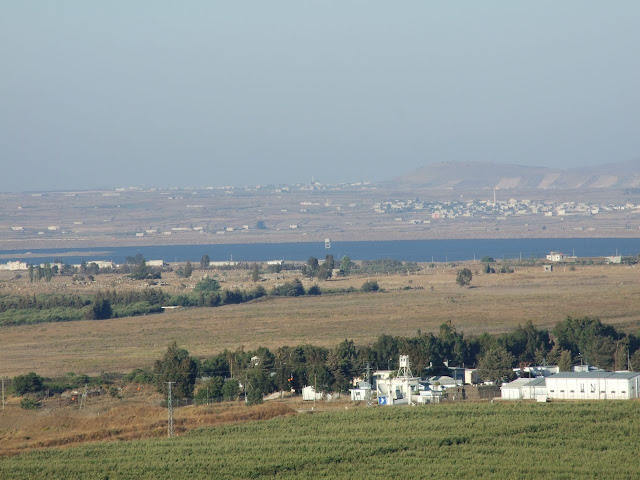
Jubata Al Khashab is situated inside the demilitarized zone, between the Israeli lines on the west and the Syrian lines on the east. It is close to Mas'ada inside the Golan Heights. When I visited the Golan last summer with friends, we drove through Mas'ada. This is a photo of some men walking along the road in Mas'ada.



Syrian army forces crossed the demilitarized zone near the border with Israel in the Golan Heights last week, a highly unusual incident, on what is considered a quiet border.
Following the incident, in which 500 soldiers and 50 vehicles crossed into the demilitarized zone, Israel filed a formal complaint to the UN secretary general and to the president of the UN's Security Council, warning that the event may have serious ramifications....
The Syrian soldiers entered the demilitarized zone last Thursday. The Syrian forces entered the area near the Syrian village of Jubata Al Khashab, a few kilometers east of the Israeli Druze village of Mas'ada in the northern part of the Golan Heights. It seems that the soldiers' entrance to the demilitarized zone was a result of the fighting with the rebel army.
On the same day, Barak was touring the border with Syria and observed clashes on the other side of the border. Barak, noting that the battle was being conducted at a distance of only "200 meters from UN forces and some 800 meters from the border fence," was not aware at the time that the Syrian soldiers had entered the demilitarized zone.
Jubata Al Khashab is situated inside the demilitarized zone, between the Israeli lines on the west and the Syrian lines on the east. It is close to Mas'ada inside the Golan Heights. When I visited the Golan last summer with friends, we drove through Mas'ada. This is a photo of some men walking along the road in Mas'ada.

The demilitarized zone in the Golan Heights is defined in the separation of forces agreement signed by Israel and Syria in 1974. The accord defined a 3-6 kilometer zone which would be demilitarized by Israeli and Syrian forces, and would be under the supervision of a UN military force and Syrian civilian authority. The UN peacekeeping force – UNDOF – includes some 1,000 soldiers, sent from Canada, Poland, Finland and Austria, who are monitoring the keeping of the agreement.When I was visiting Israel in the summer of 2007, I also visited the Golan, and we drove along a road close to the border, and stopped at a lookout point near Quneitra, which is a ruin now in the Syrian controlled part of the Golan. I'm not sure exactly what these are photographs of, whether of Quneitra or other villages.


Life During Wartime
Great article by Janine di Giavanni, Life During Wartime, about how you know when a war is starting in your country - in this case, Syria. Scary to read from Israel, where all the fighting in Syria seems increasingly closer. In an article in Haaretz, Ehud Barak, the Israeli Defense Minister, talks about standing on the Golan Heights close to the Syrian border and seeing and hearing the shooting and bombing. I've been where he was standing, near the ruined city of Quneitra, and you can easily see into Syria and see fields and nearby towns, and normal life proceeding. Not any longer. I love going to the Golan, but now I don't think it would be such a smart idea.
One thing that bothered me about this article and others I've read about Syria is shown in this excerpt:
I don't want that chaos and death to engulf Israel too, with all my friends and relatives who live here. This is not a safe world.
One thing that bothered me about this article and others I've read about Syria is shown in this excerpt:
In a government office near the Mezze Highway, a Christian official with a Muslim name says he grew up in a country that, like Bosnia, was a melting pot for ethnic groups, for refugees from Armenia, for Christians, Shias, Sunnis and Greek Orthodox. He says the uprising will change all of this. “Everyone who believed in the Syrian model is betrayed,” he said.The one ethnic group that he and others always omit to mention are the Jews of Syria, of whom very few (if any) are left now. There was a strong community in Syria before 1948. Now the Syrian Jews are in Israel, the US (there's a big community in NYC) and other places. Why does no one remember their place in the Syrian melting pot? They were brutally oppressed when Israel became a state, and most left, with the remainder living fearful lives.
I don't want that chaos and death to engulf Israel too, with all my friends and relatives who live here. This is not a safe world.
Thursday, July 19, 2012
Mystical interpolations into 2 Enoch
I've just started reading a newly-published book, New Perspectives on 2 Enoch: No Longer Slavonic Only, edited by Andrei Orlov and Gabrielle Boccaccini (Brill, 2012), which is very interesting. The first chapter gives us the first fragments of 2 Enoch in another language than Slavonic, "No Longer 'Slavonic' Only: 2 Enoch Attested in Coptic from Nubia," by Joost L. Hagen. He discovered that previously excavated Coptic fragments from Qasr Ibrim, which now exist only in photographs and in transcriptions by J. M. Plumley, the director of the excavations from 1963 to 1976, are fragments of 2 Enoch 36:3-42:3, including the very interesting Shiur Qomah passage from 39:1, about seeing the face, eyes, and right hand of the Lord. He dates these fragments to between the 8th-10th centuries, which would make them the earliest witness to 2 Enoch. They represent the shorter recension of 2 Enoch. His article obviously raises questions about how 2 Enoch was transmitted from a posited Jewish source all the way to medieval Bulgaria, where the Slavonic translations were first made.
The second article is by Christfried Böttreich, "The 'Book of the Secrets of Enoch' (2 En): Between Jewish Origin and Christian Transmission. An Overview." I'm only going to discuss one issue he raises. He goes through the entire book and notes places where there are some clear Jewish mystical or Christian interpolations (among a lot of other things he discusses). He pinpoints 2 En 20:3, 21:6-22:3, and 39:3-8 as Jewish interpolations. In 2 En. 20:3 the text says: “And on the tenth heaven is God, and it is called in the Hebrew language Aravot.” At 2 En. 21:6, Enoch sees the eighth heaven: “Which is called in the Hebrew language Muzaloth, the changer of the seasons. . . which are above the seventh heaven. And I saw the ninth heaven, which in the Hebrew language is called Kukhavim where the heavenly houses of the 12 zodiacs are.” These two inserts interrupt the existing scheme of seven heavens which 2 Enoch has already described, so they seem like obvious interpolations. I have always wondered whether these interpolations were in fact direct translations from Hebrew to Slavonic, since they give Hebrew names to the 8th, 9th, and 10th heavens.
Böttreich dates the origins of 2 Enoch to first century Alexandria, and in my opinion gives some pretty convincing arguments for this dating, but this dating cannot refer to every word in the Slavonic Enoch, and obviously not the sentences I just quoted. He is puzzled by these passages and how (and by whom) they could have gotten into the Slavonic version of the book. He writes, "I have no idea how to explain this stratum of Jewish mystical interpolations (like 2 En 20:3; 21:6-22:3; 39:3-8) which obviously depends on Hebrew sources by inserting the additions in Greek into a Greek text transmitted by Christian contemporaries." The same questions exist with regard to Ladder of Jacob 2:5-22 (prayer of Jacob) or Apocalypse of Abraham 17:7-21 (prayer of Abraham) - both also preserved in Slavonic translations only. So who could have inserted these passages?
I was just looking at the 2 Enoch passages for the chapter I've just been writing on the Enoch traditions and the tradition that the fallen angels taught sorcery to women (which doesn't exist, by the way, in 2 Enoch), and I started to wonder if the inserts could have been made by Jews who had converted to Christianity - either at some point during the Greek transmission or the Slavonic translations. Whoever inserted them had to know Hebrew - and who better than a learned Jew who had decided to become a Christian? I don't know if anyone else has suggested this for 2 Enoch, but I'd be interested to know if it's possible, historically-speaking.
The second article is by Christfried Böttreich, "The 'Book of the Secrets of Enoch' (2 En): Between Jewish Origin and Christian Transmission. An Overview." I'm only going to discuss one issue he raises. He goes through the entire book and notes places where there are some clear Jewish mystical or Christian interpolations (among a lot of other things he discusses). He pinpoints 2 En 20:3, 21:6-22:3, and 39:3-8 as Jewish interpolations. In 2 En. 20:3 the text says: “And on the tenth heaven is God, and it is called in the Hebrew language Aravot.” At 2 En. 21:6, Enoch sees the eighth heaven: “Which is called in the Hebrew language Muzaloth, the changer of the seasons. . . which are above the seventh heaven. And I saw the ninth heaven, which in the Hebrew language is called Kukhavim where the heavenly houses of the 12 zodiacs are.” These two inserts interrupt the existing scheme of seven heavens which 2 Enoch has already described, so they seem like obvious interpolations. I have always wondered whether these interpolations were in fact direct translations from Hebrew to Slavonic, since they give Hebrew names to the 8th, 9th, and 10th heavens.
Böttreich dates the origins of 2 Enoch to first century Alexandria, and in my opinion gives some pretty convincing arguments for this dating, but this dating cannot refer to every word in the Slavonic Enoch, and obviously not the sentences I just quoted. He is puzzled by these passages and how (and by whom) they could have gotten into the Slavonic version of the book. He writes, "I have no idea how to explain this stratum of Jewish mystical interpolations (like 2 En 20:3; 21:6-22:3; 39:3-8) which obviously depends on Hebrew sources by inserting the additions in Greek into a Greek text transmitted by Christian contemporaries." The same questions exist with regard to Ladder of Jacob 2:5-22 (prayer of Jacob) or Apocalypse of Abraham 17:7-21 (prayer of Abraham) - both also preserved in Slavonic translations only. So who could have inserted these passages?
I was just looking at the 2 Enoch passages for the chapter I've just been writing on the Enoch traditions and the tradition that the fallen angels taught sorcery to women (which doesn't exist, by the way, in 2 Enoch), and I started to wonder if the inserts could have been made by Jews who had converted to Christianity - either at some point during the Greek transmission or the Slavonic translations. Whoever inserted them had to know Hebrew - and who better than a learned Jew who had decided to become a Christian? I don't know if anyone else has suggested this for 2 Enoch, but I'd be interested to know if it's possible, historically-speaking.
Monday, July 16, 2012
The story of Moshe Silman, who set himself on fire on Saturday night in Tel Aviv
Source: Rabbis for Human Rights
By: Ori Ben Dov – On Shabat evening, 14.7 during a demonstration on Kaplan St. where Moshe Silman set fire to himself, in protest at the terrible economic situation he was in and at his mistreatment by state and government institutions. The following will try to clarify how Moshe got to this stage. It is recounted by Rabbi Idit Lev, Director of Social Justice at Rabbis for Human Rights, who accompanied Moshe during the last year in his desperate attempts to get what he was due and to prevent him from becoming homeless.
A personal note: Idit is my sister. For many years I have heard from her hardship stories where she has tried to help make state institutions attend to those citizens who are weak and lack basic rights. This evening I was standing very close to Moshe when he set himself alight. The following will try to be as accurate as possible, but it is written in deep shock.
A country which destroys its citizens | Ori Ben Dov
--
Since he went bankrupt ten years’ ago, Silman has lived in poverty, given up on medicine and food, and battled the establishment to get rental assistance and disability benefits.
Moshe Silman was a proud man, had his own business, owned three lorries. Ten years’ ago, Bituach Leumi (the National Insurance Institute) claimed that Moshe owed them a large sum of money and they
expropriated one of his lorries. As a result of this, his business collapsed and he went bankrupt.
The bank foreclosed on his private apartment in Yafo and he moved in to live with his mother. He worked at different jobs, he was a taxi driver, and his debts mounted. He tried to sue Bituach Leumi for the damage caused to him but the fee that the law demands in a suit against the state was too high for him. The court registrar, who has the authority to reduce the fee, refused his request, and so Moshe lost his right to sue the state and to examine the extent of damage he suffered. It is to this court registrar he refers in the letter he wrote before the event.
At a certain stage, Moshe moved to Haifa, to reduce his living expenses. He worked as a taxi driver. About a year and a half ago, he suffered a series of strokes. He suffered from continuous dizziness and could not drive, and stopped working. He received disability benefits from Bituach Leumi, which were so low that he needed to receive an additional income supplement benefit. He became a sick man who could not support himself.
In May, following a new request to Bituach Leumi, he received 100 percent disability, but only 5 percent loss of ability to work, even though he had stopped working. Bituach Leumi allocated him 2300 NIS and this was in fact the whole sum he had to live on. His two sisters helped him with food. He gave up some of his medication as well as medical checkups, in order to try and survive.
In this situation, Moshe came to the Haifa encampment when it was set up last July. Here he found a supportive home and community. During the period of the encampment, one of the activists put him in touch with a man who gave him an apartment for a year. In August 2011, he went to live there.
During all this time, Moshe requested assistance with rent from the Ministry of Housing, but was refused. According to the criteria of the Ministry of Housing, a person who has owned an apartment during the previous five years cannot request this kind of assistance. In spite of the fact that ten years had passed since he owned an apartment – this was one of the reasons for his request being rejected.
Some years ago, Moshe’s mother died. Owing to the fact that she had been a guarantor for some of his debts, her apartment was foreclosed on. Moshe’s sisters appealed to the courts for their share of the apartment and the matter is being looked into but, even though all the money that Moshe would receive from selling the apartment would immediately be confiscated, the Ministry of Housing claims that, as long as there is chance that Moshe might receive some money in the future, he is not entitled to receive any assistance. Moshe issued one appeal on his own and another with the help of “Rabbis for Human Rights.” The appeals were rejected. Getting 100 percent disability should have helped him in his appeal, but every attempt by Moshe and by those who assisted him in this process, to persuade the appeals board to update Moshe’s disability, failed. All the efforts expended on this by many different people, including Member of Knesset Orly Levy Abecassis, just to make the board understand and accept Moshe’s disability – as of today there has been no response.
Last June, Moshe received an answer that his appeal had been rejected. The legal assistance department of the Ministry of Housing (the body which is supposed to help people who lack means to get legal help) refused to help him in his attempt to sue Bituach Leumi.
There is no place for an exception to the rule: From the letter rejecting Moshe Silman’s request for assistance.
A further appeal that was lodged is due to be heard in September. For Moshe that was too late. The owner of the apartment where he was living asked him to start paying rent and, for Moshe, a man of honour, it was clear that he could not stay there. We must remember that we are talking about a sick man, who could not work, who received2300 a month on which to live. There was only one meaning – to go and live on the street.
The social worker dealing with him did not answer his request to receive rent assistance for two months, until the appeal. Simply did not reply. The staff of the department of the homeless in the Haifa municipality told him to turn to them when he was on the street – but Moshe was not ready to become homeless.
On Saturday evening, at the junction of Kaplan st. and Duvnov st. in Tel-Aviv, he set fire to himself.
Yossi Baruch, one of the people from Haifa who knows Moshe personally, emphasizes that the man is sane and that he did what he did out of desperation and as a protest at the complete deafness of every government body that he turned to for help. Moshe said repeatedly that he was not willing to be trampled on. He described the humiliation that someone asking for assistance from the state of Israel has to undergo, and said that even a poor man needs to be treated with respect. Perhaps that is why he set himself alight – to stop being walked over, that he and his needs should be addressed. Every institution that he approached – turned their back on him. Welfare, Housing, Bituach Leumi, the courts – they all showed him the way to the street.
It is important to remember: Moshe is not alone. Tens of thousands are in his situation, deteriorating more and more, fighting bureaucracy and the impermeability of a state which destroys them. Because this is not a mistake – it is policy, and it comes from the top, from the government.
A state where the welfare authorities are collapsing, public housing has dried up, the Housing Ministry does not assist those who need help and the legal system refuses to help those who have no money – this is a state that destroys its citizens.
--
This post was first published on J14 movement main site (in Hebrew - this is the English translation of Rabbis for Human Rights).
Sunday, July 15, 2012
Tonight's Jerusalem demonstration.
A photo from the Tzedek Hevrati website of the demonstration in Jerusalem tonight, showing the protestors sitting in the middle of the street at Paris Square.

Demonstrations tonight protesting in solidarity with Moshe Siman, who set himself on fire last night
Demonstrations were held tonight all over Israel in solidarity with Moshe Siman, who set himself on fire at the social justice rally last night in Tel Aviv. These are the reports from all the newspapers. I went to the Jerusalem rally, which was held in front of the Prime Minister's house. This is a photo of one of the Jerusalem protestors:
From the Jerusalem Post:
|  | |  | ||||
| © All Rights Reserved | |||||||
From the Jerusalem Post:
Thousands of protesters were blocking Yitzhak Sadeh Street in central Tel Aviv on Sunday in a show of solidarity with demonstrator Moshe Siman, who set himself on fire in the name of social justice a day before.From Haaretz:
Earlier, protesters held a moment of silence when rumors circulated that Siman had died of wounds he suffered from the immolation.
Protesters began banging on an ATM machine but border policemen gathered around it and protected it from further damage.
"It's going to be a rage demonstration," said Yael Ben Yefet, an organizer and director at the Democratic Mizrahi Rainbow. "I think people are on the verge of crying, me also, or want to strike someone or something." She added that if violence erupted, it would not be initiated by protesters, but would be a form of "counter-violence."
"There is violence: by the government. They are the violent ones. And maybe today something will strike back," she said. Demonstrators read aloud the suicide note left behind by Moshe Silman, who accused the government Finance Minister Yuval Steinitz and Prime Minister Binyamin Netanyahu of being directly responsible for his financial predicament. Silman, 46 years old, had complained that he received no rent assistance despite suffering a stroke recently and no longer being able to work.....
In Jerusalem, police arrested at least three demonstrators after they tried to block roads at Paris Square. About 80 demonstrators marched from Independence Park to the prime minister's residence chanting: "We are all Moshe Silman!" The protest started peacefully but once the demonstrators attempted to block the road, clashes broke out between the demonstrators and police, though there were no injuries.
About a hundred protesters clashed with police near the Prime Minister's Residence in Jerusalem on Sunday, in a rally summoned following the self-immolation of a Haifa resident during a protest marking one year since the onset of social unrest in Israel....From Ynet:
On Sunday, protesters descended on Jerusalem's Gaza Street, not far from Prime Minister Benjamin Netanyahu's residence.
The protest, which joins similar ones in Haifa and Tel Aviv and held under the title "We're all Moshe Silman – The Blood is on The Government's Hands," started off in the capitol's Independence Park and ended near the Prime Minister's Residence.
Along the way, protesters blocked some of the nearby roads, chanting slogans against the government and for public housing, and lifting signs reading "The Poor Won't Have Anything to Eat, and They'll Eat the Rich," and "Desperation Burns – Who's Next?"
Some 2,000 people demonstrated Sunday night in front of the government offices in Tel Aviv in protest of the public housing situation in Israel. The activists blocked Ayalon Highway and several other streets in Tel Aviv. Earlier, the demonstrators read aloud the letter left behind by Moshe Silman, who set himself on fire during the social justice protest in Tel Aviv on Saturday. They also yelled "Bibi and Steinitz go home."
Silman, who suffered burns on over 90% of his body, is still hospitalized in critical condition at Sheeba Medical Center. His relatives said Sunday night that he suffers from organ failure and doctors said his chances of survival are slim.
"Moshe isn't crazy, he's just like you and me," said social activist Iliya Mershek, adding that he visited Silman in the hospital but was too afraid to enter the room. "He is in critical condition. I couldn't go into the room, I admit I'm a coward. I would never be able to do what he did. His sisters say he did it for all of us. They cried while telling us why he had to be the victim of this struggle."
Protests were also held in Jerusalem, Haifa and Beersheba. Five protesters were arrested in Jeruslem, while trying to block King George street.
Jerusalem resident Yael Shelem said she came to the rally "out of solidarity." People who set themselves on fire are not committing suicide, but are shouting out of despair and pain after the government has abandoned them. But even in this protest they won't give us the right to shout," she said adding that the police have been using too much force on the protesters.
"People went out on the street because they are enraged, angry and sad because of what happened yesterday. We are screaming against the government's failure, which we hold responsible to the events that led Moshe Silman to set himself on fire," said activist Michael Solsbery.
"People don’t reach this level of despair over nothing. This despair has an address and it belongs to the government, who failed to provide housing solutions and who abandons people in Silman's condition," he added.
The Devil's Gateway - the evils of makeup!
I'm reading Tertullian's "On the Apparel of Women" for chapter 4 of my book, which is about the forbidden teachings the fallen angels hand on to their human wives. (The book itself will be called Angels' Tongues and Witches' Curses: Jewish Women and Ritual Power in Late Antiquity). Among these forbidden teachings are magic and sorcery, but also all kinds of adornment and makeup. Tertullian, who is a 3rd century CE father of the church, has written the most misogynistic statement I have come across in ancient literature. It appears in chapter 1 of "On the Apparel of Women."
While Tertullian blames the sin of Eve on all subsequent generations of women, he also believes that the fallen angels handed down various kinds of knowledge to women.
Tertullian bases himself on 1 Enoch, which describes just such teachings being passed on to women, but he goes farther - much much farther - on the evils of self-adornment. For just a few examples, randomly chosen:
“And do you not know that you (each) an Eve? The sentence of God on this sex of yours lives in this age: the guilty must of necessity live too. You are the devil’s gateway; you are the unsealer of that (forbidden) tree; you are the first deserter of the divine law; you are she who persuaded him whom the devil was not valiant enough to attack. You destroyed so easily God’s image, man. On account of your desert – that is, death – even the Son of God had to die.”He then goes on to argue that on this basis, women should not get dressed in pretty clothes and put on eye makeup, since of course, we should go around miserable and clad in rags, to expiate the sins of our mother Eve. One would think that the sin of bringing death to the world and causing the death of the Son of God would deserve a worse punishment than wearing ugly clothing, but there it is.
While Tertullian blames the sin of Eve on all subsequent generations of women, he also believes that the fallen angels handed down various kinds of knowledge to women.
"For when to an age much more ignorant (than ours) they had disclosed certain well-concealed material substances, and several not well-revealed scientific arts—if it is true that they had laid bare the operations of metallurgy, and had divulged the natural properties of herbs, and had promulgated the powers of enchantments, and had traced out every curious art, even to the interpretation of the stars—they conferred properly and as it were peculiarly upon women that instrumental mean of womanly ostentation, the radiances of jewels wherewith necklaces are variegated, and the circlets of gold wherewith the arms are compressed, and the medicaments of orchil with which wools are coloured, and that black powder itself wherewith the eyelids and eyelashes are made prominent.”The fallen angels revealed metallurgy, the properties of herbs, knowledge of enchantment and the interpretation of the stars - and on top of that how to make necklaces with jewels on them, circlets of gold, orchil for coloring wool, and black eye-makeup (kohl).
Tertullian bases himself on 1 Enoch, which describes just such teachings being passed on to women, but he goes farther - much much farther - on the evils of self-adornment. For just a few examples, randomly chosen:
"For they who rub their skin with medicaments, stain their cheeks with rouge, make their eyes prominent with antimony, sin against HIM."God, that is. He goes on to argue that putting on makeup is Satanic:
"Whatever is born is the work of God. Whatever, then, is plastered on, is the devil's work. To superinduce on a divine work Satan's ingenuities, how criminal is it!"He also thinks that dyeing the hair is evil, especially dyeing it blond! He writes:
"I see some (women) turn (the color of) their hair with saffron. They are ashamed even of their own nation, (ashamed) that their procreation did not assign them to Germany and to Gaul: thus, as it is, they transfer their hair (thither)!"He also condemns men's self-adornment:
"if this sex of ours acknowledges to itself deceptive trickeries of form peculiarly its own - (such as) to cut the beard too sharply; to pluck it out here and there; to shave round about (the mouth); to arrange the hair, and disguise its hoariness by dyes; to remove all the incipient down all over the body; to fix (each particular hair) in its place with (some) womanly pigment, etc."So: remember that drab clothing, wild beards, and scraggly hair are all desired by God and lead to salvation!
Thursday, July 12, 2012
Saudis to Send 2 Women to London Games
Saudi Arabia joins the 20th century: Saudis to Send 2 Women to London Games.
Jewish opposition to bans on circumcision, then and now
I'm glad to see this: European rabbis urge Germany's Jews to defy court ruling on circumcision.
1 Maccabees 1:11-15 (based on KJV):
What were the consequences of this order?
2 Macc 6:10 (Revised Standard Version):
The European rabbis calling for defiance of the German court ruling are thus in good historical company.
Europe's main Orthodox rabbinical body is urging Jews in Germany to uphold the commandment to circumcise newborn sons, despite a court ruling in Germany that said circumcising young boys could be considered a criminal act.There's a long history of Jewish opposition to state prohibitions of circumcision, dating back to the second century BCE. The books of the Maccabees record that one of the mitzvot forbidden by Antiochus IV Epiphanes, the Greek ruler of Syria-Palestine at the time, was circumcision. Even before that, there were Jews who decided to undo their circumcision in order to assimilate into Greek culture. 1 Maccabees denounces this, as does the book of Jubilees.
Rabbi Pinchas Goldschmidt, president of the Conference of European Rabbis, said his organization is ready to back Jews in challenging the May ruling by a Cologne district court, which Jewish groups see as symptomatic of a trend across Europe against some Jewish rituals. The group held an emergency meeting this week in Berlin.
Goldschmidt said some lawmakers intending to curb Muslim practices unwittingly outlaw Jewish traditions as well.
"But I don't think that 70 years after the Holocaust a German court would put a parent or a mohel in jail for performing a Jewish religious commandment," Goldschmidt, the chief rabbi of Moscow, told JTA.
1 Maccabees 1:11-15 (based on KJV):
(11) In those days went there out of Israel wicked men, who persuaded many, saying, "Let us go and make a covenant with the heathen that are round about us: for since we departed from them we have had much sorrow." (12) So this device pleased them well. (13) Then certain of the people were so forward herein, that they went to the king, who gave them licence to do after the ordinances of the heathen: (14) Whereupon they built a place of exercise at Jerusalem according to the customs of the heathen: (15) And made themselves uncircumcised, and forsook the holy covenant, and joined themselves to the heathen, and were sold to do mischief.Here is Antiochus's decree (1 Macc 1:41-49):
(41) Moreover king Antiochus wrote to his whole kingdom, that all should be one people, (42) And every one should leave his laws: so all the heathen agreed according to the commandment of the king. (43) Many also of the Israelites consented to his religion, and sacrificed to idols, and profaned the sabbath. (44) For the king had sent letters by messengers to Jerusalem and the cities of Judah that they should follow the strange laws of the land, (45) And forbid burnt offerings, and sacrifice, and drink offerings, in the temple; and that they should profane the sabbaths and festival days: (46) And pollute the sanctuary and holy people: (47) Set up altars, and groves, and chapels of idols, and sacrifice swine's flesh, and unclean beasts: (48) That they should also leave their children uncircumcised, and make their souls abominable with all manner of uncleanness and profanation: (49) To the end they might forget the law, and change all the ordinances.So according to 1 Maccabees, Antiochus' clear intention was to root out any Jewish practice - observance of the Sabbath, sacrifices in the temple, prohibition of circumcision. He imposed Greek worship in place of the Temple worship. Anyone who transgressed Antiochus's decree was to be killed (1 Macc 1:50).
What were the consequences of this order?
(54) Now the fifteenth day of the month Kislev, in the hundred forty fifth year (of the rule of the Seleucid kings), they set up the abomination of desolation upon the altar, and built idol altars throughout the cities of Judah on every side; (55) And burnt incense at the doors of their houses, and in the streets. (56) And when they had rent in pieces the books of the law which they found, they burnt them with fire. (57) And whoever was found with any the book of the testament, or if any committed to the law, the king's commandment was, that they should put him to death. (58) Thus did they by their authority to the Israelites every month, to as many as were found in the cities. (59) Now the twenty-fifth day of the month they did sacrifice upon the idol altar, which was upon the altar of God. 60 At which time according to the commandment they put to death certain women, that had caused their children to be circumcised. (61) And they hanged the infants about their necks, and rifled their houses, and slew them that had circumcised them.2200 years ago Jewish women were prepared to die (not merely face imprisonment or a fine) in order to circumcise their baby boys. 2 Maccabees goes on to personalize the detail about women who were killed for circumcising their sons.
2 Macc 6:10 (Revised Standard Version):
For example, two women were brought in for having circumcised their children. These women they publicly paraded about the city, with their babies hung at their breasts, then hurled them down headlong from the wall.It's interesting that in both books, mothers had their boys circumcised - not fathers. In rabbinic law, the commandment of circumcision is incumbent upon the father of a newborn boy, but apparently at the time of composition of these two books of the Maccabees, mothers performed the commandment, or had others do it for them.
The European rabbis calling for defiance of the German court ruling are thus in good historical company.
Rabbi David Wolpe's verses on circumcision
A poem by Rabbi David Wolpe on the German court's decision on circumcision, published in the Washington Post:
In Germany there is a move
To outlaw circumcision.
I take to verse to summarize
This outrage with concision.
The WHO recommends
That no male miss a bris
The snip that saves, WHO raves
Does not diminish bliss.
Far from disfigurement, it is
A sacred, ancient rite.
A covenant crossing untold ages
Father Abraham’s requite.
And yet, today, in Germany
--the ironies abound--
This Jewish practice meets a sanction
Where once indeed was found
Many who were circumcised
And versed in Jewish lore.
Perhaps the Germans have forgotten
For they are there no more.
Rabbi of Sinai Temple in Los Angeles, David Wolpe is the author of seven books including, Making Loss Matter: Creating Meaning in Difficult Times and his latest, Why Faith Matters.
Wednesday, July 04, 2012
Happy July 4th in Israel!
I'm listening tonight to Reshet Bet, and "American Pie" starts playing! I guess this is part of their July 4th coverage. Suddenly I feel nostalgic for when the song was first released, in 1971, the year I turned 15.
I celebrated July 4th today, although without fireworks. I went to the American consulate in Jerusalem for their annual party. A good friend of mine received an invitation because she's the director of the Jewish-Arab kindergarten at the Jerusalem YMCA. It was a lot of fun and quite a scene. Good music, including America the Beautiful, a nice speech by the consul supporting a two-state solution, great food, and very interesting people, including as a special guest, Palestinian Prime Minister Salem Fayyad, Palestinian businesspeople and P.A. officials, American military who are part of the US security assistance to the P.A., members of the Marine guard of the consulate, local Christian clergy wearing splendid hats, activists for peace, and lots of other people. I also had a chance to meet the Deputy Principal Officer of the consulate, who is the daughter of friends in Ithaca!
I celebrated July 4th today, although without fireworks. I went to the American consulate in Jerusalem for their annual party. A good friend of mine received an invitation because she's the director of the Jewish-Arab kindergarten at the Jerusalem YMCA. It was a lot of fun and quite a scene. Good music, including America the Beautiful, a nice speech by the consul supporting a two-state solution, great food, and very interesting people, including as a special guest, Palestinian Prime Minister Salem Fayyad, Palestinian businesspeople and P.A. officials, American military who are part of the US security assistance to the P.A., members of the Marine guard of the consulate, local Christian clergy wearing splendid hats, activists for peace, and lots of other people. I also had a chance to meet the Deputy Principal Officer of the consulate, who is the daughter of friends in Ithaca!
Scientific reasons in favor of circumcision
Yair Rosenberg in Tablet presents the scientific evidence in favor of circumcision.
“Male circumcision is a highly significant, lifetime intervention. It is the gift that keeps on giving. It makes sense to put extraordinary resources into it.”
Who would you guess recently offered this paean to foreskin fleecing? A rabbi? An imam? Nope. Try U.S. AIDS coordinator Eric Goosby at a health convention last month for top officials from 80 countries.
This smacks down the logic of a German regional court that has banned religious circumcision, calling the practice a “serious and irreversible interference in the integrity of the human body.” As the AFP reported at the time, Goosby was reflecting a scientific consensus that has been cemented over the last seven years:
Studies show that circumcision can dramatically reduce HIV infections. One study in South Africa last year found new infections fell by 76 percent after a circumcision programme was launched in a township.The medical success story here is even more remarkable than the AFP lets on. Those original trials, as the New York Times reported upon their publication, were so effective that theywere stopped early by the National Institutes of Health, which was paying for them, because it was apparent that circumcision reduced a man’s risk of contracting AIDS from heterosexual sex by about half. It would have been unethical to continue without offering circumcision to all 8,000 men in the trials, federal health officials said.
In 2006, trials in Kenya, Uganda and South Africa found foreskin removal more than halved men’s risk of HIV infection. Longer-term analysis has found the benefit to be even greater than thought, with a risk reduction of around 60 percent.
Monday, July 02, 2012
Iran to Israel: threatens to "wipe them off the face of the earth"
Iran threatens Israel
Iran announced missile tests on Sunday and threatened to wipe Israel "off the face of the earth" if the Jewish state attacked it, brandishing some of its starkest threats on the day Europe began enforcing an oil embargo and harsh new sanctions....Israel is threatening to destroy Iran's nuclear facilities while Iran threatens in response to destroy Israel. I'm not in favor (at all) of Israel attacking Iran, but notice the difference in their threats - one threatens military facilities, the other threatens all the inhabitants of Israel (which includes, of course, a substantial Arab Israeli population as well as the residents of the West Bank and Gaza who would also suffer if Israel is "wiped off the face of the earth").
Israel says it could attack Iran if diplomacy fails to force Tehran to abandon its nuclear aims. The United States also says military force is on the table as a last resort, but U.S. officials have repeatedly encouraged the Israelis to be patient while new sanctions take effect....
Announcing three days of missile tests in the coming week, Revolutionary Guards General Amir Ali Hajizadeh said the exercises should be seen as a message "that the Islamic Republic of Iran is resolute in standing up to ... bullying, and will respond to any possible evil decisively and strongly."
Any attack on Iran by Israel would be answered resolutely: "If they take any action, they will hand us an excuse to wipe them off the face of the earth," said Hajizadeh, head of the Guards' airborne division, according to state news agency IRNA.
Sunday, July 01, 2012
Daniel McGowan writes forward to book by Holocaust denier and antisemite, Germar Rudolf
From the JHate website of Aryeh Tuchman, I learned that Daniel McGowan has written the forward to Germar Rudolf's recent book, Resistance is Obligatory. Rudolf is a German Holocaust denier who has been imprisoned in Germany for his Holocaust denial, which is illegal in Germany. He is currently living in Pennsylvania, unfortunately for those of us who oppose anti-semitism and Holocaust denial. McGowan has been hanging around with Holocaust deniers for quite a long time - for example, he visited Ernst Zundel in prison in Germany when he was also imprisoned for Holocaust denial.
A small excerpt from McGowan's forward, which clearly also displays his antisemitism and Holocaust denial:
A small excerpt from McGowan's forward, which clearly also displays his antisemitism and Holocaust denial:
An increasing number of scholars and lay people clearly see that something is not right with Elie Wiesel and the current Holocaust narrative. The writings of Germar Rudolf and others simply confirm what they already suspect. They may care little for chemical traces in the brickwork at Auschwitz or topological evidence of mass graves, but they have seen other historical events substantially revised and they are suspicious of the outrage and scorn heaped upon those who question the uniqueness and scope of this particular event, especially when it is used to persecute Palestinians and promote endless war in the Middle East.
That Jews suffered greatly during the Third Reich is not in question, but the notion of a premeditated, planned and industrial extermination of Europe’s Jews with its iconic gas chambers and immutable six million are all used to make the Holocaust not only special but also sacred. We are faced with a new, secular religion with astonishing power to command worship. And, like Christianity with its Immaculate Conception, Crucifixion, and Resurrection, the Holocaust has key and sacred elements – the exterminationist imperative, the gas chambers, and the sacred six million. It is these that comprise the holy Holocaust which Jews, Zionists, and others worship and which Germar Rudolf and other revisionists question.
Subscribe to:
Posts (Atom)