Thursday, September 08, 2005

A debate of biblical proportions

New excavating in Jerusalem has reopened a debate of biblical proportions - between those archaeologists who argue that the Jerusalem of David and Solomon was a substantial city with large public buildings, and those who maintain that Jerusalem only became an imposing city centuries after the time of David and Solomon.

One interesting find, discovered by Dr. Eilat Mazar, was a "a bulla, a round clay seal about one centimeter in diameter in which its owner's name was inscribed." It was inscribed "in a Hebrew script characteristic of the late First Temple period," and "contained the name of Yehokal ben Shlamyahu ben Shavi, who is mentioned twice in the Book of Jeremiah."

"When Mazar investigated further to see who the owner of the seal was, she let out a cry of surprise: Yehokal ben Shlamyahu was a senior minister in the government of Zedekiah. He is mentioned in Jeremiah 37:3 as one of two emissaries dispatched by King Zedekiah to Jeremiah, asking him to pray for the people during the siege of Nebuchadnezzar, King of Babylon. Chapter 38 tells that Yehokal was one of four ministers who asked the king to kill Jeremiah, alleging that the prophet was sowing demoralization among the besieged people."


Is this cool or what?

Monday, September 05, 2005

HungryBlues

For extensive coverage on the racial implications of the hurricane in New Orleans, see my friend Ben's blog, Hungry Blues. Listening to Amy Goodman's "Democracy Now" show this morning was also eye-opening.

Sunday, September 04, 2005

A Nation's Castaways

The news about the racial divisions revealed in New Orleans by the hurricane has been noted by many news articles this weekend. In the Washington Post, an article reads:
The history of marginalizing black folk in America, especially poor ones, runs so deep that it occurs like second nature. It is one reason, say several prominent black intellectuals, that the response to the devastation of Katrina was so slow.

Racism runs "so deep that the folks who are slow to respond can't see it," says Russell Adams, professor of Afro-American studies at Howard University. "That's the unperceived character of racial behavior, of what I would call hidden racism where you don't know that this situation has a racial character to it, just like fish have trouble defining water."
The article also notes the racialized way that the photographs and news footage coming from New Orleans have been interpreted:
This feeling of being disregarded is pervasive in the African American community, where old wounds still sting. Witness a "Saturday Night Live" skit from 1998, where Samuel L. Jackson and Tracy Morgan indulge in a bit of hyperbole, playing African Americans in the fifth class steerage of the Titanic. Everyone was rescued before them -- even the furniture.

While that may have been comedy, its message is conveyed in all kinds of real-life ways. Deborah Willis, photographer and professor of the arts at New York University, laments some of the images coming out of New Orleans.

The frequent replay of what has become an iconic looting photo -- the guy with the flying braids and falling pants -- "desensitizes the viewer of finding compassion for what happened to the thousands of people who have died or who have suffered," she says.

It's an us-vs.-them kind of image, she says, and "a racialized image because of the way it's been used and reused over again."
For another way of thinking about race, see these comments:
Noel Ignatiev, author of "How the Irish Became White" and editor of Race Traitor, a journal dedicated to the "New Abolitionism," suggests that the nation is poised at a pivotal point. He sees an opportunity for a realignment of thinking.

"White is not a matter of color. White is a matter of a sense of entitlement, a sense they are or ought to be entitled to specially protected place in society," he says. "But there are plenty of white folks on the bottom rung of society, people for whom whiteness isn't doing much at all."

"Some may be awakening to the notion there's no use clinging to an identity that's doing them no good. If white folks start thinking of themselves as poor and dispossessed instead of privileged, it will change the way they act. We will see the beginnings of class conflict."

Friday, September 02, 2005

"To me, it just seems like black people are marked"

See a Washington Post article on the disproportionate number of black people hit by this disaster:
BATON ROUGE, La., Sept. 1 - It seemed a desperate echo of a bygone era, a mass of desperate-looking black folk on the run in the Deep South. Some without shoes. It was high noon Thursday at a rest stop on the edge of Baton Rouge when several buses pulled in, fresh from the calamity of Hurricane Katrina in New Orleans. Hundreds piled out, dragging themselves as if floating through some kind of thick liquid. They were exhausted, some crying.

"It was like going to hell and back," said Bernadette Washington, 38, a black homemaker from Orleans Parish who had slept under a bridge the night before with her five children and her husband. She sighed the familiar refrain, stinging as an old-time blues note: "All I have is the clothes on my back. And I been sleeping in them for three days."

While hundreds of thousands of people have been dislocated by Hurricane Katrina, the images that have filled the television screens have been mainly of black Americans - grieving, suffering, in some cases looting and desperately trying to leave New Orleans. Along with the intimate tales of family drama and survival being played out Thursday, there was no escaping that race had become a subtext to the unfolding drama of the hurricane's aftermath.

"To me," said Bernadette Washington, "it just seems like black people are marked. We have so many troubles and problems."

"After this," her husband, Brian Thomas, said, "I want to move my family to California."

Thursday, September 01, 2005

A social meltdown

Andrew Sullivan expresses eloquently how I feel: "This has morphed from a natural disaster into a social meltdown. The Lousiana governor seems overwhelmed (Barbour seems much more effective); New Orlean's civic authorities seem non-existent (and bear responsibility for the insufficient preparation for this potential and widely predicted nightmare); and the president's response has been decidedly weak. His call to restrain from using gas was, well, Carteresque. It seems to me inconceivable that we cannot impose basic law and order in a major American city five days after a hurricane has hit. This is a very basic governmental responsibility and all I can say is that I see no evidence of competence or effectiveness so far. FEMA had no solid evacuation plan? The feds had no plans to maintain order in such a situation? The explosion of complete lawlessness is beginning to make Haiti look like a pleasant place to live. This is America? Where order is so distant that snipers can prevent the evacuation of a hospital? The fundamental reason for my inability to support a second Bush term was his demonstrated incompetence in performing the basic functions of government. It seems to me that the people of New Orleans are now as much a victim of this as the people of Iraq. I guess we can merely be thankful that Rumsfeld hasn't yet appeared to say 'Stuff happens.' Yes, it does. When your government seems unable to do the most basic things required of it."

Disaster in New Orleans

I'm starting to have the feeling that the country I grew up in is no more. How can it happen that a major city can break down so quickly while the rest of us watch on television? Why isn't the federal government doing more - doing everything it can - to save people in New Orleans from hunger, thirst, heat, lack of sanitation, lack of access to doctors and medication - you name it? How can it be that people are dying in the streets and no one is even noticing the corpses? Why didn't the local and state governments bring in buses before the hurricane hit to evacuate the people too poor to get out on their own?

Is it really because our government has sent so many National Guard troops to Iraq that we have none left to deal with disasters here at home? So much for our "wartime" President, who can do nothing more than fly over Louisiana in Air Force One, watching from above. Is it because most of the people left in New Orleans are poor and black?

And the rest of us, we sit at our televisions and watch it as if it were a spectacle akin to a reality show.

Some words from local officials in New Orleans:

On the situation in the Superdome:
"Some people there have not eaten or drunk water for three or four days, which is inexcusable," acknowledged Joseph W. Matthews, the director of the city's Office of Emergency Preparedness. "We need additional troops, food, water," Mr. Matthews begged, "and we need personnel, law enforcement. This has turned into a situation where the city is being run by thugs."

On FEMA:
Col. Terry Ebbert, director of homeland security for New Orleans ... was particularly pungent in his criticism. Asserting that the whole recovery operation had been "carried on the backs of the little guys for four goddamn days," he said that "the rest of the goddamn nation can't get us any resources for security."

"We are like little birds with our mouths open, and you don't have to be very smart to know where to drop the worm," Colonel Ebbert said. "It's criminal within the confines of the United States that within one hour of the hurricane they weren't force-feeding us. It's like FEMA has never been to a hurricane." FEMA is the Federal Emergency Management Agency.

A local resident outside the Superdome:
"We're just a bunch of rats," said Earle Young, 31, a cook who stood waiting in a throng of perhaps 10,000 outside the Superdome, waiting in the blazing sun for buses to take them away from the city. "That's how they've been treating us."

On where the refugees are being sent:
The effects of the disaster spilled out over the country. In Houston, the city began to grapple with the logistics of taking tens of thousands of refugees into the Astrodome, and San Antonio and Dallas each braced for the arrival of 25,000 more. Baton Rouge overnight replaced New Orleans as the most populous city in Louisiana and was bursting at the seams.

On the receiving end in Houston, though, the Astrodome looked at times like a squatters' camp in a war-torn country. The refugees from Louisiana, many dirty and hungry, wandered about aimlessly, checking bulletin boards for information about their relatives, queuing up for supplies and pay phones, mobbing Red Cross volunteers to obtain free T-shirts. Many found some conditions similar to those that they left behind at the Superdome, like clogged toilets and foul restrooms.

But in Houston, there were hot showers, crates of Bibles and stacks of pizzas, while in New Orleans, many refugees scrounged for diapers, water and basic survival.

This article from the New York Times talks about how the government did not forsee the failure of the levees, and did not prepare for having to evacuate and house 100,000 people in the city who were too poor, old, or sick to leave on their own. They thought that even if Katrina had been a Category 5 storm, the levees and flood walls might be overtopped - not that they might be breached.
Rodney Braxton, the chief lobbyist for New Orleans, said that many of the city's poorest residents "had nowhere to go outside the region and no way to get there. And there wasn't enough police power to go to each house to say, 'You have to go, come with me.' " In a city with so many residents living in poverty, the hurricane came at the worst possible time: the end of the month, when those depending on public assistance are waiting for their next checks to be mailed on the first of the month. Without the checks, many residents didn't have money for gas, bus fare or lodging. City officials said they provided free transportation from pick-up points publicized on television, radio and by people shouting through megaphones on the streets. In addition to the Superdome, officials opened schools and the convention center as shelters.

While they may have done that, they didn't try to evacuate them outside the city.
The chaotic disaster response came despite repeated efforts over many years to plan a coordinated defense if the worst should occur. As recently as July 2004, federal, state and local officials cooperated on the Hurricane Pam drill, which predicted 10 to 15 feet of water in parts of the city and the evacuation of one million people. Martha Madden, who was the Louisiana secretary of environmental quality from 1987-1988, said that the potential for disaster was always obvious and that "FEMA has known this for 20 years." "Hundreds and hundreds of thousands of dollars were spent, in studies, training and contingency plans, scenarios, all of that," said Ms. Madden, now a consultant in strategic planning. The Army Corps, she said, should have had arrangements in place with contractors who had emergency supplies at hand, like sandbags or concrete barriers, the way that environmental planners have contracts in place to handle oil spills and similar events.

I know that it's impossible to plan for everything, and that the magnitude of the disaster has overwhelmed everyone - but can't we help those people who are suffering?

Disaster relief funds for New Orleans

Miriam at Bloghead provides useful information on Jewish agencies where money can be sent to help people in New Orleans and the Gulf coast. As she says, "The pictures and stories coming out of New Orleans tonight are simply beyond belief. An entire city destroyed! Who can comprehend. Even the most powerful nation in the world can be impotent before nature."

More on Pulsa Denura

The Israeli Attorney-General, Menahem Mazuz has decided not to charge the Jewish extremists who enacted the Pulsa Denura against Prime Minister Sharon this summer.
Attorney-General Menahem Mazuz has decided not to press charges against a group of Jewish extremists who carried out an ancient curse ceremony meant to place a death wish on Prime Minister Ariel Sharon, since the appeal was to God and not to mankind, the Justice Ministry said Tuesday.

The decision by Israel's top law enforcement official was made after determining that the ceremony was an appeal for heavenly action against the prime minister, and as such could not be viewed in the legal sense as incitement to violence, according to a letter that Deputy State Attorney Shai Nitzan sent to MK Ran Cohen (Yahad).

Tuesday, August 30, 2005

Hurricane Katrina

I am reminded of the tsunami in Indonesia and Sri Lanka in December when looking at the photographs and video of New Orleans today. Right now I'm watching the live streaming video from one of the local New Orleans television stations, WWL-TV (if you wish to find it, go to WWLTV). An AP story on Yahoo said, "From the air, neighborhood after neighborhood looked like nothing but islands of rooftops surrounded by swirling, tea-colored water." This is just an appalling disaster - the levees have broken through and water is pouring into New Orleans from Lake Pontchartrain. Apparently water is rising in the Superdome, where tens of thousands of people have taken refuge. On WWL they're now broadcasting a helicopter tour of the area (probably from earlier today, because it's in daylight), and are commenting on how high the water has gone - up the eaves on two-story houses (as I'm sure you've seen yourselves on television).

For those who wish to help with the relief efforts, contributions can be sent to the American Red Cross.

Saturday, August 27, 2005

I had not thought Death Eaters had undone so many.

For a beautiful poetic parody of T.S. Eliot's "The Wasteland" and of J.K. Rowling's latest book, "Harry Potter and the Half-Blood Prince," see this wonderful entry by ladysysiphus - Harry Potter and the Half-Blood Poet.

Friday, August 26, 2005

Dispiriting Israeli moves after the disengagement from Gaza

The Israeli government has engaged in several actions concurrent with or just after the disengagement from Gaza that make me feel very depressed about the future of any possible peace with the Palestinians. Among other things, it has decided to build the separation wall around Ma'aleh Adumim, a Jewish suburb of Jerusalem in the West Bank, so that it will be connected to the Jerusalem municipality. This means that Palestinians will suffer further from the inability to travel, to work, to go to school, to visit family, to engage in business, etc. It also means that the Arab neighborhoods of East Jerusalem will be completely surrounded by Jewish neighborhoods, thus making it impossible for Jerusalem to serve as the capital of two states, Israel and Palestine. Another move that I just received news about involves the plan to build a new Jewish settlement inside the Muslim Quarter of the Old City of Jerusalem, near Herod's Gate.

This news comes via ICAHD: Israeli Committee Against House Demolitions, which among other organizations is denouncing this decision and trying to reverse it. For more information about this decision and suggestions for letters to write against it, see the following information (I have abridged the statement).
Recently the Sub-committee of the Local Committee for Planning and Construction in Jerusalem has confirmed a plan to erect a Jewish neighbourhood in the Muslim Quarter of the Old City of Jerusalem. According to the plan, 30 housing units and a synagogue will be built to accommodate some 150 people. Professionals (BIMKOM - Planners for Planning Rights) warn of the implications of this plan:

The proposed plan violates the basic planning principles of all construction in the Old City:

1. Principles of preservation....
2. The Old City is the most densely inhabited place not only in Jerusalem but also in Israel....
3. In addition to the density, changing the open space, which is among the extremely few open spaces in the Old City, into a housing area will seriously harm the welfare of the people living there.

Besides the above planning drawbacks and the environmental implications, we recognize the political danger inherent in the plan. Building housing units for Jews in the Muslim Quarter has far-reaching implications over the delicate social fabric of the city. The Palestinians in East Jerusalem live in socio-economic distress, therefore a permanent presence of Jews in such a vicinity, in improved living conditions, would lead to provocation and a serious political and social crisis. Moreover, the proposed plan is also a continuation of a consistent Israeli policy whose purpose is a violation of the balance between Palestinians and Israelis in Jerusalem, creating by this policy a Jewish majority in East Jerusalem...

ACTION: WHAT YOU CAN DO:

One way to help change policy is to contact government representatives....

--Phone, fax, or email your representatives directly. If you are a U.S. resident or citizen, find your representative's contact information at www.senate.gov and www.house.gov. If you have the ability, one fax is generally worth about ten emails.

--To help us gauge the response, please send a cc of your messages to lucia@icahd.org.

--Please also contact Israeli policy makers:

Min. Interior Ophir Pines, fax: 03-763 2638/ 02-566-6376 or email pinespaz@knesset.gov.il..

Minister for Building & Infrastructure, Isaac Herzog, fax: 02-584-7033 and 02-582-4111

Director of Jerusalem District Planning, Ruth Yosef: fax: 02-624-1986 or phone: 02-629-0216

Jerusalem Mayor, Uri Lupoliansky, Fax: 02-629-6014

Rabbi Yehoshua Pollak, Chairman, Municipal Local Committee of Building & Planning: fax: 02-629-6178

Emails to Meir Margalit at meir@icahd.org will be hand delivered to the Municipality

SAMPLE LETTER:

Dear…….,

I was shocked to hear that the Sub-committee of the Local Committee for Planning and Construction in Jerusalem has confirmed a plan to erect a Jewish neighbourhood in the Muslim Quarter of the Old City of Jerusalem.According to the plan, 30 housing units and a synagogue will be built to accommodate some 150 people.

Besides the fact that building this settlement is illegal under international law, professionals (BIMKOM - Planners for Planning Rights) warn of the negative impact of the plan on the Old City.

The building of this settlement in the Muslim Quarter also has negative political implications for the delicate social fabric of the city between Palestinians and Jews.

I urge you to do everything in your ability to stop the building of this settlement.

Regards,

[Sign]

As a Zionist, I oppose unilateral actions like these, because they will increasingly make it impossible even to hope for the future of an Israeli Jewish state. The long-term result of Israeli governmental actions like this will be to make the idea of "two states for two peoples" impossible, and will force Israelis to contemplate the existence of a unitary state in Palestine which will, in a few decades, have an Arab majority. I also oppose actions like these because they indicate that the Israeli governmental is gratuitously ignoring the suffering it is imposing upon Palestinians - which is hardly a Jewish value!

Update
An editorial in today's Haaretz, A poorly timed provocation, also criticizes the moves by the Israeli government to build the separation wall around Ma'aleh Adumim, with these words, "It is hard not to view the decisions about the fence and the new construction near Ma'aleh Adumim as a poorly timed provocation. They damage the efforts to rebuild trust with the Palestinian Authority and to strengthen its leader, Mahmoud Abbas, as a partner for future negotiations. They lend credence to the Palestinian claim that the withdrawal from Gaza was merely an Israeli trick designed to obtain international support and to divert attention from its tightening occupation of the West Bank and East Jerusalem. They erode the contribution that the successful disengagement made to reviving the diplomatic process and show that Sharon has returned to his evil ways in the settlements."

Monday, August 22, 2005

Sun Sun Sun here we come!

I'm sitting here in my study in Ithaca, planning this semester's courses and listening to "Here Comes the Sun" by the Beatles on Israel's Reshet Bet on my computer.... It is, after all, a little after 5:00 a.m. in Israel right now. Gotta love the internet.

Settlers set IDF troop transport ablaze in West Bank

It's sounding like the pullout from the four West Bank settlements is going to be toughter to execute than in Gaza. A recent incident, Settlers set IDF troop transport ablaze in West Bank, provides further evidence. This picture, from the AP, of "settlers attempting to destroy the minaret of an old mosque located inside Sa-Nur on Monday," shows further their lack of respect for their Palestinian neighbors. (One also has to wonder why Sa-Nur was built on that particular location). Other actions by settlers against Palestinians included:
On the eve of the evacuation of the northern West Bank settlements of Sa-Nur and Homesh, settlers before dawn on Monday vandalized property in at least eight Palestinian villages in the region, Palestinian witnesses said. In some instances, settlers reportedly marched through the villages with the aim of infiltrating Sa-Nur and Homesh, areas that have been sealed by security forces in the lead up to the evacuation. In other instances, the settlers reportedly entered the Palestinian villages with the sole aim of vandalizing property. Palestinian sources confirmed property was damaged but said there were no casualties.

In a separate incident, two Palestinians were lightly wounded late Monday evening when settlers threw stones at them near the Eli settlement located east of Ariel in the West Bank. Palestinians in Fendaqumiyah, located adjacent to Homesh, said armed settlers rode through the village before dawn Sunday on all-terrain vehicles, firing their weapons in the air. Sources said settlers also entered the villages of Kuchin and Madmah, located south of Nablus. Settlers in those villages threw stones and bottles at house windows and at cars.

Additional incidents were reported in Bazariyah, Burqa and Sabastiyah, located next to Karnei Shomron. Overnight Sunday, settlers reportedly took over a Palestinian family home in the village of Burqa and kicked the residents out for an hour as they destroyed furniture and smashed windows. Settlers also reportedly threw stones at residents in the village of Jit, located next to Kedumim. There were no casualties. The overnight incidents join other recent violent attacks on Palestinians, including the terror killing of four Palestinians laborers by a settler in the Shilo industrial area.

On another point, Amira Hass in Haaretz points out the human cost to Palestinians living near Netzarim, in the Gaza Strip, the last Gaza settlement to be evacuated. When it was evacuated, there were 80 veteran families and 20 families of newcomers living there. She says, "Netzarim is 114 people killed, including 17 children; 1,915 dunams of destroyed vineyards and fields; and 105 houses that were demolished and another 35 partially torn down." In another article I read today, 17 Israeli soldiers were killed over the years defending Netzarim from Palestinian attacks of various kinds. And were all these deaths worth it? I don't think so.

Thursday, August 18, 2005

Soldiers vs. Settlers in Gaza

I was just looking at some of the photographs from Kfar Darom about the fighting between IDF soldiers and settlers on the roof of the synagogue - a horrible scene. This photograph is from the New York Times, with the following caption: "Israeli settlers fighting with Israeli riot police from the roof of the synagogue of Kfar Darom." It was taken by Pavel Wolberg/European Pressphoto Agency.


Update (from Haaetz) - What we saw here crossed all boundaries
Israeli security forces seized control of the roof of Kfar Darom's synagogue Thursday evening, as they moved to oust die-hard protesters, hours after troops stormed the inside of the building to remove illegal infiltrators. Some 44 people were injured in the operation - 27 police officers, 14 protesters and 3 soldiers. The police officers were taken for tests at Soroka Medical Center in Be'er Sheva, after acid was thrown at then during the evacuation. One of the policemen sustained moderate to serious injuries when he slipped on oil thrown by protesters to deter security forces, and fell from the second story of the synagogue. Major General Dan Harel said several troops were wounded by acid and were sent to hospital. "What we saw here crossed all boundaries," he said. "Everybody who was now on the roof will be arrested and put in prison."

Cuban crackdown brings arrests of 50 dissidents

Here we go again - Cuban crackdown brings arrests of 50 dissidents, and yet people on the left still defend it. Chris McConkey (of "Pastors for Peace") said in 2004, "'To think that there aren't organic changes occurring in Cuba is insane,' says McConkey. 'Democratic ideas are developing there at the community and local level.'" Unfortunately, those democratic ideas are being systematically suppressed by the Cuban government.

Wednesday, August 17, 2005

On the terrorist attack

Some Jewish blogs on the recent terrorist attack:

Rahel (in Jerusalem) at Elms in the Yard condemned today's terrorist attack by an Israeli with these words:
According to Weisgan’s friends, he was “depressed” over the disengagement. Well, what do you know—so is most of the country. No matter which side of the issue you’re on, what is happening in Israel right now is absolutely heartbreaking. But we don’t deal with sadness, depression and heartbreak by going out and committing murder. Anyone who practices such a hideous form of “therapy” is no better than the terrorists who, in order to sate their lust for blood and power, strap on explosive belts and blow themselves up amid crowds of innocent people.

The best Weisgan can now expect is a trial followed by a long prison term, possibly for life. But at least he will live, which is more than can be said of the four people whose lives he cut short today in cold blood.

Jack's Shack said: "This type of behavior is inexcusable and does nothing but damage. It is terrorism, it is murder and it is shameful."

Life-of-Rubin says: "The only thing being accomplished by people who think the only channel for protest is murder is convincing the world that we are just as bad as they are. We don't commit senseless acts of terror, and that's what this is. I can't speak out against this enough."

Another Israeli terrorist attack

The scenes from the disengagement are horrible to watch and hear. I was especially appalled to hear on the radio this morning that a woman had attempted to burn herself to death as a protest. And then today, another Israeli attacks Palestinians:
An Israeli Jew killed three people and wounded three others Wednesday afternoon when he opened fire on a group of Palestinians in the industrial area of the West Bank settlement of Shiloh.

Asher Weisgan, a 38-year-old driver from Shvut Rahel in the West Bank, transported Palestinian workers to and from the industrial area daily. Wednesday afternoon, he picked up the workers to take them home, and stopped on the way out to ask a security guard for a cup of water.

He then stole the guard's weapon, shot the two Palestinian workers in his car at the time, and then ran into the industrial area, killing another worker on the way and wounding two others.

Israeli Prime Minister Sharon condemned the attack:
Prime Minister Ariel Sharon on Wednesday condemned a shooting attack by an Israeli Jew in the West Bank, in which three Palestinians were killed, saying that he regarded the attack "very gravely."

"I view this act of Jewish terror, which was aimed at innocent Palestinians with the twisted thinking that it would stop the disengagement plan, very gravely," Prime Minister Ariel Sharon said in a statement released by his office.

Tuesday, August 16, 2005

Street Hebrew

Once more, a reprise of the essential Hebrew slang you never learned in ulpan, from "The Underground Academy for the Hebrew Language": Street Tongue - The Hebrew they never taught you.

My favorites: לנקר (l'na-ker) - to nod off, literally, with head striking nearest lower surface.

BAS'A - באסה. Bummer, or that which has caused said bummer.

COM'BEE'NAH - קומבינה. Somewhat sleazy deal, which often has the effect of screwing one or more of its partners, to the advantage of the COMBINATOR, see below. I first heard this one in the late 90s - I think it comes from Russian.

And finally -
ACHOOL S'RATIM - אכול סרטים. [Literally, "Eaten up by Movies"]
Adjective describing person consumed by anxieties, or one who imagines nightmare scenarios.

Sunday, August 14, 2005

The Other Uprooting

Danny Rubinstein in Haaretz reminds us today of the other uprooting. While many Jews today are mourning the evacuation from Gaza, we should remember that:
During the course of the bloody conflicts of recent years, approximately 30,000 inhabitants of the Gaza Strip have been uprooted from their homes. Entire Palestinian neighborhoods along the Philadelphi route in Rafah, at the edges of the Khan Yunis refugee camp, along the route to Netzarim and in the north on the edges of Beit Hanun have been turned into heaps of ruins by the Israel Defense Forces. The reason was an Israeli security need.

Thousands of Palestinian refugees, with only a few days' warning, and in some cases only a few hours, have had to evacuate their homes, which were demolished, and their fields and orchards, which have been razed. In at least two cases that were publicized, an Israeli bulldozer demolished a house with its tenants inside, two old people to whom no one had paid any attention, and they were buried under the ruins.

I reread Eicha (Lamentations) this morning (after hearing it in synagogue last night). One of the clear emphases of the book is that the destruction of Jerusalem and the exile from Judah were not blamed on others - the author or authors of Lamentations place the blame on the people of Israel, figured as the woman Jerusalem.

"Jerusalem has greatly sinned,
Therefore she is become a mockery.
All who admired her despise her,
For they have seen her disgraced;
And she can only sigh
And shrink back."
- Lam. 1:8

God is the author of her sufferings:

"May it never befall you,
All who pass along the road -
Look about and see:
Is there any agony like mine,
Which was dealt out to me
When the Lord afflicted me
On His day of wrath?

From above He sent a fire
Down into my bones.
He spread a net for my feet,
He hurled me backward;
He has left me forlorn,
In constant misery."
- Lam. 1:12-13

"The Lord is in the right,
For I have disobeyed HIm.
Hear, all you peoples,
And behold my agony:
My maidens and my youths
Have gone into captivity!"
- Lam. 1:18

The authors of these beautiful poems of lamentation blamed no one but themselves for their sufferings, but they still hope for reconciliation with God, as the lovely next to last verse of the book says:

"Take us back, O Lord, to Yourself,
And let us come back;
Renew our days as of old!"
- Lam. 5:21

When we finish these words at the end of the reading of Eicha, they always remind me of the great message of the Yamim Noraim (the Days of Awe - Rosh Hashanah, Yom Kippur, and the days between): teshuvah, turning back to God, repairing our relationships with God and with other people, is always possible, and when we turn back to God, God will turn back to us, as Maimonides says in the Mishneh Torah.
Repentance brings close those who are far away. Yesterday this one was hated before the Omnipresent - filthy, far away, an abomination. Today he is beloved and lovely, close and intimate. And thus you find that with the words that the Holy One sends away the sinners, He brings close those who repent, whether individuals or many people. As it is said, "In the place that it is said to them, 'you are not My people,' it is said to them, 'children of the living God.'"...

Yesterday this one was separated from the Lord, the God of Israel, as it is said, "Your sins separate you from your God." He cries out and is not answered... And today he cleaves to the Shekhinah, as it is said, "And you who cling to the Lord your God are alive here today." He cries out and is immediately answered.

- Maimonides, Mishneh Torah, Book of Knowledge, Laws of Repentance 7:6-7 (my translation).

DovBear and the Renegade Rebbetzin have recently both written movingly about the disengagement, teshuvah, and the meaning of exile. DovBear says:
In my eyes, the Gaza withdrawl is an act of Teshuva. The nation and the people are repenting for abiding 30 years of Jim Crow conditions in Yesha; and it is my abiding hope that a "treasure of gold" waits for the nation and the people who complete this process.

And the RenReb says this:
So I've given up. I'm going to let myself cry over the disengagement, that is, assuming I'm able to cry instead of just sit there all frozen. Because it's all about the same thing, isn't it. It's all about the exile, and about how God doesn't speak to us anymore, and how we have to try our best to carry out His will as well as we can interpret it, and about how unimaginably difficult, divisive, and painful that process can be.

Hashiveinu Hashem eilecha v'nashuva, chadesh yamenu k'kedem. (Lam. 5:21, translation above)

The Religious Policeman

I just made a pleasant discovery: The Religious Policeman has returned from to blogging after a year of inactivity. Who is he? "The diary of a Saudi man, currently living in the United Kingdom, where the Religious Police no longer trouble him for the moment." He started the blog while he was still living in Saudi Arabia, writing caustically about the injustices of Saudi life, especially towards women.

Thursday, August 11, 2005

Semitism.net

Well, I've just had the unusual experience of having this blog be be counted among the "more conservative Jewish blogs" in a discussion on Semitism.net about the Jewish terrorist attack on Arabs in Shefaram last week. Andrew Schamess writes a very interesting post, giving a somewhat more leftwing position than I would, but still not out of my range, about the terrorist attack, religious fundamentalism, and Zionism. I agree with him that "Islam is not the only religion to generate a radical fundamentalist philosophy that can be used to justify terrorism. Kahanism is an outgrowth of religious Zionism just as militant Islam is an outgrowth of Islamic fundamentalism."

I also agree, but less comfortably, with his statement that:
Religious Zionism has generated less violence than the Islamic movements because, until recently, Israel's actions were more or less in synch with its philosophy. There was little reason for Jewish extremists to engage in terrorism because they had the apparatus of the state at their disposal. As long as the settlements were expanding and the Palestinians being driven gradually out of Eretz Israel, there was no reason for violent opposition.

He is right that the settler movement has been able to use the power of the state to gain their ends, and that this has often (and perhaps normally) resulted in violence against Palestinians - whether direct violence by soldiers, or the more indirect violence of having their land expropriated for settlements, olive groves uprooted, people being forbidden access to their own farmland, etc.

What I find uncomfortable is that even though there has never been a religious Zionist majority in the Kenesset, they have been able to have their way for so many years with largely secular governments, because secular and religious non-Zionist parties have gone along with their messianic version of Zionism in order to make viable governmental coalitions.

Gaza disengagement

There are some interesting discussions/debates going on in the Jewish blogs about the Gaza disengagement, which is about to happen after Tisha B'Av. Dov Bear argues that "In my eyes, the Gaza withdrawl is an act of Teshuva. The nation and the people are repenting for abiding 30 years of Jim Crow conditions in Yesha; and it is my abiding hope that a "treasure of gold" waits for the nation and the people who complete this process." Over at Bloghead Miriam argues that "it's the demography, stupid." She quotes from a recent demographic study reported in Haaretz:
[F]or the first time, the proportion of Jews living in territories under the country's control has dropped below 50 percent, standing slightly more than 49 percent .The results are based on figures supplied by Israel and the Palestinian Authority's official statistics bureaus. According to the figures, following the upcoming disengagement, the proportion of Jews in territories under Israeli control will jump to 56.8 percent. As a result of this development, demographic expert Prof. Sergio Della Pergola of the Hebrew University said the country is ensured of a Jewish majority within its territories for the next 20 years.

Chayyei Sarah, in Jerusalem, blogs about her several feelings and opinions about the disengagement, and scolds those commenters who try to use her blog as a soapbox for their own opinions. Orthomom, back here in the States, posts about her ambivalence about the disengagement from Gaza.

One thing I have found useful in reading blogs from people I disagree with on the disengagement is that it has made me more sympathetic to the Jewish settlers who are being uprooted. It is easier for me to see how they feel and how wrenching and difficult it must be for them. I do believe that it is the right thing for Israel to evacuate all the settlers from Gaza, but it is at a tremendous human cost. The people who moved to Gaza were doing it with the approval of the Israeli government - it was not simply an idiosyncratic action of their own - so the government bears a great deal of the responsibility for their suffering now that they are being uprooted.

Saturday, August 06, 2005

Jewish Terrorism

In response to several commenters on Orthomom's denunciation of the Shfaram killings, who attempted to make light of this attack, I wrote this comment:

Well, some people are doing their best to avoid the fact that a Jew killed other human beings in cold blood. I remember when Yitzhak Rabin was assassinated - I was in Israel, on a sherut (shared taxi) going to the airport (at the end of a week-long visit). We heard it on the radio, and one of my fellow Jewish passengers said that it couldn't possibly be a Jew who had done this.

And don't blame Ariel Sharon for this attack. Blame the extremists in the settler movement who have been engaging in the most over-the-top rhetoric possible for inciting someone like this. The people who compare the disengagement from Gaza to the deportations to the death camps create the atmosphere that makes people like this snap. If the disengagement is like sending people to the camps, then anything is justified to stop it. And let us also not forget that the perpetrator was a member of Kach, a banned organization in Israel that has advocated racism against Arabs for many years.

I remember one day in Jerusalem stumbling upon a Kach demonstration in the center of the city. I stood on the outskirts of the (thuggish) crowd to listen to Meir Kahane speak (this was in 1988, I think). He was speaking in the most disgusting way possible about Arabs and how there should be laws forbidding sexual relations between Jews and Arabs - shades of the Nuremberg laws. I left shaking with anger. Let's not pretend that we don't have racists among us.

And let us not forget the plots of the Jewish underground in the early 1980s to blow up the Temple Mount.

Jews, unfortunately like other human beings in this respect, are fully capable of committing terrorist attacks. And just to be clear on how I define terrorist attacks - deliberate attacks on innocent civilians, with the aim of causing death and mayhem, and with the intention of terrifying and intimidating.

Thursday, August 04, 2005

IDF, police fear riots in wake of Shfaram shooting

And now this - Deserter from IDF kills four Arabs on a bus in Shfaram, in northern Israel. "A Jewish Israeli man in an Israel Defense Forces uniform opened fire on passengers on a bus in a Druze neighborhood of the Israeli Arab town of Shfaram Thursday afternoon, killing four people and wounding 12. The gunman was killed by a mob that boarded the bus after the shooting."

Israel Prime Minister Sharon denounced the deed with these words: "a sinful act by a bloodthirsty terrorist." The murderer lived in the settlement of Tapuah in the West Bank - a settlement "dominated by followers of U.S.-born Rabbi Meir Kahane, who believed in expelling Arabs from Israel and the West Bank."

Jews in Prague

Looking through my photos of Prague, the architectural difference between the churches and the synagogues strikes me. The churches are all bigger than the synagogues - especially than the Staronova (the Old-New Synagogue, the oldest in Prague, from the 13th century), the level of which is below-ground. The churches are in open public squares, obvious to everyone, with lots of fancy decoration and statues on them. The synagogues are not nearly so decorated outside, except for the Spanish synagogue and the Jerusalem synagogue (which is fabulous outside, but I didn't see the inside). When I went into the Staronova the guidebook said that in the Middle Ages the synagogues had to be built lower than the churches as a sign of the Jews' inferior status to Christians. It is really a striking architectural statement of the inferiority of Jews to Christians.


The Staronova synagogue is on top, and below it is St. Vitus Cathedral in the Prague Castle.

It is intimidating to realize in my guts that I come from a group of people who were despised and denigrated for hundreds, if not thousands of years, in the places that they called home. They were systematically discriminated against, restricted in their livelihoods, even in whether their children could marry (under the Hapsburgs, before Emancipation), prevented from living anywhere but in ghettos, their religion was denigrated, they were forced to wear special clothing to single them out for ridicule.... the list goes on and on. Knowing this intellectually is one thing, seeing it even in the architecture is another.

And it's not as if it's over. Strangely enough, tourists can go in and out of the synagogues as they wish, after having paid the entrance fees, but people who want to pray in the synagogue on Shabbat have to be inspected by guards before being allowed to enter. If one is identified as a Jew in a Jewish place there is clearly a danger of terrorism (this is not true only in the Czech Republic, for that matter - I've had this same experience going to synagogue services in Israel, for example, and when I visited Vienna a couple of years ago and went into the sole remaining synagogue, I had to show my passport and inspected by the guard). When I went on Friday night there were two guards searching bags and wanding people for weapons or explosives. And then when we entered the synagogue for the service, it was so obvious that the building had been made for a much larger congregation (this was in the Spanish synagogue, built in the late 1800s), and that we were a rather meager remnant, mostly made up of visiting tourists. The service was held in Hebrew and English, with occasional Czech translation.

Saturday, July 30, 2005

Prague architecture


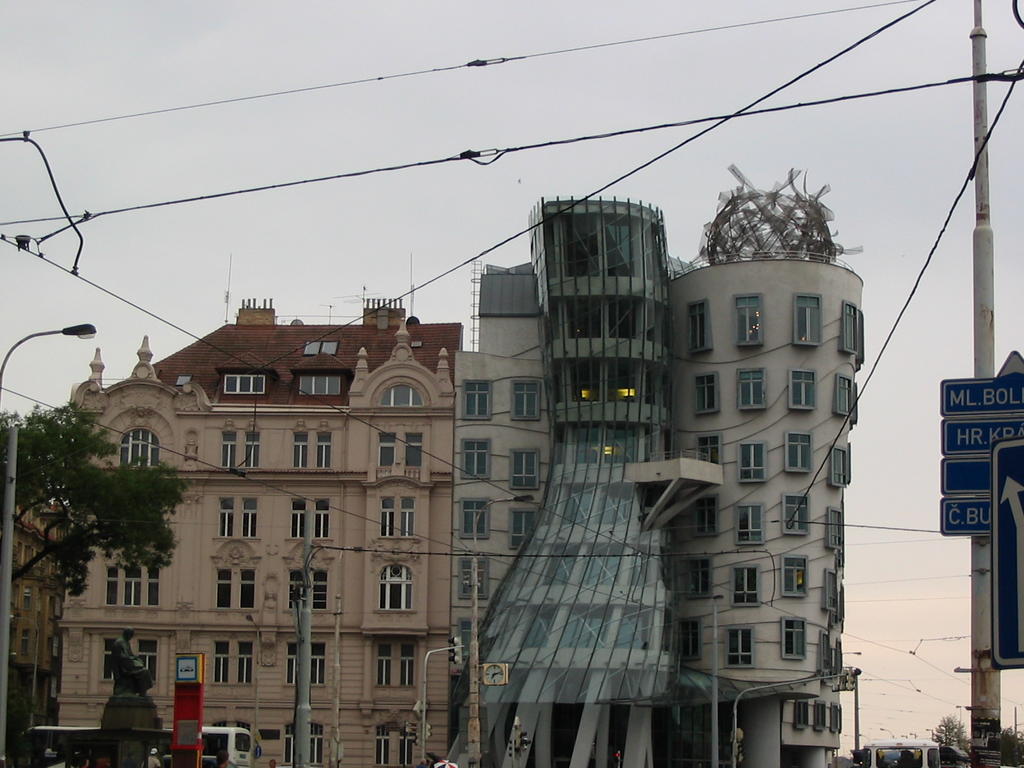
One of the more pleasant aspects of my trip to Prague was simply wandering around the city and looking at the fantastic architecture - medieval and modern. Near to where I was staying, by the Jirasek Bridge across the Vltava River, is a building called "Tancici Dom" in Czech - "Dancing House." It was built in the 1990s, and one of the architects was Frank Gehry. When I first saw the house I was astonished, and after that the building always made me smile.

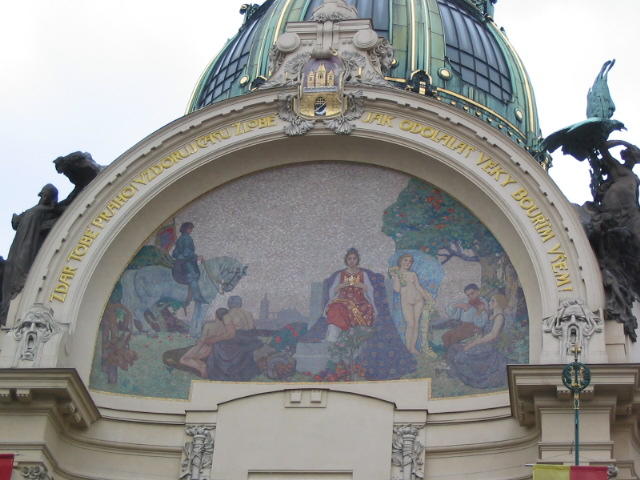
Another building was my favorite in Prague - the Obecni Dom (Municipal House), built in the early 20th century with much art nouveau decoration. This first photograph is of a mural just above the entrance to the building.

The second photo is of the balcony over the entrance. Notice the symbol of Prague in the center of the balcony.


The third photo is a detail in the stained glass of the entrance.

Thursday, July 28, 2005

Pulsa Denura

Having just arrived back from Prague, I checked my blog and discovered to my astonishment how many people have been reading it - apparently to learn about the pulsa denura that the latest group of extremists has pronounced against Israel Prime Minister Ariel Sharon.

According to Haaretz, "Twenty people took part in the ceremony, which was held last Thursday in the small northern town of Rosh Pina. The participants believe that Sharon will die in the coming 30 days, or else all those who took part in the ceremony would die." Rabbi Yosef Dayan was one of the organizers of this curse ceremony, as he was of the original curse against the late Prime Minister Yitzhak Rabin, who was killed in 1995.

I originally wrote about this when Dayan threatened to curse Sharon, in September of 2004.

Tuesday, July 26, 2005

Terezin

Yesterday I visited Terezin, the Czech town that was turned by the Nazis into a ghetto for the Jews of the Czech lands (Bohemia and Moravia), as well as Jews from other parts of Europe (in particular, elderly German Jews). The town was originally built in the late 18th century as a fortress, and had become an ordinary town where people live before being taken over by the Nazis. It is about 40 miles from Prague, and the tour was led by a survivor of Terezin and Auschwitz. We visited museums that have been constructed only since the fall of Communism in 1989 (apparently the Communist regime only memorialized the Communists who had been held prisoner there by the Gestapo, but not the Jews), as well as surviving parts of the ghetto - for example, the morgue and the crematorium, which was built by the prisoners. There were no gas chambers there - Terezin was not an extermination camp, but rather a transit ghetto. Most of the Jews who passed through there (about 150, 000) were eventually transported to death camps, especially Auschwitz. The horrible, crowded conditions (about 60,000 people living in a town fit for about 5,000), starvation, and epidemic illness killed about 35,000 in Terezin.

We saw, among other places, one of the barracks where the Jews lived - part of it has been turned into a museum about cultural life in the ghetto (visual arts, theatre, and music paradoxically thrived in the ghetto, due in part to the large number of artists and musicians imprisoned there). There was also one room that has been reconstructed to look like a barracks room - with three-level bunks, clothes hanging up, people's suitcases, pots and pans and other belongings (they were allowed to bring a suitcase of about 100 lbs. per person with everything they needed). One could see from this how crowded the living conditions must have been. The museum showed many drawings made by prisoners about life in the ghetto, including pictures of people being taken to transports to the extermination camps in Poland.

In addition to the ghetto, we also saw the Small Fortress, which was the Gestapo prison. Political prisoners were held there in terrible conditions - the Jewish prisoners in particular were crammed together into a small cell, and very few survived. It was a grim place. One entered through an archway with the typical Nazi slogan at the entrance to the concentration camps - "Arbeit macht frei" - "Work makes you free," which was, of course, completely not true in the camps.

One of the feelings I ended up with was just blank incomprehension. I felt like I came away with some sense of the what - what happened - and of the how - how the Nazis treated the Jews and other prisoners there, how the prisoners tried to organize themselves and survive - but with no better sense of the why. I can study Nazi anti-semitism and try to understand Nazi ideology, but even that doesn't give me the answer I'm seeking, which is how people are capable of such acts of cruelty. I feel kind of like one of my students, just not understanding.

Saturday, July 16, 2005

Blair speech on terror

Tony Blair made a very strong speech today denouncing terrorism which says "What we are confronting here is an evil ideology." It is very refreshing to see such an articulate explanation of what the "war on terror" is fighting - something which President Bush has never been able to explain sufficiently carefully to the American people.
They demand the elimination of Israel; the withdrawal of all Westerners from Muslim countries, irrespective of the wishes of people and government; the establishment of effectively Taleban states and Sharia law in the Arab world en route to one caliphate of all Muslim nations.

From the mid 1990s onwards, statements from Al-Qaeda, gave very clear expression to this ideology: "Every Muslim, the minute he can start differentiating, carries hatred towards the Americans, Jews and Christians. This is part of our ideology. The creation of Israel is a crime and it has to be erased.

"You should know that targeting Americans and Jews and killing them anywhere you find them on the earth is one of the greatest duties and one of the best acts of piety you can offer to God Almighty." Just as great is their hatred for so-called apostate governments in Muslim countries. This is why mainstream Muslims are also regarded as legitimate targets.

This is what we are up against. It cannot be beaten except by confronting it, symptoms and causes, head-on. Without compromise and without delusion.

The extremist propaganda is cleverly aimed at their target audience. It plays on our tolerance and good nature.

It exploits the tendency to guilt of the developed world, as if it is our behaviour that should change, that if we only tried to work out and act on their grievances, we could lift this evil, that if we changed our behaviour, they would change theirs. This is a misunderstanding of a catastrophic order.

Their cause is not founded on an injustice. It is founded on a belief, one whose fanaticism is such it can't be moderated. It can't be remedied. It has to be stood up to.

If it is the plight of the Palestinians that drives them, why, every time it looks as if Israel and Palestine are making progress, does the same ideology perpetrate an outrage that turns hope back into despair?

If it is Afghanistan that motivates them, why blow up innocent Afghans on their way to their first ever election? If it is Iraq that motivates them, why is the same ideology killing Iraqis by terror in defiance of an elected Iraqi government?

What was September 11, 2001 the reprisal for? Why even after the first Madrid bomb (in March 2004) and the election of a new Spanish government, were they planning another atrocity when caught?

Thursday, July 14, 2005

Apologists among us

This thought-provoking posting at Norman Geras' blog, Apologists among us, made me think about something that has often occurred to me after one terrorist outrage or another. My reaction, when I hear of a terrorist attack, in Israel, the United States, Britain, Russia, Iraq, etc., is usually first of all shock and sadness, and then anger and often a desire for revenge against the terrorists (not that I'm advocating revenge, but it is one of my first feelings - I would advocate cool analysis, investigation, and measures to find the attackers and defend the vulnerable, instead). I feel helpless. I can't understand why people would do such a thing, especially to innocent civilians (the attack in Baghdad yesterday that killed many children was particularly appalling). I am interested in having a political understanding of how such things occur, but I don't view this as an explanation or excuse for why people commit such atrocities.

A month or so after September 11, I went to NYC to visit friends, and made a trip to the World Trade Center site. I couldn't see much, because of the fence around the whole site, but between the slats I could see the pile and the skeleton left of part of the buildings, a couple of stories high. I also saw another building that wasn't destroyed but had obviously been hit by falling debris and a huge gash in it (I think this was the Deutsche Bank building). It wasn't as horrible a sight as it would have been earlier, but it was still stunning. As I looked at it I was trying to figure out why people would do this - how they could possibly bring themselves to do this - and I had no answer. I took the train back uptown still baffled and shaken.

It didn't occur to me right after the attacks, or at any point thereafter, what the U.S. had done to "deserve this." I thought it was completely undeserved, as I think is true for every terrorist attack. It made me angry that people had attacked our country this way.

For this reason, I'm baffled why people react to terrorist attacks by searching for "root causes," as Norman says. It seems to be part of the whole ethos of blaming the victim, even if the victims include oneself. I think it's important to understand the political framework for these attacks, but that framework includes a lot more than the usual suspects - all the purportedly evil things the U.S. (or Britain) has done in the Middle East.

And I'm even more baffled when people's reaction is that since the attack was caused, for example, by Britain's participation in the Iraq War, that this means that Britain should pull out of Iraq. Isn't that simply giving in to the enemy, declaring defeat? Is the correct answer to an attack surrender, or preparing better defenses and going after the attackers? Even if one opposed Britain's participation in the Iraq war, isn't it simply giving in to terrorists to do what (you think) they want? And why would someone who opposed the war want to give in to terrorists, whom I hope he or she also opposes?

Global Attitudes

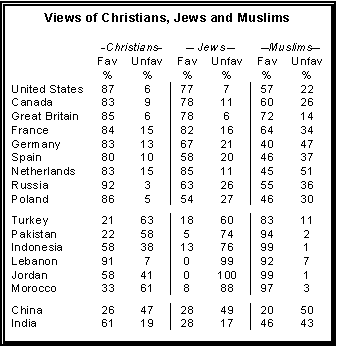
Andrew Sullivan sees positive trends in the Pew Global Attitudes Project, which reports lowered support for terrorism (specifically, suicide bombings) in six selected Muslim countries. The six countries surveyed were Jordan, Lebanon, Pakistan, Indonesia, Turkey, and Morocco. If we break it down to individual countries, however, I am not as sanguine as Andrew. Those surveyed were asked if violence against civilian targets is justified. In Jordan, 57% said it was often/sometimes justified, which is an increase from the last Pew survey, in summer 2002, when it was 43%. Perhaps this has something to do with the Palestinian intifada, since a majority of the Jordanian population is Palestinian in ethnic origin. This summer, 11% in Jordan said it was never justified, as opposed to 26% in summer 2002 - so the attitudes have worsened there. There has been a decrease in support for terrorism in the other countries, specifically Lebanon (from a height of 73% to a low now of 39%) - presumably affected by disapproval at the assassination of former Prime Minister Hariri. Support in Morocco went down from 40% to 13%. Majorities in Morocco, Pakistan, and Turkey saw Islamic extremism as a threat to their countries.

The most depressing statistics were from the questions about how people viewed those of other religious groups, specifically Jews. See the table below.


You'll notice that in all non-Muslim countries a majority has a favorable view of Jews - ranging from a low of 54% in Russia to a high of 85% in the Netherlands. If we look at the Muslim countries, opinions are uniformly negative, ranging from a high of 18% in Turkey having a favorable view of Jews to a low of 0% in Lebanon and Jordan. Even Turkey and Morocco, which have pretty good diplomatic relations with Israel, have a preponderance of negative views of Jews. I would guess that these negative opinions have been formed both by the Arab-Israeli conflict and by the spread of vile anti-semitic slanders in Muslim countries. Opinions about Christians in Muslim countries are mixed - 91% in Lebanon have a favorable view of Christians, and views are positive in Indonesia and Jordan (58% favorable). In Turkey, Pakistan, and Morocco lopsided majorities disapprove of Christians.

Views of Muslims in non-Muslim countries are much more positive, in contrast - the lowest favorable percentages are 40% in Germany, 45% in the Netherlands, 46% in Spain and Poland. In the U.S., 57% have a favorable view, 22% an unfavorable one. Thus, even after September 11, 2001, most Americans do not harbor anti-Muslim attitudes, showing that there is a reservoir of goodwill in this country.

Wednesday, July 13, 2005

Al Qaeda since 1998

At Winds of Change they have a produced a flash movie of the Al Qaeda attacks since 1998.

As the author says, “The purpose of the presentation is to graphically demonstrate al Qaeda’s ability to conduct mass casualty assaults on a global scale. This presentation by no means documents every single al Qaeda attack. For example, the murders of journalist Daniel Pearl in Pakistan and USAID executive Lawrence Foley in Jordan were excluded, as have smaller impact suicide attacks and beheadings by al Qaeda in Iraq and elsewhere. Al Qaeda's butchery in Iraq can fill a presentation of its own. Also, planned or foiled chemical attacks against Jordan, France and England, the assassination attempts on President Musharraf of Pakistan and numerous other incidents throughout the world have not been documented.

The facts presented speak for themselves.

There have been 30 major mass casualty attacks directed against the United States, Britain, France, Spain, Pakistan, Kenya, Tanzania, India, Iraq, Morocco, Yemen, Tunisia, Indonesia, Saudi Arabia, Turkey and North Osetia. 14 of the 30 attacks were conducted prior to the invasion of Iraq, making claims of the occupation of Iraq as a casus belli for al Qaeda’s terrorism to be disingenuous at best. 4,895 people have been killed in these attacks, and 12,345 plus have been wounded. The majority of the countries attacked are Muslim countries. And although not stated, the vast majority of the victims of al Qaeda's violence are Muslims.

The ideologues, leaders and foot soldiers of al Qaeda have no reservations about slaughtering the innocent. The majority of their attacks have been directed against civilian infrastructure such as embassies, consulates, shipping, transportation, hotels, resorts, nightclubs, bars, synagogues, churches, temples, mosques, markets, housing complexes, office buildings and schools. Each of al Qaeda's targets were purposefully selected and carefully timed to inflict mass casualties as well as to provide the maximum media exposure. The radical Islamists embrace Muslim casualties, as many are considered infidel for embracing Western culture and rejecting the “pure” Islam espoused by al Qaeda. This is an enemy that deserves no quarter.

Monday, July 11, 2005

First London Bomb Victims Named

The First London Bomb Victims Named today.
Susan Levy, 53, a mother-of-two from Hertfordshire, north of London, was named by police while University College London (UCL) said its employee Gladys Wundowa had also been killed.

Levy was on the Piccadilly line train that was hit between Russell Square and Kings Cross last Thursday. She had traveled to central London with her son James, 23, but they parted at Finsbury Park.

"We are all devastated by our loss,'' her husband Harry said in a statement. "She was a valued and respected member of her extended Jewish family and will be deeply mourned and sadly missed by us and her many friends. We are all distraught at her needless loss and our thoughts and prayers are also with the many other families affected by this horrendous tragedy.''

Wundowa, a cleaner at UCL, was killed in the bus explosion at Tavistock Square.
And in the meantime, while people in London are mourning the dead, still searching for bodies, and doing their best to go forward leading normal lives, my local newspaper has printed its first letter blaming President Bush for the bombings....
There was no mercy here, no compassion, just bloodlust and desire to reciprocate the deaths and injuries that England has helped the United States to commit in Iraq and Afghanistan. Between Bush's puerile, gung-ho cowboy rhetoric and Blair's sidekick acquiescence, thousands of innocent people have died, including U.S. soldiers whose better natures and love of their country caused them to enlist and protect because their leaders fed them lie after lie. Iraqi civilians watch their families being destroyed, see their homeland occupied and looted, and all without evident hope that reason and justice will prevail to protect those who deserve none of the violence, the everyday citizens of the world.
The letter writer is avoiding the inconvenient fact that the September 11 attacks occurred before the U.S. invaded Afghanistan and Iraq. I don't quite see how those attacks could be blamed on our subsequent actions.

This letter fails completely to come to grips with the Islamist ideology that governs the actions of Al Qaeda and its cohorts - an ideology well articulated long before Sept. 11. Everything is blamed on the U.S. - would the writer even hold the bombers truly responsible for their own actions?

I was visiting my family when the London attacks occurred, and thus was buoyed up by the feeling that the world is a sane place, that decent people denounce terrorist attacks. Now that I've returned to Ithaca, I have the sinking feeling that I'm just going to have to listen to more of this rhetoric and once again try to decide whether to confront it (and get into arguments with people) or just let it pass in order not to say something I'd regret.

islamicate: London, G8, and the Bombings

I have finally taken a look at the Islamicate blog; the author, "Islamoyankee," has a very moving post about Al Qaeda and the London bombings. He says, "Understand, Al-Qaeda is not only about hatred; they are not only about denying and destroying the Islamic spirit; they are about destroying hope; about destroying the future. Their only concern is themselves. Not God's message. Not their interpretation of God's message. They have to be the center of everyone's attention. Like spoiled brats they make noise to get noticed, but there's no meaning to the noise. There's no way to make it stop."

Sunday, July 10, 2005

Islam & Terrorism roundup

An excellent article by Salman Rushdie on India and Pakistan's Code of Dishonor. "The 'culture' of rape that exists in India and Pakistan arises from profound social anomalies, its origins lying in the unchanging harshness of a moral code based on the concepts of honor and shame. Thanks to that code's ruthlessness, raped women will go on hanging themselves in the woods and walking into rivers to drown themselves. It will take generations to change that."

And also in today's New York Times, For a Decade, London Thrived as a Busy Crossroads of Terror. Read this article if you subscribe to the puerile excuse that the attacks in London last week were because Britain has supported the U.S. in the war in Iraq.
Long before bombings ripped through London on Thursday, Britain had become a breeding ground for hate, fed by a militant version of Islam.

For two years, extremists like Sheik Omar Bakri Mohammed, a 47-year-old Syrian-born cleric, have played to ever-larger crowds, calling for holy war against Britain and exhorting young Muslim men to join the insurgency in Iraq. In a newspaper interview in April 2004, he warned that "a very well-organized" London-based group, Al Qaeda Europe, was "on the verge of launching a big operation" here. In a sermon attended by more than 500 people in a central London meeting hall last December, Sheik Omar vowed that if Western governments did not change their policies, Muslims would give them "a 9/11, day after day after day."

If London became a magnet for fiery preachers, it also became a destination for men willing to carry out their threats. For a decade, the city has been a crossroads for would-be terrorists who used it as a home base, where they could raise money, recruit members and draw inspiration from the militant messages. Among them were terrorists involved in attacks in Madrid, Casablanca, Saudi Arabia, Israel and in the Sept. 11 plot. Zacarias Moussaoui, the only man charged in the United States in the 9/11 attacks, and Richard C. Reid, the convicted shoe-bomber, both prayed at the Finsbury Park mosque in north London. The mosque's former leader, Abu Hamza al-Masri openly preached violence for years before the authorities arrested him in April 2004.

...Well before Thursday's bombings, British officials predicted a terrorist attack in their country. In a speech in October 2003, Eliza Manningham-Buller, the director general of MI5, Britain's domestic intelligence agency, said she saw "no prospect of a significant reduction in the threat posed to the U.K. and its interests from Islamist terrorism over the next five years, and I fear for a considerable number of years thereafter."

Britain's challenge to detect militants on its soil is particularly difficult. Counterterrorism officials estimate that 10,000 to 15,000 Muslims living in Britain are supporters of Al Qaeda. Among that number, officials believe that as many as 600 men were trained in camps connected with Al Qaeda in Afghanistan and elsewhere.

...Even last week's bombings did little to curtail the rhetoric of some of the most radical leaders, who criticized Prime Minister Tony Blair for saying that the bombings appeared to be the work of Islamic terrorists. "This shows me that he is an enemy of Islam," Abu Abdullah, a self-appointed preacher and the spokesman for the radical group Supporters of Shariah, said in an interview on Friday, adding, "Sometimes when you see how people speak, it shows you who your enemies are."

Mr. Abdullah declared that those British citizens who re-elected Mr. Blair "have blood on their hands" because British soldiers are killing Muslims. He also said that the British government, not Muslims, "have their hands" in the bombings, explaining, "They want to go on with their fight against Islam."

Imran Waheed, a spokesman for a radical British-based group, Hizb ut Tahrir, which is allowed to function here but is banned in Germany and much of the Muslim world, said: "When Westerners get killed, the world cries. But if Muslims get killed in Iraq or Afghanistan, it's the smallest of news. I will condemn what happened in London only after there is the promise from Western leaders to condemn what they have done in Falluja and other parts of Iraq and in Afghanistan."

So far, there appears to be little effort to restrain outspoken clerics, including prominent extremists like Sheik Omar, who has reportedly been under investigation by Scotland Yard. Sheik Omar, who remains free, is an example of the double-edged policies in Britain. He is a political refugee who was given asylum 19 years ago and is supported by public assistance. Asked in an interview in May how he felt about being barred from obtaining British citizenship, he replied, "I don't want to become a citizen of hell."

It's nice to see the Times not pulling any punches in today's article, because in article in yesterday's Times on Muslims in England, they presented Imran Waheed as an example of a moderate Muslim outraged by people slurring all Muslims as terrorists! See this outrageous article.
But the frustration of the community is growing as evidence mounts that Muslim immigrant citizens or the children of immigrants in Europe are increasingly populating the rank and file of terrorist organizations. Of 140 people implicated in European terrorist activities since 1993, 24 percent were European nationals, according to a study by Robert S. Leiken and Steven Brooke at Washington's Nixon Center, an independent think tank.

And whose fault is it that Muslim immigrants or their children are increasingly counted among the terrorists? Seems to me that Muslims should be frustrated at themselves, not at others!

These next paragraphs, however, are the most outrageous, picking supporters of Islamist terror and quoting them as moderate Muslims!
For many Muslims here, condemning terrorism does not mean condoning American or British policies. "It is correct to say Islam forbids the killing of civilians, but we need to have a larger discussion about why these actions happened," said Imran Waheed, spokesman for the British branch of Hizb ut-Tahrir, a global Islamist party working for the return of an Islamic caliphate, whose activists handed out leaflets outside the Finsbury Park mosque as people left Friday Prayer. "What we want is equity or parity between the life of a Briton in the suburbs of London and a farmer in Iraq," he said.

Opposition to Britain's role in Iraq has turned the area's Muslim community away from the governing Labor Party and toward the upstart Respect Party of George Galloway, who issued a statement Thursday saying that his party had warned that the war in Afghanistan and Iraq would increase the threat of terrorist attack in Britain.

Massoud Shadjareh, chairman of Britain's Islamic Human Rights Commission, argued that injustice lends legitimacy to extremist discourse. "There needs to be a separation between those who are committing those atrocities and those who are passionate about injustice," he said, adding that dismissing extremists outright only isolates them and makes them more likely to turn to violence. "We need to encourage that passion and give them avenues within the civil society to deal with injustices."

This is another excuse for terrorists. Their "passion" needs to be encouraged and given avenues within civil society! How, exactly? Making all women wear burkas? Like instituting the laws about rape cited in Salman Rushdie's op-ed piece? Like opposing the existence of the state of Israel?
"We have far greater experience as victims of terror than as perpetrators of terror," said Mr. Waheed of Hizb ut-Tahrir, saying that the community's reaction to the killing of Muslims in Afghanistan and the Middle East has been "remarkably restrained..."People need to understand the feeling on the Muslim street," he said. "People hate the foreign policy of Britain and the United States, and the West needs to consider whether constant interference in the Muslim world is productive."

What were the editors of the Times thinking when they allowed this piece of biased, slanted, and simply wrong journalism to be printed in the newspaper? It seems to me that they were letting the political biases of this particular reporter, Craig Smith, get in the way of some honest reporting about the support for Islamic terrorism among Muslims in Britain. While I am not usually one to attack the Times for its political stance, in this case I think it has made an egregious mistake.

This article, however, does give me some hope: Longtime Haven for Arabs Now Must Ask: Why Us?. One of the bombs in London went off in a predominantly Arab neighborhood.
"We have to be honest and realistic with ourselves," said Laith Abdel Fattah, a part owner of Panini Cafe, tucked on a side street a block from the bombed train station. "We are living in an age that is simply unnatural. Is there anywhere in Islam that says you have to kill? Nowhere does it say you can take away somebody's right to live. And yet they do this in the name of Islam." Like many here, Mr. Abdel Fattah said he was indignant that the bombing could possibly be done in the name of his faith and his community. Out of a sense of duty, he said, he approached the police on Friday and offered any help they required.

"I wanted to show them that we too believe that what happened was unacceptable," he said. "There are only two directions we can take now. Either we wait and see what's coming, and that can only be bad, or we have to speak out and say unequivocally this is unacceptable. We need to show people what the right example is."

At the Rafidain Real Estate Agency on Edgware Road, Abu Ahmad al-Sharif sat with his nephew and a friend, pondering the bombings. Mr. Sharif, an immigrant from Iraq, was riding a bus as the Edgware Road bomb went off a few blocks away from him. The bus service was halted and he walked to work, leading him past the carnage at the Edgware Road station, where he grasped the gravity of the incident. He realized his son had taken one of the routes to work and broke into tears, then grew furious.

"In my homeland, Iraq, terrorism is no longer a surprise," Mr. Sharif said. "But I never imagined it could happen in a place like this. This place always seemed so far from terrorism," he said, noting the safe harbor England has given many Iraqis. "I blame the fathers, the mothers and the schools of these people who let them get to this point," he said. "It is our duty to find these groups because they are like a cancer and will only continue to grow unless we cut it from its roots." "Someone has to show them the boundary," said Sabah al-Hamdani, who had been listening intently. "We need to stand in their way."

Friday, July 08, 2005

Visiting Prague

Just a quick posting, because I'm paying by the minute.... I arrived in Prague last Monday, and will be visiting here until next Thursday. I spent the first few days visiting an academic study abroad program that we have sent students to - it seems very well-organized and intellectually rooted, and I will be happily recommending it to more students. Along with that I've been a tourist in Prague, and as I'm sure almost everyone says who visits here, it's a beautiful city - lots of art nouveau buildings from the early 20th century mixed in with medieval architecture. I visited Josefov, the Jewish quarter, my first full day here - I saw the synagogues, including the Old-New synagogue, which dates from the 13th century. Yesterday and today I went to the Prague Castle complex and have still seen only a part of it - lots of beautiful buildings and art still to be seen in the days ahead. Tomorrow I'm going on a tour to Terezin - the town the Nazis turned into a concentration camp, which became the way-station to Auschwitz. I'll post more about my trip probably when I return to the states and have more time (and I'm not writing in an internet cafe!).

It was shocking to hear about the attempted bombings in London yesterday and the horrible bombings in Sharm el Sheik today. It still feels distant from Prague, which seems like a very safe city (at least in the touristy sections), but it puts me a bit on edge.

Terrorist attacks in London

Tom Friedman in tomorrow's New York Times is correct when he says: "Yesterday's bombings in downtown London are profoundly disturbing. In part, that is because a bombing in our mother country and closest ally, England, is almost like a bombing in our own country." I have to admit this is also how I feel - although more people were killed in the Madrid bombings on 3/11/04, the bombings in London have upset me more deeply. I've visited London, some of my ancestors come from England (others passed through on their way to the U.S.), and the British were the bulwark against Nazism when no one else was. Somehow, this hits closer to home.

He continues by arguing that this attack in London could lead Western countries to a crackdown not just on Muslim terrorists, but on all Muslims.
And because I think that would be a disaster, it is essential that the Muslim world wake up to the fact that it has a jihadist death cult in its midst. If it does not fight that death cult, that cancer, within its own body politic, it is going to infect Muslim-Western relations everywhere. Only the Muslim world can root out that death cult. It takes a village.

What do I mean? I mean that the greatest restraint on human behavior is never a policeman or a border guard. The greatest restraint on human behavior is what a culture and a religion deem shameful. It is what the village and its religious and political elders say is wrong or not allowed. Many people said Palestinian suicide bombing was the spontaneous reaction of frustrated Palestinian youth. But when Palestinians decided that it was in their interest to have a cease-fire with Israel, those bombings stopped cold. The village said enough was enough.

The Muslim village has been derelict in condemning the madness of jihadist attacks. When Salman Rushdie wrote a controversial novel involving the prophet Muhammad, he was sentenced to death by the leader of Iran. To this day - to this day - no major Muslim cleric or religious body has ever issued a fatwa condemning Osama bin Laden.

Some Muslim leaders have taken up this challenge. This past week in Jordan, King Abdullah II hosted an impressive conference in Amman for moderate Muslim thinkers and clerics who want to take back their faith from those who have tried to hijack it. But this has to go further and wider.

The double-decker buses of London and the subways of Paris, as well as the covered markets of Riyadh, Bali and Cairo, will never be secure as long as the Muslim village and elders do not take on, delegitimize, condemn and isolate the extremists in their midst.

There are Muslims who condemn terrorism in their name and who call for free and equal Muslim societies. The Bahraini blogger Mahmood al-Yousif says, "The way to beat them is not to give in to them, and more democracy and democratic institutions, a complete overhaul of the education system in the Arab and Muslim worlds and the full separation of Mosque and State. The time is now. We have to get this done. Otherwise we will be completely left behind and will suffer much more at the hands of these terrorists. My heart and thoughts go to the people of the United Kingdom in this very difficult time."

I second his feelingsl and hope that this will be the last terrorist attack inflicted by al-Qaeda and its cohorts.

Tuesday, July 05, 2005

Protest vigil in Jerusalem

According to this report in Haaretz, about 350 people showed up tonight for the protest vigil against the stabbing at the Jerusalem gay pride rally.
Tuesday's demonstration was an expression of solidarity with the three marchers stabbed last Thursday at Jerusalem's gay pride parade. The slogan of the demonstration was "They tried to kill me because I am gay."

Approximately 350 demonstrators gathered Tuesday on King George Street in the capital across from the spot in which Schlisel stormed the parade. Demonstrators waved signs ("Jerusalem was destroyed by hatred" and "love thy enemies") and called for an end to homophobia, addressing Jerusalem's mayor Uri Lupolianski directly.

Chair of the Jerusalem Open House and organizer of the event Noa Sattath said, "There is a direct connection between the incitement that originated with the mayor and the stabbing... I don't understand how the mayor sleeps at night."

More violence against gay people in Jerusalem

As reported in today's Jerusalem Post, Violent anti-gay protests continue in Jerusalem.
A 30-year-old haredi man who was seen approaching an event organized by Jerusalem's gay and lesbian community in the city center Tuesday night was detained for questioning after police found a knife in his possession, police said. The suspect told police that he came to the event to "read the placards" and that he uses the knife "to peel fruit", Jerusalem Police Spokesman Shmuel ben Ruby said.

Simultaneously, several thousand haredi protesters pelted three city busses with stones Tuesday evening at a central Jerusalem thoroughfare in a continuation of the protest over last week's gay pride parade in the city, police said. One police officer was struck in the head by a rock, and was treated for injuries at Sha'are Zedek Hospital. Three Egged busses were also badly damaged, ben-Ruby said. Police dispersed the rioters, who had congregated at Kikar Shabat in the heart of Jerusalem's haredi neighborhoods.

I would guess that the event referred to was the protest vigil I mentioned earlier.

One wonders why the haredi rioters pelted city buses with stones - were their drivers or riders guilty of anything in particular, or were they just handy, in the way? And one also wonders if there will be any protests by the religious "leadership" in Israel against these acts of violence?

Daf Yomi

There seems to be a new phenomenon of people blogging on the Daf Yomi. I found this blog, Daf Am Haaretz, written by Neil Litt, former chair of the National Havurah Committee. And Kaspit frequently blogs on the Daf Yomi, especially as it relates to environmental issues. Reclaiming the Daf is a group blog on the Daf, which includes Kaspit.

Gay pride parade assailant charged with attempted murder

The man who stabbed three people at the Jerusalem gay pride march has been charged with three counts of attempted murder.
The man, Yishai Schlisel, an Orthodox Jew from Upper Modi'in, was quoted by state prosecutors as telling police officers who interrogated him that he "came to kill in the name of God." According to the indictment filed against Shlisel, the defendant carefully planned his actions, purchased the knife ahead of time, hid it in his waistcoat and then ambushed the marchers along the parade's route.
The Jerusalem Open House sent out an e-mail yesterday giving more details about the protest vigil, which is to occur tonight at 7 p.m., Jerusalem time.

Web Roundup

I just read a beautiful post on Mishkaneer - Beyond the Old Zionism, about what it really means to be a "New Jew."

Jen Taylor Friedman is a soferet (female scribe), whose website I found from Netivat Sofrut. Jen Friedman writes megillot Esther (the scroll of Esther), as well as other documents.

Mordechai Pinchas, a sofer, writes about his writing of a newly composed scroll, the Megillat ha-Shoah. This Megillah was composed by Professor Avigdor Shinan, working on behalf of the Conservative movement in Israel. These are the contents:
The scroll contains six chapters that include a testimony from a survivor whose job in a death camp was to dispose of bodies while removing the victims' gold teeth, including those of his dead brother; an eyewitness account of life in the Warsaw Ghetto; and an eulogy for those who perished. Its final chapter also commemorates the survivors, including those who went on to build the State of Israel.

Velveteen Rabbi is discussing the numbering of the Ten Commandments and how they differ between Jews and Christians. She says:
But disenfranchisement of those who don't share this text, or the government's chosen version of the text, is only one problem. Another problem -- at least, for me as a Jew -- is the implication that these verses supercede the rest of the Torah. Jews don't generally call this bit of text the "Ten Commandments," because we don't want to imply that they're the Big Ten and all the other ones don't matter as much. (In Torah they're called aseret ha'dvarim/ten sayings, and from Rabbinic days onward we've used the name aseret ha-dibrot/ten utterances). We place our focus on the whole path of righteous behavior, and consider it inappropriate to elevate these ten statements above the other 603 mitzvot that Torah offers. So while it's true that I'm a member of a faith-community for whom (some versions of) these words have relevance, I wouldn't be comfortable seeing them displayed in public spaces even in the original lengthy Hebrew version.

And here's a good online article about Jewish blogs, written by Sarah Bronson.

Monday, July 04, 2005

Yishai Schlissel Stabs 3 at Jerusalem Gay Pride March in 2005

The gay pride parade in Jerusalem last Thursday night was disrupted when a protester stabbed 3 marchers.
The stabbing attack was the most serious in a series of incidents involving opponents of the gay and lesbian gathering. Police said that some 200 religious protesters gathered at the parade's starting point, the downtown offices of the Jerusalem Open House, the gay and lesbian community center that organized the fourth annual parade.

Protesters tried to stop the march by throwing a stink bomb, but some 2,000 participants marched on through the center of Jerusalem regardless, braving shouts and insults from protesters, most of them young ultra-Orthodox men.

"Homo sex is immoral," read one protester's sign. As the parade neared a main intersection, the attacker jumped into the first group of marchers and stabbed a man. Blood from the victim's chest seeped through his shirt as he sat, dazed, at the side of the road before an ambulance came to take him to a hospital, where he was said to be in serious condition.
The organized protest, I am sure, came about because of the determined opposition of the ultra-Orthodox leadership to this parade - including Mayor Lupolianski's trying to ban it (the ban was overturned by the court). It's hard to imagine that the stabbing was unrelated to the extreme rhetoric used by the ultra-Orthodox and to the general atmosphere of violent protest against the disengagement from Gaza.

In my experience of demonstrations in Israel, I never saw a weapon used against demonstrators (I mostly went to demonstrations against the Israeli occupation), but I was tear-gassed four times (by the police), and many times experienced horrible curses being directed against us by right-wing passersby. One in particular sticks in my mind - when participating in the weekly "Women in Black" anti-occupation demonstration in Paris Sq. in Jerusalem (this would have been in the late 1980s, during the first intifada), we were cursed by someone wishing that Hitler had killed us too. And this was a curse uttered by a Jew against fellow Jews! I also remember going to prayers organized by the Women of the Wall for Ta'anit Esther in 1989, when we were met by a determined band of about 50 ultra-Orthodox men yelling at us and threatening us. The police fired a tear-gas canister at them, and one man picked the canister up and threw it at us in the women's section of the Kotel. We all had to leave, since it was impossible to breathe.

According to the weekly e-mail that I receive from the Open House in Jerusalem (the Jerusalem gay and lesbian center), they are planning a protest vigil against the stabbing, at the same place where it occurred (on King George St.). I'm not sure when the vigil is planned for, since a date isn't given. The notice reads: "A community demonstration to protest the incitement, violence, and the stabbings that occurred at the Pride March on Thursday." It says that it will be guarded by the police. "It is important for us to emphasize the connection between incitement and violence, and to protest in a dignified way against hatred." They were also planning for buses to bring people from Tel Aviv to participate in the protest vigil. I looked at the Jerusalem Post and Haaretz web sites, but didn't see anything about this protest vigil, so I don't if it occurred already.

For more information, see also: Gay Stabbing Victim Blames Negative Publicity, Court extends remand of suspect in Gay Pride stabbing. To see some pictures, see Gay Pride Marchers Attacked in Israel, but ignore the anti-Zionist ravings in the comments. For an example of incitement see this story from Arutz Sheva: MK Yishai: Gay Parade is a Contamination. Yishai is the chairman of the Shas party, the Sephardi ultra-Orthodox party.

Tuesday, June 28, 2005

Sometimes people ask me if Jews still use amulets. I tell them that I've seen preprinted amulets that can be bought at Jewish book stores (I have a few in my office). But this is an example of a contemporary soferet (scribe) writing an amulet based upon the classic form of an amulet taken from Sefer Raziel, an early 18th century anthology of mystical and magical texts. Aviel Barclay-Rothschild, "the only living certified Soferet (female Jewish ritual scribe)," says about the amulet:
The top text is a series of angel names, invoked for the safety & health of the mother & child. The middle is an illustrated focal point, representing the 3 angels who have power over Lilith as birds on one hand, mysterious shapes on the other. Adam & Eve are banishing Lilith from the birthspace. The bottom text is a blessing for the mother, here referred to as "Plonit bat Plonit", or "What's-her-name daughter of What's-her-name". This space can be personalised. I sold the original work to a female obstetrician/gynecologist in St Louis, MO.

She also has an example of another amulet she has made, this time a birth-protection amulet