Monday, July 02, 2007

The return of "the concept"

I recently read Abraham Rabinovich's book on the Yom Kippur War and the most interesting thing about the book is how he explains why the war was such a surprise to Israel. It had to do with "the concept" that the Arab states did not have the military capability to attack Israel. This concept held even when Israel received a warning just before the war began from "the Source" - an Egyptian spy very close to the Egyptian president Nasser. Zvi Zamir, who was then the head of the Mossad, flew to Europe to meet with him the day before Yom Kippur. According to Rabinovich (p. 83), "The Source's message was blunt. Egypt would attack tomorrow before dawn."

Update - the spy's name was revealed to be Dr. Ashraf Marwan. Zvi Zamir accused Eli Zeira, who was head of Military Intelligence before and during the war, of revealing Marwan's name. Zeira then sued Zamir for libel, but the court decided that Zeira did indeed reveal the spy's name. What is truly peculiar is that Marwan just died in a fall from the balcony of his house in London. Zamir is now charging that "reports in Israel about Dr. Ashraf Marwan, Israel's Egyptian agent who warned of the pending outbreak of the Yom Kippur War, led to his death. 'I have no doubt that reports published about him in Israel caused his death,' Zamir told Haaretz yesterday, in response to Marwan's mysterious death in London on Wednesday. Zamir, who questioned Marwan during a secret meeting held in London on the Friday on the eve of the 1973 war, said he had no idea whether the Egyptian had committed suicide or had been assassinated."

In an article in today's Haaretz, Uri Bar-Yosef warns about The return of 'the concept'. He writes:
The possibility of initiating a diplomatic process with Syria passed before our eyes almost without notice. The president of the United States publicly declared his disinterest in participating in such a move, Israel's prime minister has more urgent matters, and Syrian President Bashar Assad, as we know full well, has no real military option against Israel. Therefore Syrian threats to pursue the military option if the path of negotiations is closed off evoke little fear on Israel's part.

This indifference is a mistake. History teaches that on at least three occasions we believed our adversary did not have a military option, and Israel could do what it pleased. On each occasion, we were proved wrong. For each mistake, we paid a high price. Those who are in charge of the country's security would be well-advised to take this into account and avoid the need to learn this lesson a fourth time.

The three examples he gives are the Six Day War, the War of Attrition, and the Yom Kippur War. In all three cases, the Israeli leadership was convinced that the Arabs had no military option, and it was wrong three times.

Bar-Yosef says, "The situation today is not very different. The IDF is stronger than the Syrian army, but that does not mean Syria does not have the ability to hurt Israel or that if it had no choice, Syria would not exercise this ability despite the risks. The military logic dominating Israel's strategic thinking tends to downplay the weight of political considerations pushing Syria into turning to the use of force. If it does turn in that direction, and if Israel pays a high price for it, in a few more years we can sit and cry once more over the error of neglecting the diplomatic route because of the adversary's lack of military options and over the heavy price we have paid."

Saturday, June 30, 2007

Israel updates

A few scattered items.

1) Scary stuff about Syria from Haaretz

Syria is producing more rockets and preparing its army for possible armed conflict with Israel, but is unlikely to initiate an attack, head of the Defense Ministry's political-security department, Amos Gilad, told Israel Radio Saturday. Gilad said Syria is increasing its army's preparedness for violent conflict, such as possible Israeli retaliation to Syria's support for militant anti-Israeli groups, but that it is unlikely Syria would initiate an attack against Israel. Gilad also said Syria is equipping the military with more anti-tank missiles and anti-aircraft missiles and producing more rockets. Noting that Israel has been in the range of Syrian rockets for years, he said: "Any disaster would stem from the fact that the attitude in Damascus is much more violent, and that they (the Syrian leaders) have become enamored with the violent option".


2) Protests over the Katzav plea bargain: Haaretz and the Jerusalem Post both say that about 20,000 people showed up in Rabin Square tonight to protest. (And this was on about 24 hours notice - pretty impressive showing).

In what was a palpable atmosphere of outrage and combative determination, some 20,000 people piled into Kikar Rabin on Saturday night to protest the plea bargain reached Thursday between the state and President Moshe Katsav.

Chanting "We will not accept this," and "We will not give up," the protestors cheered as speaker after speaker, mostly media personalities associated with women's rights, as well as several left-wing MKs, spoke about the "injustice" caused to the complainants in the Katsav sexual abuse case, after Attorney-General Menahem Mazuz dropped rape charges against the president. The women's rights groups said they planned to file a petition on Sunday with the High Court of Justice to have the plea bargain annulled. There were no right-wing or religious Knesset members in attendance.

Women's groups, along with the Association of Rape Crisis Centers, called for justice and equality, and expressed anger at the dramatic development. Such was the surprise at the amount of people in attendance, that several women's groups vied to get their spokespeople on the stage to address the crowd, with at least one group not able to enter a speaker onto the roster. The turnout for the event was unexpectedly large, said Miriam Shler, one of the organizers of the rally.


3) Yehuda Poliker concert. At the same time as the rally in Tel Aviv I went with a friend to a wonderful concert of Yehuda Poliker, whom I had not heard before, at an event sponsored by the Association for Civil Rights in Israel, at the Hechal ha-Tarbut in Tel Aviv. It was great, full of energy, towards the end everyone was on their feet dancing. He sings in Greek and Hebrew. His parents were Holocaust survivors from Salonika, Greece, who went to Israel after the war. (He made a movie that came out in 1988, "Because of that war," about being the child of survivors - which I must now see, because I want to know more about him and also because his music appears in the movie too).

Friday, June 29, 2007

Michael Totten has put up a couple of posts on the subject of whether another war is imminent this summer between Israel and a variety of enemies - Syria, Iran, Hizbullah, Hamas, or Al Qaida. He's relying on an intelligence estimate by Amos Yadlin, the head of Military Intelligence. As an update to the latest post, he includes this:
UPDATE: A reader emails: My daughter just came from spending five months at Ben Gurion University in Beer-Sheva. She had a wonderful time studying, hiking, camping, student demonstrations, working in soup kitchens, skiing up north, petra...etc. She came home two weeks ago and just matter of factly stated that "everyone knows there is a war coming."

That is pretty much how the "Israeli street" feels right now according to just about everything I've heard and read lately.

An article in Haaretz on June 6 reports on a number of troubling developments on the border with Syria:
Syria is in the midst of an effort to strengthen its forces, at all levels, through multibillion-dollar arms procurements, mostly funded by Iran. Ties between the two countries have been strengthened, and Israeli intelligence sources describe this as a strategic alliance. Senior officials from Damascus and Tehran have held frequent meetings lately.

The arms purchases, mostly from Russia, include short-range ground-to-ground missiles, advanced antitank missiles and anti-aircraft systems. In addition, the Syrians have acquired short-range rockets with satellite guidance systems, whose precision capabilities are very high. The Syrian army is trying in one fell swoop to upgrade itself from a force whose hardware had deteriorated into rusty hunks of metal to a modern army.

In addition, for the first time in many years, the Syrians have greatly expanded their training and invested in defensive fortifications on the Golan Heights. They are giving special attention to their civil defenses, including hospitals, sirens and bunkers.

Israeli security sources believe that these Syrian preparations are mainly defensive, at least for the time being. Nevertheless, they say, such preparations require a higher level of alert on Israel's part. For some months, Israel has deployed added forces in defensive formations on the Golan Heights and intensified its training of ground troops. Since the Golan Heights is one of the IDF's main training grounds, these exercises have a double effect: They improves preparedness while also allowing for greater alert levels.

Another Haaretz article from the same day reports on the establishment of ministerial committee to discuss "the security threat posed by Syria." Here's an interesting analysis of the situation that discusses both the Syrian offers for talks with Israel and Syrian military preparations.

Before I got to Israel two weeks ago I was worrying myself about the threat of war with Syria, since it would certainly not be any fun to be here during a war, but since I've gotten here, no one on the "Israeli street" that I've spoken to thinks that there's a war coming. On the other hand, when I was in Israel last summer at this point, and the subject of Lebanon and Hizbollah never came up in conversation with my friends and acquaintances, so what the Israeli street thinks now may be just as uninformed as it was last summer.

Ancient cats & the Bible

Today's New York Times has a great story on the origin of the domestic cat - and as we all suspected, cats domesticated themselves, we did not domesticate them.
Some 10,000 years ago, somewhere in the Near East, an audacious wildcat crept into one of the crude villages of early human settlers, the first to domesticate wheat and barley. There she felt safe from her many predators in the region, such as hyenas and larger cats.

The rodents that infested the settlers’ homes and granaries were sufficient prey. Seeing that she was earning her keep, the settlers tolerated her, and their children greeted her kittens with delight.

At least five females of the wildcat subspecies known as Felis silvestris lybica accomplished this delicate transition from forest to village. And from these five matriarchs all the world’s 600 million house cats are descended.

A scientific basis for this scenario has been established by Carlos A. Driscoll of the National Cancer Institute and his colleagues. He spent more than six years collecting species of wildcat in places as far apart as Scotland, Israel, Namibia and Mongolia. He then analyzed the DNA of the wildcats and of many house cats and fancy cats.

Five subspecies of wildcat are distributed across the Old World. They are known as the European wildcat, the Near Eastern wildcat, the Southern African wildcat, the Central Asian wildcat and the Chinese desert cat. Their patterns of DNA fall into five clusters. The DNA of all house cats and fancy cats falls within the Near Eastern wildcat cluster, making clear that this subspecies is their ancestor, Dr. Driscoll and his colleagues said in a report published Thursday on the Web site of the journal Science.

The wildcat DNA closest to that of house cats came from 15 individuals collected in the deserts of Israel, the United Arab Emirates, Bahrain and Saudi Arabia, the researchers say. The house cats in the study fell into five lineages, based on analysis of their mitochondrial DNA, a type that is passed down through the female line. Since the oldest archaeological site with a cat burial is about 9,500 years old, the geneticists suggest that the founders of the five lineages lived around this time and were the first cats to be domesticated.

Wheat, rye and barley had been domesticated in the Near East by 10,000 years ago, so it seems likely that the granaries of early Neolithic villages harbored mice and rats, and that the settlers welcomed the cats’ help in controlling them.

Unlike other domestic animals, which were tamed by people, cats probably domesticated themselves, which could account for the haughty independence of their descendants. “The cats were adapting themselves to a new environment, so the push for domestication came from the cat side, not the human side,” Dr. Driscoll said.

Cats are “indicators of human cultural adolescence,” he remarked, since they entered human experience as people were making the difficult transition from hunting and gathering, their way of life for millions of years, to settled communities.

Last week at Shabbat lunch with friends and fellow cat-lovers, we were discussing the puzzling fact that the Bible does not mention domesticated cats, although there surely must have been cats living in Israelite towns and villages. There are a number of words in the Bible for larger cats - more than one word for lion, and for leopard - but not for house cats. This discovery only deepens the mystery. Other animals are mentioned - dogs and mice, for example - but not the cat.

Such a topic naturally comes up in Jerusalem because the city is overrun by feral cats. Thin cats and their kittens can be found near every rubbish bin, and it can be quite startling to walk by one and suddenly hear and see an explosion of cats fleeing in all directions.

Friday, June 22, 2007

מצאד הגאוה בירושלים - Gay Parade in Jerusalem


Balloon arch

The gay pride parade yesterday in Jerusalem was a success, at least for the people who went to it (obviously not for the Haredim who opposed it). A few thousand people came to march (I've read varying estimates in the newspapers from about 2,000 to 3,500), and there were many thousands of police on alert throughout the city (apparently about 7,000). In addition there were hundreds (it seemed) of photographers and other media people at the parade itself. It was quite colorful - lots of rainbow flags, intermixed with Israeli flags, rainbow balloons, and a huge rainbow banner brought by Meretz Youth. I saw banners for the Open House (the organizer of the parade) and the Israeli Religious Action Center (of the Reform movement), in addition to the Meretz banner. Apparently there were other organizations there, but I was pushed up right at the beginning of the march and couldn't see them.


Meretz flag - rainbow flag of Jerusalem

From about 2:00 p.m. yesterday most of the streets in the center of the city were closed off by the police, so the easiest way to get to the beginning of the parade (on King David St. near the Hebrew Union College campus) was to walk from Katamon. The closer, the more police I saw. By the time I got to King David, there were police barriers blocking the way. A policeman asked me where I was going, I told him I was going to the demonstration - he corrected me by calling it a march - and I was on King David.


"Colors don't divide between man and man, between blood and blood"

That was about 4:30. Already there were a few hundred people, the balloon displays and the flags, and hundreds (if not more) of police and Mishmar Ha-Gvul (Border Police). It was quite funny to watch the very serious faces of all the police, who formed long lines with their backs to the crowd in the street facing the buildings on the street. There were not very many watchers, since the street is mostly hotels - the protection felt quite over the top. (But nonetheless, it was important, since elsewhere in the city there had been violent protests against the march, and apparently there was a Haredi protest on Jaffa St. whose participants attempted to march over to the gay march to protest us directly).


Border policemen

The crowd built up slowly and we finally set off at about 6:00 p.m - for our very short march down King David St. to Gan ha-Pa'amon. One of the funny things about the march is that right in front there was a row of Mishmar Ha-Gvul police, and right behind them either one of the arches of balloons or the banner of the Open House - so it looked like they were actually participating in the parade. What they were most useful for was keeping back all of the photographers. Right in front there was a group of three men wearing pink and holding pink umbrellas - their t-shirts read מג"י - מפלגת הגייז בישראל - Mag"i - Israeli Gay Party. The photographers loved them and kept crowding in front of them and holding the parade back, which annoyed the Mishmar Ha-Gvulniks.

The mood was very cheerful. There was very little of the explicit sexuality that often occurs at other gay parades (for example, in Tel Aviv). I was reading something this morning that described it as "very Jerusalem-like" - modest, restrained, and happy. People were walking hand in hand, occasionally shouting out a slogan in Hebrew (or even English), and singing. The Meretz Youth sang many songs about Jerusalem (not gay rights!) including Naomi Shemer's "Jerusalem of Gold" - which gave the parade the feeling of a youth movement gathering rather than a political march.

There were quite a few straight supporters associated with human rights groups who came - for example, Shatil, set up by the New Israel Fund to support NGOs in Israel working for democracy, tolerance, and social justice in Israel.


On Emek Refaim - "God loves everyone"

When we got to the intersection just before Gan Ha-Pa'amon, it turned out that there was not going to be a "happening" there as originally planned. Instead, there was going to be a party later at a club. The crowd dispersed very slowly - the police kept hemming us in until they were convinced it was safe. Then I walked down to Emek Refaim with a friend. She had to go home to see to her daughter, but I kept strolling around. Emek Refaim, which is a main street usually choked with traffice, was still closed to cars by the police, so people were walking down the middle of street. I ran into another few friends and we sat on a bench talking and watching people from the parade walk by, holding gay pride flags, Israeli flags, and wearing stickers saying "love" in Hebrew, Arabic, and English. I only saw one hostile response during the whole time - just as we were entering Emek Refaim St., a religious woman saw the people coming from the parade, and was spitting at people and cursing them. Unpleasant, but there was only one of her.

All in all, a lot of fun.

Thursday, June 21, 2007

Gay pride today in Jerusalem


Gay pride flag on King David St. (photo by Lior Mizrahi/BauBau)

I've been listening to the reports on Reshet Bet of Israel Radio about the preparations for today's parade. It's really quite amazing. The police are closing many of the main streets in the center of the city - not just along King David St., which is the path of the parade, but others around it. The center of the city is apparently full of police. I haven't ventured far today from my house, but since I'm planning to go to the parade I'm sure I'll see all the police on my way to the place where people are gathering before the march.

Tuesday, June 19, 2007

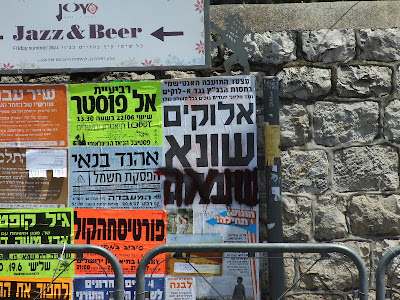
Pashkevils for Gay Rights


Ynet has an exquisite story about a pro-gay pashkevil - the big posters put up in Haredi neighborhoods to exhort people to act against what the authors consider to be immoral - pasted all over Haredi neighborhoods in Jerusalem, probably by the Meretz youth organization (Meretz is an Israeli leftwing political party).

Jerusalem's ultra-Orthodox residents thought they were dreaming Monday morning, when they encountered an unlikely sight on the city's public notice board – a "pashkevil" endorsing the gay pride parade, scheduled to take place in the capital on Thursday.

The flyer, signed by "Citizens for an equal, sane Israel" called upon all citizens of Jerusalem to take part in the parade, caused an outraged among the ultra-Orthodox community.

Beginning in the traditional pashkevil manner, the flyer called upon its readers to "hail the call of the shofar," but continues in the none-traditional way by "warning against the hate and incitement…God have mercy of those who slander against their brethren.

"…Let us come with our masses to this great, peaceful, dignified and democratic march and defy the minority inciting us to violence," continued the flyer. "Hatred is a dangerous, infections disease. Let us all prove that Judaism does not mean fascism and bloodshed."

The pashkevil, illustrated with a drawing of two men holding hands, ends with a call to the city's residents, of all religious affiliations, to take part in the parade.

Ynet has learned that the "Citizens for an equal, sane Israel" group is believed to be associated with Meretz youth.

Monday, June 18, 2007

This Week in Palestine ... Behind the News with Hanna Siniora

This is a commentary on the current situation written by Hanna Siniora, who is the co-director of the Israel/Palestine Center for Research and Information. I received it because I'm on their e-mailing list.

The damage that many Palestinians feared - took place, no excuses; we all share in the blame. Hamas heavily tarnished its image, as a democratically elected movement, by resorting to brute force to resolve the power struggle resulting from its sweeping electoral victory in January 2006. Up to the military putsch that led Hamas takeover of the Gaza Strip, the movement had the democratic and moral high ground. The impatience of its radical elements and its alliance with extremist regional partners might bring about the possible demise of the first Arab Islamic party that came to power through the ballot box.

Hamas now, although it has military supremacy in Gaza, has lost the support of civil society in Palestine. The public was horrified at the barbaric atrocities committed by the military militias. Hamas has undermined the democratic process and allowed a combination of forces, internally and externally, to seek its elimination.

President Mahmoud Abbas was constantly blamed for indecisiveness, but Abbas knew that whoever resorted to force will lose legitimacy and the backing of his people, as well as the Arab world and international community. Hamas radicals have committed political suicide by allowing civil war and usurping power by force. President Abbas with the backing of the majority of his people was finally forced into action.

Abbas dismissed PM Ismail Haniyeh and appointed a new cabinet headed by Dr. Salam Fayyad to repair the damage that divided the future Palestine into two entities, Gaza under the military domination of Hamas, and the West Bank under the legitimacy of the presidency and the PLO. PM Salam Fayyad emergency government, according to the basic laws of the PLC, have a mandate of 30 days that can be renewed up to 90 days by avoiding a constitutional showdown with Hamas majority in parliament. Ninety days are not enough for the emergency government to repair the damage of the past fifteen months. President Abbas and legal experts have to look for legal means to extend the mandate of the emergency government, at least, up to the end of the presidential term in 20 months. This the period necessary for Fayyad to deal with the political and economic damaged, also in order to repair and stabilize the internal collapse. PM Fayyad immediate concern and full attention should be focused on preventing the collapse of the security in the West Bank, institutionalizing the security force to serve the nation and not individuals and parties, provide the basic needs and services to the Palestinian people in Gaza, irrespective of the illegitimate Hamas control, to work on preserving relations with Gaza despite the political nuances. The Palestinian economy should receive the primary attention, plans prepared while Fayyad was Finance minister should be implemented, as international sanctions are being lifted.

Hamas as emotions simmers down has to revert to rational behavior, should remove weapons and masked militias from the streets of Gaza and observe and implement the rule of law. Assassinations of political and security rivals should cease immediately. As soon as possible Hamas should accept the dismissal of Ismail Haniyeh and his cabinet to begin to seek reconciliation. Hamas has two alternatives. to preserve its place as a political movement. In the first place Hamas future is not as a military force, its strength is political, it has to renounce violence to prevent Gaza from sinking deeper into violence, otherwise it will give the hard line military in Israel the perfect excuse to try to eliminate the Hamas movement by force, already such plans are being discussed by the new Minister of Defense Ehud Barak.

Secondly if sane forces in Hamas prevail, it should avoid further radicalization and military confrontation, to prevent being snuffed out by force. The Algerian experience should be fully understood by Hamas and Fateh, everybody loses in a civil war situation The Palestinian supporters of Hamas as well as the Palestinian people at large will become the victims, if the present rift is allowed to deepen. The national aspirations of the Palestinian people for self determination and independence will receive a major setback and the suffering will escalate.

Now, Hamas has to work in earnest with the special Arab League committee that was set-up recently to repair relations and heal wounds. Hamas have to consider seriously early elections to avoid a constitutional impasse, in order to regain public confidence. If Hamas is so sure of public support, it should support the process of early elections. In addition, seek the release of the BBC journalist from captivity should be one of its first acts of restoring law and order in Gaza. Hamas, if it is serious to show that it supports the recent statement of Ismail Haniyeh that Hamas accepts a Palestinian state in the borders of June 4, 1967, should release the captive soldier Gilad Shalit, via the good offices of President Abbas, it will help it to reverse negative public opinion worldwide and internally.

The President, should be firm and resolute, he was forced to act, but should keep in mind that he was elected to look after the welfare of his people, all his people. Abbas has to work toward reestablishing internal dialogue, economic reconstruction, massive reforms and an end of occupation. This is a tremendous agenda, no one except the President has this mandate, let us all support him and pray that he may succeed.

Jerusalem morning with protests

I'm sitting here in my apartment listening to the flute playing coming in through the open window, on one side, and the birds singing, on the other side - a very pleasant morning, and I hope to go to the library today and get some work done on my paper on the images of demons in the Babylonian magical bowls.... but before leaving I was reading the news online and came across the Ynet article on the Haredi protest last night against the Jerusalem gay pride parade.

According to Ynet, about 10,000 people protested in Haredi neighborhoods - there was some violence (burning of trash bins, stoning of policemen) but it was quickly squelched. Apparently the police had a number of undercover officers dressed as Haredim in among the protesters. The gay parade is still on, as of now - with 7,000 policeman planned to be deployed to protect the marchers. We will see....

Sunday, June 17, 2007

Updates on the Palestinians

Abu Mazen has dissolved the Hamas-led Palestinian government and established a new government with no Hamas ministers. He has also outlawed the Hamas armed groups - the Executive Force and the military wing, Izz A Din al-Qassam. Even though I'm listening to Israel Radio and reading the newspapers, it's not very easy to figure out what this means. Some blogs are providing some very good analyses, however. Yael, at Oleh Girl has been following events very closely. She is part of a group blog, Good Neighbours, which includes bloggers from the Middle East, including Ramzi S., from Ramallah - the comments on this post are particularly interestingn. Through Yael I also discovered a new blog - Conflict Blotter, written by Charles Levinson, the Mideast correspondent for the Sunday Telegraph, who has been reporting directly from Gaza. His latest post is on the 48 hours leading up to civil war.

"So lange bist du hier"

As part of gay pride this week in Jerusalem, the Cinematheque is showing a couple of gay films - I'm going with a friend on Wednesday night to see one of them: So lange bist du hier.
"While You Are Here,” the first film by promising German director Stefan Westerwelle, was noted with distinction at the International Film Festival in Locarno. It‘s about a friendship between two men who widely differ in age, but are brought together by shared feelings of loneliness and alienation. Sebastian is a hustler. Georg is one of Sebastian‘s regular clients. The men are so different yet so similar, trying to find some last moments of happiness together. Of special note: Bernadette Paassen‘s humble yet heart-wrenching photography. Courtesy of The Goethe Institut, Tel-Aviv
In other news, Haaretz is reporting that the police are going on high alert for the parade - "The police have announced plans to declare a state of very high alert throughout Israel and to bolster police presence in Jerusalem, Bnei Brak, and the North this Thursday to field the possible violence that may result from the Gay Pride Parade planned to take place that day in Jerusalem."

Saturday, June 16, 2007

Gay Pride in Jerusalem

Next Thursday, the gay pride parade is scheduled for Jerusalem (organized by the Jerusalem Open House), and the haredim, on schedule, have threatened to stop it by force. According to an article in yesterday's Jerusalem Post, which I can't seem to find online, a protest is planned for Sunday evening - with the expectation that it will turn violent.

When I was here last year it was considerably before the planned Worldpride gay march, but nonetheless all over the city haredi protesters had put up disgusting signs denouncing the march. Those signs have reappeared, even in areas of the city that are not predominantly haredi, such as Emek Refaim St. They read "God hates immorality." A clever person rewrote one of the signs on Emek Refaim, so that it reads instead "God hates hatred."

From Mystical Poli...

It's busy here in the Middle East

Well, since I got here on Wednesday afternoon Ehud Barak was elected chairman of the Labor Party, and will be taking over the Defense Ministry on Monday from the incompetent Amir Peretz. And Shimon Peres has finally been elected to something - he will be the new president of Israel, replacing the disgraced Moshe Katzav.

Hamas has taken over Gaza in spectacularly bloody battles against Fatah, and over in the West Bank, Fatah gunmen (Al Aksa Brigades) have in turn taken over various government ministries that were in the hands of Hamas. It sounds like the only thing preventing running gun battles between Hamas and Fatah in the West Bank is the presence there of Israeli forces. For a good roundup of coverage and analyses, see Noah Pollak in Fatahland & Hamastan. Although he is a bit right wing for my taste, his analysis seems much more realistic than the New York Times idiotic editorial from yesterday, which calls for strengthening Abu Mazen (Palestinian President Mahmoud Abbas):
It should also include an offer of regular, substantive talks with Mr. Abbas on issues related to a final peace settlement, like borders and provisions assuring the economic viability of an eventual Palestinian state. Obviously, there can be no final peace agreement until Hamas either changes its policies or is chased from power. But excluding Palestinian statehood from the negotiating agenda can only help Hamas.
Isn't it obvious that Abu Mazen has no power to negotiate anything? Gaza is completely out of his hands, and probably a good many West Bank Palestinians also support Hamas. I don't see the point in negotiating with someone who has no, or very little power. One signal sign of his weakness in Gaza before it fell to Hamas was that he waited to the last minute to order his Presidential Guard to fight against Hamas. Why did he wait so long? Honestly, it seems that he didn't take seriously the possibility that Hamas would defeat Fatah in Gaza. Or maybe it's simply that he wasn't in control of the Fatah forces either. (Some of the articles I've read in the Israeli press suggest that the Fatah forces in Gaza were so divided among themselves that they couldn't defend themselves effectively against Hamas).

It's unnerving to be here with Hamas taking over Gaza. It doesn't affect my life personally, but it does give me a sense of increased insecurity - and I'm sure that the residents of Sderot, an Israeli city very close to Gaza which has been repeatedly hit by Qassam rockets for the last several years have an even more increased sense of danger.

Thursday, June 14, 2007

Finally in Israel

I finally arrived yesterday afternoon in Jerusalem. My flights from Boston to Milan and Milan to Tel Aviv were uneventful, marked only by the lack of the kosher meals that I had ordered (I'll have to be more persistent about that for my return flights). At the airport I managed to get minutes added to my Israeli cellphone (miraculously, the battery had not drained over the course of the year so I was able to use it). I got to Jerusalem at about 6 p.m., and to the apartment that I'm renting for the summer, which is very nice. I'm sitting here and listening to the birds and looking out my porch onto a garden. In the distance I can hear the sound of someone inexpertly practicing a piano.


The view out the mirpeset (porch)

I'm staying on Ithamar ben Avi St. in Katamon, one of the older neighborhoods of Jerusalem outside the walls of the Old City. Before 1948 this was a predominantly Arab neighborhood, but as a result of the 1948 war, the Arabs left and the Jews came in (other nearby neighborhoods were largely Jewish before 1948). Some were Jews who had been living in the Old City until they had to leave when it was taken over by the Jordanians. This apartment building, however, is not pre-1948 - I think it was probably built sometime in the 1960s.


The garden outside my door.

I went out this morning for one of my favorite Israeli activities - sitting in a cafe, drinking cappuccino, and reading the newspaper (in this case Haaretz in English). The big news is that Ehud Barak is now (again) the head of the Labor party and Shimon Peres is now President of Israel (this is a largely ceremonial post). Other big news is that Hamas seems to have defeated Fatah in the fighting in Gaza. What this means for Israel I don't know, probably nothing good.


The path leading to Ithamar ben Avi St.

Sunday, June 10, 2007

Visit to Westport

My trip to Israel has been postponed for two days - my flight, which was supposed to leave tonight, was cancelled, and I have new reservations for Tuesday night. On my way from Ithaca, I came to visit my father and his wife in Westport, Mass., since I'm flying out of Boston. With my new camera, given to me by my father, I took quite a few photos of this pleasant place.


Country lane with a big field and cows next to it.


Cows in the field.


A Japanese maple in the backyard.


Front yard, facing the field with the cows.


Irises.


Peonies.

Thursday, June 07, 2007

Israeli-Palestinian Comedy Tour

I was just reading a posting by Ray Hanania on Mideast Youth and discovered that he's going to be in Israel/Palestine with the Israeli-Palestinian Comedy Tour this coming week - including a June 16 gig at Kol Haneshama in Jerusalem. I am arriving in Israel on Monday, June 11, so I may have a chance to get to this show. I enjoy reading his posts on the Mideast Youth site, so it would be fun to see him and the other comedians.

Six Day War - 40 years later

All week, National Public Radio has been running a series on the fortieth anniversary of the Six Day War in 1967. On All Things Considered for June 5 (click on the link to hear the story) covered the outbreak of the war, using sound clips from the CBS News reporting of the day. I remember the Six Day War - I was only ten years old at the time, but it made an impression on me, probably because of my parents' reaction (especially my father's). I remember sitting in our kitchen watching the black and white television coverage, and listening to the CBS radio reports. My remembrance is not of specific events as they occurred, but more of the emotional atmosphere in our family - one of tension and anxiety. As my father has told me many times, he took his radio to the office (he was working as a lawyer in a small practice) to listen to the ongoing reports. I imagine it was with a great sense of relief that he heard the report of the Israeli destruction of the Egyptian air force on the ground on the first day of the war.

The Six Day War is not the first political event I remember - that would be the assassination of President Kennedy in 1963 - but it is certainly the earliest one to make a great impact on me, since it is one of the external, political events that influenced my interest in my Jewish identity.

(Cross-posted from my Jewish Studies blog, Israel Musings).

Monday, June 04, 2007

Others on the British Academic Boycott

Judy of Adloyada has several interesting posts on the new boycott voted in by the British university teachers' union. Since I'm not familiar with the ins and outs of British academia, and especially not of the UCU, it's hard for me to follow all of the details, but one thing that stood out for me in what she said is that much of the leadership of this union comes from the hard left - the SWP (Socialist Workers Party) and other far-left groups. (From the U.S. perspective it's strange to consider that the SWP could lead anything as consequential as a university teachers' union, since the U.S. version of the SWP is a totally marginalized far left fringe group).

There was an interesting discussion at Oleh Girl on how seriously to take this boycott vote - Oh here’s a surprise, the boycott of Israeli universities is on.

Also see Jim Davila on the boycott vote: Paleojudaica. He quotes from what he said the last year when an earlier incarnation of the union also voted (initiatlly) to support the boycott: "I think the proper response ... [is] to heap international ridicule and scorn on the union for picking leaders who are more interested in making a cheap and cowardly political statement than in doing their actual job of representing the interests of British academics. In fact, those interests have been notably set back by this move. It's a pity, because there is a real need for such representation. But this isn't it."

Academic Boycott of Israel

Shalom Lappin, writing in Normblog about the recent vote by the University and College Union in Britain, makes several useful points that I haven't seen elsewhere.

First of all, contrary to the statements put out by Sally Hunt, who is the Secretary General of the UCU, the recent vote has committed the UCU to sponsor the boycott call put out by the Palestinian Campaign for the Academic and Cultural Boycott of Israel. It is quite instructive to read the full statement to learn what the UCU has committed itself to (my notes are in italics):
CALL FOR ACADEMIC AND CULTURAL BOYCOTT OF ISRAEL

Whereas Israel’s colonial oppression of the Palestinian people, which is based on Zionist ideology, comprises the following:

· Denial of its responsibility for the Nakba - in particular the waves of ethnic cleansing and dispossession that created the Palestinian refugee problem - and therefore refusal to accept the inalienable rights of the refugees and displaced stipulated in and protected by international law; [Note: this statement avoids any mention of Arab responsibility for the war against Israel in 1948]

· Military occupation and colonization of the West Bank (including East Jerusalem) and Gaza since 1967, in violation of international law and UN resolutions; [Note: again, this statement avoids any mention of how this occupation came to be, as a direct result of the 1967 war]

· The entrenched system of racial discrimination and segregation against the Palestinian citizens of Israel, which resembles the defunct apartheid system in South Africa; [Note: the Palestinian citizens of Israel, unlike the Black and Colored citizens of South Africa, have the right to vote and have elected members to the Israeli Knesset; Arabs have served in several Israeli governments, including the present one, which includes the first Arab Muslim of the government. It is certainly true, in my opinion, that Palestinian citizens of Israel are often discriminated against, and Israel Arab cities and towns have been scandalously underfunded over the history of Israel - but this is by no means apartheid ]

Since Israeli academic institutions (mostly state controlled) and the vast majority of Israeli intellectuals and academics have either contributed directly to maintaining, defending or otherwise justifying the above forms of oppression, or have been complicit in them through their silence, [To me, this is the most astonishing statement of the entire text - Israeli academics have been among the most prominent leaders of Peace Now, Gush Shalom, and other groups seeking to end the Israeli occupation of the West Bank and Gaza, and many Israeli professors are members of such groups and have demonstrated and otherwise been involved in activism to end the occupation. Not to know this is simply to be out of touch with reality]

Given that all forms of international intervention have until now failed to force Israel to comply with international law or to end its repression of the Palestinians, which has manifested itself in many forms, including siege, indiscriminate killing, wanton destruction and the racist colonial wall,

In view of the fact that people of conscience in the international community of scholars and intellectuals have historically shouldered the moral responsibility to fight injustice, as exemplified in their struggle to abolish apartheid in South Africa through diverse forms of boycott,

Recognizing that the growing international boycott movement against Israel has expressed the need for a Palestinian frame of reference outlining guiding principles,

In the spirit of international solidarity, moral consistency and resistance to injustice and oppression,

We, Palestinian academics and intellectuals, call upon our colleagues in the international community to comprehensively and consistently boycott all Israeli academic and cultural institutions as a contribution to the struggle to end Israel’s occupation, colonization and system of apartheid, by applying the following:

Refrain from participation in any form of academic and cultural cooperation, collaboration or joint projects with Israeli institutions;

Advocate a comprehensive boycott of Israeli institutions at the national and international levels, including suspension of all forms of funding and subsidies to these institutions;

Promote divestment and disinvestment from Israel by international academic institutions;

Work toward the condemnation of Israeli policies by pressing for resolutions to be adopted by academic, professional and cultural associations and organizations;

Support Palestinian academic and cultural institutions directly without requiring them to partner with Israeli counterparts as an explicit or implicit condition for such support.

As Lappin says, this boycott call is essentially an extension of the Arab League boycott of Israel. "It is an integral part of a rejectionist programme to dismantle Israel as a country." The Arab boycott began not in 1948, with the establishment of Israel, but in 1945, "as a boycott of the Jewish businesses, goods, and services of the Yishuv (the Jewish community) in Palestine. That it was instituted several years prior to the creation of Israel and the 1948 war, which generated the Palestinian refugee problem, clearly demonstrates that this boycott was directed at a politically autonomous Jewish collectivity in Palestine, rather than against any particular government policy or action." He goes on to say that

The primary purpose of the boycott campaign is not to change Israeli government policy but to undermine the legitimacy of Israel as a country. It aims to isolate, not its political leaders and policy makers, but its people as a whole. It is, then, a form of branding which seeks to mark a group of people as social outcasts. The main damage that it does is to provide cover for acts of blatant discrimination against Israeli academics, committed by individual researchers acting as journal editors, conference organizers, tenure or appointment consultants, and in similar roles. We have seen several high profile cases of such individual boycott actions within the UK over the past seven years. This trend is likely to gather momentum if the boycott campaign continues unchecked.

Lappin also discusses why it is inappropriate to equate Israel with apartheid South Africa (I have spelled out one argument above). It is worth reading the entire article to learn why the movement to institute an academic boycott of Israel is so dangerous. It is not merely a way of criticizing the actions of the Israeli government, or of calling for the end of the occupation (a goal that I fully support!) - it is a way to delegitimize Israel and declare it a criminal state.

Sunday, June 03, 2007

Still more on Gerson Method

I looked on Google to see if there were any new stories about Bert Scholl, the local Ithaca man who has been diagnosed with rectal cancer and has decided to use the Gerson method rather than conventional surgery, chemotherapy, and radiation. I discovered a notice for the fundraiser to raise money for his treatment, which gives more information about his condition.
His tumor has breached the lining of his rectum & is reaching out to his lymph nodes. This is called stage 2, T3 cancer. The conventional recommendation by several doctors is to treat Bert with heavy doses of chemo/radiation along w/ surgery that is either a permanent colostomy, or removal of his rectum & sigmoid colon, with the hope of being able to re-attach the 'pipes' down the road. That's if the tumor can be shrunk enough during the pre-surgery treatments.

We do believe that there are several medical models and ways to treat cancer and other degenerative disease. We are looking into alternative methods of healing as either a compliment to conventional methods, or ideally, as a full course of treatment. The Gerson Method, as described in the documentary, "Dying to Have Known", is the method we feel an alignment with, and wish to pursue healing via this route, before walking the conventional path.

As I had feared, they are hoping to replace conventional treatment with the unproven Gerson Method. I can understand why one might not want to use the conventional methods - they sound horrible (not that the Gerson Method sounds particularly pleasant to me either), but they do afford a better chance of survival, which it seems to me is the most important factor.

I feel passionately about this because my mother and my aunt both died of lung cancer, which is still a very bad diagnosis to receive. After my mother's lung cancer was diagnosed, she lived for about 15 months. My aunt survived much longer because it was caught by chance by a lung x-ray. She had surgery and went for quite a few years without symptoms, until it recurred about eight years after the first diagnosis. She died about two years later. On the second round, she basically only had palliative care. She decided not to go for a full chemotherapy or radiation treatment, only if it would ease her pain or make her more comfortable.

I think that there is a difference between deciding that one does not want the unpleasant effects of chemotherapy or other conventional methods, and thus not employing them with full knowledge of the possible consequences, and deciding (or being convinced) to use a method that will not work under the illusion that it will. The outcome may be the same, but at least in the first case one has not been deceived and exploited, which I think is what is happening in this instance.

"Countdown" to Israel's End?

The President of Iran Sees "Countdown" to Israel's End.
"With God's help, the countdown button for the destruction of the Zionist regime has been pushed by the hands of the children of Lebanon and Palestine," Ahmadinejad said in a speech. "By God's will, we will witness the destruction of this regime in the near future," he said. He did not elaborate.

Why does Ahmedinejad say these things? Are we supposed to understand them as threats of Iranian action against Israel? Attempts to unnerve Israelis and Jews around the world? Signals to Hezbollah or Hamas? Encouragement to them? Or is he just blowing a lot of hot air?

Kamangir or other Iranian bloggers - can you shed any light on why he says things like this?

Tuesday, May 29, 2007

Kimberly Dozier

I'm now listening to an idiotic CBS "special" on Kimberly Dozier, the CBS reporter who was severely injured last year in Iraq by a roadside bomb, and who is now recovered. She's being interviewed by Katie Couric in a simpering, maudlin style that focuses on this one CBS reporter and ignores the suffering and death of all the American and other coalition soldiers who have become casualties. I listened to many accounts over the weekend about soldiers who died in Iraq and Afghanistan - are they less important than this one reporter? There is sentimental music playing. This so-called special doesn't tell us anything about the Iraq war - instead it's manipulating our emotions so that we "feel" for Dozier and her crew. How much money and time did CBS waste putting this special together? Consider the real reporting they could have done instead.

Saturday, May 19, 2007

Baghdad in Gaza

Khaled Abu Toameh in the Jerusalem Post reports that Bearded Gazans on razor's edge between life and death.
Once, Hamas members were afraid to wear beards for fear of being arrested by Israel's security forces. Today, they are once again afraid of appearing in public with beards - this time for fear that they will be killed or kidnapped by Fatah militiamen in the Gaza Strip.

Sources close to Hamas said over the weekend that at least 10 bearded men have been shot and killed in the past week after being stopped in the street by Fatah gunmen.

One case was caught on camera and has since appeared on the Youtube Web site. The film shows several Fatah gunmen shooting a bearded man in the legs. As the man lies in a pool of blood in the street crying for help, a Fatah gunman approaches him and fires at his head from an automatic rifle, killing him instantly.

"This man was just an ordinary citizen who happened to wear a beard," said a Hamas official. "It's become very dangerous to appear with a beard on the streets of the Gaza Strip."

According to the Hamas official, most of the victims were killed execution-style by Fatah militiamen and members of various Fatah-controlled Palestinian Authority security forces.

I remember several years ago some people in Israel and some American Jews saying that they just wanted to wall off Gaza and let the Palestinians kill each other there, with the thought that what happened to the Palestinians didn't really matter. I wonder what those people are saying today, when hundreds of Palestinians have been killed in Fatah-Hamas fighting this year. Are we not our brothers' keeper? Should we not care that life for people in Gaza - including innocents - has become a living hell, aided and abetted by the Israeli blockade of Gaza and by the American embargo on aid to the Hamas government? I don't want suicide bombers to be able to enter Israel from Gaza, nor do I want to support Hamas, which still has the declared goal of destroying Israel - but we should not fool ourselves into thinking that this has nothing to do with us and our actions.

Thursday, May 17, 2007

More on Gerson Method

A local doctor, Martin A. Ginsburg, has written in to the Ithaca Journal about the Ithaca man who is going to Mexico for cancer treatment:

Having read the May 11 article (Seeking out an alternative: Local man opts for unusual cancer treatment”) about a man seeking alternative methods of treatment for a potentially lethal rectal cancer, I offer the following comments:

I am an internist with subspecialty training in gastroenterology. When I came to Ithaca from Downstate a year ago I was amazed at the massive public interest in alternative medicine.

I agree that every patient should be able to choose his method of treatment — having been fully educated as to the pros and cons of alternative vs. conventional methods. What is lacking here is the dim statistical possibility of cure when going the alternative route as first treatment.

I feel that Bert Scholl should see a competent oncologist locally or at one of the large cancer centers in Buffalo, Rochester or New York City. The bold statistics for both methods should be given to him so he won't go off blindly to Mexico for unproven care that, except for anecdotal vignettes, has been proven most dismal.


It's a relief to read a sensible, informed opinion about this treatment, rather than the credulous account provided by the Ithaca Journal reporter.

'It's dangerous inside and outside'

An AP reporter who lives in Gaza, Ibrahim Barzak, reports on the current horrendous fighting in Gaza between Fatah and Hamas:
With battles raging outside my building, and my windows blown out by bullets, I sit in a dark hallway outside my apartment with my wife and baby. It's dangerous inside and outside.

Today I have seen people shot before my eyes, I heard the screams of terrified women and children in a burning building, and I argued with gunmen who wanted to take over my home.

I have seen a lot in my years as a journalist in Gaza, but this is the worst it's been....

There have been clashes between Hamas and Fatah before, but there are dangerous new elements this time. Now they are arresting or even shooting people for the way they look. If you have a beard, you might be arrested by Fatah security for looking Islamic. If you have a chain around your neck or on your arm, Hamas gunmen might shoot you because you look secular....

I saw several people shot right in front of my home today. I'm preparing myself for even worse violence.

Sunday, May 13, 2007

$25,000 for what?!

A local Ithaca man who has been recently diagnosed with rectal cancer is trying to raise money for an "alternative" cancer treatment called the "Gerson Method." The article in the Ithaca Journal about this story is not very well written, so it's hard to tell if he's also planning to use conventional cancer treatment methods like chemotherapy or radiation therapy. (I certainly hope he is!) This alternative method requires him to go to the Baha Nutri Care clinic and pay $25,000 for the privilege, so he and his wife have organized a benefit tonight to help him pay his expenses.

So, what is this "Gerson Method" and does it have any legitimacy in the treatment of cancer? According to the article, it is a nutritional method that uses coffee enemas, "which are said to stimulate immune functioning." The passive voice is a wonderful thing - who is saying that they stimulate immune functioning and is there any evidence to support this assertion? Clearly, the reporter responsible for this article did not do any research to find out what this method was and whether it was reputable, but as I found out quickly, it's not too hard to find out that this is a wholly dubious treatment.

From what I can tell from a rather cursory websearch, this method will not cure rectal cancer, and if it is used instead of the usual methods, it will endanger the man's life by postponing effective treatment. A physician blogger known as Orac tells a sad tale about a patient who came to him with orange skin. It turns out he had been diagnosed with rectal cancer, but rather than having surgery, had begun a nutritional treatment that involved coffee enemas and megadoses of carrot juice (hence, the orange skin). His treatment was based on a program designed by Dr. Max Gerson.

Orac describes this treatment as follows:
The basis of this "therapy," developed first by Max Gerson, MD back in the 1940's and 1950's, then continued by William Kelley, DDS in the 1960's, and still practiced today by Nicholas Gonzalez, MD, is a belief that all cancers come from a deficiency of pancreatic enzymes, which supposedly allows cancer cells to grow. By the "concept" behind this, cancer grows and metastasizes because there is lack of cancer-digesting enzymes in the body. The solution is, supposedly, is to get pancreatic enzymes to the place where cancer is growing, in a concentration high enough to stop growth, but not so high as to cause too rapid production of "toxins" from tumor breakdown. Consequently, the treatment consists of "detoxification" with coffee enemas, which supposedly help flush the waste products of tumor cell breakdown out of the body; dietary manipulations; ingestion of pancreatic enzymes; and megadoses of supplements and vitamins, like carrot juice. The original Gerson diet required more than a gallon a day of juices made from fruits, vegetables, and raw calf's liver, but there are many variants.

This treatment does not do anything for rectal cancer, and because the patient had postponed surgery for over a year, by the time he came back to Orac the tumor had increased greatly in size and the operation required to treat it was much more difficult, and his chance of surviving the cancer was much lower. I hope that the Ithaca man does not postpone an appropriate cancer treatment out of the mistaken hope that the Gerson treatment will actually help him.

An exhaustive debunking of the Gerson diet and its coffee enemas can be found at Unconventional Cancer Treatments: Dietary Treatments. This is taken from Unconventional Cancer Treatments, published in September 1990 by the Office of Technology Assessment of the U.S. Congress, pp. 44-51. A more recent source of information can be found on the website of the American Cancer Society: Gerson Therapy.

Friday, May 11, 2007

Jimmy Carter, again

Jimmy Carter recently met with a group of "rabbis, Christians and Muslims organized by Michael Lerner." While I'm not a fan of Lerner, it sounds like he gave Carter some valuable criticism of his recent books and statements (whether Carter really received it is another questions).
In his e-mail, Rabbi Lerner said he “invited eight rabbis, two nationally respected leaders of the Muslim world, several ministers and activists in the Christian world, several professors, and leaders in the Network of Spiritual Progressives and in Beyt Tikkun Synagogue, as well as Mitchell Plitnick, the national director of Jewish Voices for Peace, and one of the founders of Brit Tzedeck ve’Shalom.” Four Reform rabbis declined the invitation, he wrote, citing political differences.

Most of the hour-long meeting between Carter and the group, and a later one-on-one meeting between Carter and Rabbi Lerner, was spent discussing the fallout from Carter’s book. The rabbi said some critics were won over, and some asked Carter how they could help him spread his message.

Rabbi Lerner, who strongly advocates a two-state solution to the Israeli-Palestinian conflict, generally supports the book’s thesis — that inequities between Jews and Arabs on the West Bank hamper peace efforts — but said he is not without disagreements, which he expressed in the meeting.

“It’s a mistake to use the term apartheid,” Rabbi Lerner said Tuesday. “It’s incendiary and really has the opposite effect to what he wanted, which is to have a serious discussion about Israel.”

Rabbi Lerner also faulted the book as lacking historical context. “It was a big mistake not to focus on the role that Arab states played before the creation of the state in relation to keeping Jews out of Palestine in the ‘30s and ‘40s when Jews were being murdered in Europe. They played a significant role in convincing Britain to impose a blockade … They had incurred a moral guilt that needed repentance. The failure to discuss that was in my mind a significant failure of the book.”

Further, Rabbi Lerner said Carter should have scrutinized Arab rejection of the 1947 Partition Plan and “didn’t give adequate attention” to the fears of modern Israelis generated by terror attacks.

Another important topic of discussion was the relationship of Christian Zionists (particularly right-wing ones who belong to conservative churches) to Israel and Jews. Apparently Carter, who is a Southern Baptist, is trying to get his denomination to be more open to criticism of Israel while at the same time affirming Judaism as a legitimate path to God, so that Jews need not convert to Christianity in order to be saved. Both of these strike me as a tall orde, especially the latter, since the Southern Baptists support such groups as Jews for Jesus, whose goal is to convert Jews.
“Carter described his efforts to counter the extreme right-wing Christian Zionists, and his efforts to help the Baptists understand that the real way to be allies to the Jews is not by giving unconditional support to the current government of the State of Israel,” Rabbi Lerner announced in an e-mail to supporters after the meeting. He said the comments were on the record, taped and would appear, in part, in Tikkun this summer.

In a phone interview from California, the rabbi said Carter, a devout Southern Baptist, “has been involved and continues to be involved in theological debate within the American Baptists on the issue of how best to serve Jewish interests …

“He pointed out the strong connections between Christian Zionism and the desire to push the Jews eventually toward converting to Christianity or burning in hell. He pointed out that the Christian Zionist view is part of that general theology that essentially views the Jews as an obstacle, not as friends, but temporarily views the Jews as friends in the process of bringing back Jesus and at that point having all of us convert .”

I am also very concerned when evangelicals hold to a theology that leads to their looking forward an end of days scenario where Jews will return to Israel only to be slaughtered on a massive scale by enemies led by Russia, and a remnant will become Christians. This does seem to be the basis for the support that some evangelicals give to Jews and Israel - because we play a crucial role in their end-time plans.

On the other hand, I have also met other evangelicals who seem much less apocalyptic in their thinking, who are curious about Jews, are interested in learning more about Judaism, and support Israel as the state of the Jewish people. (See Liza's account of her recent trip to the U.S. where she encountered an enthusiastic evangelical supporter of Israel). I think it's really a mixed bag, but that it is important for the Jewish community to be careful with whom we ally ourselves. I don't think it should be done on a one-issue basis (only support for Israel), but we should consider carefully a range of issues, including social and political issues here in the United States as well.

Sunday, May 06, 2007

Ray Hanania on Israel/Palestine

Ray Hanania on the Mideast Youth website has a very interesting posting on the upcoming demonstration in Washington to commemorate the 40th year of the Israeli occupation of the West Bank and Gaza, and to call for an end to the occupation.
This June marks the 40th anniversary of the Six-day war when Israel defeated the combined Arab armies and occupied the West Bank, Arab East Jerusalem and the Gaza Strip.

To commemorate the event, pro-Palestinian supporters including ultra-leftist Israelis and American Jews have organized a rally in Washington June 10 –11.

But, a war of words has erupted between protest organizers and moderate Israelis and pro-peace American Jews that touches on the heart of how pro-Palestinian groups are helping to undermine rather than help the peace movement.

The protest is organized by two powerful yet loosely structured networks called “the U.S. Campaign to end the Israeli Occupation” and “United for Peace and Justice” who contend the rally should “only” focus on pressuring Congress to stop supporting Israel’s policies.

They do not want to lose the support of the more extremist pro-Palestinian groups who advocate the “One-State solution,” which is the latest in a long line of creative strategies to destroy Israel and undermine peace based on compromise.

Two Israeli and American Jewish leaders who advocate the “Two State solution,” Uri Avnery and Rabbi Michael Lerner, challenged the protest in the May/June issue of Tikkun Magazine (www.tikkun.org). They argue that the failure of protest organizers refusal to denounce the wrongs of both sides and offer a reasoned political settlement only strengthens the extremist Palestinian and Israeli elements who continue to fuel the occupation and the conflict.

Hanania agrees with Avnery and Lerner and argues that:
Avnery and Lerner argue that in order to be effective and achieve its goals, the peace movement must disassociate itself from extremists who use peace demonstrations as a cover for extremist policies like advocating the “One-State Solution.”

There is a sad truth in the pro-Palestinian movement. It is dominated by a small group of fanatics who use intimidation to silence moderate voices. They exploit Palestinian suffering to augment the hate against Israel and Jews, and advocate Holocaust Revisionism and anti-Semitism. They say they support peace but all they do is bash Israel and close their eyes to Palestinian crimes against Israel.

He says:
The correct and principled strategy is to denounce the Occupation and denounce those who reject compromise based on Two-States. They should denounce Hamas and suicide bombings and the use of violence against Israeli civilians just as strongly they denounce the brutality of the Israeli military occupation against Palestinians.

Don’t just denounce the Wall and the expansion of settlements, denounce the refusal of the current Palestinian government to embrace the fundamental principles of the only solution that will result in both sides winning.

They should speak out when Israelis are killed just as strongly as they speak out when Palestinians are killed.

I agree with everything he says, and have the same discomfort with groups like United for Peace and Justice and the U.S. Campaign to End the Israeli Occupation. I certainly want the occupation to end, but I don't want Israel to end - and Israel is not coterminus with the occupation. It is groups like this that increasingly make me feel like there is no room in the middle, between them and the right-wing elements of the American Jewish community who think that our salvation lies with the Christian Zionists (like Pastor John Hagee who spoke to an enthusiastic crowd at the most recent AIPAC conference in Washington). (For more information on Hagee and his organization, "Christians United for Israel," see Jews on First).

Progressive/moderate blogs on Israel

I've been wondering if there are any blogs whose main subject (whether written by Israelis or others) that are somewhere in the middle politically on Israel, tending to the left - i.e., center-left. I have quite a few Israeli blogs on my blogroll - most don't touch much on Israeli politics, and the ones that do, tend to be fairly right-wing. The blogs I've seen that are left-wing on Israel are much too left-wing for me. I'd love to receive some suggestions for blogs to read on Israel that are both supportive of Israel and also critical of the occupation, calling for a two-state solution and displaying compassion for people on both sides of the conflict.

Jimmy Carter at Berkeley

Amos of Kishkushim reports on Jimmy Carter at Berkeley. It's an interesting account of his speech, making Carter sound much more moderate (and in some ways ill-informed) than I had previously thought. (Ignore the bitter argument in the comments to the post, however - it's almost entirely irrelevant to the post itself).

On another note, Israeli politics certainly is interesting these days, after the Winograd preliminary report was released on the conduct of the Lebanon war last summer. Amir Peretz, the defense minister, will be stepping down when the Labor party has its primaries in about a month. It's anybody's guess how long Olmert can hang on. I find it hard to get excited about any of his possible replacements. If there are new elections, Bibi Netanyahu has a pretty good chance of winning - and he was a disaster the last time he was prime minister. Barak may run (Labor). He was also not much of a success. I kind of like Tzipi Livni, but perhaps this is because I don't know enough about her. And Peres, who would I'm sure dearly love to be Prime Minister again, would have no chance in an election. It will be an interesting summer in Israel.

Sunday, April 22, 2007

Protesting Iran

Given the negative posts that I've written about the behavior of the Iranian regime and its president, you might think that I'd be in favor of kicking it out of the UN, as called for by a recent protest (April 17) at the United Nations organized by Rabbi Avi Weiss and his organization Amcha. Steg attended the demonstration and provides a detailed account and lots of photographs. I feel ambivalent, however, because I've been reading a couple of Iranian blogs - one written by Esther, an American woman married to an Iranian and now living in Tehran (View from Iran) and another written by Arash, an Iranian who is now studying in Canada (Kamangir). Both of them are quite critical of the regime (perhaps Arash is more critical), but they both obviously love the country. I despise the Iranian regime, and think that it is a threat to Israel, especially if they manage to make nuclear weapons, but I'm not sure that calling for throwing Iran out of the UN is really a worthwhile demand. For one thing, it's not going to happen. For another thing, why should this just be identified as a Jewish issue? For another thing, I wish that the demonstrators had made it clear that they're not interested in the U.S. going to war against Iran.

The thing is that when I read Esther's and Arash's blogs, I stop thinking of Iranians as a monolithic mass, and start thinking of individual Iranians that I might really like, and who are and who will be harmed by sanctions against Iran (which Hillel is calling for - see this news release on their website - Iran Petition). There are already sanctions against Iran imposed by the U.N. because of the intransigence of the regime about their nuclear program - and of course they will hurt the ordinary people of Iran and not the members of the regime. So I'm very ambivalent about them, since I'm starting to think of people whose writings I enjoy being injured by them, not just an undifferentiated mass of people who are an "enemy."

Yom Ha-Atzma'ut

Today we had our IC Hillel Israel Independence Day celebration - a day earlier than Israel (since we have Sunday off). It was fun, although a bit loud (students like louder music than I do). The last band was Pey Dalid, a Jewish rock/reggae band - fun to listen to. On their MySpace page you can listen to four of their songs.

Thursday, April 19, 2007

Professor Liviu Librescu z"l

Of all the acts that happened at Virginia Tech on Monday, Professor Librescu's standing in the path of the shooter to save the life of his students is inspiring, but so sad. I don't really know what to say that others haven't yet said. May the memory of the righteous be a blessing for all of us.

Monday, April 16, 2007

Killings at Virgina Tech

Peggy Williams, the president of Ithaca College, sent out an Important Message for the Campus Community on the massacre at Virgina Tech today. I first learned about them when I looked at the New York Times web site this afternoon, when they first reported that about 22 people had been killed. Now at least 33 people are reported dead. It's scary to hear about this - American colleges and universities are open places, and anyone can walk in, unlike Israeli universities which have fences around them and checkpoints with guards. I don't know that I can say anything particularly new about this - I can only imagine the shock and horror the students, their families, the faculty, and the staff at Virgina Tech feel. May they be able to find some comfort in the coming days and years.

Sunday, April 15, 2007

Israeli Masorti movement and gay rabbis

Rabbi Einat Ramon, the dean of the Masorti Rabbinical School in Jerusalem, writes in an article in the Washington Jewish Week, Healing heterosexuality within Jewish people, that
Should we, then, deviate from the longstanding and clear perspective on the issue presented by Jewish law and theology? The answer is positive only if our vision is to transcend sexual differences between men and women and blindly follow the modern reality and ideology of gender and family fluidity. As long as there are Jews who advocate that view, they deserve to be able to make their spiritual homes at various rabbinical schools and congregations that promote such an ideal.

Yet, will the spiritual home at Schechter Rabbinical Seminary, for those of us who believe in the complementary difference between men and women, as an opportunity for deeper intellectual and spiritual family and community bonds, be likewise respected by our colleagues in the long run? We hope that the value of unity - not uniformity - of the people of Israel has not disappeared in the face of different ideologies of gender.

It is very disappointing to read such a viewpoint from Rabbi Ramon. It is clear from reading the entire article that her views are heavily influenced by Rabbi Joel Roth, who was her teacher at JTS. Rabbi Ramon, however, was the first Israeli woman ordained by JTS, and certainly in the past has expressed a far more feminist vision of the relationship between men and women.

In an article published in the book Life of Judaism, edited by Harvey Goldberg, she spells out the ways that she and her husband rewrote the traditional ketubah to spell out a broader range of obligations of both parties (unlike the traditional ketubah, which only spells out the obligation of the husband to the wife, and assumes what the wife's obligations are to be). For them, kiddushin was an act of mutual consecration, not an act of a man acquiring a wife by transferring a ring. She justifies this rewriting of the ketubah by recourse to Mordechai Kaplan's concept of "reevaluation" - clarification of the values and religious and psychological needs that a particular observance required in the past, and an adaptation of the observance and creation of a modern halakhah that remains faithful to those needs and values, as well as to modern sensibilities. It seems that she no longer holds to the values she wrote about so passionately in this article, which is a step backward for women, feminism, and certainly the role of gays and lesbians in the Israel Masorti movement.

Later thoughts: Since both JTS and the University of Judaism rabbinical school have decided to admit gays and lesbians into their rabbinical program, how will they be greeted when they go to Israel for their obligatory year of study at Machon Schechter? Will they be shunned by Rabbi Ramon and the other faculty, or the Israeli students? Will they be forced back into the closet? Will they be given aliyot or counted in the minyan? I wonder if Chancellor Eisen of JTS or Rabbi Artson of the UJ have communicated with Rabbi Ramon on this issue?

Today

Today is one of those moist, rainy, Ithaca days that we get so many of. The daffodils, tulips, and forsythia are just about to bloom if we ever get a couple of warm days. The weather forecast is for a big snowstorm, but it's certainly not happening yet. The birds are out and singing - I have a cardinal who sits in the fir tree between my house and the next, who sings out vigorously, and I hope avoids being eaten by my cat, whose ability to run up the trees is impressive. I walked down the street to Gimme! coffee to sit and drink a mocha and grade papers. As I walked over the bridge at Cascadilla St. the stream was racing along towards Cayuga Lake. Gimme! was full of academic looking folk - I sat down and sipped my mocha and someone who taught computer science sat down across from me and read his New Yorker. Further in, several people crouched in front of their laptops, and one man wrote comments on a paper. It looks chilly outside, but nonetheless there are the sights and sounds and smells of spring about to pop.

Saturday, April 14, 2007

New York to Paris

Normblog has pointed out a highly amusing feature of Google Maps. See New York to Paris for directions on how to get from New York to Paris. I find that the same directions work for New York or other American cities to London and other European destinations, but not across the Pacific Ocean. According to Google, it should take about 29 days 21 hours to drive from New York to Warsaw. What is wrong with this picture?

The Forbidden Gospels Blog

I just discovered The Forbidden Gospels Blog, written by April DeConick, professor of biblical studies at Rice University and founder of the Early Jewish and Christian Mysticism section of the Society of Biblical Literature. There's a very interesting discussion going on now about the Jewishness of Jesus. April writes:
It has only been in the last eight or ten years, as far as I can tell, that scholars as a collective voice have been reacting to this problem in their publications on the historical Jesus, demanding that we take seriously the obvious - that Jesus was Jewish. Jesus as a Jew is not just another agenda-driven "construct" as some have been suggesting (this really is a hyper-post-Modern stance). Being Jewish was Jesus' self-identity, and it has taken us two thousand years to admit it and talk about what it means. No amount of pressing the button on the "diversity" and/or Hellenization of early Judaism is going to erase the fact that for Jesus the Torah and prophets were his scriptures, the Temple his cult, Yahweh his god, and the coming of God's Kingdom his hope. Jesus as Jewish is probably the most essential (and dangerous) idea that I can think of.

Susannah Heschel has written a fascinating book on Abraham Geiger, who already in the 19th century constructed a Jewish Jesus, seeing him as a Pharisee who came to reform Judaism. He also denounced the anti-Judaism of Christian scholars of Judaism. It is interesting that Geiger's arguments (and those by other Jewish scholars of Jesus) are finally getting their just due.

Thursday, April 12, 2007

Israel

I just bought my plane ticket for travel to Israel this summer. I'll be in Jerusalem for two months, doing research and I hope finishing a first draft of my book. This may be too ambitious a goal, but I'm going to try to do it. Tentative title: Angels' Tongues and Witches' Curses: Women in Early Jewish Magic and Mysticism.

Sunday, April 01, 2007

Fateless

I just went to a couple of movies sponsored by FLEFF - the Finger Lakes Environmental Film Festival, which is run by people at Ithaca College. The first movie was Fateless, after a book by Imre Kertesz, the Nobel Prize winner (in literature). I was fooled by the description given of the movie, which gave the impression that it focused on a Jewish boy's experiences (Gyurgy Koves) in Budapest after he had returned from imprisonment in Nazi concentration camps. Actually, most of the movie shows his experiences under Nazi rule. It begins by showing the goodbye given to his father just before he is going to be taken away to a forced labor camp. (He never saw his father again - he died in Mauthausen). Then Gyurgi has to go to work in a factory. One day on his way to work the bus he is riding is stopped by a Hungarian policeman, and all those wearing the yellow star are taken off.

This is the beginning of his journey to the camps - first to Auschwitz, then to Buchenwald, and finally to Zeitz. For most of the story detailed in the movie he is in Zeitz, where we see him become more and more drawn and emaciated until he almost dies. These scenes are beautiful and disturbing - and I would think they are far more realistic (and much less sentimental) than Schindler's List. He is then sent to Buchenwald to be cremated (because Zeitz does not have a crematorium) - although he is not dead yet. He ends up somehow in a hospital ward (at least that's what it looks like) be taken care of. As I watched the movie I thought this must have happened after the Americans liberated the camp, but apparently this took place in Buchenwald, somehow, before the liberation. He is there when the Americans liberate the camp, and there is a scene showing his encounter with an American Jewish officer who urges him not to return to Budapest, but to go to another country and apply for entrance to the United States.

Instead, he does return to Budapest, and searches for his father. He goes back to his old apartment, but another family is living there now and a woman opens the door just a little at his buzz and then closes it on him. He goes to the next door, and at first he is turned away, but then it turns out relatives of his live there - who were never sent to the camps. This is when he learns of his father's death. All of the people he meets in Budapest say the right things - how horrible and dreadful it must have been for him - but none of them truly understand what he experienced.

When I saw these encounters it crystallized for me a feeling I had a couple of summers ago when I visited what had been the concentration camp at Terezin, in the Czech Republic - that if one had not suffered that experience, one could really not understand. It was not possible to touch it from the outside. The movie gives the viewer a sense of both positions - both the returning survivor and the friends and relatives whom he is returning to. They have been continuing their lives as before (although they probably suffered something under Nazi rule) but he has had this utter interruption in his life that they cannot understand - and that they really don't want to (and who can blame them?). They still have their own personal concerns - they tell him that his stepmother has remarried. They talk about the business his father used to own. They tell him that his mother is waiting for him. We the viewer have seen his experience in the camps, so we have the feeling that we understand his perspective - although we are actually in the situation of the people he returns to. We were not in the camps - instead, we visit them now, 60 years later, and see movies about them that give us the illusion of experience and understanding. But the barrier to true understanding still remains.